Tuesday, June 10, 2014

The best known fossil pinniped, part 4:Phylogenetic relationships and evolution of Allodesmus, and future directions

Finally, we're at the last post in this series - one that I've been procrastinating on, as I knew it would be a total bear to write. But, now I'm done! Hooray. Next up after this - a recent announcement of fossil marine vertebrate discoveries in the East Bay (e.g. east San Francisco Bay Area) and some photos from a recent field excavation, or as I like to call it, going fishing in the Oligocene.


The phylogenetic position of Allodesmus

The relationships of Allodesmus have been a serious bone of contention (pun intended…sorry) in pinniped paleontology for several decades, and is a bit of a polarizing issue within the field. I have my own biases which no doubt will shine through below, but will try to show both sides of the argument. Two major camps exist within pinniped paleontology: those in favor of pinniped diphyly and otarioid monophyly (Otariidae + Odobenidae + Desmatophocidae + enaliarctines), and those who embrace pinniped monophyly and phocoid monophyly (Phocoidea is a Desmatophocidae + Phocidae clade).


A handy hand drawn phylogenetic tree with illustrations of skulls. From Barnes et al. (1985). Although outdated, no subsequent illustration has ever been put together of this caliber for pinniped evolution, and I've always wanted to redo this given our substantially expanded fossil pinniped record.
Mitchell (1966) arguably represents the first “modern” treatment of Allodesmus, and while he did not explicitly propose any phylogenetic hypothesis for pinnipeds, he  recognized that Allodesmus was quite derived and probably not directly ancestral to living sea lions. Prior workers, in the absence of other fossils, implicated the fragmentary remains of Allodesmus in the ancestry of modern pinnipeds. We now know that desmatophocids were a relatively highly derived evolutionary experiment that lasted for about 10 Ma – and ultimately went totally extinct – and despite predating true seals (by 5 Ma), walruses (by 2-3 Ma), and fur seals and sea lions (by 10 Ma or so) – desmatophocids evolved independently from early pinnipeds and did not give rise to any of these modern groups. Given the sheer abundance of Allodesmus in the mid Miocene fossil record, it is ultimately unsurprising that it was one of the earliest discovered fossil pinnipeds; unfortunately, this also remained one of the only well known fossil pinnipeds for quite some time, and it was not until the 1970’s that paleontologists could make heads or tails of it.
Allodesmus was classified as an otariid relatively early on by such researchers as Remington Kellogg, Theodore Downs, and Victor Scheffer. Mitchell (1966) suggested some relationship with walruses and sea lions, and erected the subfamily Desmatophocinae to include it and Desmatophoca (and curiously, the walrus Dusignathus) within the Otariidae (=Otarioidea of other workers). It must be stated that during the 1960’s, 1970’s, and 1980’s, most pinniped researchers were working under the implicit assumption that pinnipeds were diphyletic – with walruses and sea lions sharing a common bear-like ancestor, and true seals evolving separately from a mustelid ancestor (more on this later).


The phylogenetic hypothesis of Barnes (1972). 
Barnes (1972) recognized that desmatophocids diversified prior to the appearance of otariids, and even recognized that otariids were more primitive than desmatophocids in many regards, despite diversifying long before the appearance of the earliest fossil otariids. Barnes (1972) was appropriately skeptical that otariid ancestry had anything to do with desmatophocids, and suggested that otariids were secondarily derived from a primitive ancestral stock, and similarly indicated that desmatophocids could probably not be implicated in walrus origins either. Barnes’ (1972) proposed phylogeny can be seen above. Mitchell (1975) published a phylogenetic hypothesis which did not differ appreciably from Barnes (1972).


The phylogenetic hypothesis of Mitchell (1975). 
A later study by Repenning and Tedford (1977) showed a more or less similar phylogeny, with desmatophocids and odobenids sharing a more recent common ancestor than otariids. Repenning and Tedford (1977) further agreed that no modern pinnipeds could have been derived from the desmatophocids.


The phylogenetic hypothesis of Repenning and Tedford (1977). 
New research published by Andre Wyss in 1987 indicated the possibility that pinnipeds were not only monophyletic (spurred by early studies of molecular phylogeny), but that walruses and true seals (together with desmatophocids) might form a monophyletic group (the clade Phocomorpha). As a response to this, Barnes, in his 1989 description of the enaliarctine Pteronarctos goedertae, published a new phylogeny for fossil and modern pinnipeds (see below). Curiously, one of the earliest comments regarding Wyss’ hypothesis of pinniped monophyly was that his “conclusion is contradictory to that reached by many other researchers who have examined many of the same characters as Wyss”. Although a fair comment here, this point has been reiterated time and again by proponents of pinniped diphyly, in print and in person to the point where it is reminiscent of an appeal to authority. But I digress. Barnes (1989) shows a hand-drawn cladogram depicting otarioid relationships, and pointed out a couple of minor holes in Wyss’ arguments, including the observation that phocids, desmatophocids, and the enaliarctine Pinnarctidion all share a “mortised” (e.g. vertically thickened/expanded) zygomatic arch (or cheekbone for the uninitiated). Barnes pointed out that some odobeninae also possess this in addition to sirenians and desmostylians, and that the convergent nature of this feature means it should be avoided in phylogenetics. Such arguments are commonplace in vertebrate paleontology, and the idea that certain types of characters ought to be avoided because they are convergent is pervasive. However, the moment any character evidence is ignored – for any reasoning – is the moment that subjectivity is introduced into the analysis. Conversations with Jonathan Geisler back in January 2011 opened my eyes to this, and as a result, my own philosophy is to include as much character evidence as possible.


The phylogenetic hypothesis of Barnes (1989). 
Regardless, Barnes (1989) did not present a computer-assisted analysis, but rather listed a series of characters supporting otarioid monophyly, and other clades within the Otarioidea. In a non-computer assisted analysis, a hand-drawn cladogram is assembled based on the listing of characters supporting “premeditated” clades – no testing is involved, and it is completely subjective. The 1980’s saw the proliferation of computer-aided cladistic analysis (referred to hereafter as just cladistic analysis). For the uninitiated, cladistic analysis emphasizes the grouping of organisms based on shared features rather than differences. This sort of analysis is conducted by producing a list of characters (e.g. characteristics or features) with different character states (e.g. conditions). An example of a classic (and already mentioned) character for fossil pinnipeds would be:

Character 1: zygomatic arch. 0-splintlike, zygomatic process tapers. 1-mortised, distal zygomatic process is dorsoventrally expanded.

This character would be coded as such:

Grizzly bear (Ursus): 0
Enaliarctos (earliest fossil pinniped): 0
Northern Fur Seal (Callorhinus): 0
California Sea Lion (Zalophus): 0
Walrus (Odobenus): 0
Desmatophoca: 1
Allodesmus: 1
Harbor Seal (Phoca): 1
           
            All species coded as ‘1’ would be grouped by the computer into a clade. In this case, the supported clade would be the clade Phocoidea. It is possible to have more than two character states; only derived character states (e.g. anything other than zero) will unite species together. When an analysis includes hundreds of characters like this, it is likely that some will be mutually exclusive: for example, in the context of this discussion, some characters might support otarioid monophyly and others might support phocoid or phocomorph monophyly. What happens when two characters support mutually exclusive groups of species? The short answer is that, as you might suspect, they cancel each other out. At larger scales, if an analysis includes dozens of characters that support mutually exclusive clades – they will also cancel each other out if they are of roughly equal proportions. This can be solved by one of two ways: ignoring characters that support a clade you don’t like, or searching for additional characters that might support one hypothesis over another. Admittedly, the first option sounds dangerously unscientfic (…because it is), but plenty of paleontologists are guilty of this practice, unfortunately.

An excellent summary figure contrasting the "newly" proposed phylogeny under the "Phocomorpha hypothesis" of Berta and Wyss (1994) with the "classical" view of pinniped diphyly advocated by most earlier researchers. From Berta and Wyss (1994).
            A response to the phylogenetic hypothesis of Barnes (1989) was a large cladistic analysis of morphological data by Berta and Wyss (1994) that still remains the only comprehensive phylogenetic analysis of pinnipeds (as alluded to below, Morgan Churchill and I presented an even larger analysis at the 2010 SVP meeting, but it needs a lot more work and was a good “first stab”; comprehensive phylogenetic analysis of pinnipeds remain a viable future research project). This study used 143 characters including skeletodental, soft tissue, and even behavioral characters. Berta and Wyss (1994) found strong support for a monophyletic Pinnipedia, monophyly of the Phocomorpha (walruses + desmatophocids + true seals), and monophyly of the Phocoidea (Desmatophocidae + true seals + Pinnarctidion). Berta and Wyss (1994) identified that the sheer majority of purported synapomorphies for the Otarioidea also occurred in terrestrial arctoids (indicating that they are primitively present in “otarioids” and are thus not phylogenetically informative), and that many other features are also present in true seals (which, of course, were not considered by Barnes because of the a priori assumption that pinnipeds are diphyletic).


The phylogenetic hypothesis of Berta and Wyss (1994); black bars denote the number of synapomorphies for each node (I think). 
            A biting response to this analysis was published less than a year later by Barnes and Hirota (1995) who criticized the definition of a few features (some of which were later acknowledged by Deméré and Berta, 2002, to be valid criticisms). Barnes and Hirota (1995) made some comments on Berta and Wyss characters which in my mind don’t make much logical sense. For example, they criticize the use of a character based on the presence of an enlarged digastric insertion on the mandible as it is “related to the musculature and functional morphology of the dentary and not of phylogenetic significance” (Barnes and Hirota, 1995:356). So what? I fail to see the distinction here: all morphological features are influenced by function to some degree, and either characteristics have a known function, or the function is unknown and we simply do not know enough to make an informed statement about the functional significance of a certain feature. The second puzzling statement is a criticism of the use of soft tissue features by Berta and Wyss (1994), as “soft anatomical structures that are not reflected by bone morphology cannot elucidate the relationships of fossil taxa”. While it is true that such soft tissue features are not preserved in desmatophocids, they are present in the walrus, which is sister to the desmatophocid + true seal clade (Phocoidea) in the analysis of Berta and Wyss (1994). Here’s the problem with this statement: when it comes to cladistic analysis, soft and hard tissue characters hold no inherent value over one another: they are all equally important according to the computer. To the computer, a soft tissue character codable only for modern pinnipeds is no different from, say, mandibular characteristics that can only be coded for fossil and modern species with preserved mandibles: no distinction is made. Thus, the argument that a certain character is irrelevant because it can only be coded for a small number of species is erroneous. To further illustrate this, there are some skeletal characteristics that could potentially be coded for fossil pinnipeds – if found beautifully articulated – that can generally only be coded in modern specimens. Subsequent studies have focused on smaller groups of pinnipeds, and not a single morphological study since has really tested any of the larger clades within pinnipeds – and that includes the phylogenetic position of Allodesmus as a true seal relative.
            So, where does that leave us today? It’s now 20 years since Berta and Wyss (1994) was published, establishing a new paradigm for pinniped phylogeny – and we are still without a followup to it. It is an excellent paper, and I strongly recommend that any student of pinniped evolution read it. However, there’s a serious catch. Virtually all published studies of molecular data have unilaterally supported an otariid-odobenid clade (Otaroidea – walruses and sea lions), and also supporting pinniped monophyly. So, molecular phylogeny suggests a bit of a compromise between the two extremes. But, molecular analyses – like soft tissue data – are inapplicable to the question of where Allodesmus fits in. The postcranial skeleton of Allodesmus is very similar to odobenids and otariids – while many features of the skull are more similar to true seals. Personally, I’ll remark upon the fact that there are far fewer skeletal features linking walruses with Phocoidea than there are supporting the Phocoidea (desmatophocids + true seals), and I could be convinced of otarioid monophyly if someone were to carefully identify a suite of synapomorphies. In this context, my own suspicion is that molecular work is probably correct – but as of yet I cannot point to much morphological evidence in support of it – and that Allodesmus most likely, given the volume of shared features identified by Berta and Wyss (994), does share common ancestry with the true seals. Much, much more work is necessary to test all of these hypotheses, and I am not particularly beholden to any idea, other than it is abundantly clear that pinniped diphyly is an outdated concept not supported by modern science and lacking molecular and anatomical support. Another post on pinniped diphyly would be instructive.

Evolution of Allodesmus

Regardless of larger phylogenetic relationships, a few comments can be said about the evolution of this fossil pinniped are worth making. Allodesmus is the sister genus of Desmatophoca – and if a genuinely separate genus, Atopotarus is closer yet to Allodesmus. Desmatophoca is fairly old – the type specimen of Desmatophoca brachycephala is perhaps as old as 21 Ma, demonstrating that desmatophocids diverged fairly early from enaliarctines. Desmatophocids in general are noteworthy for being the earliest large bodied pinnipeds to evolve; both species of Desmatophoca are large, and most species of Allodesmus are even larger. Numerous changes occurred between the evolution of Allodesmus from Desmatophoca-like morphology (fossils from the Astoria Formation purportedly show that Desmatophoca oregonensis and an “Allodesmine” co-occurred, thus demonstrating that the two do not share an ancestor-descendant relationship – but this undescribed Allodesmus/Allodesmine has yet to be described; Barnes and Hirota, 1995). Changes in the skull and mandible include elongation of the rostrum, enlargement of the orbits, development of a prenarial shelf, further elaboration of the “mortised” zygomatic arch, fusion of postcanine tooth roots, simplification of tooth crowns, elongation of the mandible, and enlargement of the posteroventral flange for the digastric insertion of the mandible.
            Curiously, Allodesmus appears to have gone extinct by the early Messinian or late Tortonian (~9 Ma), based on the age of the youngest known specimens from the Montesano Formation of Washington and the Santa Margarita Sandstone near Santa Cruz. Post-middle Miocene specimens of Allodesmus are also relatively rare: the post-middle Miocene record is effectively restricted to the partial skeleton from the Montesano Fm. of Washington, about a dozen teeth from the Santa Margarita Sandstone near Santa Cruz, and a few teeth from the Monterey Formation of Orange County I saw at the Cooper Center last Fall. In contrast, the late Miocene record of larger pinnipeds is dominated by “imagotariine” and dusignathine walruses like Imagotaria, Gomphotaria, Dusignathus, Pontolis (and two other unnamed dusignathine genera) and the early odobenine Aivukus. Other pinnipeds include the early otariids Pithanotaria starri and Thalassoleon. Interestingly, early and Middle Miocene walruses (e.g. Proneotherium, Neotherium, Pseudotaria) that co-occur with desmatophocids are mostly relatively small bodied, similar in size to large fur seals and female sea lions (Pelagiarctos is a notable exception, although it wasn’t very large). However, in the late Miocene, walruses both increase in body size (the “smaller” walruses like Imagotaria were only the size of large California sea lions, while monsters like Pontolis were five or six meters in length – southern elephant seal sized) but also became more diverse.


Future Directions

Clearly, the issue of the phylogenetic position of Allodesmus amongst pinnipeds is not quite a dead and beaten horse, rather one that has been assaulted numerous times but failed to die. As things stand, we know barely more about the relationships of this species than we did in 1990 – which is not to deride either side of the debate. In my opinion, the answer has not yet been adequately addressed, and more character evidence - and a much broader taxonomic sample - are needed. Smaller studies with limited taxonomic sampling are inherently going to be less adequate than broader approaches, and I think the next big step is going to be putting together a comprehensive phylogeny of all modern and fossil pinnipeds (at least, the ones complete enough to be useful, that is). This is something Morgan Churchill and I are planning on in the somewhat distant future; our first stab at this was presented on a poster at the 2010 SVP meeting in Pittsburg, which showed a somewhat similar topology to that of the Berta and Wyss (1994) paper. As we speak, some promising research is being done by Reagan Furbish, a student of Annalisa Berta at San Diego State University. Reagan had a pretty neat poster about her Master’s thesis work on the phylogenetic position of Allodesmus, which actually won an award for best student poster at the Marine Mammal conference here in Dunedin last December. Needless to say I’m really looking forward to seeing what else she digs up.


An undescribed skull and mandible of Allodesmus sp. from the Monterey Formation, on display at the San Diego Natural History Museum. Does this represent a new species of Allodesmus? Or a previously described species? The short answer is, nobody knows (yet). 
In addition to these ongoing issues, there is a whole lot more material of Allodesmus known now. The late Miocene Allodesmus specimen at the Burke Museum (Montesano Formation, Washington) is still undescribed, and there are numerous isolated teeth in collections at UCMP and the Santa Cruz Museum representing similarly young specimens of Allodesmus from the Santa Margarita Sandstone near Santa Cruz (the latter being an easy project I’ll probably take on in search of “low hanging fruit”). Last fall I saw a partial but nonetheless informative skull (with mandibles and an atlas) of Allodesmus kernensis from Sharktooth Hill at Sierra College; this, and other new specimens from SDNHM (including another nice, partially disarticulated skull), certainly warrant further study. If you read Mitchell’s (1966) paper on Allodesmus, yeah, it’s big and thick and well illustrated, but the skull description is actually quite brief. It’s been supplemented by the descriptions in Barnes (1972), but more material always offers to provide new insights. Another undescribed Allodesmus from the Monterey Formation is on display at SDNHM. There is undescribed Sharktooth Hill Bonebed material at LACM that needs publishing, but I can’t say more about it. Barnes and Hirota (1995) also mention an early Miocene “allodesmine” from the Astoria Formation of all places.
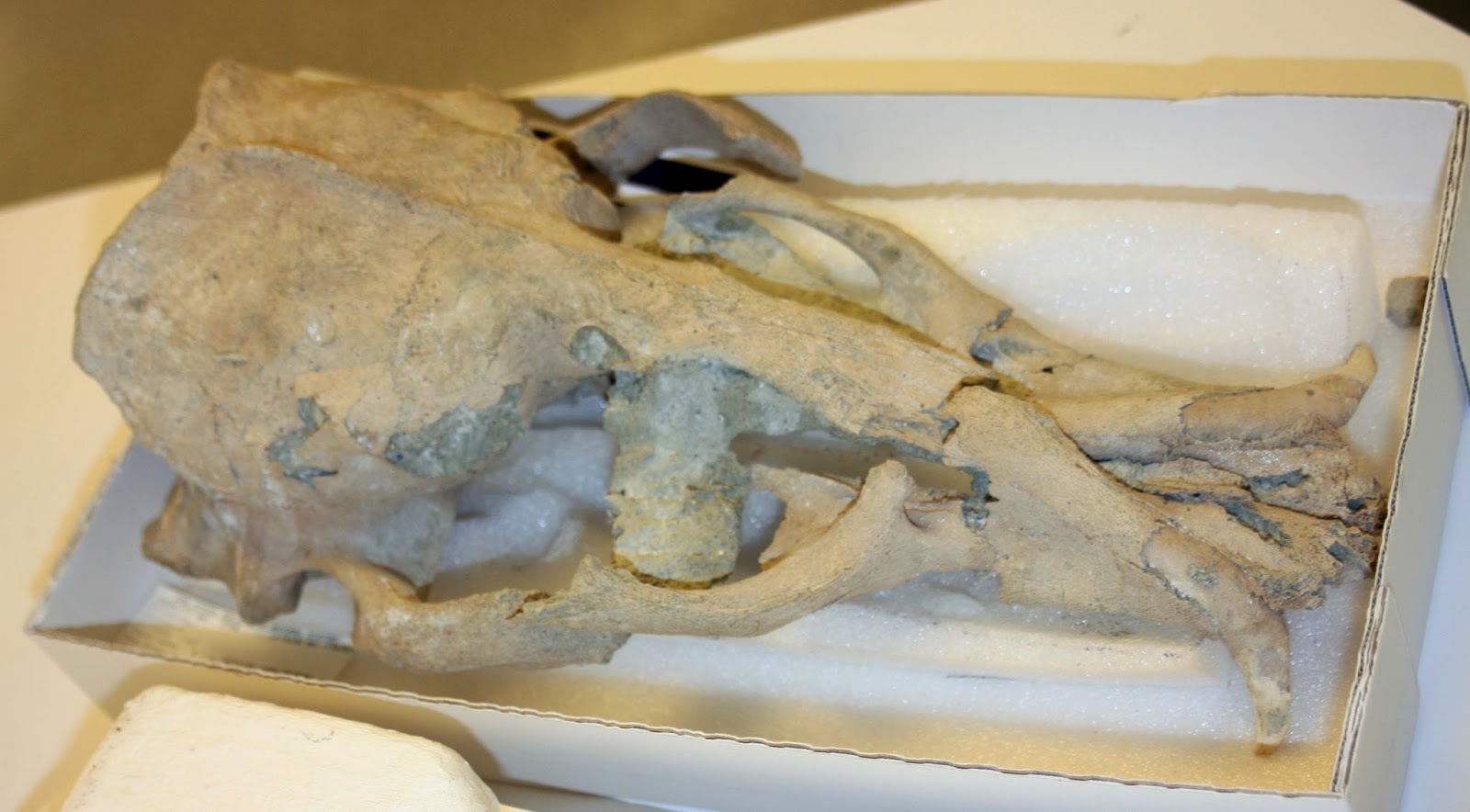

Skulls like this (Allodesmus kernensis, Sharktooth Hill Bonebed, SDNHM) are by no means as impressive as some of the previously published specimens - but even squashed, roadkill specimens like this preserve a hell of a lot of morphology and beg - no, deserve careful study. 
Allodesmus has been arguably oversplit, and the taxon is in dire need of revision. Detailed study of new material – whether from Sharktooth Hill or beyond – will help resolve questions of diversity, biogeography, and phylogeny.
What else can be done? The sample from the Sharktooth Hill Bonebed alone is sufficient enough to permit studies of variation of any number of elements (skulls, mandibles, teeth, postcrania), in addition to providing well-preserved specimens for functional analysis (feeding ecology, muscle attachment mapping, further studies of locomotion) and studies of ontogeny and sexual dimorphism, as well as isotope geochemistry (e.g. Oxygen and Carbon isotopes for studying paleoecology). There is literally a host of avenues for future research – just on a single genus of pinniped. The sky’s the limit – and Morgan and I can’t do all of it! I hope this reaches someone who can help out with the California marine mammal fossil record – there is so much more left to do, even on the best known fossil pinniped.

References

L. G. Barnes. 1972. Miocene Desmatophocinae (Mammalia: Carnivora) from California. University of California Publications in Geological Sciences 89:1-76.

L.G. Barnes. 1989. A new enaliarctine pinniped from the Astoria Formation, Oregon, and a classification of the Otariidae (Mammalia: Carnivora). Contributions in Science, Natural History Museum of Los Angeles County 403:1–26.

L. G. Barnes and K. Hirota. 1995. Miocene pinnipeds of the otariid subfamily Allodesminae in the North Pacific Ocean: Systematics and relationships. The Island Arc 3:329-360.

L.G. Barnes, D. P. Domning, and C. E. Ray. 1985. Status of studies on fossil marine mammals. Marine Mammal Science 1:15–53.

A. Berta and A. R. Wyss. 1994. Pinniped phylogeny. Proceedings of the San Diego Society of Natural History 29:33–56.

T.A. Deméré and A. Berta. 2002. The Miocene pinniped Desmatophoca oregonensis Condon 1906 (Mammalia: Carnivora), from the Astoria Formation of Oregon; pp. 113–147 in R. J. Emry (ed.), Cenozoic Mammals of Land and Sea: Tributes to the Career of Clayton E. Ray. Smithsonian Contributions to Paleobiology 93. 

E. D. Mitchell. 1966. The Miocene pinniped Allodesmus. University of California Publications in Geological Sciences 61:1-105.

A.R. Wyss. 1987. The walrus auditory region and the monophyly of pinnipeds. American Museum Novitates 2871:1–31.

Thursday, June 5, 2014

The best known fossil pinniped, part 3: life habits, paleoecology, and biogeography of Allodesmus


An undescribed skeleton of Allodesmus from the Miocene of Japan, on display at the National Museum of Nature and Science in Tokyo.

The abundance of Allodesmus in the Neogene marine record in concert with its completeness made investigation of its paleoecology and life habits inevitable. However, most of what follows is scoured from a few publications, and ample scope for further studies of functional morphology, ontogeny, and sexual dimorphism exist for future researchers.

 
This doesn't really belong anywhere in here, but when I found this strange photo I knew I couldn't leave it out. Ignoring the bizarre pose and composition of the slab and the unecessarily included models, this picture does actually give you an idea of how large Allodesmus was.

Ontogeny and Body Size

A few studies have touched upon growth in Allodesmus, and have mostly discussed issues of age determination rather than growth-related changes in morphology. Mitchell (1966) briefly investigated epiphyseal fusion in Allodesmus, and found that (unsurprisingly), in the forelimb epiphyses fused at the elbow before other parts of the forelimb, and that in the hindlimb, fusion begins at the hip and ankle before progressing to the knee joint (for casual readers, epiphyses are the ends of long bones that begin as separate osteological units and later fuse to the shaft – known as the diaphysis – the radius and ulna have a proximal epiphysis, a distal epiphysis, and the diaphysis; the diaphysis generally composes most of the bone).
            A classic and widely used method for age determination in pinnipeds and other marine mammals is counting periodic growth marks in teeth in sectioned teeth under a microscope. Additionally, in pinnipeds (and presumably other carnivores) preserve a series of annular ridges/grooves in the root, corresponding to periodic growth marks in the cross section of the tooth. Mitchell (1966) was one of the earliest researchers to apply this method to fossil pinnipeds, and sectioned teeth of Allodesmus from the Sharktooth Hill Bonebed. Although the canines of the Allodesmus kelloggi holotype did not yield good results owing to “varying replacement phenomena” (unclear if this refers to an in vivo process or diagenesis), canines of similar size (and presumably root closure) were sectioned and exhibited a minimum of 13 growth marks, suggesting a minimum age of 13 years for Allodesmus kelloggi.
            Allodesmus kelloggi was estimated to be 2.6 meters in length by Mitchell (1966); this is the most complete skeleton of a desmatophocid known, so other Allodesmus (=Allodesminae of Barnes and Hirota, 1995) may be scaled from this species. It should be pointed out here that Allodesmus kelloggi is the smallest known species of Allodesmus. Mitchell (1966) pointed out that other specimens from Shartooth Hill would be much larger (up to 3.35 meters), surpassing even the Northern sea lion Eumetopias jubatus (3+ meters) in size. Taking measurements of other skulls of Allodesmus, small body sizes for Allodesmus sadoensis (2.1 meters) and Allodesmus packardi (2.2 meters) are probable. A much larger body size is indicated for LACM 9723 – the largest known Allodesmus kernensis/gracilis specimen – this individual, scaled up from Allodesmus kelloggi, would have been 3.8 meters in length. Lastly, the positively enormous adult rostrum of Allodesmus sinanoensis (=Allodesmus megallos of Barnes and Hirota 1995) would have been a whopping 4.8 meters in length! To put this in context, this would be an animal the size of the largest male Northern Elephant Seal (Mirounga angustirostris – 4.3-4.9 meters), and surpassed only by the Southern Elephant Seal (Mirounga leonina – 4.2-6 meters).
            Despite having a relatively large sample size from the Sharktooth Hill Bonebed, little investigation of sexual dimorphism has been attempted – and remains a lucrative research topic for future researchers.

Mitchell's (1966) elephant seal-like reconstruction of Allodesmus. Although some have criticized the addition of a proboscis (Adam and Berta, 2001) I don't feel like it's such a bad call myself. However, more time looking at the structure of the prenarial shelf in this pinniped would permit me to make a more informed interpretation.


Life Restoration

This is by far the most speculative part of this post. Mitchell (1966) hypothesized that due to the large size of Allodesmus, and relatively short forelimbs (although that really remains to be established), Allodesmus likely had thick layers of blubber, and further speculated that Allodesmus lacked fur and was possibly hairless like elephant seals. Another observation first made by Mitchell (1966) with the first skull of Allodesmus was that it exhibited a peculiar prenarial shelf, somewhat similar to elephant seals. Based on the size of this prenarial shelf, and the position of muscle attachment scars, Mitchell (1966) speculated that Allodesmus had a short proboscis like extant elephant seals. However, Berta and Adam (2001) suggested that Allodesmus may not have a proboscis, citing as yet unpublished research. The question of whether or not Allodesmus had a proboscis has barely been answered, and future studies could certainly go further.

The teeth of Allodesmus, from Mitchell (1966). J-M are classic examples of "phallic" Allodesmus cheek teeth.
Feeding Ecology

The skull of Allodesmus is quite different from many other pinnipeds. It has one of the proportionally longest palates of any known pinniped, fossil or modern. All of the teeth of Allodesmus are single-rooted with bulbous, simple cheek teeth bearing a single cusp; isolated Allodesmus teeth are frequently found by fossil collectors at Sharktooth Hill and appear “phallic” to many amateurs (check out the photo; you can do the math). The canines are relatively small in Allodesmus in comparison to similarly sized otariids and odobenids (with the exception of the adult “snout” of Allodesmus sinanoensis; =Allodesmus megallos of Barnes and Hirota, 1995). The mandible is relatively gracile but bears a well developed flange for the digastric insertion, as in modern elephant seals (Mirounga). Allodesmus curiously lacks well developed nuchal and sagittal crests as in many fossil and modern otariids and many odobenids, and also has an unusually small coronoid process of the mandible – suggesting reduced temporalis musculature (the temporalis is the primary jaw closing muscle; those of you who are dog owners can feel it by petting the top of your dog’s head while it is chewing; cat owners should not try this). Lastly, the eye sockets of Allodesmus are proportionally enormous; they are so large, that Debey and Pyenson (2011) suggested that Allodesmus was a deep diver, like modern elephant seals.
The lengthening of the palate is probably related to suction feeding (Adam and Berta, 2002), and Allodesmus was reconstructed as a pierce/raptorial feeder by Adam and Berta (2002). The simplification of the postcanine teeth and reduction in size of the posterior postcanine teeth suggests reduced utility of the dentition, potentially even more so than other pinnipeds. The underdeveloped cranial crests and small coronoid process suggests a decreased importance of jaw closing musculature relative to many other pinnipeds. All of this, in concert with the enormous eye size and potential deep diving ecology, in my opinion, suggests a possible suction feeding elephant seal-like habitus. However, it is important to note that craniodental morphology correlates poorly with diet in pinnipeds.

Allodesmus kernensis (=Allodesmus gracilis of Hirota and Barnes, 1995) at the San Diego Natural History Museum reconstructed in a very sea lion like pose. Check out the length of the forelimb - at first glance, it screams "sea lion" in terms of function.
Locomotion

Osteological characteristics of limb bones and the hypothesized monophyletic clade formed by desmatophocids and phocids (Phocoidea) led Berta and Adam (2001) to interpret Allodesmus as a hindlimb-dominated swimmer. However, a subsequent study by former Gingerich student Ryan Bebej (2009) based on proportions of limb bones identified that Allodesmus was most similar to modern fur seals and sea lions, which are forelimb-dominated swimmers. In fact, fur seals and sea lions swim in a somewhat similar fashion to penguins (although have a forelimb that bends more at the elbow). Interestingly, Allodesmus was found to be slightly less aquatically adapted than extant pinnipeds by Bebej (2009), which is borne out by the fact that Allodesmus first appeared within the first 10 million years of the evolutionary history of pinnipeds. Significantly, Allodesmus has an otariid/odobenid like ankle, indicating that this pinniped could terrestrially "walk" as opposed to wriggle like modern earless seals (Phocidae). Modern true seals cannot rotate their ankle forwards, meaning their hindflippers are always pointing posteriorly and cannot be used for locomotion, and so they must wriggle around awkwardly on beaches like a kid trapped in a sleeping bag.

Biogeography

Lastly, Allodesmus is now known from the middle and late Miocene of California, Baja California, Washington, and Japan. This indicates that this genus was widely distributed across much of the Northern Pacific, including most of the west coast of North America. Allodesmus had a circum-North Pacific distribution, paralleled with many other Mio-Pliocene marine mammals (Desmostylus, Paleoparadoxia, Albireo, Kentriodon, Thalassoleon, Callorhinus, Hydrodamalis, Dusisiren, and many others), and many modern cetaceans and pinnipeds. Allodesmus courseni (=Atopotarus of some authors) and Allodesmus kernensis are known from both California and Japan, suggesting that some species of Allodesmus may have enjoyed a wide geographic range. Curiously, desmatophocids never escaped the north Pacific. Why? My hypothesis would be that Allodesmus was cold-water adapted, and unable to cross the warm equatorial waters that serve as a formidable thermal barrier to north-south dispersal even today. Similarly, Allodesmus never invaded the Atlantic, suggesting it was unable to disperse through the Central American Seaway, although many pinnipeds and other marine mammals were able to disperse from the western North Atlantic to the eastern South Pacific during the Miocene.

Next up: part 4, the controversial phylogenetic position of Allodesmus, and future directions for research.

P.J. Adam and A. Berta. 2002. Evolution of prey capture strategies and diet in the Pinnipedimorpha (Mammalia, Carnivora). Oryctos 4:83-107.
L. G. Barnes. 1972. Miocene Desmatophocinae (Mammalia: Carnivora) from California. University of California Publications in Geological Sciences 89:1-76.
 
L. G. Barnes and K. Hirota. 1995. Miocene pinnipeds of the otariid subfamily Allodesminae in the North Pacific Ocean: Systematics and relationships. The Island Arc 3:329-360.
 
R.M. Bebej. 2009. Swimming mode inferred from skeletal proportions in the fossil pinnipeds Enaliarctos and Allodesmus (Mammalia, Carnivora). Journal of Mammalian Evolution 16:77-97.

A. Berta and P.J. Adam. 2001. Evolutionary history of pinnipeds. In Mazin J.M., Buffrenil V. de (eds), Secondary Adaptation of Tetrapods to Life in Water. Verlag Dr. Friedrich Pfeil, Munich, pp. 235-260.
 
L.B. Debey, and N.D. Pyenson. 2013.Osteological correlates and phylogenetic analysis of deep diving in living and extinct pinnipeds: what good are big eyes? Marine Mammal Science 29:48-83
 
E. D. Mitchell. 1966. The Miocene pinniped Allodesmus. University of California Publications in Geological Sciences 61:1-105.
 

Sunday, May 11, 2014

The best known fossil pinniped, part 2: How many species (...and genera) are there of Allodesmus, anyway?

Last week I summarized the history of research on Allodesmus (and Atopotarus). How many species of Allodesmus exist? And how many genera of desmatophocids are there? On one extreme, one could take the view that there are only two genera – Allodesmus and Desmatophoca – and that Atopotarus, Megagomphos, and Brachyallodesmus are all synonyms of Allodesmus. On the other hand, a more diverse view of the Desmatophocidae would include as many as 10 species in the aforementioned 5 genera. We’ll start with genera – and then look at the species level.

How many genera of desmatophocids are there?

I won’t bother with Allodesmus and Desmatophoca, since these are both clearly “real” and the oldest available names for generic concepts.

Atopotarus – Atopotarus is largely diagnosed by the retention of primitive characteristics in comparison to Allodesmus spp. For example, Atopotarus lacks the prenarial shelf of more derived Allodesmus such as Allodesmus kernensis/kelloggi/gracilis, has a less inflated braincase, and retains double-rooted postcanine teeth (premolars and molars). In contrast, the teeth of Allodesmus are single rooted. All these features were listed by Barnes and Hirota (1995) as distinguishing A. courseni from Allodesmus at the generic level. Mitchell (1966) was the first to suggest that Atopotarus courseni was possibly a species of Allodesmus – prior to his description of Allodesmus kelloggi, insufficient cranial and postcranial material was known to really evaluate the generic validity of Atopotarus. This skepticism was echoed by Barnes (1972), Kohno (1996) and Deméré and Berta (2002) – although its generic distinctiveness was endorsed by Barnes and Hirota (1995). I’ve always been on the fence about Atopotarus – it’s barely distinguishable from Allodesmus as it is slightly more plesiomorphic and its morphology – with the exception of the possibly lost second lower molar – could reflect the ancestral morphology of the entire genus. Amongst extant pinnipeds, including phocids – closely related clusters of species (e.g. Zalophus, Arctocephalus, Monachus), with the exception of the Phoca-Pusa-Halichoerus complex – tooth rooting doesn’t vary this much between species, potentially suggesting that Atopotarus might be real. More fossil material of Atopotarus is necessary to further evaluate it, since the holotype is a somewhat flattened articulated specimen exposed in relief in a large slab.


The holotype specimen of Atopotarus courseni, from Downs (1956).

Brachyallodesmus: this genus was erected by Barnes and Hirota (1995) for Allodesmus packardi, the skull from Portola Valley in southern San Mateo County. Features used by these authors to distinguish it from other Allodesmus include canines with an oval cross section (rather than round), an inflated braincase lacking strong nuchal crests, enormous orbits with an extremely narrow intertemporal region, and some primitively retained characteristics such as bilobed premolar roots, a furrow on the side of the braincase marking the position of the pseudosylvian sulcus on the brain, and a less flattened tympanic bulla. This species is arguably much less primitive than Atopotarus courseni, and while I’m on the fence about the generic distinction of Atopotarus, the claim that Allodesmus packardi is generically distinct is spurious in my opinion, and in my preference for taxonomic conservatism (aka lumping), I’ve always held the consideration that this is a species of Allodesmus.
Megagomphos: This genus of desmatophocid was also erected by Barnes and Hirota (1995) for a fragmentary rostrum previously known as Allodesmus sinanoensis (originally erroneously placed in Eumetopias). This specimen is the same size as the largest specimens of Allodesmus from California. Characteristics used by Barnes and Hirota (1995) to elevate it to a separate genus include the lack of a prenarial shelf (like Atopotarus) and the presence of larger canines than other Allodesmus. Kohno (1996), however, identified several features of this specimen suggesting that it was immature, such as unworn teeth that have large pulp cavities and are not completely erupted. In contrast, Barnes and Hirota (1995) thought that this specimen was an adult because of the shape of the tooth roots and purported fusion of the premaxilla-maxilla suture, but didn’t discuss the ontogenetic stage of this specimen any further. In contrast, Kohno (1996) interpreted the specimen to have a large prenarial shelf, eliminating one purported feature excluding it from Allodesmus; similarly, it exhibits single rooted postcanine teeth and no features of the dentition preclude it from being Allodesmus. Furthermore, one Allodesmus synapomorphy – the prenarial shelf – unequivocally links this specimen with Allodesmus to the exclusion of all other pinnipeds. Although Barnes and Hirota (1995) considered this specimen to lack a shelf, it is present but since the specimen is bilaterally compressed and crushed, which has made the shelf appear less apparent than in life. While this specimen has a few minor differences with other described species of Allodesmus such as procumbent, large canines – no features suggest that establishment of Megagomphos was necessary.

In conclusion, evidence supporting the generic distinction of Megagomphos and Brachyallodesmus is limited to non-existent – but Atopotarus may be “real”, although more cranial material is necessary to evaluate Atopotarus.

How many species of Allodesmus?

Allodesmus from Japan: To date, four species of Allodesmus have been described from Japan. These include the aforementioned Allodesmus sinanoensis, the well-preserved Allodesmus sadoensis, and the more fragmentary Allodesmus naorai (the “Mito seal”) and Allodesmus megallos. Allodesmus sadoensis is known from a nearly complete skull and partial mandibles, and is readily distinguished from all other Allodesmus by having anteriorly crowded and procumbent (forward pointing) postcanine teeth, more vertically oriented mandibular symphysis, and lower postcanine teeth without gaps between them. Allodesmus naorai is similar to Allodesmus packardi, and differs only in a few minor features such as having a slightly wider interorbital region and supraorbital processes positioned further posterior – potentially diagnostic features. The fourth species, Allodesmus megallos, was also named by Barnes and Hirota (1995) and diagnosed based on its enormous size, procumbent tusk-like canines and proportionally larger incisors. However, Kohno (1996) independently referred this specimen to Allodesmus sinanoensis, based upon the shared large size, large procumbent canines, and enlarged incisors, and considered this specimen to be an adult – it is substantially larger than the holotype of A. sinanoensis, now recognized to be a juvenile. Furthermore, Kohno (1996) pointed out that both this specimen and the juvenile A. sinanoensis type specimen were from the same rock unit. This specimen, by the way, represents one of the most gigantic of all pinnipeds – it has an estimated skull length of 55-59 centimeters, just a hair smaller than the giant walrus Pontolis (60 cm), and even larger than the double tusked walrus Gomphotaria (40 cm). I think Kohno (1996) makes a reasonable case that this specimen is an adult of Allodesmus sinanoensis, and therefore that Allodesmus megallos is a junior synonym. In conclusion, three species of Allodesmus appear to be known from Japan.

A size comparison with casts of the partial gigantic rostrum of Allodesmus sinanoensis (=Allodesmus megallos) and the type specimen of Allodesmus kelloggi.

Allodesmus from Sharktooth Hill, California: Five species of Allodesmus are known from the middle Miocene of California, and three of them have all been named from the Round Mountain Silt: Allodesmus kernensis, Allodesmus kelloggi, and Allodesmus gracilis. As stated in the previous post, Allodesmus kernensis was described from a partial mandible with an erect canine, a deep mandibular symphysis, and a somewhat double-rooted lower molar. Mitchell (1966) originally drew attention to the observation that the mandibles of Allodesmus kelloggi and other mandibles from the Sharktooth Hill Bonebed consistently differed from Kellogg’s type specimen in having a shallower mandibular symphysis, having a more erect canine, and having a single rooted lower molar. Mitchell (1966) also pointed out that the locality data for the Allodesmus kernensis holotype actually pointed to two different, mutually exclusive localities, and suggested that the locality data indicated that the Allodesmus kernensis holotype was collected somewhat below the stratigraphic level of the Sharktooth Hill Bonebed, lower down within the Round Mountain Silt. Because of these perceived differences, Mitchell restricted A. kernensis to the type specimen, named his new skeleton A. kelloggi, and referred all known Allodesmus material from the bonebed to his new species.


The holotype skull of Allodesmus kelloggi. Check out the size of that orbit!

            Many of these claims were criticized by Barnes (1970, 1972). He pointed out that in the context of variation of modern Zalophus (California Sea Lion), the features identified by Mitchell as separating Allodesmus kernensis from the rest of the bonebed sample are within the range of variation expected for a pinniped species, with the exception of shape of the mandibular symphysis – which varies less within extant Zalophus than it does within the bonebed sample of Allodesmus. Regardless, Barnes (1970) pointed out that all of the morphologic features used by Mitchell (1966) to separate Allodesmus kernensis actually fell within the range of variation of Allodesmus mandibles from within the bonebed itself. Barnes (1970, 1972) then synonymized A. kelloggi with A. kernensis, and referred all known material from the bonebed to A. kernensis. Barnes further pointed out “no conclusive arguments that the holotype of A. kernensis was collected from some formation other than the Round Mountain Silt”. Although this does not really negate Mitchell’s suggestion that the holotype came from an older horizon, Barnes correctly points out that there is uncertainty regarding the A. kernensis type locality – which in my mind means that Mitchell’s hypothesis is speculative. In the context of known Allodesmus variation and the fact that the A. kernensis holotype falls within the range of variation reported for mandibles from the bonebed – I think the idea that the A. kernensis type is more primitive than the bonebed sample falls on its face, and that the hypothesis that A. kernensis was really collected from a lower, older horizon need not be invoked. After all, the type specimen was (thought to be) collected in 1911 by R.C. Stoner, according to the specimen label, or by Charles Morrice (according to Kellogg, 1922), in 1909-1912; locality data were not always accurate in those days. Given the two sets of contradictory data regarding the provenance of the type specimen, any argument being made about the locality of this specimen should be considered to be speculative at best. I speculate that, given how abundant vertebrate fossils are within the bonebed, and how rare they are outside the bonebed, that it is more likely that the specimen was in fact collected from the bonebed and that the locality data is inexact. This seems more reasonable to me, but I note that it is not falsifiable – and that Mitchell’s (1966) arguments are not falsifiable either (although perhaps less parsimonious than my suggestion).


Fifty years of taxonomic disagreement contained in a single photograph. How many species of Allodesmus are represented here? One? Two? or Three? From top to bottom, holotype mandible of Allodesmus kelloggi, cast of holotype of Allodesmus kernensis, and cast of referred mandible of Allodesmus gracilis.
Despite the rather sober arguments made earlier, Barnes and Hirota (1995) indicated that the wider variation within the “Allodesminae” resulted in the recognition that the seemingly minor differences between Allodesmus kernensis and the bonebed sample were in fact meaningful. In the absence of quantitative study (as Barnes, 1970, had done) they resurrected Allodesmus kelloggi – a name which they restricted to Mitchell’s type specimen – and went so far as to establish a third species, Allodesmus gracilis, for the remainder of material from the bonebed. Barnes and Hirota (1995) echoed many of Mitchell’s (1966) arguments and casually dismissed Barnes (1970, 1972) earlier, and in my opinion well-reasoned observations. They further pointed out that the holotype mandibles of Allodesmus kelloggi have a strange, widened flange of bone on the anterior part of the coronoid process, in addition to having a single-rooted lower molar, apparently unique amongst specimens from Sharktooth Hill. However, it is well known that modern pinnipeds have tooth roots that vary quite a bit – the short version is that arctoids primitively have triple or double-rooted premolars and molars, and that in the transition to aquatic life, many pinnipeds have lost their carnassial teeth in favor of simplified teeth for catching fish, roughly similar to what happened with dolphins. Dental simplification, in concert with crowding the teeth in the front of the jaw, has resulted in double rooted teeth of archaic pinnipeds fusing together, generally starting from the front of the jaw. In my 2011 paper on fossil Callorhinus, I noted that there is a fair amount of variation in the tooth roots of extant Callorhinus ursinus (Northern Fur Seal). In the context of extant pinniped dental variation (which is considerably more than terrestrial carnivores, probably because pinnipeds do not chew and thus do not require precise occlusion), this observation on Allodesmus kelloggi does not preclude it from being a member of Allodesmus kernensis.


The holotype skull of Allodesmus gracilis.

Deméré and Berta (2002), although not focused on Allodesmus taxonomy, noted that the occurrence of three species of Allodesmus within a narrow stratigraphic interval in the Round Mountain Silt is a bit hard to swallow, and I agree. I can understand the rationale behind restricting names to seemingly oddball specimens like the holotypes of Allodesmus kelloggi and Allodesmus kernensis – these are decisions done in spirit of taxonomic stability. However, any argument that these three perceived species are distinctive enough to be recognized as separate taxonomic entities needs to be done quantitatively – which has been done exactly once - by Barnes (1970). There is a huge discrepancy between the rather taxonomically conservative conclusions of Barnes (1970) and the rather optimistic splitting of Allodesmus into several genera.


The holotype mandible of Allodesmus gracilis - or a referred specimen of Allodesmus kernensis?

So, how many species and genera are there? I tend to be on the taxonomic lumping side of things, as modern pinnipeds show quite a bit of variation – and keeping this variation in mind, I think a bit of skepticism is in order regarding new taxonomic names for the densely sampled and well published record of pinnipeds from the eastern North Pacific. I think the following list best summarizes my opinions on which genera and species are real:

Atopotarus? Allodesmus? courseni
Allodesmus packardi (syn: Brachyallodesmus)
Allodesmus kernensis (syn: A. gracilis, A. kelloggi)
Allodesmus sadoensis
Allodesmus sinanoensis (syn: Megagomphos sinanoensis, Allodesmus megallos)
Allodesmus naorai


Next up: we still have at least two more parts to this, including the paleoecology of Allodesmus and the phylogenetic position of the family Desmatophocidae.

References

L. G. Barnes. 1970. A re-evaluation of mandibles of Allodesmus (Otariidae, Carnivora) from the Round Mountain Silt, Kern County, California. PaleoBios 10:1-24.

L. G. Barnes. 1972. Miocene Desmatophocinae (Mammalia: Carnivora) from California. University of California Publications in Geological Sciences 89:1-76.

L. G. Barnes and K. Hirota. 1995. Miocene pinnipeds of the otariid subfamily Allodesminae in the North Pacific Ocean: Systematics and relationships. The Island Arc 3:329-360.

Demere, T. A., and A. Berta. 2002. The Miocene pinniped Desmatophoca oregonensis Condon 1906 (Mammalia: Carnivora), from the Astoria Formation of Oregon; pp. 113–147 in R. J. Emry (ed.), Cenozoic
Mammals of Land and Sea: Tributes to the Career of Clayton E. Ray. Smithsonian Contributions to Paleobiology 93.

T. Downs. 1956. A new pinniped from the Miocene of southern California: With remarks on the Otariidae. Journal of Paleontology 30(1):115-131.

R. Kellogg. 1922. Pinnipeds from Miocene and Pleistocene deposits of California. University of California Publications in Geological Sciences 13(4):23-132.

N. Kohno. 1996. Miocene pinniped Allodesmus (Mammalia: Carnivora); with special reference to the "Mito seal" from Ibaraki Prefecture, Central Japan. Transactions and Proceedings of the Palaeontological Society of Japan, New Series 181:388-404.

E. D. Mitchell. 1966. The Miocene pinniped Allodesmus. University of California Publications in Geological Sciences 61:1-105.

Thursday, May 1, 2014

The best known fossil pinniped, part 1: a review of research and taxonomy of the Miocene pinniped Allodesmus


What to call this animal? Allodesmus kernensis, kelloggi, or gracilis? This very topic remains one of the major bones of contention in marine mammal paleontology. Skeletal reconstruction (by yours truly, 2009) of a mounted skeleton at the San Diego Natural History Museum, and beautiful life reconstruction based on my skeletal illustration by Roman Yevseyev.

Four fossil pinnipeds were discovered from California and Oregon during the early 20th century: Pontolis magnus, from the Empire Formation of Oregon, described by Frederick True in 1905, Desmatophoca oregonensis, from the Astoria Formation of Oregon, described by Thomas Condon in 1906, Pliopedia pacifica, from the Paso Robles Formation of Oregon, described by Remington Kellogg in 1921, and Allodesmus kernensis, from the Round Mountain Silt, named by Remington Kellogg in 1922. Desmatophoca and Pontolis were originally known from partial skulls, but neither specimen was well preserved or well-prepared, and hailed from localities with vertebrate fossils embedded largely within hard concretions – it would not be until the late 1980’s that more research on fossil pinnipeds from these localities would continue again. In short, neither specimen seriously influenced the early understanding of pinniped evolution. Pliopedia was only known from a partial forelimb, and it wasn’t until the late 1970’s that it was identified as an odobenine walrus. At the time of its discovery, Allodesmus was only known from a partial, not very well-preserved mandible. In 1931, Kellogg referred several mandibular and skull fragments and postcrania to Allodesmus.


 The fossil that started it all. The holotype mandible of Allodesmus kernensis.

            Elsewhere worldwide, few fossil pinnipeds had been discovered; the early seal Leptophoca had been named, in addition to a bunch of fragmentary fossil true seals (Phocidae) with problematic taxonomic history from the North Sea named by Van Beneden in the late nineteenth century. As a result, none of these fossils influenced the understanding of pinniped evolution much, either. And while Allodesmus at first was less completely known at the time of discovery, it would soon dominate discussions of pinniped phylogeny for decades. A problem facing these early workers in North America was that they were Otariidae-centric – many of these early fossils were assumed, a priori, to represent ancestors of sea lions, rather than featuring in walrus or true seal evolution – or representing completely extinct groups of pinnipeds.

            In the 1950’s, LACM paleontologist Theodore Downs reported a series of discoveries of new Allodesmus material. In 1953, he reported a nearly complete mandible from Sharktooth Hill, and then in 1955, he reported some associated postcrania from the Monterey Formation in Orange County. And then, in 1956, he reported an Allodesmus-like skeleton including a nearly complete skeleton, lacking parts of the hindlimbs. He named it Atopotarus courseni, and its distinction as a truly separate genus from Allodesmus has been controversial.

            A few years later, Earl Packard (1962) reported on a partial skull in a concretion collected from unnamed middle Miocene rocks of Portola Valley in southernmost San Mateo County, right near where I grew up – he tentatively referred this specimen to Atopotarus courseni.


 One of the first complete skulls of Allodesmus: the holotype specimen of Allodesmus/Brachyallodesmus packardi, from unnamed middle Miocene rocks of Portola Valley, San Mateo County, California.


 Life restoration of Allodesmus kelloggi from Mitchell (1966).

            In 1966, Ed Mitchell published a monograph on a newly discovered skeleton (actually collected in 1960) from Sharktooth Hill. This skeleton was nearly complete, missing only a few bones from the hindflipper. A baculum unequivocally indicates it was a male. This specimen represented the first good skull referable to Allodesmus (not including Atopotarus), and demonstrated how the postcranial skeleton was very convergent with extant otariids – but the skull was not. The skull of Allodesmus is about as different from an otariid as you can get – an elongate, narrow rostrum with a prenarial shelf, similar to elephant seals, an elongate palate, enormous orbits, a vertically expanded zygomatic arch, absent supraorbital shelves (a distinctive feature unique to fur seals and sea lions), a shallowly sloping mandibular symphysis, and a retained lower second molar (this tooth position has been lost in modern fur seals and sea lions). Many of these skull features occur in true seals – and aside from simplified teeth and a primitively otariid-like basicranium, few features are evocative of otariids. Mitchell admitted that these differences precluded Allodesmus from having an ancestral role in the evolution of the Otariidae. Regardless, Mitchell concluded that the holotype jaw of Allodesmus kernensis was collected from somewhat below the Sharktooth Hill Bonebed, but within the Round Mountain Silt – and also noted that Allodesmus specimens from the bonebed consistently had a shallower mandibular symphysis, lower incisors that were positioned differently, a less vertical canine, a single rooted lower first molar, and a slightly more robust mandible. Because of this, Mitchell restricted Allodesmus kernensis to the type specimen, named the skeleton from the bonebed as the holotype of Allodesmus kelloggi, and referred all material from the bonebed to this new species.

The modern mount of the holotype skeleton of Allodesmus kelloggi, as it can be seen today hanging in the hall of mammals at the Los Angeles County Museum. Unfortunately much of the actual skeleton is hanging there and totally inaccessible for study; cardinal elements, such as the skull, mandibles, scapula, humerus, femur, and baculum, are mounted as casts so that they may be studied.

The next two publications in the saga were published by Larry Barnes in 1970 and 1972. The first study was an analysis of mandibles, including the types of Allodesmus kernensis and Allodesmus kelloggi. Barnes (1970) concluded that the differences between these were minimal, and that they easily fell within the range of variation expressed by modern pinnipeds. Barnes (1972) described new skulls, mandibles, and postcrania of Allodesmus, and reiterated his earlier conclusion (based on quantitative analysis!) that Allodesmus kelloggi was a junior synonym of Allodesmus kernensis. He also transferred Atopotarus courseni to Allodesmus, recombining it as Allodesmus courseni, and reported on the skull reported earlier by Packard (1962) – which was now fully prepared, and designated it as the holotype specimen of Allodesmus packardi. For another 20 years, this study constituted the last word on Allodesmus taxonomy.


The first, and only quantitative study of morphological variation in Allodesmus - from Barnes (1970).

            In 1995, Larry Barnes and Kiyoharu Hirota published an article in the special volume (mostly marine mammal-themed) of The Island Arc on “allodesmine” pinnipeds from the North Pacific. In the intervening decades, Barnes changed his mind on Allodesmus from Sharktooth Hill – and (without executing any sort quantitative analysis using the large sample of Allodesmus mandibles) not only reaffirmed Mitchell’s (1966) conclusion that Allodesmus kernensis was different from those specimens from the bonebed, but also restricted Allodesmus kelloggi to Mitchell’s type specimen, and named a well-preserved skull and mandibles originally described by Barnes (1972) as a new species – Allodesmus gracilis – to which they referred the rest of known bonebed Allodesmus specimens. In addition to this decision, they also resurrected Atopotarus as a distinct genus, and named the new genus Brachyallodesmus to contain the Portola Valley skull – recombined as Brachyallodesmus packardi. Material from Japan was considered to represent three species in two genera. A large but fragmentary roustrum and mandible fragments, similar in size and morphology to Allodesmus kernensis, was named Megagomphos sinanoensis (originally named in the 1950’s as Eumetopias sinanoensis). A far more enormous snout – comparable in size to a steller’s sea lion or small elephant seal – was named as the holotype specimen of Allodesmus megallos. Lastly, a somewhat more complete specimen with skull and mandibles was named as the new species Allodesmus sadoensis. Their use of the subfamily name Allodesminae was necessitated by the splitting of the generic concept into eight named (and three unnamed) species in four genera.


 The holotype skull of Allodesmus gracilis, from Barnes (1972).

            A paper by Naoki Kohno that came out in 1996 was evidently submitted and accepted prior to publication of the Barnes and Hirota (1995) paper. This study by Kohno (1996) was a bit more sober in its taxonomic conclusions, considering the gigantic snout of Allodesmus megallos as an adult specimen of Allodesmus sinanoensis (=Megagomphos sinanoensis of Barnes and Hirota), and considered only one species of Allodesmus from the Round Mountain Silt to be valid (Allodesmus kernensis), following Barnes (1970, 1972). Kohno (1996) also considered Atopotarus courseni to be a species of Allodesmus. In this article, Kohno (1996) named the “Mito seal” – a partial skull thought to be lost due to Allied bombing of Japan during the second world war, but figured and discussed by Repenning and Tedford (1977) based on a cast at the Smithsonian. In fact, the specimen had not been destroyed but was rediscovered – and the specimen He named the “Mito seal” Allodesmus naorai, and considered it to be closely related to Allodesmus packardi. Kohno also summarized other fragmentary occurrences of Allodesmus from Japan.

An alternate view of desmatophocid/allodesmine diversity published by Kohno (1996); this idea was published in parallel and independent from Barnes and Hirota (1995).

In 1998, a paper by Kimura et al. reported a mandible of Atopotarus sp. from the middle Miocene of Hokkaido. It is very similar to the holotype of Atopotarus courseni - but under a different paradigm of Allodesmus taxonomy, it could also be identified as Allodesmus courseni rather than Atopotarus sp.

            The most recent paper weighing in on the subject was Deméré and Berta (2002), which actually focused on the closely related Desmatophoca oregonensis. They argued that Allodesmus was oversplit, and emphasized the problematic recognition of three species of Allodesmus from a narrow stratigraphic interval in a single rock unit in California – Allodesmus kernensis, Allodesmus kelloggi, and Allodesmus gracilis from the Round Mountain Silt. However, a discussion of Allodesmus taxonomy was clearly beyond the scope of the study, and they elected to not discuss the topic further.

Next up: How many species of Allodesmus are there, any way? I've given out a brief sketch of the history of work on Allodesmus, but there's quite a bit more to the story than this.

References

L. G. Barnes. 1970. A re-evaluation of mandibles of Allodesmus (Otariidae, Carnivora) from the Round Mountain Silt, Kern County, California. PaleoBios 10:1-24.

L. G. Barnes. 1972. Miocene Desmatophocinae (Mammalia: Carnivora) from California. University of California Publications in Geological Sciences 89:1-76.

L. G. Barnes and K. Hirota. 1995. Miocene pinnipeds of the otariid subfamily Allodesminae in the North Pacific Ocean: Systematics and relationships. The Island Arc 3:329-360.

T.A. Demere, and A. Berta. 2002. The Miocene pinniped Desmatophoca oregonensis Condon,
1906 (Mammalia: Carnivora) from the Astoria Formation, Oregon. Smithsonian Contributions to Paleobiology 93: 113–147.

T. Downs. 1953. A mandible of the seal Allodesmus kernensis from the Kern River Miocene of California. Bulletin of the Southern California Academy of Sciences 52:93-102.

T. Downs. 1955. A fossil sea lion from the Miocene of the San Joaquin Hills, Orange County, California. Bulletin of the Southern California Academy of Sciences 54:49-56.

T. Downs. 1956. A new pinniped from the Miocene of southern California: With remarks on the Otariidae. Journal of Paleontology 30(1):115-131.

R. Kellogg. 1922. Pinnipeds from Miocene and Pleistocene deposits of California. University of California Publications in Geological Sciences 13(4):23-132.

M. Kimura, K. Hirota and C. Kiyono. 1998. Fossil pinniped mandible from the Middle Miocene of Haboro-Cho, Hokkaido. The Bulletin of the Hobetsu Museum 13:1-7.

N. Kohno. 1996. Miocene pinniped Allodesmus (Mammalia: Carnivora); with special reference to the "Mito seal" from Ibaraki Prefecture, Central Japan. Transactions and Proceedings of the Palaeontological Society of Japan, New Series 181:388-404.

E. D. Mitchell. 1966. The Miocene pinniped Allodesmus. University of California Publications in Geological Sciences 61:1-105.