Showing posts with label taxonomy. Show all posts

Thursday, August 9, 2012

Parabalaenoptera baulinensis: the fossil baleen whale from Bolinas, Marin County, California


Until relatively recently, fossil balaenopterids have been avoided by modern paleocetologists like the plague. Modern balaenopterids include the humpback whale (Megaptera novaeangliae) and species of Balaenoptera, including the Minke, Blue, Fin, and Sei whales. Although balaenopterids have very distinctive and easy to identify crania, they are really only common in latest Miocene and Pliocene marine rocks, and early work by Kellogg and others yielded fossil baleen whales with much more primitive skulls, formerly called "cetotheres" sensu lato, also jokingly referred to by some paleocetologists as "Kelloggitheres".

Fossil balaenopterids have been plagued by a particularly nasty taxonomic situation since the late nineteenth century, when P.J. Van Beneden began describing fossil mysticetes collected during the construction of a series of forts around Antwerp. Unfortunately, many of these fossils which names like Plesiocetus and Herpetocetus are based upon were isolated finds, which were subsequently arranged into type 'series' with other skeletal parts based on a preconceived notion of what each taxon should have looked like. The end result was a series of chimaeras, some of which represented by potentially informative but often fragmentary material, lacking type specimens, the associated names of which have been dragged through the systematic mud by subsequent authors, and not allowed to simply die gracefully.

The skull and mandibles of the holotype specimen of Parabalaenoptera baulinensis from the late Miocene Santa Cruz Mudstone of Marin County, California.

Many of these fossil balaenopterids are difficult or impossible to diagnose: which specimen of the series would you designate as a lectotype? Is that specimen diagnostic? What do you do with the other specimens? Is an isolated mandible diagnostic or not? What about a piece of a braincase with unassociated bullae? According to Bosselaers and Post (2010), many of Van Beneden's taxa are based on "syntype" collections that are not possible to unambiguously diagnose: diagnostic syntype elements are either too incomplete, or include multiple diagnostic elements but from multiple individuals (and occasionally taxa; i.e. a balaenid bulla was grouped with the lectotype mandible of Herpetocetus scaldiensis by Van Beneden). Accordingly, Bosselaers and Post (2010) declared all of Van Beneden's Pliocene balaenopterid taxa to be nomina dubia: for the time being, I think this is probably the "safe", appropriate, and right thing to do.

The discovery and description of Parabalaenoptera baulinensis was one of the first important advances in balaenopterid paleontology: it was one of the first balaenopterids described from a nearly complete skull with associated mandibles and postcrania. Some other previously published fossil balaenopterids were described on somewhat complete remains: Megaptera miocaena (late Miocene of California), Megaptera hubachi (late Miocene of Chile), Protororqualus cortesii (Pliocene of Italy), "Balaenoptera" cortesi var. portisi (Pliocene of Italy), and Cetotheriophanes capellinii (...also Pliocene of Italy). Unfortunately, the holotype skeleton of Protororqualus was destroyed during bombing in World War II, and M. miocaena only includes earbones and a braincase; furthermore, the other Italian balaenopterids have been plagued with nomenclatural issues for over a century (see Demere et al. 2005).
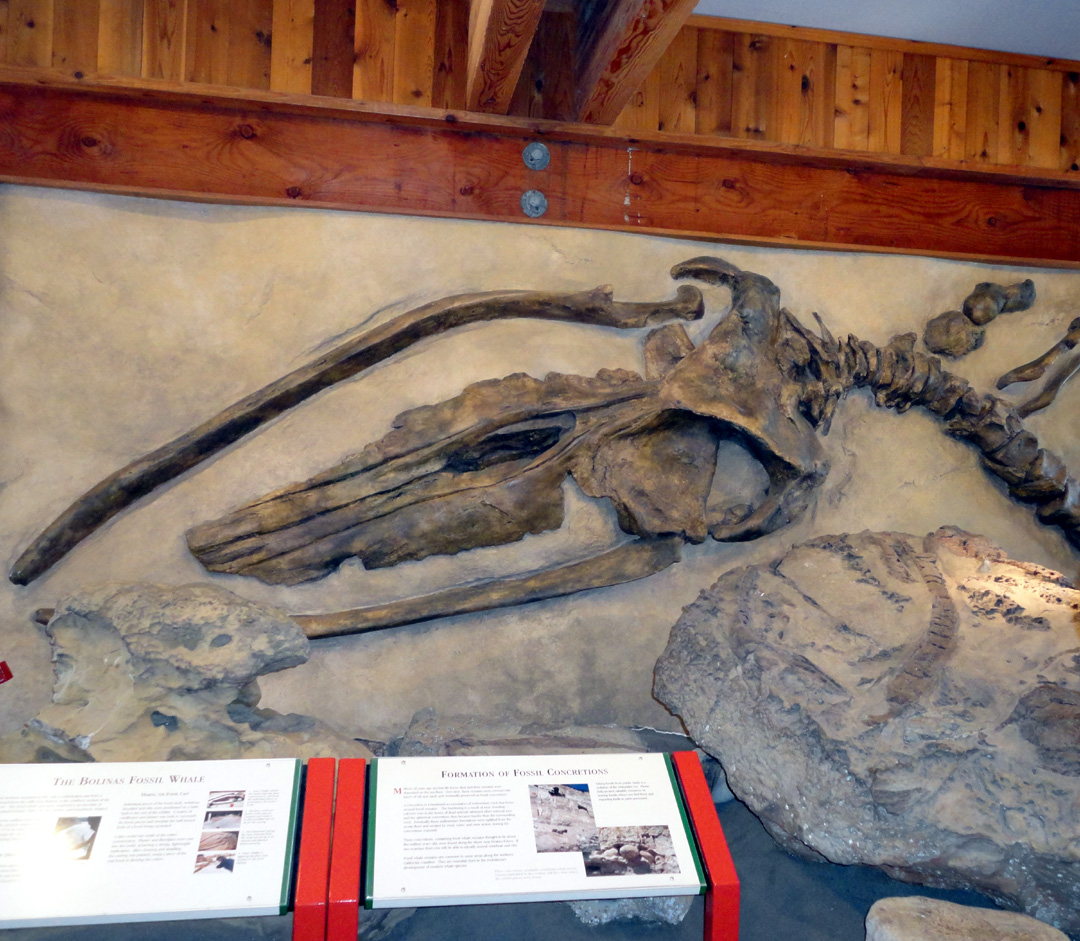
The exhibit at the Drakes Beach visitor's center showing the holotype skeleton of 
Parabalaenoptera baulinensis.

In 1973, a large mysticete skeleton was discovered by Carl Zeigler of the College of Marin, weathering out of cliffs near Bolinas in Marin County, California. Bolinas is a quaint artist community on the Marin County coast and has changed little since the 1960's and 70's; it is predominantly settled by ex-hippies, who generally don't like visitors from out of county, and have continually removed the exit sign for "Bolinas: 2 miles" off of highway 1, to the point where the California Dept. of Transportation (CalTrans) has given up putting up new signs. Tales abound of visitors with out of county or out of state license plates having car tires popped or vandalized, and nails and other tire-popping objects being intentionally laid out onto dirt roads in town. My car had a San Rafael Honda license plate holder, so I never had this problem.

The assembled holotype skull of Parabalaenoptera at California Academy of Sciences, photographed by fellow Otago Ph.D. student Felix Marx.

Exposed along the southern tip of Point Reyes is a unit formerly identified as the early late Miocene Monterey Formation; this was subsequently reevaluated after Domning (1978) suggested that sea cow fossils from the Bolinas locality were too derived to be from such an old unit. Afterwards, microfossils suggested a much younger age, closer to the Mio-Pliocene boundary (6-6.8 Million years old), and the formation was reidentified as the Santa Cruz Mudstone, which has only been mapped in Santa Cruz County.

Anterior view of Parabalaenoptera.
The fossil occurred in indurated, blocky mudstone, and was collected over a ten year period as the blocks incrementally eroded from the cliff. The lead authors - Gordon ("Gordie") Chan and Carl Zeigler of the College of Marin in Kentfield, and their field assistants - would have to travel over the hill and out to Bolinas (nearly an hour's drive through some of the windiest vomit-inducing roads in Northern California) on a monthly basis during the summer, and much more often during the winter during periods of intense erosion, and sometimes daily, anticipating falling blocks. After collection, the blocks were prepared, and some were glued together - but left as a series of blocks that could be lined up and assembled. The holotype was prepared at College of Marin, and eventually molded, casted, and donated to the California Academy of Sciences. Mounted casts of Parabalaenoptera baulinensis are currently on display at College of Marin in Kentfield and at the Drake's Beach visitor center at Point Reyes National Seashore. Sadly, before the paper could be published on the fossil - Carl Zeigler and Gordon Chan passed away. Chan passed away in 1996 of Lou Gehrig's disease; I could not find information on Zeigler, though I seem to recall hearing that he was killed by a drunk driver. Dr. Lawrence Barnes of the Los Angeles County Museum of Natural History finished the manuscript and brought it to publication in the California Academy of Sciences in 1997.

The braincase and vertex of Parabalaenoptera.
Parabalaenoptera baulinensis is a medium-sized balaenopterid with a 2.2 meter skull, slightly larger than minke whales (Balaenoptera acutorostrata; a 10 meter long whale with a 2m skull), but has a number of features that are too divergent to warrant inclusion within humpbacks (Megaptera) or Balaenoptera. These include the very elongate and somewhat swollen zygomatic processes, narrow intertemporal region (the skull is less 'telescoped than in modern balaenopterids), and extremely long and narrow nasal bones. The mandibles are strongly outwardly bowed like in Megaptera, and have an elongate coronoid process - somewhat like blue and fin whales (Balaenoptera musculus and physalus). Many of these features suggest that Parabalaenoptera baulinensis was capable of lunge feeding just like modern rorquals. It is additionally convergent with Balaenoptera musculus in having a supraorbital process of the frontal that is somewhat triangular and narrows laterally, whereas in Balaenoptera and Megaptera, the posterior and anterior margins are either parallel, or the posterior margin is perpendicular to the midline. Unfortunately, the holotype specimen is not preserved very well, and it appears that a significant amount of bone was accidentally removed or ground away during preparation, and details of the basicranium are almost totally indiscernible. Parabalaenoptera has been found in many phylogenetic analyses to be a stem-balaenopterid - in other words, a primitive member of the clade (family Balaenopteridae) that does not belong to the clade formed by humpback whales and modern species of Balaenoptera - the Megaptera + Balaenoptera clade, if you will. These two modern genera have been traditionally grouped into the "Megapterinae" and "Balaenopterinae" - Zeigler et al. (1997) even went so far as to name a new subfamily, the Parabalaenopterinae. However, given that none of these subfamilies have really shown to be stable or even consistent in cladistic analyses, it's unclear what the utility of such taxon names even is.

Reconstruction of the holotype skull and mandibles of Parabalaenoptera. Unfortunately, certain features (e.g. squamosal morphology) of the actual skull don't really look like how they're portrayed in this figure. From Zeigler et al. (1997).

Nevertheless, the description of Parabalaenoptera was a hallmark in balaenopterid paleontology; however, given the stagnated taxonomic situation of fossil balaenopterids, little else was published on fossil balaenopterids until Michelangelo Bisconti started revisiting Italian fossils starting in 2007. In the last five years, a number of informative balaenopterid finds have been described - but it is only the tip of the iceberg. Perusing late Miocene and Pliocene marine mammal assemblages in Museums, it is apparent that balaenopterids comprise nearly two-thirds of the more recent baleen whale fossil record (it is at least the case for California marine mammal assemblages). In California, at least four to five unpublished balaenopterids await description from the Pliocene alone. Additional fossils that may represent Parabalaenoptera - potentially a new and slightly younger species - have been collected from the Purisima Formation near Santa Cruz (and are in much better condition than the holotype). The future of balaenopterid paleontology is bright!

References

Bosselaers, M., and Post, K. 2010. — A new fossil rorqual (Mammalia, Cetacea, Balaenopteridae) from the Early Pliocene of the North Sea, with a review of the rorqual species described by Owen and Van Beneden. Geodiversitas 32:331-363. 

Deméré, T. A., Berta, A., and McGowen, M. R. 2005. — The taxonomic and evolutionary history of modern balaenopteroid mysticetes. Journal of Mammalian Evolution 12:99-143.


Domning, D. P. 1978. — Sirenian evolution in the North Pacific Ocean. University of California Publications in Geological Sciences 18:1-176.


Zeigler, C. V., Chan, G. L., and Barnes, L. G. 1997. — A new late Miocene balaenopterid whale (Cetacea: Mysticeti), Parabalaenoptera baulinensis, (new genus and species) from the Santa Cruz Mudstone, Point Reyes Peninsula, California. Proceedings of the California Academy of Sciences 50(4):115-138.


Tuesday, August 9, 2011

Recent fieldwork in the Purisima Formation, Part 2: a possible new species of Herpetocetus?

Back in late May, Dick Hilton (Sierra College) and I did a three day field trip collecting fossil vertebrates from a locality in the Purisima Formation I recently got a permit for. On the second day, excavated a large block of sediment with what I assumed at the time were sirenian bones. I had not seen the bones except in cross section, and because they were somewhat dense, I thought they might be from a sea cow. We quickly carved out a large block, and due to the cohesive nature of the sediment, we were able to wrap it in tinfoil and duct tape. It was one of the first finds of the day, and I thought there could definitely be something neat inside. Because we were only a half mile from the cars, I left my pack with Dick and hoofed it back to the car with the thirty pound block, and also to grab some gatorade I had left in my car. When I returned, Dick was taking a siesta, and after some lunch, we headed further down the beach. Only a few hundred feet down I spotted a distinctly potato-shaped thing sticking out next to a piece of bone: it rather looked to me like a tympanic bulla, and I climbed up a bit to check it out. It was in fact a tympanic, and when the rest of the piece came out, I was able to see that it was in fact a nearly complete squamosal, complete with the bulla and posterior process of the petrosal. Dick and I thought the trip had been a success just because of this specimen, especially because it was from a section of cliffs where neither of us expected to find anything.

Dick Hilton digging up a huge baleen whale tympanic.

I couldn't have been more wrong. Unfortunately, I didn't know that I was until after the SATLW (Aquatic Tetrapods) conference. I did have a day or two before the conference to prepare the squamosal, and it did indeed have a plug-shaped posterior process of the petrosal, indicating it belonged to the Herpetocetinae, which includes Herpetocetus, Nannocetus, (probably) Piscobalaena, and Cephalotropis (according to Steeman, 2007). After the conference, I opened up the duct taped jacket and began preparation. After a couple hours the exposed pieces were still not making sense, and then I found a couple of bones that looked like they were adjacent to one another. When I removed them, there was a tiny neck of bone connecting them – and after a little more preparation, I realized it was a Herpetocetus petrosal and posterior process. Damnit, another goddamn Herpetocetus.

The petrosal and posterior process of the new specimen, with the facial nerve canal labeled. Upper left is ventral, lower left is dorsal, and right is medial view.

The skull with (partially incorrectly) articulated petrosal of the new skull in dorsal (top) and ventral (bottom) views.

Once I had enough of the block prepared, I realized I had quite a bit of the ventral portion of a small braincase preserved. It includes both exoccipitals, one occipital condyle, the basioccipital, the right squamosal, and the complete petrosal. After preparation, the petrosal is most similar to petrosals of Herpetocetus. This may be a bit technical, but herpetocetine baleen whales have several peculiar features that define them as a group. The posterior process of the petrosal – which is typically an elongate strap of bone that connects with the skull posteriorly – is very short and plug-shaped in these animals. Additionally, the posterior process (which is rarely found attached in isolated fossil mysticete petrosals) is flat and contributes to the lateral side of the skull, instead of being 'hidden' in a trench between the squamosal and exoccipital bones. Secondly, some herpetocetines have a flattened anterior process that is blade shaped; this structure is typically conical and robust or knoblike in most other mysticetes. Clearly, this specimen exhibits both of these features. Additionally, Herpetocetus spp. exhibit a large triangular flange on the side of the bone, which overhangs the squamosal – also present in this specimen. Additionally, herpetocetines all have extremely small earbones relative to most mysticetes. Unfortunately, the neck of the posterior process appears to have been deformed slightly, and when the main portion is articulated correctly, the posterior process sits in its trough a little wonky, and when the posterior process is articulated correctly, the main portion doesn't articulate well.

The posterior process, squamosal, and tympanic of Herpetocetus bramblei.

The two alternate articulations of the petrosal showing correct articulation of the posterior process (left) and correct articulation of the body of the petrosal (right).

The temporal region of the skull of Herpetocetus bramblei with the petrosal outlined in red.

However – it shows several features that differentiate it from all species of Herpetocetus as well as other herpetocetines like Nannocetus and Piscobalaena. Firstly, the anterior process is medially oriented – it is usually anteriorly facing instead. Second, the posterior process is very transversely narrow and elongate – it is typically more nearly circular in other species. Lastly, the most bizarre feature is that it has a very long anterior fissure of the facial nerve canal which is contorted into an S-shape – something I have not seen in any mysticete, fossil or modern.

Various mysticete petrosals in ventral view, showing two fossil rorquals (Plesiobalaenoptera and Balaenoptera sursiplana), a modern balaenid (Eubalaena japonica), the new specimen, and two other Herpetocetus specimens.

This is pretty exciting, and I am looking forward to preparing the other specimen, which includes part of a squamosal and a tympanic, and most likely a petrosal. It should not be too difficult to get these specimens written up and described.

Further Reading

Geisler, J. H. & Luo, Z.-X. 1996. The petrosal and inner ear of Herpetocetus sp. (Mammalia: Cetacea) and their implications for the phylogeny and hearing of archaic mysticetes. Journal of Vertebrate Paleontology, 70, 1045–1066.

Steeman, M.E. 2007. Cladistic analysis and a revised classification of fossil and recent mysticetes. Zoological Journal of the Linnean Society 150:875–894.

Steeman, M.E. 2010. The extinct baleen whale fauna from the Miocene-Pliocene of Belgium and the diagnostic cetacean ear bones. Journal of Systematic Palaeontology 8:63-80.

Whitmore, F.C., and L.G. Barnes. 2008. The Herpetocetinae, a new subfamily of extinct baleen whales (Mammalia, Cetacea, Cetotheriidae). In C.E. Ray, D.J. Bohaska, I.A. Koretsky, L.W. Ward, and L.G. Barnes (eds.). Geology and Paleontology of the Lee Creek Mine, North Carolina, IV. Virginia Museum of Natural History Special Publication 14:141–180.

Tuesday, August 2, 2011

More problems with Herpetocetus

Back in June at the Aquatic Tetrapods conference I coauthored a poster with Joe El Adli (San Diego Natural History Museum) and Jonathan Geisler (New York College of Osteopathic Medicine) on some of the taxonomic problems of Herpetocetus. Herpetocetus, as I've mentioned before, is an enigmatic small bodied mysticete whale which many bizarre and derived features, while retaining some primitive features as well. Fossils of Herpetocetus are fairly common in Northern California, particularly in the Purisima Formation - or maybe I just have a knack for finding them. Thus far, there is only one described species of Herpetocetus from California: Herpetocetus bramblei, named by Whitmore and Barnes (2008) from a very partial skull (basically just a squamosal with part of the exoccipital, parietal, and pterygoid) with a petrosal from the Purisima Formation. In summer 2007, I excavated a nearly complete skull of this same species from near the type locality, and last summer, I excavated a second specimen which lacked the braincase but included a complete rostrum. Since this topotypic material was collected, additional specimens from other localities in the Purisima Formation indicate that two additional undescribed species are present - one of the new species was discovered very recently, and I'll have more on that soon.

*Holotype, for the non-specialist, is the specimen which a new species is based off of. It should be representative of the new species in terms of its anatomy, and should be relatively complete enough to be comparable to other taxa. A type locality is where the holotype specimen originated.

There are several other described species of Herpetocetus from other corners of the globe - all from the Northern Hemisphere. The genus was first described from the Pliocene of Belgium (Herpetocetus scaldiensis) based on a partial dentary. A partial skull from the Pliocene Yorktown Formation was described as Herpetocetus transatlanticus, also by Whitmore and Barnes (2008). In the 1960's, an isolated tympanic bulla from Japan was named as the type specimen of Mitzuhoptera sendaicus, and a fossil mysticete skeleton with a skull, earbones, and dentary shared both the dentary morphology of Herpetocetus scaldiensis as well as the tympanic morphology of Mitzuhoptera sendaicus, and Oishi and Hasegawa (1995) transferred M. sendaicus to Herpetocetus, resulting in the new combination, Herpetocetus sendaicus. Each of these records is from either side of the Pacific (east and west) and the Atlantic (east and west).

How diagnostic are bullae and dentaries? I've already addressed problems with the jaw morphology of herpetocetines (here and here), and mysticetes in general. If you recall, there are two problems concerning the dentary of Herpetocetus spp. in particular: 1) The dentary of the possible sister taxon Nannocetus is not yet known, and dentaries substantially older than Herpetocetus (and possibly belonging to Nannocetus) are nearly identical to Herpetocetus (see below image), indicating that this general morphology is possibly characteristic of a larger group of whales. 2) Some species of Herpetocetus have dentaries that are very difficult to tell apart and lack autapomorphic characters (unique derived features), and thus are not suitable as holotypes. This logically results in the implication that Herpetocetus scaldiensis, which is based on a jaw, is the type species of Herpetocetus, and thus the species and genus may be taxonomically invalid or nomina dubia (means dubious name in latin).

The first figure of our poster, showing comparative drawings of various fossil herpetocetines.

Earbones have long been used for taxonomic purposes, and in many cases have been designated as holotypes. Sir Richard Owen designated many isolated bullae from the Plio-Pleistocene Red Crag of eastern England as holotypes (all of which have been sunk; e.g. Balaena definata). It is unclear how diagnostic earbones are for baleen whales: petrosals (otherwise known as periotics - the inner ear bone) have all sorts holes and knobs and crests and are rather easy to tell apart from genus to genus. A recent paper published by Eric Ekdale, Annalisa Berta, and Tom Demere (2011) indicate that earbones of extant mysticetes are diagnostic to the species and are easily told apart. Additionally, Steeman (2010) reexamined a large suite of earbones previously described by taxonomic mad man P.J. Van Beneden, who is largely responsible for constipating the entire field of mysticete systematics for over 100 years. Steeman (2010) found that many of these earbones - specifically petrosals - may be diagnostic tools, and generally reached a similar conclusion like Ekdale et al. (2011). But what about bullae?


The second figure from our poster, showing variation in tympanic bulla morphology from various herpetocetines. Note the overall similarity between Herpetocetus spp.

Bullae of three species of Herpetocetus have been described: H. scaldiensis, H. transatlanticus, and H. sendaicus. In our poster, we figured all known bullae (described or undescribed), including both the holotype of Mizuhoptera sendaicus and the referred specimen of Herpetocetus sendaicus, and a new bulla of Herpetocetus bramblei. Additionally figured are bullae of Nannocetus and Piscobalaena, also herpetocetines. We concluded, as we hope that you will when looking at this figure, that the bullae of different Herpetocetus species do not vary significantly from species to species. They are, on the other hand, diagnostic at the family level: they are clearly distinct from all other bullae of (described) cetotheriids. However, a bulla that is only distinct at the genus level is inadequate to be used as a holotype. This suggests that Mizuhoptera sendaicus, unsurprisingly, is probably a nomen dubium. It also indicates something interesting is going on with the skulls of mysticetes, or at least cetotheriids: tympanics are slightly less informative than the petrosals. It might be possible someday to quantify how phylogenetically useful different anatomical regions are, aside from just counting up the number of characters used per anatomic region in a cladistic analysis. Who knows, maybe someone has already thought of that and developed a method.

Further Reading:

New published article (Part 1): herpetocetine jaws, and an example of finding a "simple" research project


New published article (Part 2): taxonomic problems with Herpetocetus and "cetotheres"

References:


El Adli, J., Boessenecker, R.W., and J. H. Geisler. 2011. Taxonomic problems of and relationships among species of the fossil baleen whale genus Herpetocetus. Sixth Triennial Conference on Secondary Adaptation of Tetrapods to Life in Water Program with Abstracts: 23.

Ekdale, E.G., A. Berta, and T.A. Demere. 2011. The comparative osteology of the petrotympanic complex (ear region) of extant baleen whales (Cetacea: Mysticeti). PLOS One 6:1-42.

Oishi, M., and Y. Hasegawa 1995. Diversity of Pliocene mysticetes from eastern Japan. The Island Arc 3:436–552.

Steeman, M.E. 2010. The extinct baleen whale fauna from the Miocene-Pliocene of Belgium and the diagnostic cetacean ear bones. Journal of Systematic Palaeontology 8:1:63-80.

Whitmore, F.C., and L.G. Barnes. 2008. The Herpetocetinae, a new subfamily of extinct baleen whales (Mammalia, Cetacea, Cetotheriidae). In C.E. Ray, D.J. Bohaska, I.A. Koretsky, L.W. Ward, and L.G. Barnes (eds.). Geology and Paleontology of the Lee Creek Mine, North Carolina, IV. Virginia Museum of Natural History Special Publication 14:141–180.