Showing posts with label Odobenidae. Show all posts

Thursday, January 26, 2012

Southern California Research Trip, Part 3: Natural History Museum of Los Angeles County (collections)

The purpose for our trip to visit the LACM collections was to examine a large collection of pinniped fossils housed there. Curator Emeritus Dr. "Larry" Barnes has been studying fossil pinnipeds since his master's thesis in the late 1960's (which he published in 1972, on Allodesmus and other desmatophocid pinnipeds), and has researched a wide variety of fossil pinnipeds including the early diverging and 'primitive' enaliarctines (a paraphyletic group of early pinnipeds), the relatively large and aberrant desmatophocids (an extinct group of phocoids known only from the North Pacific), all manners of fossil walruses, and fossil sea lions and fur seals. Larry has named quite a few fossil pinniped taxa from the northeastern Pacific region (Enaliarctos mitchelli, Pteronarctos goedertae, Pteronarctos piersoni, Pacificotaria hadromma, Desmatophoca brachycephala, Allodesmus gracilis, Proneotherium repenningi, Pelagiarctos thomasi, Gomphotaria pugnax, and Proterozetes ulysses), and there are a whole slew of holotype specimens to look at at the LACM - including a number of other important finds, including crania and jaws of the walrus Imagotaria downsi and the even earlier Neotherium mirum (but not quite as old as Proneotherium...). Our goal was to photograph all of these skulls and jaws, and take all sorts of measurements of them for our research. Between Morgan and I, we took about 5 gigabytes of photographs of these fossils. At the moment, we have two concurrent research projects which will soon be culminating in submittable manuscripts: a phylogenetic analysis of fossil and modern sea lions and fur seals (Otariidae; Morgan gave a talk on this at SVP this last fall), and another project describing some new material of the extinct "killer" walrus Pelagiarctos, originally described by Larry Barnes from the Sharktooth Hill Bonebed, and discovered by LACM head preparator and all around fun guy Howell Thomas. At bare minimum, we needed to examine, photograph, and measure the holotype "chin" and the referred teeth. Anything else we got done was a bonus - and our bonus included looking at dozens and dozens of skulls, jaws, and teeth of various other pinnipeds.

The hollywood hills can be seen very well from the prep lab, which is several floors up. You can just make out the hollywood sign below the top of the mountains.

The holotype "chin" of Pelagiarctos thomasi.

A referred lower left third or fourth premolar of Pelagiarctos, published by Barnes (1988).

My wife borrowed some of the clay we used for propping oddly shaped specimens up during photography and made a walrus and a manatee; the manatee even has
motorboat propeller scars (just for J. Velez-Juarbe!)

A referred lower jaw of Neotherium mirum from the Sharktooth Hill Bonebed, published by Barnes (1988); this is the only other early walrus from the middle Miocene bonebed.

My wife happened to find a book of 3D cat photos with 3D glasses. Don't ask.

Three different jaws of Allodesmus from the Round Mountain silt; but how many species? According to Barnes, there are three species: the topmost is the holotype of Allodesmus kelloggi, the middle is the holotype of Allodesmus kernensis, and the bottom one is Allodesmus gracilis. Others would lump all these in to Allodesmus kernensis (which would have taxonomic priority).

Three different early walruses! From left to right, they are Proneotherium repenningi from the Astoria Formation of Oregon (early Middle Miocene), Neotherium mirum from the Sharktooth Hill Bonebed of California (late Middle Miocene), and Imagotaria downsi from the Santa Margarita Sandstone (early Late Miocene) of Santa Cruz County, California.

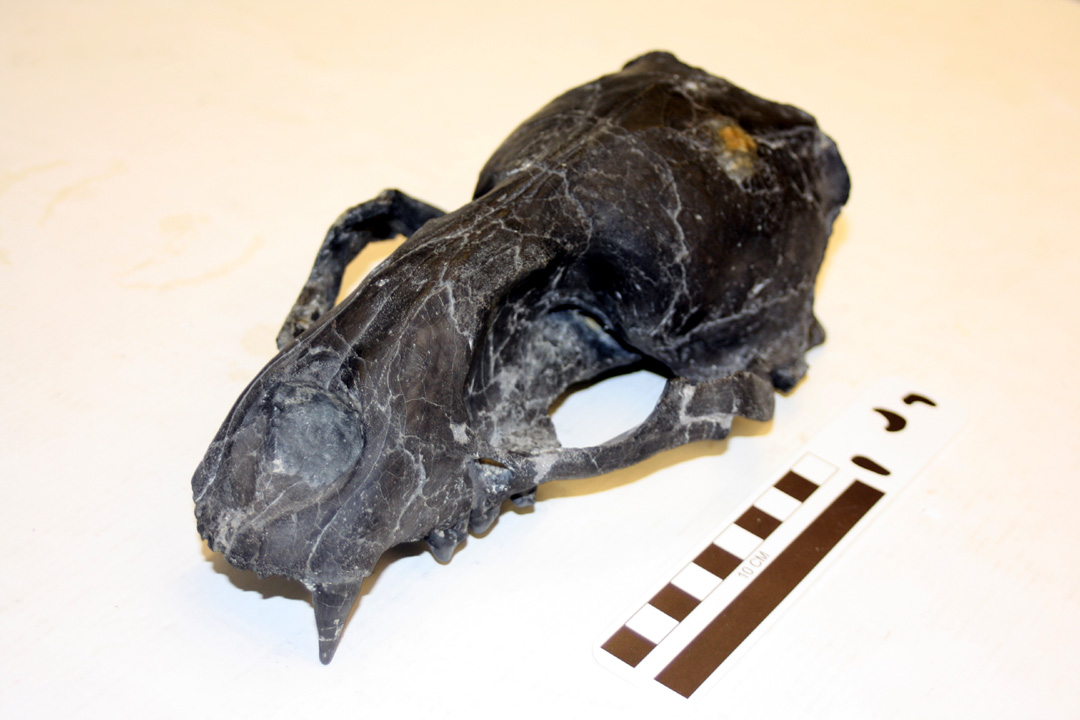
The beautifully preserved holotype skull of Pacificotaria hadromma from the Astoria Formation of Oregon. According to Berta (1994), this may be a junior synonym of Pteronarctos.

Morgan and I conducting research amid a chaotic mess of fossil pinnipeds and other paleontological debris.

Downtown Los Angeles from the window in the prep lab. The US Bank tower can be seen in the middle. If you recall, it was blown to smithereens in Independence Day.

The rostrum and upper dentition of a referred snout of Desmatophoca oregonensis.

Morgan photographing the obscenely gigantic jaw of the bizarre double tusked behemoth of a walrus Gomphotaria pugnax. Seriously, that thing is offensively large.

The holotype skull of Allodesmus kelloggi, described by Ed Mitchell in the mid 1960's from the Sharktooth Hill Bonebed.

An undescribed late Pleistocene jaw of a California sea lion, Zalophus sp., from the Newport Bay mesa.

Last, but not least, another shot of those three walruses -
Proneotherium, Neotherium, and Imagotaria.

What's up next? One or two more posts on the southern CA trip including the Page Museum as well as the Santa Barbara Museum of Natural History, and eventually, I should probably try and cover some recent marine mammal research, I still have to cover a paper I got published on our wedding day, Kolponomos, and a bazillion other things.

Wednesday, January 18, 2012

Southern California Research Trip, Part 1: San Diego Museum of Natural History

After a ten day visit with my wife's family for Christmas in Billings, Montana, my wife and I flew back to California, and had two days to get ready for a research trip to southern California with our friend and colleague Morgan Churchill. Except that we both got sick with a nasty two day cold - we got back on a thursday night around midnight, and were supposed to leave on sunday morning (which also happened to be January 1st). Needless to say, neither of us really were able to get ready for the trip on account of how crappy we both felt, and miraculously, waking up on sunday morning for the trip, I finally felt okay to drive, and the trip was a go (only we still had to pack, and didn't get out of town until close to 1pm). It's an 8 hour drive from San Francisco to San Diego (without traffic), so we were looking at a pretty late arrival. That being said, we had just driven up to Montana a couple weeks prior, and 8 hours seemed miniscule compared to two 10 hour days across the American west. We got to Los Angeles around 7pm, and stopped in for a couple hours to visit our best friend, Lee Hall, and his awesome girlfriend Ashley Fragomeni, which was refreshing (and far too brief). We finally pulled into east San Diego to pick up Morgan at about 12:30am (after driving through the densest coastal fog I've ever seen - and that's coming from a San Francisco native!). We pulled up to the house of our gracious host (and my coauthor) Joe El Adli, who also hosted me during the SATLW meeting in June at SDSU.
Morgan measuring a skull of Valenictus chulavistensis, the "toothless" walrus from the Pliocene San Diego Formation.

We had several goals for our visit - Morgan and I are studying a new specimen of the middle Miocene walrus Pelagiarctos, which Larry Barnes descibed in 1988 from the "chin" end of a pair of mandibles and some teeth, and suggested some interesting hypotheses regarding its paleoecology. At San Diego in particular, Morgan needed to spend some time photographing and measuring every pinniped skull and jaw he could (and it took up nearly the entire time of our visit). When not helping Morgan with measurements, I was chatting with Tom Demere (paleontology curator at the SDNHM) and Joe El Adli (lead preparator of the paleo department at SDNHM) about the fossil mysticete Herpetocetus, as well as photographing some earbones and crania of balaenopterids that occur in both the Purisima and San Diego Formations.

A mounted skeleton of Allodesmus (kernensis? gracilis? depends on who you talk to) at the SDNHM, while the tail and claspers of a giant Carcharocles megalodon loom ominously above.

A closeup of the business end of Allodesmus.


A skull of Desmatophoca oregonensis, a smaller and earlier relative of Allodesmus from the Astoria Formation of coastal Oregon. This specimen was collected by Douglas Emlong, and described by Tom Demere and Annalisa Berta in 2002.

Two pinniped skulls in particular that we definitely needed to see are on display in a huge cabinet out in the Fossil Mysteries hall. During my 2007 visit, I had been let into the cetacean display case to examine and photograph a porpoise skull, but that case actually had an entire door and you could walk around in it; this display case with the walruses had a 150 pound sheet of glass that required four of us (Morgan, Joe, myself, and the SDNHM collections manager, Kesler Randall) to use large suction cups to lift the ~7 foot tall sheet off of the case (which required Joe and Kesler to go up on ladders on either side). It was quite the performance, all done prior to the museum opening.

Joe (left) and Kesler (right) brainstorming about removing the sheet of glass from the walrus exhibit.

Joe placing the suction cups on the glass. The two walrus skulls in
question
- Dusignathus seftoni on the left, and Valenictus chulavistensis on the
right - can be
seen at the bottom of the case.

We needed to see two specimens in particular - one is the nearly complete and well preserved paratype skull of Valenictus chulavistensis, and the other is a referred skull of the dusignathine "double tusked" walrus Dusignathus seftoni. I had really ought to blog about each of these taxa, as they are truly wonderful and bizarre creatures. The new skull of Dusignathus was collected about 6 or 7 years after Tom Demere described and named the species in 1994, and is in much better shape than the holotype specimen, which is substantially smaller, and is missing the palate (although this new larger male specimen is missing the top of the skull). Although I've seen this display several times before, I must admit I was very surpised with 1) how small the Valenictus paratype is in comparison to other skulls, 2) how light the paratype is (Tom stated that it was very poorly mineralized and held together primarily with consolidant), and 3) how damn huge the Dusignathus skull is in comparison to other skulls in collections.

Joe (in brown) and Kesler (left) set the walrus crania down onto foam, while Morgan (right) and I (gray) watch.

While Morgan was taking photos, I decided to get a different angle on some of the fossils while I had a ladder available. Here I am shooting the Allodesmus photos seen above.

Here's a nice shot I got from the ladder of a new species of balaenopterid mysticete from the Pliocene San Diego Formation (this taxon is being studied by SDSU student Jessica Martin). So far as I can tell, I've not yet seen this animal from the Purisima Formation.

A neat mount of a fossilized wing of an albatross, Diomedea sp. (but should probably be identified as Phoebastria sp.). Albatrosses are definitely huge birds - but the partial humerus of Pelagornis sp. I recently published, which was only 1/2 complete, was the same length as the complete humerus of this specimen.

My wife always makes friends on research trips.

By the end of the San Diego visit, we had each taken several gigabytes of photos, and dozens of measurements for our research. My wife had spent a fair amount of time next door at the San Diego Zoo, and at the Museum of Man. We spent wednesday morning at the SDNHM to wrap up everything before driving to LA, where we would spend our first afternoon of research at the Natural History Museum of Los Angeles County (NHMLAC), but known to paleontologists simply as "LACM" - which will be the subject of the next post.

Wednesday, February 2, 2011

Mammal bite marks on fur seal bones, part 2

A few months after I collected the radius, I was invited to go examine Frank Perry's private collection. He's donated the majority of his material to UCMP, LACM, and the Santa Cruz Museum, but there was some remaining material. Several specimens he allowed me to borrow and prepare, including a partial juvenile Parapontoporia cranium, a walrus vertebra, and several fur seal bones. One of these was a very small humerus from a fur seal pup, roughly the same size individual as the radius I mentioned earlier. This specimen also happened to have a circular depression with a ring fracture, although it is much more shallow, and larger. This may be attributable to a larger, blunter tooth. Both of these specimens are probably attributable to the species Thalassoleon macnallyae, although in the article the bones are only identified to the family otariidae.
The right radius of a juvenile fur seal in anterior (left) and lateral (middle) views, and a closeup of the bite mark (right).

So, what caused these? Many, many, many studies have been published on shark tooth inflicted bite marks, which are typically linear gouges. These gouges are sometimes associated with removed 'chunks' of bone, but never have any fractures. These are obviously not linear gouges, and instead appear to be the result of the bone surface being pushed in. Circular holes can be caused by boring clams (pholad clams), but these are eroded, and do not result in fracturing. As it turns out, many similar tooth marks have been reported for conical mammalian teeth, of terrestrial mammalian predators and scavengers. One single similar tooth mark has been reported for a marine mammal: a skull of a juvenile sea lion (Eumetopias) from the Pleistocene of British Columbia (see the paper for more comments on this article). In fact, this is only the second reported occurrence of probable mammalian bite marks on fossil marine mammal bones.

Figure 2 from Boessenecker and Perry (2011) showing the bones and bone modifications.


The next question is, what type of mammal has the dental equipment capable of inflicting this sort of damage? Several pinnipeds, including the bizarre walrus Dusignathus santacruzensis, have teeth small enough to inflict these punctures. Most dolphins have teeth that are too small, and too closely spaced to make these punctures. Larger odontocetes, including the beluga relative Denebola, have larger teeth which are spaced far enough apart to form the punctures. Recently, Jonathan Geisler, Frank Perry, and I presented a poster on a pilot whale-like delphinid, and something the size of this cetacean could easily have produced the bite marks. The possibility remains that a terrestrial carnivore, like a canid, felid, or ursid; modern mammalian carnivores often prey upon or scavenge upon pinnipeds on shorelines. Lastly, the fur seal Thalassoleon has teeth that could produce the punctures. But Thalassoleon is the same species, you say! Well, oddly enough, extant fur seals and sea lions frequently commit infanticide - killing juveniles of their own species, sometimes in order to feed, other times as a part of aberrant sexual behavior where juveniles are mistaken for females.

Table of biogenic bone modifications from Boessenecker and Perry (2011) reported from marine vertebrate bones.

Unfortunately, it isn't possible to narrow the possibilities down any further. I'm getting tired, so stay tuned for part 3.

Sunday, November 8, 2009

Reconstructing a fossil walrus, part 2: the finished product

So, quick rehash of part 1, in case you're really that lazy. To reconstruct the cranium and jaws of Dusignathus santacruzensis (which has an 'exploded' holotype cranium with isolated parts that don't quite match up well), I used more complete material of a younger species, Dusignathus seftoni, from the late Pliocene San Diego Formation. I used the skull of D. seftoni as a template to 'hang' the various parts of D. santacruzensis on to.
Cranial mosaic of Dusignathus seftoni with holotypic fragments of Dusignathus santacruzensis 'hung on'.

From here, it was pretty much an exercise in printing it off, tracing it, and inking it out (followed of course by scanning and some image editing). Below is the finished product.

New cranial restoration of Dusignathus santacruzensis.


Cranial restoration of Mitchell (1975).

Compare this with the older cranial restoration of Dusignathus santacruzensis by Mitchell (1975); there are some obvious differences, including a significantly smaller orbit, and a dorsoventrally shallower cranium, which serves to make the dentary appear much more massive.


Cranial reconstruction of Dusignathus santacruzensis with photos of crania
of
Dusignathus seftoni and Gomphotaria pugnax. Not to scale.

So... that's basically that. During my lifetime, I want to test this hypothesis of what this animal looked like by finding a new cranium of D. santacruzensis; this won't be easy, and will probably take a lot more searching (i.e. decades). Wishful thinking, I know... Otherwise, I hope that this gives you folks some ideas on how to tackle similar problems with incomplete material you may be studying.

Mitchell, E.D., jr. 1975. Parallelism and convergence in the evolution of the otariidae and phocidae. In Biology of the Seal, p. 12-26.

Thursday, October 29, 2009

Reconstructing a fossil walrus, part 1: the enigmatic Dusignathus santacruzensis

For a recent manuscript project I found myself in need of a cranial reconstruction of the strange pinniped Dusignathus santacruzensis. D. santacruzensis was named from the Purisima Formation in 1927 by Remington Kellogg, the father of modern marine mammal paleontology. Research and interviews conducted by F.A Perry have successfully relocated the type locality, which evaded Kellogg and later forays by E.D. Mitchell in the early 1960's. The holotype specimen consists of a few cranium fragments including a partial maxilla bearing a procumbent canine, a squamosal, and a fragment of the 'vertex' of the skull (a term usually relegated to cetaceans, but utilized for odobenids by Demere [1994]), as well as both dentaries. The 'exploded' nature of the cranium is actually fairly literal; interviews by F.A. Perry indicate the collector 'poked it with a stick and the skull exploded', and only some of the cranium fragments were recovered. The dentaries are thus far the most distinctive element of the taxon; they are very robust, also with a procumbent canine, curious postcanine teeth with anterior and posterior wear facets, and a sinuous ventral border of the dentary (the first and last are synapomorphies of the Dusignathinae - Demere [1994]). Mitchell (1975) depicted the first reconstruction of the cranium of D. santacruzensis.

Mitchell's 1975 reconstruction of Dusignathus santacruzensis.

Unfortunately, no more cranial remains of Dusignathus santacruzensis have been recovered from the Purisima Formation since. Trust me, this isn't for lack of trying - dozens of dedicated amateurs and professionals (myself included, for the last few years) have been scouring the coastal exposures of the Purisima Formation nonstop since the 1970's. Plenty of odobenid postcrania have been collected, in addition to an edentulous odobenine walrus cranium (Barnes and Perry, 1989).

Former display at the Santa Cruz Museum of Natural History of casts of the Dusignathus santacruzensis holotype (without squamosal) based on Mitchell's reconstruction. Done by my colleague, Frank Perry. I apologize for the reversed image.

A gigantic pinniped skeleton was unearthed in the late 1980's from the Capistrano Formation, and was named Gomphotaria pugnax (Barnes and Raschke, 1991). This very strange animal was initially perceived as being very different from Dusignathus in terms of its mandibular morphology. Gomphotaria, which had a 40cm+ skull, bore two stout, worn, procumbent tusks - in the cranium and in the mandible.

Gomphotaria pugnax, a pinniped straight from hell.

Collections from the late Pliocene San Diego Formation of southern California included two new species of walruses - the extremely bizarre toothless Valenictus chulavistensis (which deserves several posts by itself), and the 'bizarrer' Dusignathus seftoni, both described by Tom Demere (1994a), the curator of SDNHM. D. seftoni is known from several crania and jaws, a partial skeleton, and a handful of postcranial elements. This animal had a cranium generally similar to the well known Imagotaria, and very similar to the 'killer walrus' Pontolis, and Gomphotaria. A trait shared with Gomphotaria were the possession of upper and lower (but less procumbent) tusks, also highly worn. The dentary shared similarities with both taxa; the sinuous ventral border, but it had a gigantic lower canine.

Referred crania of Dusignathus seftoni, described by Demere (1994).

Although the holotype of D. santacruzensis does not have very large canines, Demere (1994b) suggested that the specimen represents a female. Indeed, the canines are relatively small for any male pinniped, although the skull fragments do preserve a sagittal crest. The root of the lower canine is also exceptionally long, suggesting some potential.

The holotype right dentary of Dusignathus santacruzensis, from
Repenning and Tedford (1977).


Sure enough, in March 2008 I collected (from near the type locality) a pair of associated tusks (one upper, one lower) - one is straight, and the other curved posteriorly and laterally; these are adult teeth (based on root pulp cavity closure), and lack the highly abraded and parasagittally oriented tusks of Gomphotaria, and instead have tusks more similar to D. seftoni (albeit unworn). Additionally, these tusks are substantially smaller than in Gomphotaria, which was a monster in comparison (although dwarfed by Pontolis magnus, another dusignathine, one of the largest carnivorans of all time, possibly only smaller than elephant seals). These are best identified as male tusks of D. santacruzensis. These tusks are larger than any male D. seftoni specimen, and indicate an animal that is pretty damn sexually dimorphic. One of the tusks exhibits curvature in a parasaggital plane, but also lateral curvature. Tom Demere has successfully convinced me that the curved tusk is the lower canine, very similar to D. seftoni.

Unfortunately, dentaries of female D. seftoni are not yet known, and male dentaries of D. santacruzensis are not yet known. I guess I just have to keep looking in the Purisima Formation!

Coming up - the actual reconstruction process I used, now that the essential (albeit convoluted) backstory is done.

T. A. Demere. 1994a. Two new species of fossil walruses (Pinnipedia: Odobenidae) from the Upper Pliocene San Diego Formation, California. Proceedings of the San Diego Society of Natural History 29:77-98

Demere, T.A. 1994b. The family Odobenidae : a phylogenetic analysis of fossil and living taxa. Proceedings of the San Diego Society of Natural History 10:99-123.

R. Kellogg. 1927. Fossil Pinnipeds from California. Contributions to Palaeontology from the Carnegie Institution of Washington 27-37

Mitchell, E.D., jr. 1975. Parallelism and convergence in the evolution of the otariidae and phocidae. In Biology of the Seal, p. 12-26.

Repenning, C. and Tedford, T., 1977. Otarioid seals of the Neogene. USGS Professional Paper 992.