Showing posts with label thalassoleon. Show all posts

Tuesday, December 27, 2011

October pinniped excavations

Dick Hilton and I excavating a pair of fur seal (Thalassoleon) dentaries from the base of the cliff.

A famished yearling California Sea Lion on the beach.

The weekend before the annual meeting of the Society of Vertebrate Paleontology in Las Vegas, my wife and I joined Dick Hilton from Sierra College for what we assumed would be a routine visit to the Purisima Formation at Point Reyes. We drove up on a Friday night, and cooked hot dogs at the campground with Dick, and set up our tent for the weekend. The following morning, we set out along the shoreline, and within five minutes, found what appeared to be a pinniped skeleton. Since we wanted to get on to more prosperous localities further down, we left it there with the intention of digging it up the following day (Sunday).
My wife pointing to something tiny she is proud of finding...

It's a beautiful fur seal (Thalassoleon) molar! She has a real eye for finding things like tiny pinniped and shark teeth, which is why I keep her around.

Dick Hilton trying to explain something to my wife and I. At least I hope he was talking to my wife, because it sure looks like I wasn't paying attention.

As we headed further on down to the good section of shoreline, I found a well preserved porpoise earbone (petrosal), and a few other odds and ends. Not too long afterward, and nearly at the same time, Dick spotted a couple bones eroding out with an associated tooth, and my wife spotted a well preserved fur seal tooth (Thalassoleon), only a few meters away. It took us the better part of an hour to dig the bones up – which turned out to be a pair of associated fur seal dentaries! Unfortunately, neither specimen had any cheek teeth, but one did have a broken canine. Either way, only the middle chunk of the dentary is preserved in the holotype of Thalassoleon macnallyae (from the same locality), and these are the most complete and well preserved jaws of this taxon now known. We hiked down the beach a little further, and collected a couple of pinniped limb elements – a proximal end of a tibia, and a metatarsal. After collecting these, we headed back towards the cars. On our way back, I spotted a string of a dozen articulated pinniped vertebrae – a second skeleton we would have to excavate the following day.

A cast of the holotype skeleton of Parabalaenoptera baulinensis on display at the visitor center.

For comparison, there is also a skeleton of an adorably tiny (~15 feet long) minke whale (Balaenoptera acutorostrata) on display as well.

My wife examining some baleen (presumably from a balaenopterid) at the visitor center.

We also finally had a chance to visit the visitor’s center; previously, I had always been there on a weekday, when the center was closed. I was particularly excited to check it out because it has one of the only known casts of the holotype skeleton of Parabalaenoptera baulinensis (which was excavated from the Santa Cruz Mudstone at a nearby locality) on display – there is one other, but it is at the College of Marin in Kentfield, and is falling apart and badly needing repairs.
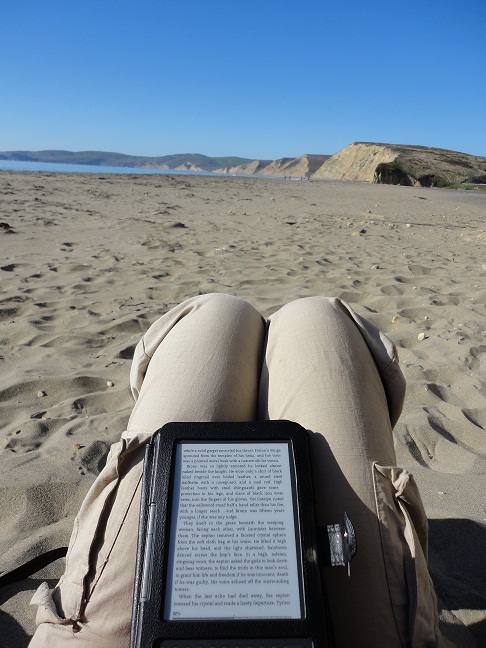
My wife decided she was done, and decided to spend the day reading A Game of Thrones on the beach and napping and taunting birds all day.

On the second day, we spent about seven hours excavating the first pinniped skeleton, which resulted in about 100 pounds of tin-foil jackets. This skeleton is probably of a large fur seal or small walrus, and the skeleton was completely disarticulated; as soon as we were close to removing one bone, another would be under it, or behind it. There were probably about two dozen or so bones in the cliff that we excavated. At about 4 in the afternoon, we wrapped up the first excavation, and walked down the beach to relocate the articulated skeleton. It took a while to relocate it, but as soon as we did, we started excavating it in a large block. Thanks to the specimen being articulated, we were able to finish this excavation in a little over an hour. Once we got back to the car, we loaded up nearly two hundred pounds of fossils we had collected in only two days in the field; furthermore, the most ridiculous aspect of the weekend was that by weight, cetacean fossils comprised less than 1% of our haul (only one specimen). For the uninitiated – pinniped fossils are relatively rare, and my master’s thesis sample of specimens indicates that there is a 4:1 ratio of cetacean fossils to pinnipeds, and that pinnipeds constitute only 8% of the marine vertebrate assemblage from the Purisima Formation at Santa Cruz. To collect a pair of associated dentaries, a tooth, a couple of associated hindlimb bones, and two skeletons (one being articulated) all in one weekend – is surprising, and tripled the number of major pinniped finds I’ve made. I’ll post some updates when some of this material gets prepared.

She nearly got this gull to come to her backpack. Sorry, no pictures of the pinniped excavation.

Wednesday, March 16, 2011

Research featured in the Santa Cruz Sentinel

Hey Folks,

My research with Frank Perry concerning bite marks on fur seal bones was recently highlighted in a recent article in the Santa Cruz Sentinel. Check it out!

http://www.santacruzsentinel.com/ci_17604819

Wednesday, February 2, 2011

Mammal bite marks on fur seal bones, part 1

It's approximately four in the AM in beautiful Long Island, New York, and this most recent blog post is brought to you by insomnia! I tend to not fare well in unfamiliar hotel rooms unless I'm relatively exhausted. Even though I'm running on a total of four hours of sleep since the night before I flew out to New York, I fared pretty well today. Tomorrow, I have a visit to the American Museum of Natural History in NYC, and Jonathan Geisler and I will be examining globicephaline dolphin skulls; the Globicephalinae are a clade of delphinids (oceanic dolphins) including pilot whales (Globicephala), Risso's Dolphin (Grampus), and false killer whales (Pseudorca). We're working on a short article together on a very fragmentary large odontocete skull from the Purisima Formation in Santa Cruz that shares some features in common with Globicephala.

But I'll talk more about that project later. More importantly, over this last weekend my first article was published - "Mammalian bite marks on juvenile fur seal bones from the late Neogene Purisima Formation of central California", which I coauthored with my friend and colleague Frank Perry of the Santa Cruz Museum of Natural History. And, oddly enough, right as I am typing this up now, I see that my friend Dr. Alton "Butch" Dooley at the VMNH has already beat me to the punchline (thanks for the free publicity, Butch!), and has discussed my new paper on his blog, and compared it with some similar bite marks on proboscidean and chalicothere postcrania. Seeing as this is my first published article, I'll go a bit more in depth this time and post this in two or three parts.


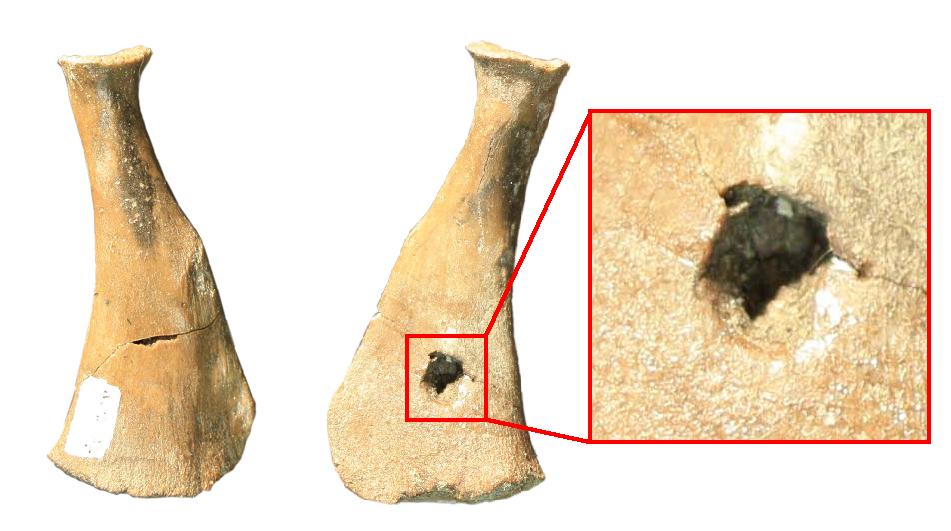
The story starts on Christmas day, 2008. As I've alluded to before, winter is one of the best times to go out to the coast and do fieldwork. I suffered through some pretty intense, cold, biting weather this winter - I do not advise wearing hiking sandals on the beach and crossing streams in 45 degree weather with 40mph wind. That hurts. Anyway, now I'm rambling. I left our annual (gigantic) family Christmas dinner in Marin County and went to bed early, planning to take advantage of a favorable tide the day after Christmas. While out on the coast, I saw a boulder of a shellbed that is not normally accessible that had fallen on the beach, and a cute little brown object sticking out of it. Enough was exposed to identify it as a radius (forearm bone) of a juvenile fur seal. The specimen is tiny, and is only 69mm in length; this specimen, however, is lacking the proximal and distal ("elbow" and "wrist" ends of the bone, respectively) epiphyses (epiphyses are the ends of long bones which at birth are unfused, and fuse onto the middle 'shaft' of the bone later in life; the joint they fuse at is sometimes called the 'growth plate', and the fusion of epiphyses is what results in the decreased number of bones in adults relative to the higher number of bones in infants).

The fossil fur seal radius, UCMP 219009, in lateral (left), medial (center), and a magnified image of the bite mark (right).

When I prepared the bone from the soft shelly sandstone later that evening, I found a strange hole on the medial (medial means the side fo the radius closer to the body) side of the bone. This hole had a ring fracture around it, and a depressed ring of the bone's surface was adjacent to the hole itself. Pushed down into the hole was a fragment of the bone surface that had formerly occuppied the middle of the hole. Most importantly, when I prepared this fossil, there was sandstone filling in this feature, and because I was very careful and collected the bone in a block of sandstone, I knew that I had not damaged the specimen, and that this feature had not been formed after fossilization (i.e. it could not have been damaged when it was exposed, because the side with the puncture mark was embedded in sediment). Additionally, there were no hard objects such as a pebble or a shell that could have been pushed into the bone surface - sediment becomes compacted after burial, due to the immense pressures induced by trillions upon trillions of tons of rock overhead. Diagenetic compaction could push a pebble or an invertebrate shell into the bone surface and cause a similar puncture mark. Incidentally, bone can as well - a cranium of Herpetocetus bramblei I am working on describing with Jonathan Geisler has a similar puncture to those reported here, but the end of the jugal bone actually was lodged into the hole, probably as a result of diagenetic compaction. That would make a great paper, too, come to think of it...

Needless to say I was pretty confused at first, and I held off on interpreting it immediately, until I had read some more literature in order to come to a more informed decision on what I thought it was. I've written enough for now, so I'll continue this in a following post.

See also: Dr. Alton Dooley's blog post about this and other bite marks at Updates from the Vertebrate Paleontology Lab.

Boessenecker, R.W. and F.A. Perry. 2011. Mammalian bite marks on juvenile fur seal bones from the late Neogene Purisima Formation of Central California. Palaios 26:2:115-120. Abstract. Paper at Bioone.org.