Showing posts with label Northern California. Show all posts

Thursday, August 9, 2012

Parabalaenoptera baulinensis: the fossil baleen whale from Bolinas, Marin County, California


Until relatively recently, fossil balaenopterids have been avoided by modern paleocetologists like the plague. Modern balaenopterids include the humpback whale (Megaptera novaeangliae) and species of Balaenoptera, including the Minke, Blue, Fin, and Sei whales. Although balaenopterids have very distinctive and easy to identify crania, they are really only common in latest Miocene and Pliocene marine rocks, and early work by Kellogg and others yielded fossil baleen whales with much more primitive skulls, formerly called "cetotheres" sensu lato, also jokingly referred to by some paleocetologists as "Kelloggitheres".

Fossil balaenopterids have been plagued by a particularly nasty taxonomic situation since the late nineteenth century, when P.J. Van Beneden began describing fossil mysticetes collected during the construction of a series of forts around Antwerp. Unfortunately, many of these fossils which names like Plesiocetus and Herpetocetus are based upon were isolated finds, which were subsequently arranged into type 'series' with other skeletal parts based on a preconceived notion of what each taxon should have looked like. The end result was a series of chimaeras, some of which represented by potentially informative but often fragmentary material, lacking type specimens, the associated names of which have been dragged through the systematic mud by subsequent authors, and not allowed to simply die gracefully.

The skull and mandibles of the holotype specimen of Parabalaenoptera baulinensis from the late Miocene Santa Cruz Mudstone of Marin County, California.

Many of these fossil balaenopterids are difficult or impossible to diagnose: which specimen of the series would you designate as a lectotype? Is that specimen diagnostic? What do you do with the other specimens? Is an isolated mandible diagnostic or not? What about a piece of a braincase with unassociated bullae? According to Bosselaers and Post (2010), many of Van Beneden's taxa are based on "syntype" collections that are not possible to unambiguously diagnose: diagnostic syntype elements are either too incomplete, or include multiple diagnostic elements but from multiple individuals (and occasionally taxa; i.e. a balaenid bulla was grouped with the lectotype mandible of Herpetocetus scaldiensis by Van Beneden). Accordingly, Bosselaers and Post (2010) declared all of Van Beneden's Pliocene balaenopterid taxa to be nomina dubia: for the time being, I think this is probably the "safe", appropriate, and right thing to do.

The discovery and description of Parabalaenoptera baulinensis was one of the first important advances in balaenopterid paleontology: it was one of the first balaenopterids described from a nearly complete skull with associated mandibles and postcrania. Some other previously published fossil balaenopterids were described on somewhat complete remains: Megaptera miocaena (late Miocene of California), Megaptera hubachi (late Miocene of Chile), Protororqualus cortesii (Pliocene of Italy), "Balaenoptera" cortesi var. portisi (Pliocene of Italy), and Cetotheriophanes capellinii (...also Pliocene of Italy). Unfortunately, the holotype skeleton of Protororqualus was destroyed during bombing in World War II, and M. miocaena only includes earbones and a braincase; furthermore, the other Italian balaenopterids have been plagued with nomenclatural issues for over a century (see Demere et al. 2005).
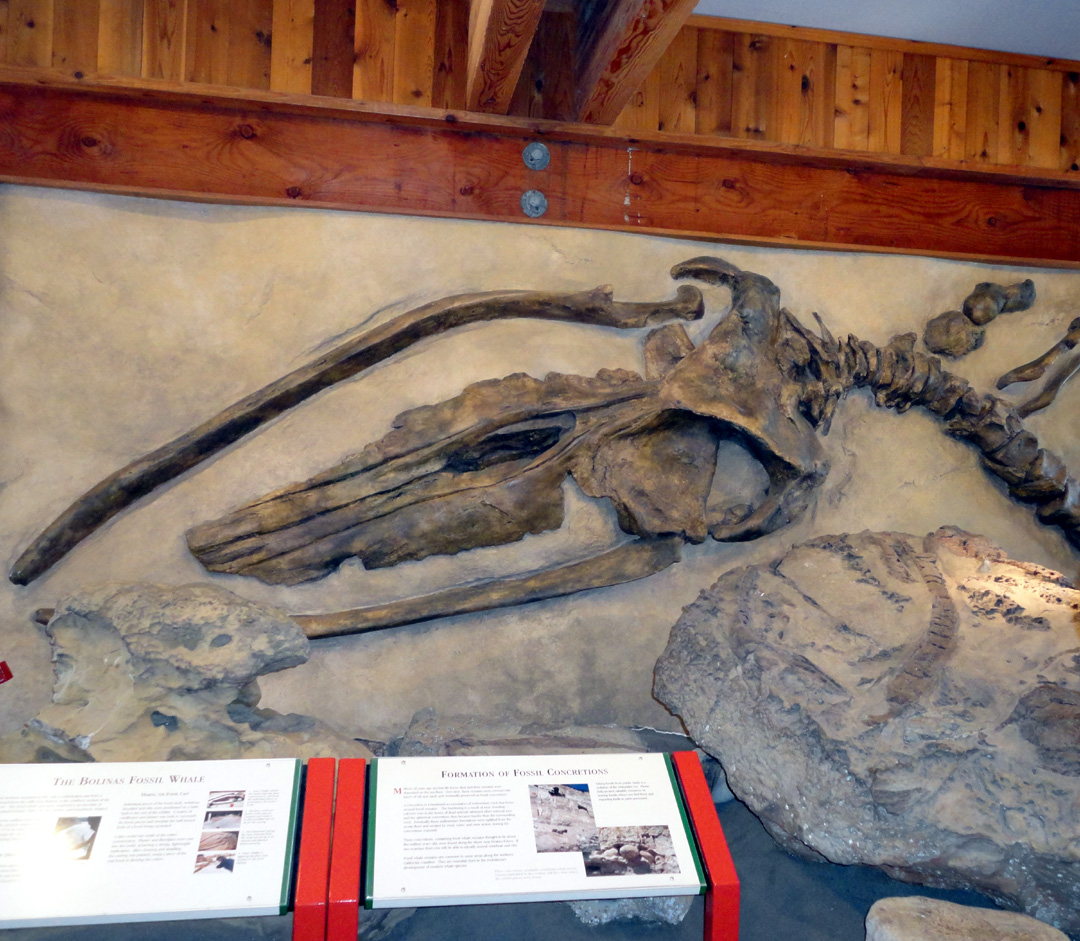
The exhibit at the Drakes Beach visitor's center showing the holotype skeleton of 
Parabalaenoptera baulinensis.

In 1973, a large mysticete skeleton was discovered by Carl Zeigler of the College of Marin, weathering out of cliffs near Bolinas in Marin County, California. Bolinas is a quaint artist community on the Marin County coast and has changed little since the 1960's and 70's; it is predominantly settled by ex-hippies, who generally don't like visitors from out of county, and have continually removed the exit sign for "Bolinas: 2 miles" off of highway 1, to the point where the California Dept. of Transportation (CalTrans) has given up putting up new signs. Tales abound of visitors with out of county or out of state license plates having car tires popped or vandalized, and nails and other tire-popping objects being intentionally laid out onto dirt roads in town. My car had a San Rafael Honda license plate holder, so I never had this problem.

The assembled holotype skull of Parabalaenoptera at California Academy of Sciences, photographed by fellow Otago Ph.D. student Felix Marx.

Exposed along the southern tip of Point Reyes is a unit formerly identified as the early late Miocene Monterey Formation; this was subsequently reevaluated after Domning (1978) suggested that sea cow fossils from the Bolinas locality were too derived to be from such an old unit. Afterwards, microfossils suggested a much younger age, closer to the Mio-Pliocene boundary (6-6.8 Million years old), and the formation was reidentified as the Santa Cruz Mudstone, which has only been mapped in Santa Cruz County.

Anterior view of Parabalaenoptera.
The fossil occurred in indurated, blocky mudstone, and was collected over a ten year period as the blocks incrementally eroded from the cliff. The lead authors - Gordon ("Gordie") Chan and Carl Zeigler of the College of Marin in Kentfield, and their field assistants - would have to travel over the hill and out to Bolinas (nearly an hour's drive through some of the windiest vomit-inducing roads in Northern California) on a monthly basis during the summer, and much more often during the winter during periods of intense erosion, and sometimes daily, anticipating falling blocks. After collection, the blocks were prepared, and some were glued together - but left as a series of blocks that could be lined up and assembled. The holotype was prepared at College of Marin, and eventually molded, casted, and donated to the California Academy of Sciences. Mounted casts of Parabalaenoptera baulinensis are currently on display at College of Marin in Kentfield and at the Drake's Beach visitor center at Point Reyes National Seashore. Sadly, before the paper could be published on the fossil - Carl Zeigler and Gordon Chan passed away. Chan passed away in 1996 of Lou Gehrig's disease; I could not find information on Zeigler, though I seem to recall hearing that he was killed by a drunk driver. Dr. Lawrence Barnes of the Los Angeles County Museum of Natural History finished the manuscript and brought it to publication in the California Academy of Sciences in 1997.

The braincase and vertex of Parabalaenoptera.
Parabalaenoptera baulinensis is a medium-sized balaenopterid with a 2.2 meter skull, slightly larger than minke whales (Balaenoptera acutorostrata; a 10 meter long whale with a 2m skull), but has a number of features that are too divergent to warrant inclusion within humpbacks (Megaptera) or Balaenoptera. These include the very elongate and somewhat swollen zygomatic processes, narrow intertemporal region (the skull is less 'telescoped than in modern balaenopterids), and extremely long and narrow nasal bones. The mandibles are strongly outwardly bowed like in Megaptera, and have an elongate coronoid process - somewhat like blue and fin whales (Balaenoptera musculus and physalus). Many of these features suggest that Parabalaenoptera baulinensis was capable of lunge feeding just like modern rorquals. It is additionally convergent with Balaenoptera musculus in having a supraorbital process of the frontal that is somewhat triangular and narrows laterally, whereas in Balaenoptera and Megaptera, the posterior and anterior margins are either parallel, or the posterior margin is perpendicular to the midline. Unfortunately, the holotype specimen is not preserved very well, and it appears that a significant amount of bone was accidentally removed or ground away during preparation, and details of the basicranium are almost totally indiscernible. Parabalaenoptera has been found in many phylogenetic analyses to be a stem-balaenopterid - in other words, a primitive member of the clade (family Balaenopteridae) that does not belong to the clade formed by humpback whales and modern species of Balaenoptera - the Megaptera + Balaenoptera clade, if you will. These two modern genera have been traditionally grouped into the "Megapterinae" and "Balaenopterinae" - Zeigler et al. (1997) even went so far as to name a new subfamily, the Parabalaenopterinae. However, given that none of these subfamilies have really shown to be stable or even consistent in cladistic analyses, it's unclear what the utility of such taxon names even is.

Reconstruction of the holotype skull and mandibles of Parabalaenoptera. Unfortunately, certain features (e.g. squamosal morphology) of the actual skull don't really look like how they're portrayed in this figure. From Zeigler et al. (1997).

Nevertheless, the description of Parabalaenoptera was a hallmark in balaenopterid paleontology; however, given the stagnated taxonomic situation of fossil balaenopterids, little else was published on fossil balaenopterids until Michelangelo Bisconti started revisiting Italian fossils starting in 2007. In the last five years, a number of informative balaenopterid finds have been described - but it is only the tip of the iceberg. Perusing late Miocene and Pliocene marine mammal assemblages in Museums, it is apparent that balaenopterids comprise nearly two-thirds of the more recent baleen whale fossil record (it is at least the case for California marine mammal assemblages). In California, at least four to five unpublished balaenopterids await description from the Pliocene alone. Additional fossils that may represent Parabalaenoptera - potentially a new and slightly younger species - have been collected from the Purisima Formation near Santa Cruz (and are in much better condition than the holotype). The future of balaenopterid paleontology is bright!

References

Bosselaers, M., and Post, K. 2010. — A new fossil rorqual (Mammalia, Cetacea, Balaenopteridae) from the Early Pliocene of the North Sea, with a review of the rorqual species described by Owen and Van Beneden. Geodiversitas 32:331-363. 

Deméré, T. A., Berta, A., and McGowen, M. R. 2005. — The taxonomic and evolutionary history of modern balaenopteroid mysticetes. Journal of Mammalian Evolution 12:99-143.


Domning, D. P. 1978. — Sirenian evolution in the North Pacific Ocean. University of California Publications in Geological Sciences 18:1-176.


Zeigler, C. V., Chan, G. L., and Barnes, L. G. 1997. — A new late Miocene balaenopterid whale (Cetacea: Mysticeti), Parabalaenoptera baulinensis, (new genus and species) from the Santa Cruz Mudstone, Point Reyes Peninsula, California. Proceedings of the California Academy of Sciences 50(4):115-138.


Friday, February 17, 2012

Coming soon: Oregon coast road trip with Kirk Johnson and Ray Troll

Later today, my wife and I will depart on a four day road trip along the Oregon coastline. We were invited several months ago for this trip by the dynamic duo, shortly after meeting them in person back in October. Kirk and Ray are putting together a new book as a sequel to Cruisin' the Fossil Freeway. The new book project is titled "Cruisin' the Eternal Coastline: the best of the fossil west from Baja to Barrow". The new book will cover all sorts of paleontological sites along the west coast, including Alaskan dinosaurs, the La Brea tar pits, Californian marine reptiles, the John Day fossil beds, and due in part to the coastal focus of their new project – the extremely rich and diverse marine mammal assemblage from the west coast.Kirk Johnson and I checking out a slab of the Concretionary Bed of the Purisima Formation near Santa Cruz, California. Photo courtesy Ray Troll.

An articulated baleen whale vertebral column sits in a multiton block in the foreground, with Kirk and I looking for smaller fossils in the distance. Photo courtesy Ray Troll.

Here I've spotted a baleen whale skull to show Kirk - I first spotted this specimen in 2002, and it's still there. It's in a 400 lb block, so it is likely not going to go anywhere for a while unless some heavy machinery is involved. Photo courtesy Ray Troll.

One of the most notable series of fossil localities are exposures of various strata in the Newport Embayment (a geological basin), including the Alsea Formation, Yaquina Formation, Nye Mudstone, and Astoria Formation. The eccentric, extraordinarily gifted, and tragic figure Douglas R. Emlong amassed an incredible collection of marine mammal fossils from this area and elsewhere in the Pacific Northwest during the 1960's and 1970's, prior to his premature death in 1980. One of the purposes of our trip is to visit several of Emlong's famed fossil localities as a pilgrimage of sorts, and pay homage to the great collector.

Douglas R. Emlong, with the partially prepared skull of USNM 215068, a male skull of the early walrus Proneotherium repenningi. Presumably this is during preparation in the Paleobiology Department at the Smithsonian Institution, during one of his visits to the east coast museum. From "The Ore Bin".

Previously, in October, I met up with Ray and Kirk when they were in California for a week. We took a day trip down to Santa Cruz where I showed them some fossil localities, and all in all had a rather nice day – although I didn't find a damn thing (thanks to there being little erosion over the prior 20 months). As it turns out, Ray and Kirk have increasingly been picking my brain for details on fossil marine mammals from the eastern North Pacific, and I am pleased and excited to help them with their project; most popular books on paleontology deal with dinosaurs, and very few have ever really touched the subject of marine mammals (Neptune's Ark by David Rains Wallace is an exception). Needless to say, I am very excited for their project to take off.

I found out that if the first fossil locality you go to is kind of ugly and has few fossils (but used to have a lot...), Ray Troll will make you pose with the crappiest fossil you find and a bunch of garbage he finds laying about. Included is a toothbrush, a cardboard mayan calendar, a random photo album (yes, we looked through it) and some other odds and ends; I'm pointing to a rather unassuming scrap of sea cow (Dusisiren jordani) bone. True story.

Tuesday, December 27, 2011

October pinniped excavations

Dick Hilton and I excavating a pair of fur seal (Thalassoleon) dentaries from the base of the cliff.

A famished yearling California Sea Lion on the beach.

The weekend before the annual meeting of the Society of Vertebrate Paleontology in Las Vegas, my wife and I joined Dick Hilton from Sierra College for what we assumed would be a routine visit to the Purisima Formation at Point Reyes. We drove up on a Friday night, and cooked hot dogs at the campground with Dick, and set up our tent for the weekend. The following morning, we set out along the shoreline, and within five minutes, found what appeared to be a pinniped skeleton. Since we wanted to get on to more prosperous localities further down, we left it there with the intention of digging it up the following day (Sunday).
My wife pointing to something tiny she is proud of finding...

It's a beautiful fur seal (Thalassoleon) molar! She has a real eye for finding things like tiny pinniped and shark teeth, which is why I keep her around.

Dick Hilton trying to explain something to my wife and I. At least I hope he was talking to my wife, because it sure looks like I wasn't paying attention.

As we headed further on down to the good section of shoreline, I found a well preserved porpoise earbone (petrosal), and a few other odds and ends. Not too long afterward, and nearly at the same time, Dick spotted a couple bones eroding out with an associated tooth, and my wife spotted a well preserved fur seal tooth (Thalassoleon), only a few meters away. It took us the better part of an hour to dig the bones up – which turned out to be a pair of associated fur seal dentaries! Unfortunately, neither specimen had any cheek teeth, but one did have a broken canine. Either way, only the middle chunk of the dentary is preserved in the holotype of Thalassoleon macnallyae (from the same locality), and these are the most complete and well preserved jaws of this taxon now known. We hiked down the beach a little further, and collected a couple of pinniped limb elements – a proximal end of a tibia, and a metatarsal. After collecting these, we headed back towards the cars. On our way back, I spotted a string of a dozen articulated pinniped vertebrae – a second skeleton we would have to excavate the following day.

A cast of the holotype skeleton of Parabalaenoptera baulinensis on display at the visitor center.

For comparison, there is also a skeleton of an adorably tiny (~15 feet long) minke whale (Balaenoptera acutorostrata) on display as well.

My wife examining some baleen (presumably from a balaenopterid) at the visitor center.

We also finally had a chance to visit the visitor’s center; previously, I had always been there on a weekday, when the center was closed. I was particularly excited to check it out because it has one of the only known casts of the holotype skeleton of Parabalaenoptera baulinensis (which was excavated from the Santa Cruz Mudstone at a nearby locality) on display – there is one other, but it is at the College of Marin in Kentfield, and is falling apart and badly needing repairs.

My wife decided she was done, and decided to spend the day reading A Game of Thrones on the beach and napping and taunting birds all day.

On the second day, we spent about seven hours excavating the first pinniped skeleton, which resulted in about 100 pounds of tin-foil jackets. This skeleton is probably of a large fur seal or small walrus, and the skeleton was completely disarticulated; as soon as we were close to removing one bone, another would be under it, or behind it. There were probably about two dozen or so bones in the cliff that we excavated. At about 4 in the afternoon, we wrapped up the first excavation, and walked down the beach to relocate the articulated skeleton. It took a while to relocate it, but as soon as we did, we started excavating it in a large block. Thanks to the specimen being articulated, we were able to finish this excavation in a little over an hour. Once we got back to the car, we loaded up nearly two hundred pounds of fossils we had collected in only two days in the field; furthermore, the most ridiculous aspect of the weekend was that by weight, cetacean fossils comprised less than 1% of our haul (only one specimen). For the uninitiated – pinniped fossils are relatively rare, and my master’s thesis sample of specimens indicates that there is a 4:1 ratio of cetacean fossils to pinnipeds, and that pinnipeds constitute only 8% of the marine vertebrate assemblage from the Purisima Formation at Santa Cruz. To collect a pair of associated dentaries, a tooth, a couple of associated hindlimb bones, and two skeletons (one being articulated) all in one weekend – is surprising, and tripled the number of major pinniped finds I’ve made. I’ll post some updates when some of this material gets prepared.

She nearly got this gull to come to her backpack. Sorry, no pictures of the pinniped excavation.

Monday, September 5, 2011

A new specimen of Parapontoporia

Last fall I made a couple posts detailing an excavation (here and here) of a new odontocete skull from a relatively young (middle-late Pliocene) horizon in the Purisima Formation. This specimen was collected over a six hour period, and the excavation was pulled off and completed just before sunset. The specimen is still not completely prepared, but it does include a complete braincase, the posterior half of the rostrum, both petrotympanics (articulated petrosal and tympanics), and part of one of the lower jaws.

The new skull of Parapontoporia sternbergi in oblique dorsolateral view; bottom photo is labeled.

Three species of Parapontoporia have been described: Parapontoporia pacifica, from the late Miocene Almejas Formation in Baja California, Parapontoporia sternbergi, from the Pliocene San Diego Formation, the Mio-Pliocene San Mateo Formation, and possibly from the Pliocene Wilson Grove Formation, and of course, Parapontoporia wilsoni from the Mio-Pliocene Purisima Formation. Most of the Purisima material is referable to P. wilsoni, which is characterized by a very deep "basin" at the base of the rostrum (shown poorly in the photo below) and by a facial region that is longer than it is wide. P. sternbergi has a shallower basin, and has a facial region wider than it is long (and also appears to me to be smaller in general; P. wilsoni crania can be up to 20% larger than those of P. sternbergi). P. pacifica is not known from a complete braincase, and it has a flat base of the rostrum (i.e. no rostral basin). The new specimen exhibits a shallow rostral basin, and has a braincase that is wider than long, and is damn tiny - all suggesting that it is assignable to Parapontoporia sternbergi rather than P. wilsoni. "But the Purisima Fm. species is Parapontoporia wilsoni!", you might say. Just like modern cetaceans, fossil cetaceans likely had a cosmopolitan distribution - and Parapontoporia sternbergi is primarily known from late Pliocene rocks (specimens identified as P. sternbergi from Miocene strata should probably instead be called Parapontoporia sp.). The type locality of P. wilsoni is about 5.3 Ma, slightly older than the San Diego Fm. Likewise, the new specimen from the Purisima is from a horizon about 10 meters below an ash bed dated at 3.35 Ma, and therefore probably late Pliocene also.

Parapontoporia sternbergi, the most completely known species within Parapontoporia, exhibits an extremely elongate rostrum, filled with about 80 teeth per quadrant; that's a total of 320 teeth. I don't know the specifics for other toothy odontocetes (such as Eurhinodelphinids), but this strikes me as being a terrifyingly large number of teeth for a mammal, and I would not be surprised if Parapontoporia was the toothiest of all mammals. Additionally, the skull of parapontoporia is asymmetrical, unlike Pontoporia and more like the now extinct chinese river dolphin Lipotes. Parapontoporia was obviously named because it is closely related to the La Plata River Dolphin, Pontoporia, right? Right? Believe it or not, this new specimen weighs in on the phylogenetic relationships of Parapontoporia.

A reconstruction of a nearly complete skull from the San Diego Formation referred to Parapontoporia sternbergi by Barnes (1985).


The holotype of Parapontoporia wilsoni from the Purisima Formation.

When Larry Barnes published is major study of Parapontoporia in 1985 (the year I was born...), there were no skulls of Parapontoporia with associated earbones. Because of the similarity of Parapontoporia to modern river dolphins like Pontoporia and Lipotes, he looked through museum collections and tried to identify possible petrosals that could be referred to this new taxon. Oddly enough, one set of six petrosals from the San Diego Formation appeared very similar to modern Lipotes, although Barnes felt that the skull was more similar to Pontoporia.

Isolated petrosals from the San Diego Formation referred to Parapontoporia sternbergi by Barnes (1985).

Because of this discrepancy, there has been some disagreement (not in the published literature - in discussion only) about what the real petrosal of Parapontoporia looks like. At a UCMP visit once, Nick Pyenson showed me another petrosal which he felt might be a better match than the ones Barnes referred. This is a fairly serious matter, because these isolated petrosals have been used in various cladistic analyses to fill in the data matrix - and given the key phylogenetic position of Parapontoporia as a sister taxon to Delphinoidea - means that if the petrosals are not in fact from Parapontporia, there could be some serious errors in previously phylogenetic studies.

The petrotympanic complexes of the new Purisima Formation specimen of Parapontoporia sternbergi in dorsal/cerebral aspect.

The petrotympanic complexes in (near) ventral aspect.

This specimen is the first skull of Parapontoporia with well-preserved petrotympanic complexes associated with it. These petrosals are identical to those referred to this taxon by Barnes (1985), and confirm his referral. Interestingly, this also confirms the Lipotes-like morphology of the earbones. Previous cladistic analyses (e.g. Muizon 1988) have resulted in Parapontoporia being the sister taxon to Lipotes rather than Pontoporia, and several authors have suggested such a relationship, despite the hand-drawn cladogram and assertions of Barnes (1985). This new find indicates the Lipotes-like ear morphology does belong to Parapontoporia.

Petrosals of A) Inia, B) Pontoporia, and C) Lipotes.


Another Purisima Fm. skull of Parapontoporia wilsoni with a petrotympanic complex, in a private collection.

I'd be lying if I said that this were the first specimen ever found with petrosals and tympanics; two other specimens are known. One is a specimen of Parapontoporia pacifica from the Capistrano Formation at the San Diego Natural History Museum, which has a crushed tympanic and petrosal. The other specimen is also from the Purisima Formation, shown above, but has been unavailable for study. The petrosal is barely exposed and stuck within the concretion. This specimen remains in a private collection. This no longer bothers me, as the new specimen has both petrotympanics fully freed from the skull, and one of which has already been CT-scanned at UT Austin for a study by Manuel Martinez and Jonathan Geisler (among other authors, which I am dead last for this minor contribution). Look out for it at SVP!

References and further reading:

BARNES, L. G. 1984. Fossil odontocetes (Mammalia: Cetacea) from the Almejas Formation,
Isla Cedros, Mexico. Paleobios 42:1–46.

BARNES, L. G. 1985. Fossil pontoporiid dolphins (Mammalia: Cetacea) from the Pacific coast
of North America. Contributions in Science, Natural History Museum of Los Angeles
County 363:1–34.

FORDYCE, E., AND C. DE MUIZON. 2001. Evolutionary history of cetaceans: a review. Pages
169–233 in J. -M. Mazin and V. de Buffrenil, eds. Secondary adaptation of tetrapods to
life in water. Verlag Dr. Friedrich Pfeil, Munich, Germany.

GEISLER, J. H., AND A. E. SANDERS. 2003. Morphological evidence for the phylogeny of
Cetacea. Journal of Mammalian Evolution 10:23–129.

MUIZON, C. de. 1988. Les relations phylog`en´etiques des Delphinida (Cetacea, Mammalia).
Annales de Paleontologie 74:159–227.

PYENSON, N. D. 2009. Requiem for Lipotes. Marine Mammal Science 25:714-724.

Tuesday, August 9, 2011

Recent fieldwork in the Purisima Formation, Part 2: a possible new species of Herpetocetus?

Back in late May, Dick Hilton (Sierra College) and I did a three day field trip collecting fossil vertebrates from a locality in the Purisima Formation I recently got a permit for. On the second day, excavated a large block of sediment with what I assumed at the time were sirenian bones. I had not seen the bones except in cross section, and because they were somewhat dense, I thought they might be from a sea cow. We quickly carved out a large block, and due to the cohesive nature of the sediment, we were able to wrap it in tinfoil and duct tape. It was one of the first finds of the day, and I thought there could definitely be something neat inside. Because we were only a half mile from the cars, I left my pack with Dick and hoofed it back to the car with the thirty pound block, and also to grab some gatorade I had left in my car. When I returned, Dick was taking a siesta, and after some lunch, we headed further down the beach. Only a few hundred feet down I spotted a distinctly potato-shaped thing sticking out next to a piece of bone: it rather looked to me like a tympanic bulla, and I climbed up a bit to check it out. It was in fact a tympanic, and when the rest of the piece came out, I was able to see that it was in fact a nearly complete squamosal, complete with the bulla and posterior process of the petrosal. Dick and I thought the trip had been a success just because of this specimen, especially because it was from a section of cliffs where neither of us expected to find anything.

Dick Hilton digging up a huge baleen whale tympanic.

I couldn't have been more wrong. Unfortunately, I didn't know that I was until after the SATLW (Aquatic Tetrapods) conference. I did have a day or two before the conference to prepare the squamosal, and it did indeed have a plug-shaped posterior process of the petrosal, indicating it belonged to the Herpetocetinae, which includes Herpetocetus, Nannocetus, (probably) Piscobalaena, and Cephalotropis (according to Steeman, 2007). After the conference, I opened up the duct taped jacket and began preparation. After a couple hours the exposed pieces were still not making sense, and then I found a couple of bones that looked like they were adjacent to one another. When I removed them, there was a tiny neck of bone connecting them – and after a little more preparation, I realized it was a Herpetocetus petrosal and posterior process. Damnit, another goddamn Herpetocetus.

The petrosal and posterior process of the new specimen, with the facial nerve canal labeled. Upper left is ventral, lower left is dorsal, and right is medial view.

The skull with (partially incorrectly) articulated petrosal of the new skull in dorsal (top) and ventral (bottom) views.

Once I had enough of the block prepared, I realized I had quite a bit of the ventral portion of a small braincase preserved. It includes both exoccipitals, one occipital condyle, the basioccipital, the right squamosal, and the complete petrosal. After preparation, the petrosal is most similar to petrosals of Herpetocetus. This may be a bit technical, but herpetocetine baleen whales have several peculiar features that define them as a group. The posterior process of the petrosal – which is typically an elongate strap of bone that connects with the skull posteriorly – is very short and plug-shaped in these animals. Additionally, the posterior process (which is rarely found attached in isolated fossil mysticete petrosals) is flat and contributes to the lateral side of the skull, instead of being 'hidden' in a trench between the squamosal and exoccipital bones. Secondly, some herpetocetines have a flattened anterior process that is blade shaped; this structure is typically conical and robust or knoblike in most other mysticetes. Clearly, this specimen exhibits both of these features. Additionally, Herpetocetus spp. exhibit a large triangular flange on the side of the bone, which overhangs the squamosal – also present in this specimen. Additionally, herpetocetines all have extremely small earbones relative to most mysticetes. Unfortunately, the neck of the posterior process appears to have been deformed slightly, and when the main portion is articulated correctly, the posterior process sits in its trough a little wonky, and when the posterior process is articulated correctly, the main portion doesn't articulate well.

The posterior process, squamosal, and tympanic of Herpetocetus bramblei.

The two alternate articulations of the petrosal showing correct articulation of the posterior process (left) and correct articulation of the body of the petrosal (right).

The temporal region of the skull of Herpetocetus bramblei with the petrosal outlined in red.

However – it shows several features that differentiate it from all species of Herpetocetus as well as other herpetocetines like Nannocetus and Piscobalaena. Firstly, the anterior process is medially oriented – it is usually anteriorly facing instead. Second, the posterior process is very transversely narrow and elongate – it is typically more nearly circular in other species. Lastly, the most bizarre feature is that it has a very long anterior fissure of the facial nerve canal which is contorted into an S-shape – something I have not seen in any mysticete, fossil or modern.

Various mysticete petrosals in ventral view, showing two fossil rorquals (Plesiobalaenoptera and Balaenoptera sursiplana), a modern balaenid (Eubalaena japonica), the new specimen, and two other Herpetocetus specimens.

This is pretty exciting, and I am looking forward to preparing the other specimen, which includes part of a squamosal and a tympanic, and most likely a petrosal. It should not be too difficult to get these specimens written up and described.

Further Reading

Geisler, J. H. & Luo, Z.-X. 1996. The petrosal and inner ear of Herpetocetus sp. (Mammalia: Cetacea) and their implications for the phylogeny and hearing of archaic mysticetes. Journal of Vertebrate Paleontology, 70, 1045–1066.

Steeman, M.E. 2007. Cladistic analysis and a revised classification of fossil and recent mysticetes. Zoological Journal of the Linnean Society 150:875–894.

Steeman, M.E. 2010. The extinct baleen whale fauna from the Miocene-Pliocene of Belgium and the diagnostic cetacean ear bones. Journal of Systematic Palaeontology 8:63-80.

Whitmore, F.C., and L.G. Barnes. 2008. The Herpetocetinae, a new subfamily of extinct baleen whales (Mammalia, Cetacea, Cetotheriidae). In C.E. Ray, D.J. Bohaska, I.A. Koretsky, L.W. Ward, and L.G. Barnes (eds.). Geology and Paleontology of the Lee Creek Mine, North Carolina, IV. Virginia Museum of Natural History Special Publication 14:141–180.

Tuesday, March 29, 2011

Fossil Fur seals from Northern California, part 2: The Gilmore Fur Seal

In 1948, Gretchen Burleson published a short article on some fossil pinniped jaws discovered in the Pliocene San Diego Formation, a sandstone mollusk-bearing unit that forms the hills of the San Diego area. These were some of the earliest pinniped fossils to be described from California - previously only a handful had been described, including the strange phocoid Allodesmus from the Sharktooth Hill Bonebed near Bakersfield, California, the woefully incomplete walrus (then assumed to be an otariid) Pliopedia pacifica from the Kettleman Hills, the hopelessly squashed fur seal Pithanotaria from Santa Barbara, and the even stranger Dusignathus santacruzensis from Santa Cruz.

All of these creatures were assumed then to belong to sea lions: most of them were large, and relatively robust, and differed markedly in many respects from true seals. Most of the early descriptions of pinnipeds we now know to be walruses are se
emingly obsessed with comparing them to sea lions, and no doubt early workers such as Kellogg were frustrated with the alien nature of many of the fossils: they were about the same size as sea lions, but there were just so many little differences. The answer would not come until much later when decidedly modern researchers like Charles Repenning realized the true walrus affinities of many of these critters (like Pliopedia and Dusignathus).

Unlike the rather large and aberrant jaws of Allodesmus kernensis and Dusignathus santacruzensis, the fossil jaws from San Diego looked like a perfect match for a modern sea lion or fur seal: it had a shallow jaw with small triangular cuspate teeth, and the jaw was rectangular (i.e. the dorsal and ventral margins are parallel). The larger jaws o
f other better known pinnipeds had too many specialized features to be ancestral to sea lions: Dusignathus had widely flaring jaws without incisors and a canine that projected anteriorly, while Allodesmus lacked cusps on its postcanine teeth, which looked instead like little onions or bulbs. Burleson (1948) assigned these specimens to Pithanotaria, despite the much older age of Pithanotaria starri material described by Kellogg (1922) and the lack of actual morphological characters that identified the jaw of Pithanotaria. Burleson (1948) thought this specimen had a morphology intermediate between Pithanotaria and the modern Northern Fur Seal, Callorhinus.

Skull and dentition of a modern female Callorhinus ursinus, showing
single rooted, cuspate teeth.

In a much later paper by the preeminent paleo-pinnipedologist Charles
Repenning and carnivoran researcher Richard Tedford (1977), this specimen was briefly discussed and they concluded that it did not represent Pithanotaria and was likely much closer to Callorhinus ursinus. After observing trends within the dental evolution of walruses like Imagotaria, Repenning and Tedford (1977) had identified the utility of the stage of root fusion as a taxonomic guide. For example, all modern otariids (fur seals and sea lions), the walrus, and some seals have single rooted teeth, while primitive pinnipeds and terrestrial carnivorans retain a number of double and triple-rooted teeth. For whatever reason, these root lobes coalesced through time and resulted in single rooted teeth in a number of taxa.

The dentary of the holotype of Callorhinus gilmorei, from Berta and Demere 1986.

Repenning and Tedford (1977) were surprised that Burleson (1948) had not noticed the interesting configuration of the tooth roots of this specimen: the third and fourth premolars and the molar were still double rooted, while only the first and second premolars were single rooted; in the modern Northern Fur Seal, Callorhinus ursinus, all the lower
premolars and molar are single rooted. It was indeed a fur seal, but retained some interesting primitive features.

In 1986, after an extensive excavation of a bonebed in the San Diego Formation that would be christened the Mission Hills Bonebed, additional remains of this fossil pinniped were discovered including several jaws, teeth, skull fragments, and postcranial bones
. The discovery of a partial skeleton of an immature female skeleton allowed Annalisa Berta (San Diego State University) and Tom Demere (San Diego Natural History Museum) to describe the San Diego fur seal as a new species - and sure enough, they found that its features placed it as a close relative of the modern Northern Fur Seal, Callorhinus. They named it Callorhinus gilmorei, named after Dr. Raymond Gilmore. In other regards, Callorhinus gilmorei was a relatively small fur seal - substantially smaller than modern skeletal remains, with less strongly developed cusps on postcanine teeth, and a more 'primitive' state of root fusion.
The new specimen of Callorhinus gilmorei from the Rio Dell Formation of Northern California described by Boessenecker (2011)

Subsequently, Kohno and Yanagisawa (1997) reported a tiny partial jaw from the late Pliocene of Japan. This jaw exhibited double rooted cheek teeth (although the anterior premolars were not preserved), and had accessory cusps on the cheek teeth, so they identified it as Callorhinus gilmorei. This extended the range of the Gilmore fur seal to the western Pacific - similar to the range of the modern Callorhinus ursinus.

Needless to say, I had a few ideas to follow once I started looking into Bushell's fur seal specimen. Fossils of C. gilmorei had so far only been found in Middle to Late Pliocene deposits, whereas in the late Miocene and earliest Pliocene of Japan, California, and Mexico the earlier fur seal Thalassoleon occurred (which has all double rooted teeth, and lacks cuspate cheek teeth, among other differences). The new specimen only has one cheek tooth - but it has a well developed accessory cusp, like C. gilmorei, and the first two premolars are both single rooted - also like C. gilmorei. In addition, it is relatively small - many other modern otariids are substantially larger. Furthermore, C. gilmorei appears to be the only middle-late Pliocene otariid in the entire Northeastern Pacific fossil record, which made the identification process somewhat easier.

Next up: Other fossil otariids from California and Oregon, and the Pleistocene Callorhinus
specimen.

References:

Berta, A., and T. A. Demere. 1986. Callorhinus gilmorei n. sp., (Carnivora: Otariidae) from the San Diego Formation (Blancan) and its implications for otariid phylogeny. Transactions of the San Diego Society of Natural History 21:111–126.

Boessenecker, R.W. 2011. New records of the fur seal Callorhinus (Carnivora: Otariidae) from the Plio-Pleistocene Rio Dell Formation of Northern California and comments on otariid dental evolution. Journal of Vertebrate Paleontology 31:2:454-467.

Burleson, G. L. 1948. A Pliocene pinniped from the San Diego Formation of southern California. University of California Publications in Zoology 47:247-254.

Kellogg, R. 1922. Pinnipeds from Miocene and Pleistocene deposits of California. University of California Publications, Bulletin of the Department of Geological Sciences 13:23–123.

Kohno, N., and Y. Yanagisawa. 1997. The first record of the Pliocene Gilmore fur seal in the Western North Pacific Ocean. Bulletin of the National Science Museum, Tokyo 23:119–130.

Repenning, C. A., and R. H. Tedford. 1977. Otarioid seals of the Neogene. US Geological Survey Professional Paper 992:1–87.

Saturday, March 26, 2011

Fossil Fur seals from Northern California, part 1: discovery

Earlier this week saw the publication of my third article, concerning fossil fur seals of the genus Callorhinus from the Pliocene and Pleistocene of Humboldt County in Northern California. This paper has been in the works since 2006; I presented a poster on this topic at SVP in 2007. I did some of the initial research in 2006 and 2007, and after my SVP poster, I tried a couple more drafts of the manuscript - but it, along with a couple of other projects, fell by the wayside until I started graduate school. It wasn't until I had the herpetocetine jaw paper off my plate that I returned to this project, and in may of last year I submitted my completed MS to the Journal of Vertebrate Paleontology after three years of intermittent research.

The first page of Boessenecker (2011)

The story really starts in 2004. My buddy Ron Bushell, who helped me identify many of my fossils when I was still in High School, was collecting at a fossil site in Humboldt County, California. At this particular locality, he was looking for large concretions from the Rio Dell Formation which occasionally bear beautiful scallops (Patinopecten) the size of dinner plates, and incredible 6-10" long gastropods.

Ron and his collecting partners walked down the riverbank looking for nodules bearing mollusks, and thought he had hit the jackpot when he found a large nodule, about 2 feet in diameter, just sitting there in the gravel bar. Now, Ron is an experienced nodule collector - he's spent a lot of time collecting nodules with mollusks from the Pliocene and Pleistocene of Humboldt County, and Eocene crabs from Oregon and Washington.

So, if you're a nodule collector, naturally you take out a sledge hammer and attempt to destroy the concretion. Many concretions have nothing in them, and it is better to crack them in the field rather than lug them home and find out later (at some crab localities, Ron knows well enough which concretions will have crabs, and which ones won't, and packs them all out, and cracks them in his garage). Well, he broke this concretion open, and instead of white shells being exposed, familiar (but much rarer) brown fragments flew out onto the river bank - he immediately knew that he had found bone.

Initial preparation of the Bushell specimen.

Normally, Ron would keep any vertebrate fossils from this locality, due to their rarity. However, he also noticed a tooth fragment - and he knew he had found something pretty important. So, just like any crab or mollusk fossil, he collected all the pieces, took them home, and glued them all together in his garage, and begun airscribing the fossil.

Continued preparation of the Bushell specimen.

As it turned out, Ron had found two associated lower jaws (left and right) of a small fur seal, preserved beautifully in relief in a large concretion. He posted these photos on the old "Collecting fossils in California" forum, and I was very interested once I saw it. After a few emails, he offered to let me study the specimen - an opportunity I was most excited for.

Finished preparation of the Bushell specimen.


The Bushell specimen as it was when I first saw it.

The following summer, my fiancee (then girlfriend) and I drove out to California for the summer, but took a detour through Oregon and Humboldt County in order to visit Ron and pick up this beautiful specimen. Thanks to Ron's generosity, this fossil was made available to study - and now (finally, five years later) Ron's wish that it be studied finally culminated in my paper in the Journal of Vertebrate Paleontology.

Next up - introduction to the "Gilmore Fur Seal", Callorhinus gilmorei.

Boessenecker, R.W. 2011. New records of the fur seal Callorhinus (Carnivora: Otariidae) from the Plio-Pleistocene Rio Dell Formation of Northern California and comments on otariid dental evolution. Journal of Vertebrate Paleontology 31:2:454-467

Saturday, February 26, 2011

New artwork II: 'rediscovered' specimen drawing

About two months ago, I was cleaning off my desk and found a sheet of vellum paper with an old specimen drawing I had done. This drawing was is of a pair of associated dentaries of the Pliocene fur seal Callorhinus gilmorei. I first presented on this fantastic specimen on my 2007 SVP poster at the Austin, TX meeting.


Unfortunately, I discovered this about three months after my manuscript describing this fossil was accepted in JVP, and there was no way to include it in the published article. To be honest, I could probably do better now, but I think it turned out reasonably well for a journal article figure. In the future I'm going to do a lot more technical illustrations of individual specimens, partly as practice, but also to showcase myself.

Stay tuned! The article will be published in the March 2011 issue of JVP: that's sometime in the next couple of weeks. (Holy god, it's March in only 48 hours!). More artwork is on its way.

Boessenecker, R.W. In Press. New records of the fur seal Callorhinus (Carnivora: Otariidae) from the Plio-Pleistocene Rio Dell Formation of Northern California and comments on otariid dental evolution. Journal of Vertebrate Paleontology 31:2. 14pp.