While I was in Montana enjoying my first christmas vacation with my in-laws, I got an email with an attached pdf of a new paper that had just been published. I had expected quite a bit of time to get some work done -after all, my wife and I were up there for a week and a half and her parents would be at work much of that time - and the weather was too poor to go and do anything outside. I had already expected to get some reading and writing done, so I was pleased to hear of the new publication. Once I saw the title page, though, I was immediately skeptical, and indeed - my skepticism did not go away once I was finished with the article. The title of the article was "The world’s oldest fossil seal record", and the abstract indicated that an Eocene seal - not just any pinniped, but a phocid seal - had been discovered in Germany. I was not familiar with the author, Cajus Diedrich, whose previous work has focused on other groups (Pleistocene carnivores, Triassic marine reptiles) - but I did remember reading an article by him revising placodont (you remember, those funky sauropterygian marine reptiles with big crushing teeth) paleoecology, suggesting that most placodonts were Triassic analogs of sea cows.

The skeleton of the dawn seal, Enaliarctos - the oldest known
bona fide pinniped. From Berta et al. (1989).
bona fide pinniped. From Berta et al. (1989).
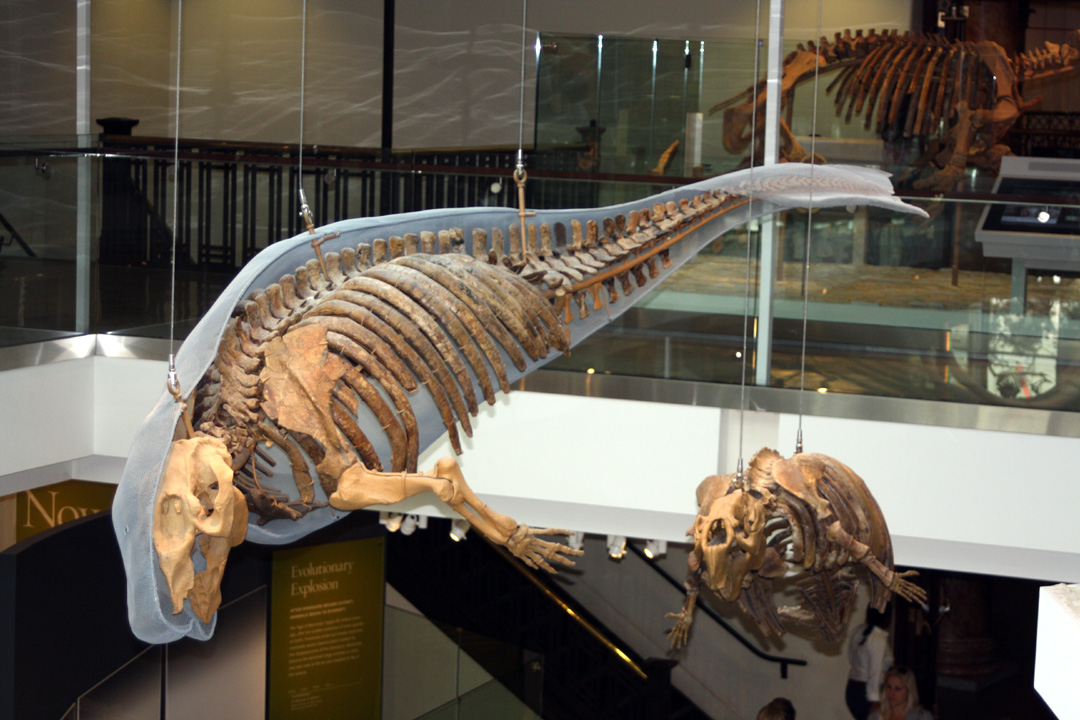
Before I go any further, I should summarize why exactly one should be skeptical of an Eocene pinniped. For starters, the majority (either by taxa or number of specimens, ~99%) of fossil pinnipeds are from the Miocene or younger strata. There are a handful of bona fide pinnipeds from the late Oligocene, though, which are represented by skulls. These include Enaliarctos tedfordi from the Yaquina Formation of Oregon (~28-25 Ma), and Enaliarctos barnesi from the uppermost Yaquina Formation or lowermost Nye Mudstone (~26-23 Ma, also Oregon). There are a bunch of other species of Enaliarctos known from the early Miocene and roughly 20-25 Ma in age, including Enaliarctos emlongi from near the Nye Mudstone-Astoria Formation contact in Oregon, Enaliarctos mitchelli (early Miocene Jewett Sand of California and Nye Mudstone of Oregon), and Enaliarctos mealsi from the Jewett Sand. Slightly younger fossil assemblages from the Astoria Formation, further upsection in the Newport Basin of Lincoln County, Oregon, show a mix of "enaliarctine" pinnipeds (Pteronarctos, Pacificotaria), two species of Desmatophoca, an early 'allodesmine', and the dawn walrus Proneotherium (Barnes, 1989; 1990; 1992; Barnes and Hirota, 1995; Kohno et al., 1995). Note that during the early Miocene in the North Pacific, yes - pinnipeds first start to diversify and different groups (e.g. non-"enaliarctines"), but most of these are either "enaliarctines", members of a wholly extinct clade (Desmatophocidae), or extremely archaic and "enaliarctine"-like members of extant clades (Proneotherium).

The femur of the dawn seal, Enaliarctos. This is Enaliarctos emlongi
from Oregon. From Berta (1991).
from Oregon. From Berta (1991).
In other words, there aren't any crown-clade pinnipeds anywhere close to the Oligo-Miocene boundary. In the North Atlantic, the oldest known pinniped with diagnostic remains is Leptophoca from the middle Miocene Calvert Formation of Maryland, crania of which were described by Koretsky (2001). In fact, this is the oldest bona-fide and widely accepted record of fossil phocids. Irina Koretsky and Al Sanders published a paper in 2002 about partial fossil femora reputedly from the late Oligocene of South Carolina (I have discussed these specimens elsewhere). To summarize - these fossils are roughly 10 Ma older than Leptophoca and were presented as being 1) the oldest fossil phocids, and 2) evidence for pinniped diphyly. For the uninitiated, there have been several morphological hypotheses for pinniped evolution, and the diphyletic view states that true seals (Phocidae) are related to mustelids/musteloids, and sea lions (Otariidae) and walruses (Odobenidae) form a monophyletic clade (Otarioidea) and share a common ursid-like ancestor, having adapted to water separately from phocids. I won't go into it now, as the Eocene seal is totally separate from diphyly/monophyly. There are several problems with Koretsky and Sanders (2002) - 1) they did not examine femora of other Oligocene terrestrial mammals, and 2) the stratigraphic provenance of those specimens are questionable (see here for more on this). To summarize: late Oligocene pinnipeds consist of only a few diagnostic fossils from the North Pacific, and modern "family" level clades do not appear until a ways into the Miocene.


The femora of the alleged Oligocene seal. From Koretsky and Sanders (2002).
Phew, now that the introduction is done, I can talk about the paper. Diedrich (2011) published a partial, proximal femur fragment (just like Koretsky and Sanders 2002), from the Fürstenau Formation of Northern Germany, which is a Lutetian age shallow marine unit deposited on the southern margin of the pre-North Sea basin, roughly 45-49 Ma in age. So, we're not even talking latest Eocene and bordering on Oligocene - this is early middle Eocene, about 5 Ma before basilosaurids show up, just before protocetids evolve. The fossil itself is phosphatized and exhibits several borings, is missing the distal end, and has clearly been reworked (for the uninitiated: phosphatization can only occur on bones or sediment below the sediment-water interface, so a bone that is both phosphatized and abraded or polished by default has been reworked). It does look remarkably phocid-like: it lacks a fovea capitis for the teres ligament - a little pit on the femoral head. It also appears to genuinely lack a lesser trochanter (as opposted to being abraded or broken off) and is very anteroposteriorly flattened. All of these features are phocid or pinniped characteristics; the lack of a fovea capitis is a probable pinniped synapomorphy (Berta and Wyss, 1994). A lesser trochanter is absent in all modern and fossil phocids and the modern walrus, but present in all fossil walruses and modern and fossil otariids. Interestingly, these are all the same features listed by Koretsky and Sanders (2002) to identify their femora from the Oligocene of South Carolina. I'm not sure that erecting the name Praephoca bellunensis for this fragment of an element with dubious diagnostic utility was prudent.
 The holotype femoral fragment of Praephoca bellunensis, the alleged
Eocene seal. From Diedrich (2011).
So far so good. When oddball fossils like this crop up - ones that just smell fishy - the best thing to do is to see if something could have gotten seriously screwed up between it leaving the ground and entering the annals of a journal. Reading the Materials and Methods, it goes through a long description of the large excavation conducted at Dalum, Germany, where the Fürstenau Formation is exposed. Buried toward the end of the Materials and Methods section, I found this:
"The femur illustrated in Figure 2 was actually found was actually found in these gravels during the 1980s, and has prompted a major program seeking to understand the biodiversity of marine vertebrates in Europe during the Eocene, in relation to that of the terrestrial vertebrates. This femur, together with all material from the 2011 excavations, is housed in the Shark Center at Bippen (SCB) in northwest Ger-many, a public visitor center and museum in the UNESCO- supported “Geo and Naturpark TERRA. Vita”."
So, it sounds like this started with the discovery of the fossil femur 25-30 years ago, and then the excavation was undertaken in May 2011. Who collected the fossil originally? I just don't know. Whoever it was - especially if was an amateur collector unfamiliar with local stratigraphy - do we know that they were able to positively remember the exact locality and horizon at which the fossil was collected? 25-30 years is a long time - and people often have unreliable memories, which is why most scientists can't afford to not write important things down. I have also met collectors who have admitted to intentionally making misleading statements to researchers about the locality and provenance of certain specimens, and I've met collectors who can't remember what they collected last week. To be clear, I know many collectors who know local stratigraphy very well and remember the exact location, time, date, etc. of a fossil collection. The same variable quality of memory exists within paleontologists - which is why we really must write everything down. To summarize, the stratigraphic provenance is poor, and it is not clear if the fossil really came from that locality or not. Secondly: the fossil is reposited at the "Shark Center at Bippen". Look it up - the only results are the pdfs of Diedrich's articles. I'm not sure where this place is, or who runs it.

An additional bit of interesting contextual data is a paper published on the results of the May 2011 excavation (Diedrich 2012), which yielded 13,690 shark teeth (!!!!), 206 ray teeth, a handful of other marine vertebrates, and two indeterminate mammal bones. Not even a single isolated seal tooth; my own field collecting suggests that you should find a tooth for every 5 pinniped bones or so, and perhaps a pinniped bone for every 10 shark teeth (Purisima Fm. data from my still unpublished Master's Thesis). So, where are they? There should have been hundreds of phocid fossils, and there aren't even any cetacean bones (probably because it's too old for archaeocetes; only a couple of protocetid and remingtonocetid specimens are known from Europe, and it's too early for basilosaurids). Cetaceans are almost always more common than pinnipeds in any given marine assemblage. It just doesn't add up.
 Cladogram with fossil-calibrated molecular divergence dates, modified from Fulton and Strobeck (2010). This study isn't perfect by any means (and warrants further discussion on this blog), but is a hell of a lot closer to the mark than what Praephoca would do to this cladogram.
Another line of evidence are molecular divergence dates for pinnipeds, and the "fissiped" carnivoran fossil record. The most recent molecular divergence dates published by Fulton and Strobeck (2010) suggest an Oligo-Miocene divergence of basal pinnipeds (this is, however, based on Enaliarctos as a fossil calibration). The pinniped + mustelid divergence is in the latest Eocene, and the caniform divergence occurs just earlier in the early-middle Eocene. The earliest true carnivorans don't even appear until the Eocene, and the earliest possible Caniformia appear about 42 Ma - about 3 Ma after this alleged seal fossil. Purported pinniped sister taxa like Amphicticeps, Amphicynodon, Pachycynodon, and Allocyon don't show up until the Oligocene; apparently more pinniped-like taxa like Kolponomos and Puijila aren't even in the picture until the earliest Miocene. Just on grounds of parsimony, given the ranges of these other taxa - this record should be considered suspect. Accepting Praephoca at face value, and putting it into a phylogeny would 1) telescope nearly all cladogenesis within the Caniformia ~30 million years earlier than previously thought, and 2) add dozens of ghost lineages for nearly every caniform clade across the entirety of the Oligocene and halfway across the Eocene, at that. Where are all the fragmentary scraps of the dozens of other crown-clade carnivorans in the early Eocene? They just don't exist, although they would be a natural consequence of having phocids in the Eocene.
On the other hand, I am glad that the study got published, because it gives us something interesting and controversial to talk about it - just as long as molecular systematists don't take it too seriously. This is a nagging worry, as I've seen in happen before (e.g. the Milinkovitch 1993 hypothesis, which I will talk about another time). In all seriousness - there are a number of problems with the work of Diedrich (2011), and should not be taken at face value. Extraordinary claims require extraordinary evidence - a busted up femur that may or may not be from a phocid seal and may or may not have been collected at the same site which later produced nearly 14,000 vertebrate fossils and not a single other pinniped element is not extraordinary evidence.

Modern pinniped femora (from right to left - walrus, California sea lion, and harbor seal), arrow showing the position of the lesser trochanter. While it is reduced and absent in the modern walrus, it is present in nearly all fossil walruses for which femora are known (e.g. Imagotaria, Gomphotaria, Valenictus, Proneotherium).
An additional bit of interesting contextual data is a paper published on the results of the May 2011 excavation (Diedrich 2012), which yielded 13,690 shark teeth (!!!!), 206 ray teeth, a handful of other marine vertebrates, and two indeterminate mammal bones. Not even a single isolated seal tooth; my own field collecting suggests that you should find a tooth for every 5 pinniped bones or so, and perhaps a pinniped bone for every 10 shark teeth (Purisima Fm. data from my still unpublished Master's Thesis). So, where are they? There should have been hundreds of phocid fossils, and there aren't even any cetacean bones (probably because it's too old for archaeocetes; only a couple of protocetid and remingtonocetid specimens are known from Europe, and it's too early for basilosaurids). Cetaceans are almost always more common than pinnipeds in any given marine assemblage. It just doesn't add up.
 Cladogram with fossil-calibrated molecular divergence dates, modified from Fulton and Strobeck (2010). This study isn't perfect by any means (and warrants further discussion on this blog), but is a hell of a lot closer to the mark than what Praephoca would do to this cladogram.
Another line of evidence are molecular divergence dates for pinnipeds, and the "fissiped" carnivoran fossil record. The most recent molecular divergence dates published by Fulton and Strobeck (2010) suggest an Oligo-Miocene divergence of basal pinnipeds (this is, however, based on Enaliarctos as a fossil calibration). The pinniped + mustelid divergence is in the latest Eocene, and the caniform divergence occurs just earlier in the early-middle Eocene. The earliest true carnivorans don't even appear until the Eocene, and the earliest possible Caniformia appear about 42 Ma - about 3 Ma after this alleged seal fossil. Purported pinniped sister taxa like Amphicticeps, Amphicynodon, Pachycynodon, and Allocyon don't show up until the Oligocene; apparently more pinniped-like taxa like Kolponomos and Puijila aren't even in the picture until the earliest Miocene. Just on grounds of parsimony, given the ranges of these other taxa - this record should be considered suspect. Accepting Praephoca at face value, and putting it into a phylogeny would 1) telescope nearly all cladogenesis within the Caniformia ~30 million years earlier than previously thought, and 2) add dozens of ghost lineages for nearly every caniform clade across the entirety of the Oligocene and halfway across the Eocene, at that. Where are all the fragmentary scraps of the dozens of other crown-clade carnivorans in the early Eocene? They just don't exist, although they would be a natural consequence of having phocids in the Eocene.
On the other hand, I am glad that the study got published, because it gives us something interesting and controversial to talk about it - just as long as molecular systematists don't take it too seriously. This is a nagging worry, as I've seen in happen before (e.g. the Milinkovitch 1993 hypothesis, which I will talk about another time). In all seriousness - there are a number of problems with the work of Diedrich (2011), and should not be taken at face value. Extraordinary claims require extraordinary evidence - a busted up femur that may or may not be from a phocid seal and may or may not have been collected at the same site which later produced nearly 14,000 vertebrate fossils and not a single other pinniped element is not extraordinary evidence.
References/further reading:
L. G. Barnes. 1989. A new enaliarctine pinniped from the Astoria Formation, Oregon, and a classification of the Otariidae (Mammalia: Carnivora). Contributions in Science 403:1-26
L. G. Barnes. 1990. A new Miocene enaliarctine pinniped of the genus Pteronarctos (Mammalia: Otariidae) from the Astoria Formation, Oregon. Contributions in Science 422:1-20
L. G. Barnes. 1992. A new genus and species of middle Miocene enaliarctine pinniped (Mammalia, Carnivora, Otariidae) from the Astoria Formation in Coastal Oregon. Contributions in Science 431:1-27
L. G. Barnes and K. Hirota. 1995. Miocene pinnipeds of the otariid subfamily Allodesminae in the North Pacific Ocean: Systematics and relationships. The Island Arc 3:329-360
Berta, A. 1991. New Enaliarctos* (Pinnipedimorpha) from the Miocene of Oregon and the role of "Enaliarctids" in Pinniped Phylogeny. Smithsonian Contributions to Paleobiology 69.
A. Berta. 1994. New specimens of the pinnipediform Pteronarctos from the Miocene of Oregon. Smithsonian Contributions to Paleobiology 78:1-30
C. Diedrich. 2011. The world's oldest fossil seal record. Natural Science 3(11):914-920.C. Diedrich. 2012. Eocene (Lutetian) Shark-Rich Coastal Paleoenvironments of the Southern North Sea Basin in Europe: Biodiversity of the Marine Furstenau Formation Including
Early White andMegatooth Sharks. International Journal of Oceanography doi:10.1155/2012/565326
T. L. Fulton and C. Strobeck. 2010. Multiple fossil calibrations, nuclear loci and mitochondrial genomes provide new insight into biogeography and divergence timing for true seals (Phocidae, Pinnipedia). Journal of Biogeography 37:814-829
N. Kohno, L. G. Barnes, and K. Hirota. 1995. Miocene fossil pinnipeds of the genera Prototaria and Neotherium (Carnivora; Otariidae; Imagotariinae) in the North Pacific Ocean: Evolution, relationships and distribution. The Island Arc 3:285-308
I. Koretsky. 2001. Morphology and systematics of Miocene Phocinae (Mammalia: Carnivora) from Paratethys and the North Atlantic region. Geologica Hungarica Series Palaeontologica 54:1-109
Koretsky, I.A. and A.E. Sanders, 2002. Paleontology of the Late Oligocene Ashley and Chandler Bridge Formations of South Carolina, 1: Paleogene pinniped remains; the oldest known Seal. Smithsonian Contributions to Paleobiology 93: 179-183.
Rybczynski, N., Dawson, M.R., Tedford, R.H. (2009). "A semi-aquatic Arctic mammalian carnivore from the Miocene epoch and origin of Pinnipedia". Nature 458 (7241): 1021–24
R. H. Tedford, L. G. Barnes, and C. E. Ray (1994). "The early Miocene littoral ursoid carnivoran Kolponomos: Systematics and mode of life". Proceedings of the San Diego Society of Natural History 29:11-32.
X. Wang, M. C. McKenna, and D. Dashzeveg. 2005. Amphicticeps and Amphicynodon (Arctoidea, Carnivora) from Hsanda Gol Formation, Central Mongolia and phylogeny of basal arctoids with comments on zoogeography. American Museum Novitates 3483:1-57