Showing posts with label marine mammals. Show all posts

Thursday, August 9, 2012

Parabalaenoptera baulinensis: the fossil baleen whale from Bolinas, Marin County, California


Until relatively recently, fossil balaenopterids have been avoided by modern paleocetologists like the plague. Modern balaenopterids include the humpback whale (Megaptera novaeangliae) and species of Balaenoptera, including the Minke, Blue, Fin, and Sei whales. Although balaenopterids have very distinctive and easy to identify crania, they are really only common in latest Miocene and Pliocene marine rocks, and early work by Kellogg and others yielded fossil baleen whales with much more primitive skulls, formerly called "cetotheres" sensu lato, also jokingly referred to by some paleocetologists as "Kelloggitheres".

Fossil balaenopterids have been plagued by a particularly nasty taxonomic situation since the late nineteenth century, when P.J. Van Beneden began describing fossil mysticetes collected during the construction of a series of forts around Antwerp. Unfortunately, many of these fossils which names like Plesiocetus and Herpetocetus are based upon were isolated finds, which were subsequently arranged into type 'series' with other skeletal parts based on a preconceived notion of what each taxon should have looked like. The end result was a series of chimaeras, some of which represented by potentially informative but often fragmentary material, lacking type specimens, the associated names of which have been dragged through the systematic mud by subsequent authors, and not allowed to simply die gracefully.

The skull and mandibles of the holotype specimen of Parabalaenoptera baulinensis from the late Miocene Santa Cruz Mudstone of Marin County, California.

Many of these fossil balaenopterids are difficult or impossible to diagnose: which specimen of the series would you designate as a lectotype? Is that specimen diagnostic? What do you do with the other specimens? Is an isolated mandible diagnostic or not? What about a piece of a braincase with unassociated bullae? According to Bosselaers and Post (2010), many of Van Beneden's taxa are based on "syntype" collections that are not possible to unambiguously diagnose: diagnostic syntype elements are either too incomplete, or include multiple diagnostic elements but from multiple individuals (and occasionally taxa; i.e. a balaenid bulla was grouped with the lectotype mandible of Herpetocetus scaldiensis by Van Beneden). Accordingly, Bosselaers and Post (2010) declared all of Van Beneden's Pliocene balaenopterid taxa to be nomina dubia: for the time being, I think this is probably the "safe", appropriate, and right thing to do.

The discovery and description of Parabalaenoptera baulinensis was one of the first important advances in balaenopterid paleontology: it was one of the first balaenopterids described from a nearly complete skull with associated mandibles and postcrania. Some other previously published fossil balaenopterids were described on somewhat complete remains: Megaptera miocaena (late Miocene of California), Megaptera hubachi (late Miocene of Chile), Protororqualus cortesii (Pliocene of Italy), "Balaenoptera" cortesi var. portisi (Pliocene of Italy), and Cetotheriophanes capellinii (...also Pliocene of Italy). Unfortunately, the holotype skeleton of Protororqualus was destroyed during bombing in World War II, and M. miocaena only includes earbones and a braincase; furthermore, the other Italian balaenopterids have been plagued with nomenclatural issues for over a century (see Demere et al. 2005).
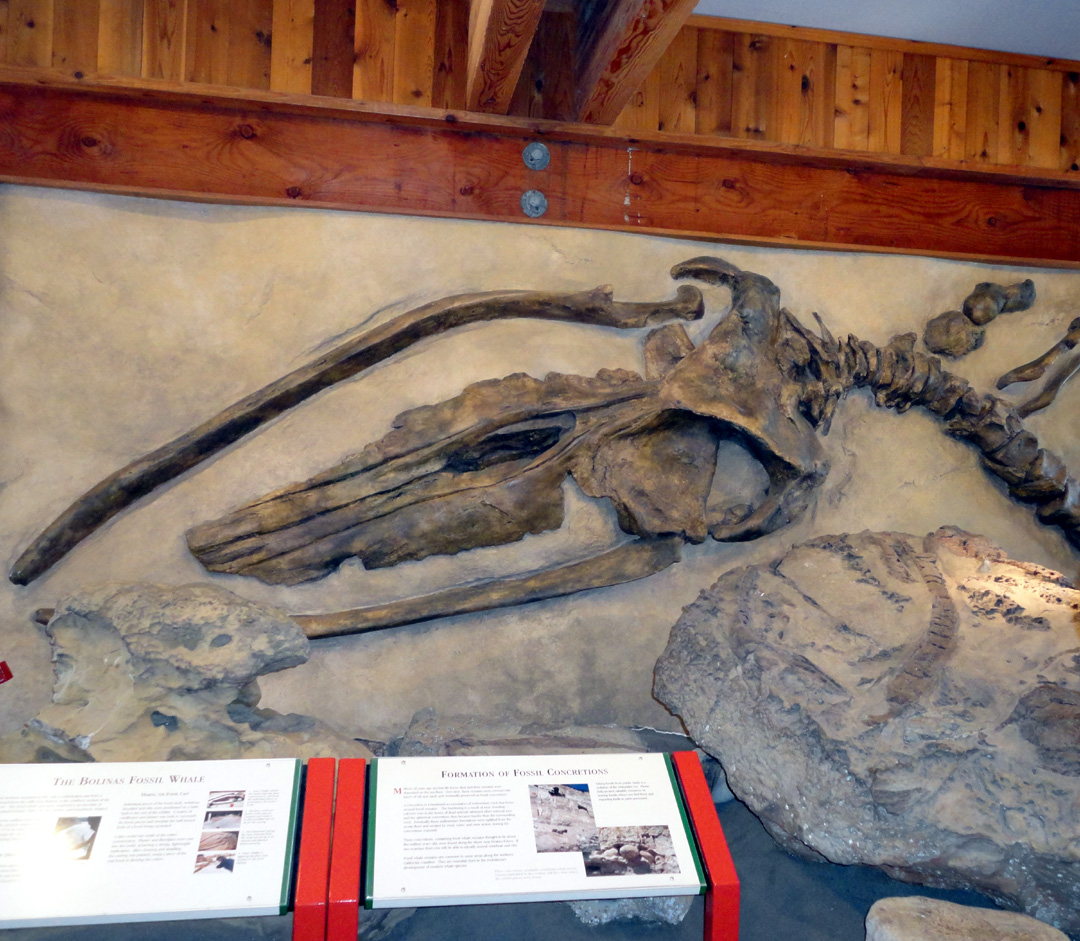
The exhibit at the Drakes Beach visitor's center showing the holotype skeleton of 
Parabalaenoptera baulinensis.

In 1973, a large mysticete skeleton was discovered by Carl Zeigler of the College of Marin, weathering out of cliffs near Bolinas in Marin County, California. Bolinas is a quaint artist community on the Marin County coast and has changed little since the 1960's and 70's; it is predominantly settled by ex-hippies, who generally don't like visitors from out of county, and have continually removed the exit sign for "Bolinas: 2 miles" off of highway 1, to the point where the California Dept. of Transportation (CalTrans) has given up putting up new signs. Tales abound of visitors with out of county or out of state license plates having car tires popped or vandalized, and nails and other tire-popping objects being intentionally laid out onto dirt roads in town. My car had a San Rafael Honda license plate holder, so I never had this problem.

The assembled holotype skull of Parabalaenoptera at California Academy of Sciences, photographed by fellow Otago Ph.D. student Felix Marx.

Exposed along the southern tip of Point Reyes is a unit formerly identified as the early late Miocene Monterey Formation; this was subsequently reevaluated after Domning (1978) suggested that sea cow fossils from the Bolinas locality were too derived to be from such an old unit. Afterwards, microfossils suggested a much younger age, closer to the Mio-Pliocene boundary (6-6.8 Million years old), and the formation was reidentified as the Santa Cruz Mudstone, which has only been mapped in Santa Cruz County.

Anterior view of Parabalaenoptera.
The fossil occurred in indurated, blocky mudstone, and was collected over a ten year period as the blocks incrementally eroded from the cliff. The lead authors - Gordon ("Gordie") Chan and Carl Zeigler of the College of Marin in Kentfield, and their field assistants - would have to travel over the hill and out to Bolinas (nearly an hour's drive through some of the windiest vomit-inducing roads in Northern California) on a monthly basis during the summer, and much more often during the winter during periods of intense erosion, and sometimes daily, anticipating falling blocks. After collection, the blocks were prepared, and some were glued together - but left as a series of blocks that could be lined up and assembled. The holotype was prepared at College of Marin, and eventually molded, casted, and donated to the California Academy of Sciences. Mounted casts of Parabalaenoptera baulinensis are currently on display at College of Marin in Kentfield and at the Drake's Beach visitor center at Point Reyes National Seashore. Sadly, before the paper could be published on the fossil - Carl Zeigler and Gordon Chan passed away. Chan passed away in 1996 of Lou Gehrig's disease; I could not find information on Zeigler, though I seem to recall hearing that he was killed by a drunk driver. Dr. Lawrence Barnes of the Los Angeles County Museum of Natural History finished the manuscript and brought it to publication in the California Academy of Sciences in 1997.

The braincase and vertex of Parabalaenoptera.
Parabalaenoptera baulinensis is a medium-sized balaenopterid with a 2.2 meter skull, slightly larger than minke whales (Balaenoptera acutorostrata; a 10 meter long whale with a 2m skull), but has a number of features that are too divergent to warrant inclusion within humpbacks (Megaptera) or Balaenoptera. These include the very elongate and somewhat swollen zygomatic processes, narrow intertemporal region (the skull is less 'telescoped than in modern balaenopterids), and extremely long and narrow nasal bones. The mandibles are strongly outwardly bowed like in Megaptera, and have an elongate coronoid process - somewhat like blue and fin whales (Balaenoptera musculus and physalus). Many of these features suggest that Parabalaenoptera baulinensis was capable of lunge feeding just like modern rorquals. It is additionally convergent with Balaenoptera musculus in having a supraorbital process of the frontal that is somewhat triangular and narrows laterally, whereas in Balaenoptera and Megaptera, the posterior and anterior margins are either parallel, or the posterior margin is perpendicular to the midline. Unfortunately, the holotype specimen is not preserved very well, and it appears that a significant amount of bone was accidentally removed or ground away during preparation, and details of the basicranium are almost totally indiscernible. Parabalaenoptera has been found in many phylogenetic analyses to be a stem-balaenopterid - in other words, a primitive member of the clade (family Balaenopteridae) that does not belong to the clade formed by humpback whales and modern species of Balaenoptera - the Megaptera + Balaenoptera clade, if you will. These two modern genera have been traditionally grouped into the "Megapterinae" and "Balaenopterinae" - Zeigler et al. (1997) even went so far as to name a new subfamily, the Parabalaenopterinae. However, given that none of these subfamilies have really shown to be stable or even consistent in cladistic analyses, it's unclear what the utility of such taxon names even is.

Reconstruction of the holotype skull and mandibles of Parabalaenoptera. Unfortunately, certain features (e.g. squamosal morphology) of the actual skull don't really look like how they're portrayed in this figure. From Zeigler et al. (1997).

Nevertheless, the description of Parabalaenoptera was a hallmark in balaenopterid paleontology; however, given the stagnated taxonomic situation of fossil balaenopterids, little else was published on fossil balaenopterids until Michelangelo Bisconti started revisiting Italian fossils starting in 2007. In the last five years, a number of informative balaenopterid finds have been described - but it is only the tip of the iceberg. Perusing late Miocene and Pliocene marine mammal assemblages in Museums, it is apparent that balaenopterids comprise nearly two-thirds of the more recent baleen whale fossil record (it is at least the case for California marine mammal assemblages). In California, at least four to five unpublished balaenopterids await description from the Pliocene alone. Additional fossils that may represent Parabalaenoptera - potentially a new and slightly younger species - have been collected from the Purisima Formation near Santa Cruz (and are in much better condition than the holotype). The future of balaenopterid paleontology is bright!

References

Bosselaers, M., and Post, K. 2010. — A new fossil rorqual (Mammalia, Cetacea, Balaenopteridae) from the Early Pliocene of the North Sea, with a review of the rorqual species described by Owen and Van Beneden. Geodiversitas 32:331-363. 

Deméré, T. A., Berta, A., and McGowen, M. R. 2005. — The taxonomic and evolutionary history of modern balaenopteroid mysticetes. Journal of Mammalian Evolution 12:99-143.


Domning, D. P. 1978. — Sirenian evolution in the North Pacific Ocean. University of California Publications in Geological Sciences 18:1-176.


Zeigler, C. V., Chan, G. L., and Barnes, L. G. 1997. — A new late Miocene balaenopterid whale (Cetacea: Mysticeti), Parabalaenoptera baulinensis, (new genus and species) from the Santa Cruz Mudstone, Point Reyes Peninsula, California. Proceedings of the California Academy of Sciences 50(4):115-138.


Thursday, January 26, 2012

Southern California Research Trip, Part 3: Natural History Museum of Los Angeles County (collections)

The purpose for our trip to visit the LACM collections was to examine a large collection of pinniped fossils housed there. Curator Emeritus Dr. "Larry" Barnes has been studying fossil pinnipeds since his master's thesis in the late 1960's (which he published in 1972, on Allodesmus and other desmatophocid pinnipeds), and has researched a wide variety of fossil pinnipeds including the early diverging and 'primitive' enaliarctines (a paraphyletic group of early pinnipeds), the relatively large and aberrant desmatophocids (an extinct group of phocoids known only from the North Pacific), all manners of fossil walruses, and fossil sea lions and fur seals. Larry has named quite a few fossil pinniped taxa from the northeastern Pacific region (Enaliarctos mitchelli, Pteronarctos goedertae, Pteronarctos piersoni, Pacificotaria hadromma, Desmatophoca brachycephala, Allodesmus gracilis, Proneotherium repenningi, Pelagiarctos thomasi, Gomphotaria pugnax, and Proterozetes ulysses), and there are a whole slew of holotype specimens to look at at the LACM - including a number of other important finds, including crania and jaws of the walrus Imagotaria downsi and the even earlier Neotherium mirum (but not quite as old as Proneotherium...). Our goal was to photograph all of these skulls and jaws, and take all sorts of measurements of them for our research. Between Morgan and I, we took about 5 gigabytes of photographs of these fossils. At the moment, we have two concurrent research projects which will soon be culminating in submittable manuscripts: a phylogenetic analysis of fossil and modern sea lions and fur seals (Otariidae; Morgan gave a talk on this at SVP this last fall), and another project describing some new material of the extinct "killer" walrus Pelagiarctos, originally described by Larry Barnes from the Sharktooth Hill Bonebed, and discovered by LACM head preparator and all around fun guy Howell Thomas. At bare minimum, we needed to examine, photograph, and measure the holotype "chin" and the referred teeth. Anything else we got done was a bonus - and our bonus included looking at dozens and dozens of skulls, jaws, and teeth of various other pinnipeds.

The hollywood hills can be seen very well from the prep lab, which is several floors up. You can just make out the hollywood sign below the top of the mountains.

The holotype "chin" of Pelagiarctos thomasi.

A referred lower left third or fourth premolar of Pelagiarctos, published by Barnes (1988).

My wife borrowed some of the clay we used for propping oddly shaped specimens up during photography and made a walrus and a manatee; the manatee even has
motorboat propeller scars (just for J. Velez-Juarbe!)

A referred lower jaw of Neotherium mirum from the Sharktooth Hill Bonebed, published by Barnes (1988); this is the only other early walrus from the middle Miocene bonebed.

My wife happened to find a book of 3D cat photos with 3D glasses. Don't ask.

Three different jaws of Allodesmus from the Round Mountain silt; but how many species? According to Barnes, there are three species: the topmost is the holotype of Allodesmus kelloggi, the middle is the holotype of Allodesmus kernensis, and the bottom one is Allodesmus gracilis. Others would lump all these in to Allodesmus kernensis (which would have taxonomic priority).

Three different early walruses! From left to right, they are Proneotherium repenningi from the Astoria Formation of Oregon (early Middle Miocene), Neotherium mirum from the Sharktooth Hill Bonebed of California (late Middle Miocene), and Imagotaria downsi from the Santa Margarita Sandstone (early Late Miocene) of Santa Cruz County, California.

The beautifully preserved holotype skull of Pacificotaria hadromma from the Astoria Formation of Oregon. According to Berta (1994), this may be a junior synonym of Pteronarctos.

Morgan and I conducting research amid a chaotic mess of fossil pinnipeds and other paleontological debris.

Downtown Los Angeles from the window in the prep lab. The US Bank tower can be seen in the middle. If you recall, it was blown to smithereens in Independence Day.

The rostrum and upper dentition of a referred snout of Desmatophoca oregonensis.

Morgan photographing the obscenely gigantic jaw of the bizarre double tusked behemoth of a walrus Gomphotaria pugnax. Seriously, that thing is offensively large.

The holotype skull of Allodesmus kelloggi, described by Ed Mitchell in the mid 1960's from the Sharktooth Hill Bonebed.

An undescribed late Pleistocene jaw of a California sea lion, Zalophus sp., from the Newport Bay mesa.

Last, but not least, another shot of those three walruses -
Proneotherium, Neotherium, and Imagotaria.

What's up next? One or two more posts on the southern CA trip including the Page Museum as well as the Santa Barbara Museum of Natural History, and eventually, I should probably try and cover some recent marine mammal research, I still have to cover a paper I got published on our wedding day, Kolponomos, and a bazillion other things.

Monday, January 2, 2012

Is Puijila a pinniped?

Back in February 2009, Natalia Rybczynski and colleagues surprised the paleomammalogy community with their Nature paper naming a new genus and species of early pinniped, Puijila darwini. The holotype skeleton is relatively complete, and include fore- and hind-limbs along with much of the vertebral column, both jaws, and a well preserved skull. Puijila was about one meter long, and would have appeared relatively similar to a modern river otter. It had a short snout and a wide head, with large eyes and relatively high-crowned teeth. The teeth of Puijila still retain many of the cusps lost in modern pinnipeds, and also exhibit pits in the roof of the mouth for the lower teeth (embrasure pits). Unlike modern pinnipeds, it had a long tail, and did not have its fore- and hindlimbs modified into flippers. Puijila was discovered in 2007 from the Haughton Formation on Devon Island in Nunavut (formerly Northwest Territories in Canada). The Haughton Formation was deposited in an impact crater – the impact has been dated to 24-21 Ma (earliest Miocene), and fossil mammals from the Haughton Formation corroborate an early Miocene age. The Haughton Formation was deposited in an ancient lake that filled in the impact crater. In fact – if it were not for the impact, there would be no sedimentary rocks of Miocene age preserved that far North – all the young rocks have been eroded away by glaciation.
The skull and jaw of Puijila darwini, from Rybczynski et al. (2009).

The holotype skeleton of Puijila darwini (from http://nature.ca)

Previously, the earliest diverging pinniped (and arguably more derived than Puijila) is Enaliarctos, a fur seal sized pinniped from the latest Oligocene and early Miocene of California and Oregon. Enaliarctos retains carnassials, although many of the other dental features are very simplified and reduced, trending toward the condition in modern pinnipeds. Enaliarctos also exhibits limbs developed into flippers – and is very clearly a pinniped. But the relationships of Puijila – to pinnipeds and other carnivores – are not so clear. Because of the older age of Enaliarctos and its marine occurrence, Puijila is hypothesized to represent a lineage of early pinnipeds that stayed in their freshwater niche while marine pinnipeds like Enaliarctos evolved, remaining otterlike. It suggests that pinnipeds went through an otterlike freshwater stage before invading the ocean. Prior to this, Enaliarctos suggested a direct to saltwater invasion – although due to the absence of intermediates, it was not exactly clear one way or the other.

The skeleton and life restoration of Enaliarctos mealsi, from Berta et al. (1989).

Before we continue – I must also be specific about some clade names. Although Rybczynski et al. (2009) refer to Puijila as a member of the Pinnipedia – which is not really the traditional cladistic nomenclature for basal pinnipeds. Annalisa Berta and colleagues (1989) proposed the clade Pinnipedimorpha, for Enaliarctos and all later diverging pinnipeds. Berta (1994) later proposed the name Pinnipediformes for Pteronarctos and all later diverging pinnipeds. Pinnipedia is nested within Pinnipediformes, and Pinnipediformes within the Pinnipedimorpha. Within this traditionally accepted and utilized framework, Puijila’s obviously more primitive morphology than Enaliarctos indicates it should be referred to as a pinnipedimorph.

Rybczynski et al. (2009) listed six characteristics that unite Puijila with Enaliarctos and other pinnipeds. These are: a posteriorly expanded palate (the palate extends posteriorly past the upper toothrow in pinnipeds), an enlarged infraorbital foramen (occurring within pinnipeds due to larger whiskers and greater innervation of the snout), a shelf-like protocone on the upper fourth premolar (occurring in basal pinnipeds and some related arctoids), an upper second molar that is reduced and positioned medially to the upper first molar (reduction of the molariform teeth to conical teeth is a major dental transition within the pinnipedimorpha), a posterodorsally expanded scapula (a feature of pinnipeds, which often have very broad scapulae, an adaptation for swimming), and an expanded deltopectoral crest of the humerus (another feature in pinnipeds related to swimming).

Some of these features may be of only limited use in hypothesizing a close relationship between Puijila and pinnipeds. First, an enlarged infraorbital foramen (the small hole below the eye socket in a skull) also occurs in many mustelids, such as badgers (Taxidea), weasels (Mustela), and most (if not all) otters (e.g. Lontra, Enhydra); in badgers and weasels, this is due to a more innervated and sensitive snout, an adaptation for digging in burrows. This characteristic may not be useful in identifying early pinniped relatives, as otters (another hypothesized pinniped sister taxon) exhibit this feature – presumably evolving for the same purpose. The two postcranial features – an enlarged deltopectoral crest and a posterodorsally expanded scapula – may not be coded correctly in Puijila. To be quite honest, based on the available photographs – these features do not appear too different between Puijila and a river otter (Lontra), and don’t really exhibit the derived condition, which is much more extremely developed in Enaliarctos and other fossil and modern pinnipeds). This leaves only three reliable characters behind.

Skeletons of Enaliarctos (A), Puijila (C), and Lontra (D).

One of these features – a posteriorly expanded hard palate – also appears in the aberrant arctoid Kolponomos, as well as Pachycynodon and Allocyon (Tedford et al., 1994). This feature appears to be more widely distributed than previously admitted, although it is worth mentioning that it is probably an adaptation towards aquatic feeding. The two dental characteristics are probably more reliable, although it is odd to note that these two dental characteristics are also found in Kolponomos. Kolponomos will feature more in part two of this post, as it is both a fascinating creature which I have not yet properly covered on this blog, and it is also extremely topical to the subject of Puijila.

A wonderful reconstruction of Kolponomos by Ken Kirkland, published in Neptune's Ark by David Rains Wallance.

There are a whole host of pinniped characteristics that Puijila does not have, or features that were not described in enough detail to independently evaluate. Cranial and dental features that characterize pinnipeds (either at the level of the Pinnipedimorpha, Pinnipediformes, or Pinnipedia) include a reduced upper first molar, reduced cingulum on the upper first molar, an absent or reduced metaconid, loss of the embrasure pit between the upper fourth premolar and first molar, closely spaced mastoid and paroccipital processes, a reduced nasolabialis fossa, reduced cingulum on the upper third incisor, and a reduced trigonid cusp on the lower molars. None of these derived conditions appear to be present in Puijila. A number of postcranial features which characterize pinnipeds (either at the level of the Pinnipedimorpha, Pinnipediformes, or Pinnipedia, as above) include a short and robust humerus, enlarged tuberosities of the humerus, a flattened radius and ulna that are longer than the humerus, emphasis of certain digits in the hand and foot (i.e. largest digit in the hand being the first or “thumb”, and the lateral and medialmost digits of the foot being largest and the smallest being the middle digit), a short, flattened femur with an enlarged greater trochanter and medially inclined condyles, a reduced tail, and a short ilium (bone in the pelvis). Curiously, none of these features are present in Puijila – although nearly all of them (perhaps all – I can’t remember off the top of my head) occur in Enaliarctos.

In summary, there are very few features that actually unite Puijila and pinnipeds. The cladistic analysis of Rybczynski et al. (2009) was relatively limited, both in terms of the number of fossil and modern species used, and also with regard to the number of morphological characters used in the analysis. An earlier study – considered to be the landmark phylogenetic analysis of pinnipeds, Berta and Wyss (1994) – utilized 143 characters, while Rybczynski et al. (2009) only used 42. Granted, the earlier study focused on relationships within pinnipeds – and many of those characters may or may not apply to Puijila and other similar arctoids.

Because of the above, I am skeptical that Puijila has a close relationship with pinnipeds – and although I’m not convinced, I am equally receptive to the idea pending further analyses. There is much we’ve been waiting for – a detailed description of its anatomy and large, detailed figures of its skeleton were not included in the original study, which is understandable given the short length of Nature papers (however, it was not included as supplementary info either). There is certainly more work to be done, and there are rumors of a more detailed phylogenetic analysis in the works; such a study should include a comprehensive description of the skull and skeleton of Puijila accompanied by exhaustive figures (formerly difficult, but several modern journals have made this a far less difficult prospect), sample a broader variety of caniform carnivorans as well as more fossil and modern pinnipeds (fossil pinnipeds with postcranial skeletons such as Allodesmus, Thalassoleon, Leptophoca, Acrophoca, Piscophoca, Imagotaria, Neotherium, and Proneotherium) as well as the “beach bear” Kolponomos (which was not included in the original analysis or discussed by Rybczynski et al. 2009). Puijila certainly could belong to some group of otterlike “protopinnipeds” as hypothesized, but given the few characters uniting them, it very well could be some sort of mustelid or other aquatic carnivore.

Further reading

Official Puijila website (Canadian Museum of Nature)

Puijila, a very basal 'pinnipedimorph' (this blog)

Commentary by Ed Yong (Not exactly Rocket Science)

Commentary by Brian Switek (Laelaps)

Literature cited

Berta, A., C.E. Ray and A.R. Wyss. 1989. Skeleton of the oldest known pinniped, Enaliarctos mealsi. Science 244:60-62

Berta, A. 1991. New Enaliarctos* (Pinnipedimorpha) from the Miocene of Oregon and the role of "Enaliarctids" in Pinniped Phylogeny. Smithsonian Contributions to Paleobiology 69.

A. Berta. 1994. New specimens of the pinnipediform Pteronarctos from the Miocene of Oregon. Smithsonian Contributions to Paleobiology 78:1-30

Rybczynski, N., Dawson, M.R., Tedford, R.H. (2009). "A semi-aquatic Arctic mammalian carnivore from the Miocene epoch and origin of Pinnipedia". Nature 458 (7241): 1021–24

R. H. Tedford, L. G. Barnes, and C. E. Ray (1994). "The early Miocene littoral ursoid carnivoran Kolponomos: Systematics and mode of life". Proceedings of the San Diego Society of Natural History 29:11-32.

Tuesday, August 2, 2011

More problems with Herpetocetus

Back in June at the Aquatic Tetrapods conference I coauthored a poster with Joe El Adli (San Diego Natural History Museum) and Jonathan Geisler (New York College of Osteopathic Medicine) on some of the taxonomic problems of Herpetocetus. Herpetocetus, as I've mentioned before, is an enigmatic small bodied mysticete whale which many bizarre and derived features, while retaining some primitive features as well. Fossils of Herpetocetus are fairly common in Northern California, particularly in the Purisima Formation - or maybe I just have a knack for finding them. Thus far, there is only one described species of Herpetocetus from California: Herpetocetus bramblei, named by Whitmore and Barnes (2008) from a very partial skull (basically just a squamosal with part of the exoccipital, parietal, and pterygoid) with a petrosal from the Purisima Formation. In summer 2007, I excavated a nearly complete skull of this same species from near the type locality, and last summer, I excavated a second specimen which lacked the braincase but included a complete rostrum. Since this topotypic material was collected, additional specimens from other localities in the Purisima Formation indicate that two additional undescribed species are present - one of the new species was discovered very recently, and I'll have more on that soon.

*Holotype, for the non-specialist, is the specimen which a new species is based off of. It should be representative of the new species in terms of its anatomy, and should be relatively complete enough to be comparable to other taxa. A type locality is where the holotype specimen originated.

There are several other described species of Herpetocetus from other corners of the globe - all from the Northern Hemisphere. The genus was first described from the Pliocene of Belgium (Herpetocetus scaldiensis) based on a partial dentary. A partial skull from the Pliocene Yorktown Formation was described as Herpetocetus transatlanticus, also by Whitmore and Barnes (2008). In the 1960's, an isolated tympanic bulla from Japan was named as the type specimen of Mitzuhoptera sendaicus, and a fossil mysticete skeleton with a skull, earbones, and dentary shared both the dentary morphology of Herpetocetus scaldiensis as well as the tympanic morphology of Mitzuhoptera sendaicus, and Oishi and Hasegawa (1995) transferred M. sendaicus to Herpetocetus, resulting in the new combination, Herpetocetus sendaicus. Each of these records is from either side of the Pacific (east and west) and the Atlantic (east and west).

How diagnostic are bullae and dentaries? I've already addressed problems with the jaw morphology of herpetocetines (here and here), and mysticetes in general. If you recall, there are two problems concerning the dentary of Herpetocetus spp. in particular: 1) The dentary of the possible sister taxon Nannocetus is not yet known, and dentaries substantially older than Herpetocetus (and possibly belonging to Nannocetus) are nearly identical to Herpetocetus (see below image), indicating that this general morphology is possibly characteristic of a larger group of whales. 2) Some species of Herpetocetus have dentaries that are very difficult to tell apart and lack autapomorphic characters (unique derived features), and thus are not suitable as holotypes. This logically results in the implication that Herpetocetus scaldiensis, which is based on a jaw, is the type species of Herpetocetus, and thus the species and genus may be taxonomically invalid or nomina dubia (means dubious name in latin).

The first figure of our poster, showing comparative drawings of various fossil herpetocetines.

Earbones have long been used for taxonomic purposes, and in many cases have been designated as holotypes. Sir Richard Owen designated many isolated bullae from the Plio-Pleistocene Red Crag of eastern England as holotypes (all of which have been sunk; e.g. Balaena definata). It is unclear how diagnostic earbones are for baleen whales: petrosals (otherwise known as periotics - the inner ear bone) have all sorts holes and knobs and crests and are rather easy to tell apart from genus to genus. A recent paper published by Eric Ekdale, Annalisa Berta, and Tom Demere (2011) indicate that earbones of extant mysticetes are diagnostic to the species and are easily told apart. Additionally, Steeman (2010) reexamined a large suite of earbones previously described by taxonomic mad man P.J. Van Beneden, who is largely responsible for constipating the entire field of mysticete systematics for over 100 years. Steeman (2010) found that many of these earbones - specifically petrosals - may be diagnostic tools, and generally reached a similar conclusion like Ekdale et al. (2011). But what about bullae?


The second figure from our poster, showing variation in tympanic bulla morphology from various herpetocetines. Note the overall similarity between Herpetocetus spp.

Bullae of three species of Herpetocetus have been described: H. scaldiensis, H. transatlanticus, and H. sendaicus. In our poster, we figured all known bullae (described or undescribed), including both the holotype of Mizuhoptera sendaicus and the referred specimen of Herpetocetus sendaicus, and a new bulla of Herpetocetus bramblei. Additionally figured are bullae of Nannocetus and Piscobalaena, also herpetocetines. We concluded, as we hope that you will when looking at this figure, that the bullae of different Herpetocetus species do not vary significantly from species to species. They are, on the other hand, diagnostic at the family level: they are clearly distinct from all other bullae of (described) cetotheriids. However, a bulla that is only distinct at the genus level is inadequate to be used as a holotype. This suggests that Mizuhoptera sendaicus, unsurprisingly, is probably a nomen dubium. It also indicates something interesting is going on with the skulls of mysticetes, or at least cetotheriids: tympanics are slightly less informative than the petrosals. It might be possible someday to quantify how phylogenetically useful different anatomical regions are, aside from just counting up the number of characters used per anatomic region in a cladistic analysis. Who knows, maybe someone has already thought of that and developed a method.

Further Reading:

New published article (Part 1): herpetocetine jaws, and an example of finding a "simple" research project


New published article (Part 2): taxonomic problems with Herpetocetus and "cetotheres"

References:


El Adli, J., Boessenecker, R.W., and J. H. Geisler. 2011. Taxonomic problems of and relationships among species of the fossil baleen whale genus Herpetocetus. Sixth Triennial Conference on Secondary Adaptation of Tetrapods to Life in Water Program with Abstracts: 23.

Ekdale, E.G., A. Berta, and T.A. Demere. 2011. The comparative osteology of the petrotympanic complex (ear region) of extant baleen whales (Cetacea: Mysticeti). PLOS One 6:1-42.

Oishi, M., and Y. Hasegawa 1995. Diversity of Pliocene mysticetes from eastern Japan. The Island Arc 3:436–552.

Steeman, M.E. 2010. The extinct baleen whale fauna from the Miocene-Pliocene of Belgium and the diagnostic cetacean ear bones. Journal of Systematic Palaeontology 8:1:63-80.

Whitmore, F.C., and L.G. Barnes. 2008. The Herpetocetinae, a new subfamily of extinct baleen whales (Mammalia, Cetacea, Cetotheriidae). In C.E. Ray, D.J. Bohaska, I.A. Koretsky, L.W. Ward, and L.G. Barnes (eds.). Geology and Paleontology of the Lee Creek Mine, North Carolina, IV. Virginia Museum of Natural History Special Publication 14:141–180.