Showing posts with label taphonomy. Show all posts

Sunday, January 29, 2012

Southern California Research Trip, Part 4: Page Museum at the La Brea tar pits

After our last day of research at NHMLAC, Sarah, Morgan, and I drove to LAX to drop Morgan off for his flight back to the rockies. Sarah and I continued on, and had a two day trip planned ahead: first, we would visit the Page Museum of La Brea Discoveries in Hollywood, and then we'd drive north on Highway 1 from Santa Monica north through Malibu, Oxnard, Santa Barbara, Santa Maria, San Luis Obispo, Big Sur, and eventually through Monterey on our way back to the San Francisco area. We took a ton of great photos at the Page Museum which we arrived at just before opening; I've included some of the better and more informative photos here.

The front of the uniquely designed Page Museum. The museum is shaped like a square with a botanical garden courtyard, and above the museum, a large bas-relief is supported by that scaffolding.

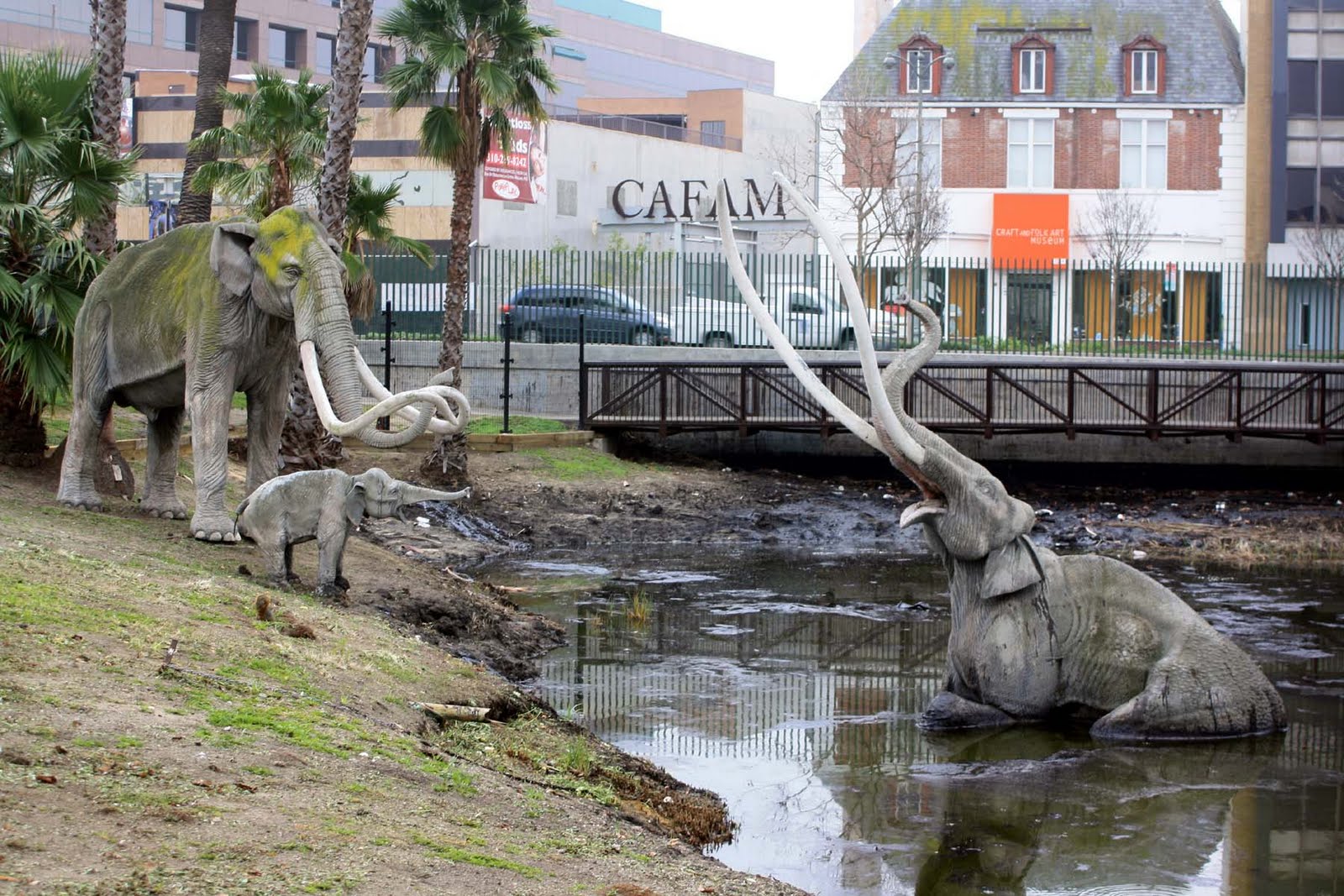
A poor Columbian Mammoth is in deep... stuff.

My wife snapped this photo of tar bubbling up outside the museum. It's amazing how much tar is still seeping up. On my last visit in 2004, I didn't see anything around the park that was half this good; you can clearly see here the leaf litter and detritus that covers and camouflages the tar, while also seeing some obviously viscous, black, cartoon style tar bubbling up.

The famous Pit 91 excavation, which is temporarily on hold during the project 23 excavation a stone's throw away.
One of the panels from the bas relief above the museum, depicting a teratorn confronting a ground sloth.
A Columbian Mammoth skeleton, which I look way too happy to see (considering it's not marine, that is).
One of these things is not like the other ones...
My wife attempting to pull the plunger, showing how damned difficult it is.
The right canine is not the thing that's important in this shot, it's the left canine; although this is not a marine carnivoran, I'm interested in tooth eruption in carnivorans in general, and this made my day.
Skull and life restoration of Merriam's giant condor, Teratornis merriami. Still not as big as Pelagornis, but impressive and terrifying none the less.
Lots and lots of dire wolves (Canis dirus). This has to be my favorite display in the entire museum... it's beautifully constructed.
The spectacularly large and robust skeleton of the American Lion, Panthera atrox.
What? I thought this was the American Lion? Some recent studies have indicated the skull and mandibular morphology of Panthera atrox is more similar to the extant Jaguar (Panthera onca) than it is to African Lions (Panthera leo). There is a conflicting molecular study done with ancient DNA, however, but I'll save that for another time. Here's a question for any readers in the know: who the hell is Naegele? Joseph Leidy named the damn thing after all, so why isn't it named Leidy's Giant Jaguar?

A new American Lion specimen named "Fluffy" was recently excavated, and there was this temporary case which had in it what I thought was one of the better exhibits in the whole place: a three dimensional representation of the skeleton, using the same skeletal elements of a housecat. As a taphonomist, I particularly enjoyed this.
The bubble prep lab at the Page.
I love seeing stuff like this in prep labs. Apparently Arctodus is a patriot.
Is that a walrus in there? Damn, it's just a Smilodon. I really loved this display showing the three dimensional configuration of bones.
Smilodon again.
A bee outside the Page Museum. This has no relevance to the rest of the post, but it is a pretty picture, no?
A composite of two panoramic shots my wife took showing the bas relief.

A great shot taken by my wife of the wall of dire wolf skulls.
Hollywood!

Up next: Southern California Research Trip, Part 5 - detailing the Santa Barbara Museum, the coast, and the conclusion of the series of posts.

Sunday, January 22, 2012

Southern California Research Trip, Part 2: Natural History Museum of Los Angeles County (exhibits)

After two and a half days at the San Diego MNH, Morgan, Sarah, and I said our goodbyes to our friends and colleagues there (Joe El Adli, Eric Ekdale, and Tom Demere), and piled into my tiny honda for the drive up to LA - we decided that spending another morning at SDNHM would allow us to drive up to LACM and miss all the morning traffic. We arrived at the museum at about 2 in the afternoon, and after chatting with Curator Emeritus Dr. Lawrence ('Larry') Barnes for a little bit, we got right to work examining fossil pinnipeds. I'll discuss the collections visit in the next post - first I'd like to talk a bit about the new mammal paleontology hall.

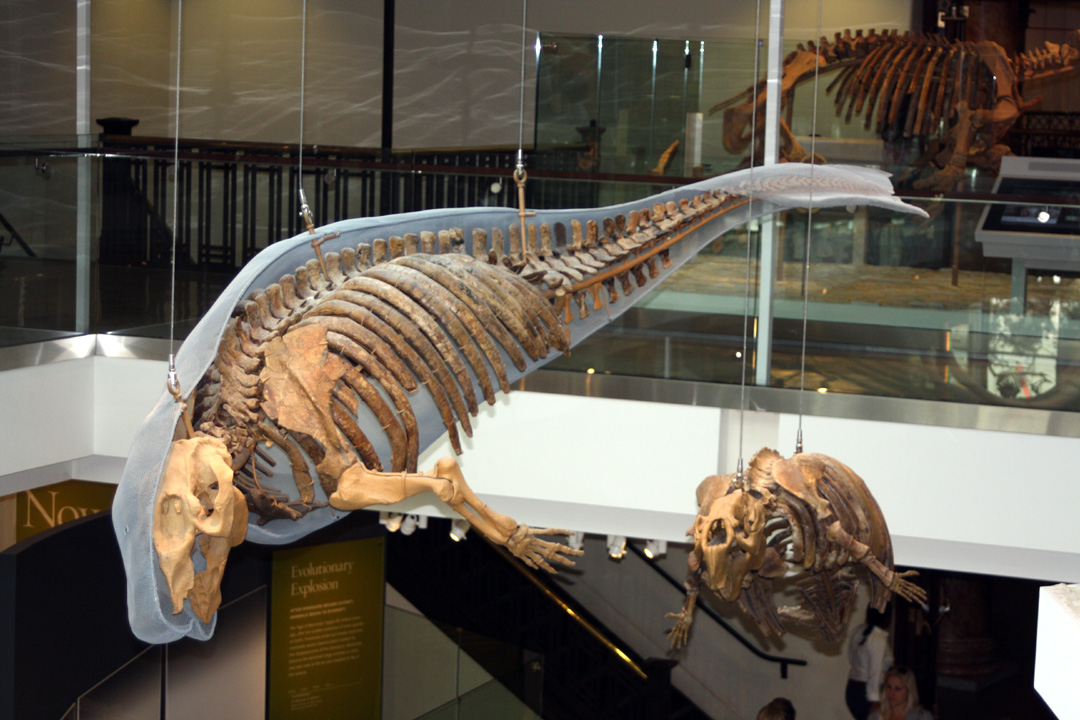
The new "Age of Mammals" hall has been in the works for several years, and has taken quite a bit of time on behalf of most of the Paleontology Dept. employees at LACM. I've seen a few photos on the internet prior to my visit, so I knew a little of what to expect. I don't have much of a research interest concerning terrestrial mammals - so, sorry terrestrial paleomammalogists who happen to be reading this blog (admittedly a very, very, very small fraction of humanity), but I'm going to ignore the land mammals. Some of the marine mammal highlights include a mounted skeleton of the sperm whale Aulophyseter morricei from the Sharktooth Hill Bonebed, as well as the holotype skeleton of the phocoid pinniped Allodesmus kelloggi (which, according to some, may be a junior synonym of Allodesmus kernensis), and adult and juvenile mounted skeletons of the late Miocene dugongid Dusisiren jordani, which were collected from the Santa Margarita Sandstone in Santa Cruz County. Lastly, and arguably the centerpiece of the marine mammal exhibits - is a beautiful new skeleton of Paleoparadoxia (which apparently may be named as a new genus in the near or distant future). Aside from these, there are a handful of skulls and pinniped fossils on display, including the world's oldest delphinid dolphin fossil - a complete skull from the Monterey Formation, unnamed and still undescribed. Overall, however - I must admit I was a bit underwhelmed. Certainly on the lower floor, there are plenty of fossil land mammals just packed in. But the top floor, which was an odd mix of La Brea specimens and marine mammals, there was just a lot of empty space, and there wasn't really that much marine mammal material on display, which is surprising given that the LACM holds one of the largest fossil marine mammal collections in North America.

Not in the Age of Mammals hall, but I had to include a picture of my favorite
pinniped, Callorhinus ursinus.

The juvenile skeleton of Aulophyseter morricei from the Sharktooth Hill Bonebed. This individual is under 50% adult size. The only known skeleton of this taxon.

This also was not taken in the Age of Mammals hall - but it goes to show that my wife likes to photobomb fossils all the time. I mostly put this up here to demonstrate to others that she is an awful person.

The holotype skeleton of Allodesmus kelloggi.

A cast of the holotype (and only known specimen) skull and jaw of the desmatophocid pinniped Atopotarus courseni. Atopotarus has occasionally been recombined as Allodesmus courseni, but desmatophocid taxonomy will have to be covered in a separate post.

A referred lower jaw of the Miocene sirenian Dioplotherium allisoni.

The adult female and juvenile skeletons of Dusisiren jordani from the Santa Margarita Sandstone in Santa Cruz County. The juvenile is so damn cute...

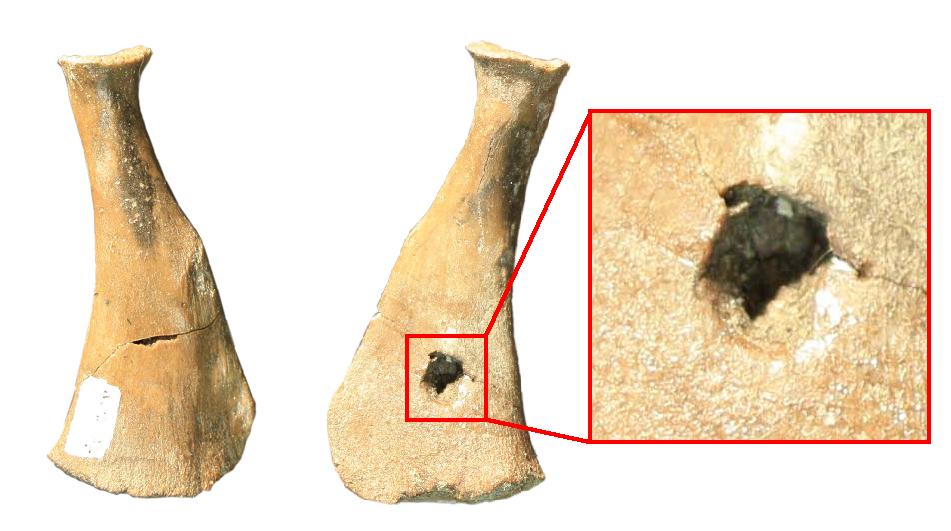
A Paleoparadoxia ulna with sharktooth bite marks. This specimen belongs to the mounted skeleton shown below.

A rather bizarrely portrayed fossil dolphin in some artwork related to sharktooth bite marks; I'm sure the artist was more interested and familiar with depicting sharks than cetaceans.

One of the exhibits I was looking forward to as a taphonomist - the gut contents of a Basilosaurus cetoides skeleton from Mississippi! It had as gut contents when it died
a mass of fish bones.


The articulated forelimb of the late Miocene delphinoid Albireo whistleri, originally described by Larry Barnes from the Almejas Formation at Cedros Island in Baja California.

The business end of the new Paleoparadoxia skeleton.

I'll leave you with this large size image of the Paleoparadoxia skeleton - my dslr camera doesn't have a wide angle lens, so I had to stitch these photos together for an ultra-size photo (I have a much larger version; contact me if you want it). And yes, that is the intrepid Morgan Churchill standing behind its ass.

Thursday, September 29, 2011

California shark teeth

Yesterday while doing fieldwork at one of my research localities, I spotted a beautiful shark tooth poking out of the cliff. Only a very tiny part of the serrated tooth blade could be seen, and initially I was unsure of how large it was. After a few minutes of chiseling, it was clear that this was a rather large specimen of the great white shark, Carcharodon carcharias, and upon removal, ended up being about 3 cm long - the second largest specimen I had collected from this locality. This was a good day, as I generally have only found about 3-4 of these teeth per year; they are not too hard to spot - in fact, they are fairly obvious due to the easy-to see enamel and serrations (unless a root lobe is all that is exposed). Altogether, I have collected perhaps 50 Carcharodon teeth from the Purisima Formation in total - they are relatively rare in comparison to marine mammal bones. And this is not for lack of trying: I've found that it generally takes about 3-4 trips to a given locality before I spot another specimen; whether this is due to examining exposures not covered by the previous trip, or erosion between trips, I'm not sure.
The Carcharodon carcharias tooth as found in the outcrop.
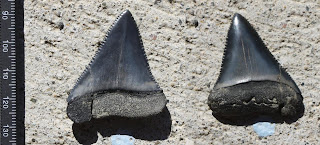
The prepared specimen.

I've found that shark teeth are nearly impossible to find during the summer months, and easy to find in the winter, when the cliffs are cleaned off by surf action. I rarely find teeth in the summer simply because I tend to pick the localities clean in the winter, and I have to wait until the erosion of the following winter to find anything. Shark teeth are so rare in west coast strata that it is not very fruitful to look for them on nearby beaches; indeed, I found one Carcharodon tooth in this manner, in 2006 - and I have not found another this way.

Certainly, the Purisima Formation is not the only shark-tooth yielding unit on the west coast. Two rock units that boast a healthy dose of shark teeth are the Sharktooth Hill Bonebed in the Round Mountain Silt near Bakersfield, one of the highest concentrations of fossil shark teeth in the world - and the Santa Margarita Sandstone near Santa Cruz. At both of these localities, one can find dozens of teeth with little work (Sharktooth Hill) or quite a bit of digging (Santa Margarita Sandstone). In high school, I played hooky one day and drove down to Santa Cruz, and spent 8 hours in a pit with a shovel and my screen, and collected 70 teeth - but only after ending up with enough screened sediment to fill a Volkswagen beetle.

Fossil mako teeth (Cosmopolitodus hastalis and Cosmopolitodus planus) from the Sharktooth Hill Bonebed, UCMP Collections (image borrowed from http://www.ucmp.berkeley.edu/).

In 2005, I was fortunate to contrast my west coast experience with that of Calvert Cliffs. I had three hours to check out the famous Brownie's Beach, where just looking through shelly debris on the beach, I found 80 shark teeth (mostly the reef shark Carcharinus), just on the surface of the beach, in an area smaller than one side of a tennis court. I've seen mason jars filled with shark teeth folks have scooped up from Florida beaches, and seen multitudes of shark teeth from the famous Lee Creek mine in North Carolina. Sure, there is plenty of lore and mysticism surrounding east coast shark teeth (and their collectors in particular!), but I have gotten the distinct impression that most shark-bearing strata on the west coast are depauperate compared to that on the east coast. Contrast nearly 100 teeth per 3 hours of work to 30 hours of work for one tooth, for example. Additionally, although I have not personally collected data on this, the obscene number of shark teeth from certain east coast units (i.e. 24,000 shark teeth from Calvert Cliffs from just 3 years of donations to the Calvert Marine Museum; Visaggi and Godfrey 2010) suggests that the ratio of sharks:marine mammals in the east coast is astronomically higher than in the Purisima Formation (which in my thesis, I determined it to be around 1:40) and other west coast units. How could this be?

A heap of shark teeth from Florida (image borrowed from www.sharkysshop.com).

A number of biological and taphonomic hypotheses can be made:
1) The fossil shark assemblages perhaps differ in their taxonomic composition, and perhaps there is some related preservation bias.
2) The western Atlantic had higher productivity and stronger upwelling in the Neogene, supporting a larger absolute population of sharks.
3) Sharks and marine mammals have a different preservation potential, which a large-scale taphonomic process could act upon.

Immediately dismissing out of hand absurd suggestions like fossil marine vertebrates were preserved differently along either coast or had different skeletal mineralogy between ocean basins, one can start to think about the above suggestions. For example, contrasting the Carcharodon carcharias-dominated shark assemblage of the Purisima Formation with that of the Calvert Formation which is dominated by carchariniforms like Carcharinus, Hemipristis, and Galeocerdo, this suggestion seems to have some merit. However, there is little difference in preservation potential between these different types of sharks, aside from differences in size. In general, marine vertebrate assemblages in bonebeds and the like are very poorly sorted, and all shark teeth are relatively small in comparison, to say, a whale jaw.


The second suggestion has some merit: the old skeletal supply v. concentration idea discussed by Susan Kidwell back in her 1985 paper (although she was talking about mollusks). She argued that skeletal concentrations are usually caused by changes in sedimentation rate - a slowdown in the rate of sedimentation eliminates the diluting effect on bioclasts, allowing them to form a shell or bonebed (or even just a zone where they are slightly more abundant). Kidwell also argued that computer modelling she used demonstrated that her concentration model still worked even when the skeletal supply rate changed. Is it reasonable to assume that the populations of organisms have not changed through time? Of course not. Can we, from a uniformitarian standpoint, work with this in mind? Using Kidwell's model, perhaps - perhaps not. This being said, I'm not sure that more teeth = more sharks. This is a relatively simplistic view of the fossil record, and in the past, interpreting the paleoecology of fossil organisms has been fraught with problems (usually of the taphonomic kind). Sharks aren't the only organisms who would enjoy higher productivity - you'd expect marine mammals to be going bat-shit crazy with all the extra fish, krill, etc. to feed on as well (and eventually dying, shedding their hard parts onto the seafloor as well along with shark teeth).
The sedimentologic fossil concentration model proposed by Kidwell (1985).

What about the third suggestion? Sharks and marine mammals clearly have different skeletal anatomy, and although some elasmobranchs have been found with preserved skeletal elements (including skates from the Purisima Formation - stay tuned!), all that typically preserve are teeth, and occasionally, dermal denticles. Marine mammals have teeth, skulls, earbones, and postcrania that get preserved frequently. Teeth are harder than bones, and probably have a higher preservation potential with respect to purely physical taphonomic processes (i.e. abrasion from winnowing, erosion, and transport). In fact, my data from my master's thesis indicate that shark teeth are less commonly abraded or fragmented relative to marine mammal bones, and therefore it is probably kosher to say they have a higher preservation potential.

Okay, so what? There is clearly some differential preservation potential. But the Atlantic and Pacific oceans are big places: any specific sedimentological process (i.e. bonebed formation) is going to vary along hundreds of miles of the continental shelf, and through geologic time, and it may be difficult to pinpoint one single phenomenon responsible. In fact, to really examine this, we have to zoom way far out, to the basin level. What is the single most obvious difference between Neogene strata of the east coast and the west coast? Again we turn back to the work of Susan Kidwell (1993). In general, because the east coast is a passive continental margin, most of the strata (i.e. Calvert Fm., Pungo Ls., Yorktown Fm., Bone Valley Fm.) are deposited in low subsidence settings ('low' sensu Kidwell, 1993). Most of the strata on the west coast, including the Purisima Fm., are deposited in smaller basins undergoing "wrench" tectonics (i.e. pull-apart basins) or even rifting (Imperial Group, southern California), which Kidwell (1993) classified as medium-high subsidence basins; most basins in California probably qualify under this category (and could be determined via deposition 'rates' and basin thickness/depth).

The concept of supply versus concentration in Kidwell's model can be extrapolated to an entire basin: basin subsidence controls the sedimentation rate, and instead of looking at the microanatomy of a single shellbed, the types of fossil concentrations and their thicknesses and lateral extent can be compared between formations and basins. Just like a longer pause in sedimentation may form thicker shell bed, a formation deposited under lower rates of sedimentation will result in more numerous, thicker, and more architecturally complex shell concentrations. The Calvert Formation in particular was Kidwell's example of a low-subsidence setting. In general, Neogene marine strata of the west coast in general have less numerous and thinner shell concentrations, a general proxy for the sedimentation rate.

A taphonomic process of this magnitude can then be imparted upon a given example of differential preservation: at the end of this, the generally lower sedimentation rate of the western Atlantic resulted in higher amounts of taphonomic damage, more widespread and longer-duration hiatuses/bonebeds, and could have effectively acted as a taphonomic "wedge". By wedge, I am referring to the eventual difference in the preserved abundances of shark teeth and marine mammal bones. Marine mammal bones, with their relatively lower preservation potential, perhaps lost out due to their greater susceptibility to damage by abrasion and fragmentation.

References Cited

Kidwell, S. M. 1985. Paleobiological and sedimentological implications of fossil
concentrations. Nature 318:457-460.

Kidwell, S. M. 1993. Influence of subsidence on the anatomy of marine siliciclastic
sequences and on the distribution of shell and bone beds. Journal of the Geological
Society, London 150:165-167.

Visaggi, C.C. and S.J. Godfrey. 2010. Variation in Composition and Abundance of Miocene Shark Teeth from Calvert Cliffs, Maryland. Journal of Vertebrate Paleontology 30:1:26-35.

Tuesday, May 3, 2011

Thesis defense: Passed

Hey Folks,
Sorry for the unannounced month-long delay; I have had zero time to contribute to the blog because I've been busy trying to finish my master's thesis, which I successfully defended a week ago today. I've been consumed with edits and other last minute work over the last week, and still have a bit of thesis writing left for this iteration.
I'm nearing the end of the master's degree journey and all that crap; my folks are flying up here for my graduation on Friday.

Once I have my next draft in, I'll be writing up an actualistic taphonomy article on "What's currently happening to Osama Bin Laden's corpse?" In addition to its humorous objectives, it really will be an exercise in deep-sea taphonomy.

Wednesday, March 16, 2011

Research featured in the Santa Cruz Sentinel

Hey Folks,

My research with Frank Perry concerning bite marks on fur seal bones was recently highlighted in a recent article in the Santa Cruz Sentinel. Check it out!

http://www.santacruzsentinel.com/ci_17604819

Thursday, February 10, 2011

Mammal bite marks on fur seal bones, Part 3

Within 48 hours of my paper being published, I tried seeing if I could find anything if I searched for 'pinniped bite marks' on google. Sure enough, I saw that Dr. Alton 'Butch' Dooley had already covered it (thanks, Butch!), but I saw something else that made me angry and very excited at the same time. This was an article on feeding damage induced by a leopard seal attack on a human.

Pair of tooth punctures from the leopard seal attack.

Yes, the loss of human life is very tragic and all, but this is really exciting! As aggressive as leopard seals are (and as bad a rap as they get in movies like March of the Penguins and Happy Feet), and as scary as some other pinnipeds are, they normally don't attack humans, and if anything are typically wary of humans. This attack involved the 28-year old Kirsty Brown, a scientist in Antarctica, who was snorkeling at the time. The seal attacked her, and dragged her under water for 6 minutes to a depth of 70 meters (!). That's pretty incredible. Observers estimated the seal was 4-4.5 meters long.

What is most interesting about this paper is that the punctures figured above in the article are very similar to those that Frank Perry and I described (Boessenecker and Perry, 2011). The bite mark on the radius is most similar, as the puncture penetrated the cortex, and left a peripheral ring of depressed bone, just like these. It is difficult to say because the article did not go into the details much, but although these punctures are undoubtedly canine punctures, they appear much too close together to be from the same bite. Perhaps these were from the same canine on different bites, or something along those lines.

Unfortunately, this paper was published in 2007, and had I known about it, I would have totally cited it. In fact, this paper makes the pinniped origin of the bite marks seem all that more probable. And, on top of that, it also bolsters the case that these bone modifications have been identified correctly. So, my apologies to Guy Rutty; I didn't mean to not cite you, and I certainly wish I had.

Rutty, G.N. 2007. Pathological findings of a fatal leopard seal attack. Forensic Science, Medicine, and Pathology 3:57-60.

Wednesday, February 2, 2011

Mammal bite marks on fur seal bones, part 2

A few months after I collected the radius, I was invited to go examine Frank Perry's private collection. He's donated the majority of his material to UCMP, LACM, and the Santa Cruz Museum, but there was some remaining material. Several specimens he allowed me to borrow and prepare, including a partial juvenile Parapontoporia cranium, a walrus vertebra, and several fur seal bones. One of these was a very small humerus from a fur seal pup, roughly the same size individual as the radius I mentioned earlier. This specimen also happened to have a circular depression with a ring fracture, although it is much more shallow, and larger. This may be attributable to a larger, blunter tooth. Both of these specimens are probably attributable to the species Thalassoleon macnallyae, although in the article the bones are only identified to the family otariidae.
The right radius of a juvenile fur seal in anterior (left) and lateral (middle) views, and a closeup of the bite mark (right).

So, what caused these? Many, many, many studies have been published on shark tooth inflicted bite marks, which are typically linear gouges. These gouges are sometimes associated with removed 'chunks' of bone, but never have any fractures. These are obviously not linear gouges, and instead appear to be the result of the bone surface being pushed in. Circular holes can be caused by boring clams (pholad clams), but these are eroded, and do not result in fracturing. As it turns out, many similar tooth marks have been reported for conical mammalian teeth, of terrestrial mammalian predators and scavengers. One single similar tooth mark has been reported for a marine mammal: a skull of a juvenile sea lion (Eumetopias) from the Pleistocene of British Columbia (see the paper for more comments on this article). In fact, this is only the second reported occurrence of probable mammalian bite marks on fossil marine mammal bones.

Figure 2 from Boessenecker and Perry (2011) showing the bones and bone modifications.


The next question is, what type of mammal has the dental equipment capable of inflicting this sort of damage? Several pinnipeds, including the bizarre walrus Dusignathus santacruzensis, have teeth small enough to inflict these punctures. Most dolphins have teeth that are too small, and too closely spaced to make these punctures. Larger odontocetes, including the beluga relative Denebola, have larger teeth which are spaced far enough apart to form the punctures. Recently, Jonathan Geisler, Frank Perry, and I presented a poster on a pilot whale-like delphinid, and something the size of this cetacean could easily have produced the bite marks. The possibility remains that a terrestrial carnivore, like a canid, felid, or ursid; modern mammalian carnivores often prey upon or scavenge upon pinnipeds on shorelines. Lastly, the fur seal Thalassoleon has teeth that could produce the punctures. But Thalassoleon is the same species, you say! Well, oddly enough, extant fur seals and sea lions frequently commit infanticide - killing juveniles of their own species, sometimes in order to feed, other times as a part of aberrant sexual behavior where juveniles are mistaken for females.

Table of biogenic bone modifications from Boessenecker and Perry (2011) reported from marine vertebrate bones.

Unfortunately, it isn't possible to narrow the possibilities down any further. I'm getting tired, so stay tuned for part 3.

Mammal bite marks on fur seal bones, part 1

It's approximately four in the AM in beautiful Long Island, New York, and this most recent blog post is brought to you by insomnia! I tend to not fare well in unfamiliar hotel rooms unless I'm relatively exhausted. Even though I'm running on a total of four hours of sleep since the night before I flew out to New York, I fared pretty well today. Tomorrow, I have a visit to the American Museum of Natural History in NYC, and Jonathan Geisler and I will be examining globicephaline dolphin skulls; the Globicephalinae are a clade of delphinids (oceanic dolphins) including pilot whales (Globicephala), Risso's Dolphin (Grampus), and false killer whales (Pseudorca). We're working on a short article together on a very fragmentary large odontocete skull from the Purisima Formation in Santa Cruz that shares some features in common with Globicephala.

But I'll talk more about that project later. More importantly, over this last weekend my first article was published - "Mammalian bite marks on juvenile fur seal bones from the late Neogene Purisima Formation of central California", which I coauthored with my friend and colleague Frank Perry of the Santa Cruz Museum of Natural History. And, oddly enough, right as I am typing this up now, I see that my friend Dr. Alton "Butch" Dooley at the VMNH has already beat me to the punchline (thanks for the free publicity, Butch!), and has discussed my new paper on his blog, and compared it with some similar bite marks on proboscidean and chalicothere postcrania. Seeing as this is my first published article, I'll go a bit more in depth this time and post this in two or three parts.


The story starts on Christmas day, 2008. As I've alluded to before, winter is one of the best times to go out to the coast and do fieldwork. I suffered through some pretty intense, cold, biting weather this winter - I do not advise wearing hiking sandals on the beach and crossing streams in 45 degree weather with 40mph wind. That hurts. Anyway, now I'm rambling. I left our annual (gigantic) family Christmas dinner in Marin County and went to bed early, planning to take advantage of a favorable tide the day after Christmas. While out on the coast, I saw a boulder of a shellbed that is not normally accessible that had fallen on the beach, and a cute little brown object sticking out of it. Enough was exposed to identify it as a radius (forearm bone) of a juvenile fur seal. The specimen is tiny, and is only 69mm in length; this specimen, however, is lacking the proximal and distal ("elbow" and "wrist" ends of the bone, respectively) epiphyses (epiphyses are the ends of long bones which at birth are unfused, and fuse onto the middle 'shaft' of the bone later in life; the joint they fuse at is sometimes called the 'growth plate', and the fusion of epiphyses is what results in the decreased number of bones in adults relative to the higher number of bones in infants).

The fossil fur seal radius, UCMP 219009, in lateral (left), medial (center), and a magnified image of the bite mark (right).

When I prepared the bone from the soft shelly sandstone later that evening, I found a strange hole on the medial (medial means the side fo the radius closer to the body) side of the bone. This hole had a ring fracture around it, and a depressed ring of the bone's surface was adjacent to the hole itself. Pushed down into the hole was a fragment of the bone surface that had formerly occuppied the middle of the hole. Most importantly, when I prepared this fossil, there was sandstone filling in this feature, and because I was very careful and collected the bone in a block of sandstone, I knew that I had not damaged the specimen, and that this feature had not been formed after fossilization (i.e. it could not have been damaged when it was exposed, because the side with the puncture mark was embedded in sediment). Additionally, there were no hard objects such as a pebble or a shell that could have been pushed into the bone surface - sediment becomes compacted after burial, due to the immense pressures induced by trillions upon trillions of tons of rock overhead. Diagenetic compaction could push a pebble or an invertebrate shell into the bone surface and cause a similar puncture mark. Incidentally, bone can as well - a cranium of Herpetocetus bramblei I am working on describing with Jonathan Geisler has a similar puncture to those reported here, but the end of the jugal bone actually was lodged into the hole, probably as a result of diagenetic compaction. That would make a great paper, too, come to think of it...

Needless to say I was pretty confused at first, and I held off on interpreting it immediately, until I had read some more literature in order to come to a more informed decision on what I thought it was. I've written enough for now, so I'll continue this in a following post.

See also: Dr. Alton Dooley's blog post about this and other bite marks at Updates from the Vertebrate Paleontology Lab.

Boessenecker, R.W. and F.A. Perry. 2011. Mammalian bite marks on juvenile fur seal bones from the late Neogene Purisima Formation of Central California. Palaios 26:2:115-120. Abstract. Paper at Bioone.org.

Sunday, January 23, 2011

New article in Palaios

New articles will be coming soon. I've spent the week and a half since I've been back in Montana recuperating from a moderate case of poison oak, writing major revisions for an article about Pliocene pelagornithids from California (for JVP, with N. Adam Smith), and completing revisions for an article on nonmammal vertebrates from the Purisima Formation (for PalArch's Journal of Vertebrate Paleontology).

Anyway, sometime in the next week or two, the February issue of Palaios will be published, which includes one of my first published articles: Mammalian bite marks on juvenile fur seal bones from the late Neogene Purisima Formation of Central California, by myself and Frank Perry of the Santa Cruz Museum of Natural History.

To view the abstract of the forthcoming article, go here. Once the article comes out, I'll have a less technical summary of it posted here at coastal paleo.

Friday, November 12, 2010

Shark-bitten dolphin skull

In 2008 I spent the day before Christmas Eve shivered on a cold, wind-blasted California beach prospecting for vertebrate fossils in the Purisima Formation. I was home on winter break, and although it is far more cold where I go to graduate school in Montana (as I write this I'm looking out at the results of our first winter snow), nothing is worse than being wet and miserably cold out on the foggy, windy coast of the golden state (except perhaps being wet and miserable on the Oregon coast, which I've done).

The thrill (or promise) of discovery is more than enough to keep me fueled in the field during the winter. Indeed, when the birds start singing and the snow melts in the spring, most paleontologists start to get field fever - the field season for most vertebrate paleontologists is during the summer months. Anyone who's ever tried to do coastal fieldwork during the summer, on the other hand, is in for a rude awakening. No erosion takes place during the summer, and many of the outcrops are totally buried. The exposures that are above the beach sand level (which is higher during the summer) are typically covered with dust, sand, and grime, which obscures fossils. The storms in the winter months clean this nasty coating off, and transport beach sand into offshore bars, often exposing strata below the beach (I see new fossil localities every winter this way). Winter is my field season.

Historically, I've had really good luck the day before Christmas Eve. It's my last day before Christmas to make it out in the field. The prior year, I found a humongous Carcharocles megalodon tooth (the only specimen known from the Purisima Formation), and discovered a partially articulated fur seal skeleton.

The Christmas Eve dolphin.

At 4pm, the tide was beginning to come back in, and with little over an hour of daylight, it was looking like I was going to come home empty-handed. I went to one last cove before I turned around to head back to the beach. I walked for a few minutes and spotted something in a boulder I had not seen on my way out: a pair of flat bones joined along an articulation that looked suspiciously (even from 20 feet away) like the palate of a dolphin skull. Upon closer examination, yes indeed! It was a dolphin skull in a mollusk shell bed; the width and flatness of the palate suggested it was not Parapontoporia, the most common odontocete in the Purisima Formation. I set about chopping into the boulder; fortunately, most of it was relatively soft. However, an extremely hard calcium-carbonate cemented concretion the size of a basketball had formed over the dorsal surface of the braincase and rostrum, and this slowed digging down. By dusk, the concretion didn't budge. After another half hour, it finally popped out of the boulder, and I lugged the 45 pound block back to my car. Exhausted, I drove home, drank a couple of hard-earned beers with dinner, and passed out.

View of the facial region of the skull.

When it came time to go back to Montana, I decided I would rather take the fossil as a carry-on than risk checking it and picking up a broken fossil that I had paid 25 bucks for thanks to baggage fees. After arriving in Bozeman (with a very sore back and neck from lugging 65 pounds
of luggage through the Denver airport), I almost immediately began preparation (starting, of course, with acetic acid baths for several weeks to soften the concretionary matrix). It took about two months to prepare, and as you can see from the above photos, it is damn beautiful. I initally identified it as something like Haborophocoena - it bears numerous similarities. However, after showing them photos of the specimen at SVP 2009 in Bristol, UK, Olivier Lambert and Giovanni Bianucci both think this represents a basal delphinid rather than a basal phocoenid. I'm inclined to agree with them, although part of my original ID was based on the presence of premaxillary eminences, which this specimen has (a phocoenid character). However, the ascending process of the right premaxilla is in contact with the nasals while the left is not (a delphinid character). Whatever it is, it will require preparation of the ventral aspect, and more careful analysis of the morphology than what I've been able to do thus far. Whatever it is, it appears to represent a new genus and species, and will make a beautiful holotype specimen in the future. During preparation, one curious thing I noticed was a notch in one of the premaxillary eminences (the large pads/bumps in front of the bony nares). I initially dismissed it as a pathology.

The left premaxillary eminence showing linear gouges (red lines) and missing bone.

Upon closer examination (which admittedly did not occur until yesterday, almost two years after collection) it became apparent that the abnormal area had two distinct, paralell linear gouges, and a short, less distinct third one in the middle (this one is still partly filled with matrix). Around these gouges is an area of exposed cancellous bone, where the bone has been removed.

Additional gouges present near the base of the rostrum.

I also found four more gouges present: two long ones, and two short ones; all but one are parallel. In fact, aside from the one gouge seen above trending towards the upper left corner of the photo, all the gouges are parallel. This is a textbook set of shark-inflicted bite marks. There are a lot of papers on this in the literature, documenting shark bites on dolphins, baleen whales, pinnipeds, sea turtles, other shark teeth, mosasaurs, plesiosaurs, dinosaur bones, sea stars, and probably other marine critters as well.

In fact, the first record of these types of trace fossils were actually first documented in the modern environment: on predated and scavenged sea-otter carcasses from Monterey Bay, and reported by Ames and Morejohn (1980). The reported linear gouges, subparallel wavy small gouges, and a specimen including a shark tooth embedded in a sea otter skull. The morphology of the traces along with the tooth identified the culprit as the Great White Shark, Carcharodon carcharias. Two years later, these exact types of traces were identified by Tom Demere and Richard Cerutti (1982) on a baleen whale dentary (of my favorite whale, Herpetocetus!), and identified as "Carcharodon sulcidens" (a taxon now just considered to be fossil Carcharodon carcharias).

It's not clear what type of shark fed on my poor little dolphin, or if it was a case of predation or scavening; from what I've read, the majority of carcasses that exhibit bites have bite marks on the posterior portion of the body, which is just about as far as you can get from the face. This makes total sense, given how a shark would have to bite into a fleeing dolphin during pursuit. Furthermore, it's interesting to note that this bite would have had to go clean through the dolphin's melon (if it had not already decomposed). Anyway, I interpret these traces as drag marks from the apices of the shark's teeth; I suppose later on I can figure out the relative motion of the shark's mouth during the bite (most likely lateral shake feeding). It'll make for a nice short paper some day...

Ames, J. A., and Morejohn, G.V., 1980, Evidence of white shark, Carcharodon carcharius, attacks on sea otters, Enhydra lutris: California Fish and Game, v. 66, p. 196-209.

Deméré, T.A., and Cerutti, R.A., 1982, A Pliocene shark attack on a cetotheriid whale: Journal of Paleontology, v. 56, p. 1480-1482