Hey Folks,
My research with Frank Perry concerning bite marks on fur seal bones was recently highlighted in a recent article in the Santa Cruz Sentinel. Check it out!
http://www.santacruzsentinel.com/ci_17604819

perspectives on marine vertebrate paleontology
Showing posts with label bite marks. Show all posts
Showing posts with label bite marks. Show all posts
Wednesday, March 16, 2011

Wednesday, March 2, 2011
Boessenecker & Perry 2011 is the featured Palaios article for March 2011
Last night, after a delicious dinner at one the best steakhouses in Montana, I returned to my apartment to find an email from the editors of Palaios. They both nominated my recent article "MAMMALIAN BITE MARKS ON JUVENILE FUR SEAL BONES FROM THE LATE NEOGENE PURISIMA FORMATION OF CENTRAL CALIFORNIA" to be the featured Palaios article for March of this year.
What does that mean exactly? First and foremost, that means my article is now open access, and freely available (to everyone) here (click here for the pdf). So, download the article while you still can access it! You have 30 days. Secondly, it means that I totally kick ass.
You can see the list of featured articles (including mine) here. Not only is my article right up at the top, but it's also one of the only ones in all caps. Too bad they couldn't put in bold, italics, and make it flash different colors while they were at it.
NOTE: Many of these links may not work past the end of March.
What does that mean exactly? First and foremost, that means my article is now open access, and freely available (to everyone) here (click here for the pdf). So, download the article while you still can access it! You have 30 days. Secondly, it means that I totally kick ass.
You can see the list of featured articles (including mine) here. Not only is my article right up at the top, but it's also one of the only ones in all caps. Too bad they couldn't put in bold, italics, and make it flash different colors while they were at it.
NOTE: Many of these links may not work past the end of March.
Wednesday, February 2, 2011
Mammal bite marks on fur seal bones, part 2
A few months after I collected the radius, I was invited to go examine Frank Perry's private collection. He's donated the majority of his material to UCMP, LACM, and the Santa Cruz Museum, but there was some remaining material. Several specimens he allowed me to borrow and prepare, including a partial juvenile Parapontoporia cranium, a walrus vertebra, and several fur seal bones. One of these was a very small humerus from a fur seal pup, roughly the same size individual as the radius I mentioned earlier. This specimen also happened to have a circular depression with a ring fracture, although it is much more shallow, and larger. This may be attributable to a larger, blunter tooth. Both of these specimens are probably attributable to the species Thalassoleon macnallyae, although in the article the bones are only identified to the family otariidae.
 The right radius of a juvenile fur seal in anterior (left) and lateral (middle) views, and a closeup of the bite mark (right).
 Figure 2 from Boessenecker and Perry (2011) showing the bones and bone modifications.
 The next question is, what type of mammal has the dental equipment capable of inflicting this sort of damage? Several pinnipeds, including the bizarre walrus Dusignathus santacruzensis, have teeth small enough to inflict these punctures. Most dolphins have teeth that are too small, and too closely spaced to make these punctures. Larger odontocetes, including the beluga relative Denebola, have larger teeth which are spaced far enough apart to form the punctures. Recently, Jonathan Geisler, Frank Perry, and I presented a poster on a pilot whale-like delphinid, and something the size of this cetacean could easily have produced the bite marks. The possibility remains that a terrestrial carnivore, like a canid, felid, or ursid; modern mammalian carnivores often prey upon or scavenge upon pinnipeds on shorelines. Lastly, the fur seal Thalassoleon has teeth that could produce the punctures. But Thalassoleon is the same species, you say! Well, oddly enough, extant fur seals and sea lions frequently commit infanticide - killing juveniles of their own species, sometimes in order to feed, other times as a part of aberrant sexual behavior where juveniles are mistaken for females.
 Table of biogenic bone modifications from Boessenecker and Perry (2011) reported from marine vertebrate bones.
 The right radius of a juvenile fur seal in anterior (left) and lateral (middle) views, and a closeup of the bite mark (right).
So, what caused these? Many, many, many studies have been published on shark tooth inflicted bite marks, which are typically linear gouges. These gouges are sometimes associated with removed 'chunks' of bone, but never have any fractures. These are obviously not linear gouges, and instead appear to be the result of the bone surface being pushed in. Circular holes can be caused by boring clams (pholad clams), but these are eroded, and do not result in fracturing. As it turns out, many similar tooth marks have been reported for conical mammalian teeth, of terrestrial mammalian predators and scavengers. One single similar tooth mark has been reported for a marine mammal: a skull of a juvenile sea lion (Eumetopias) from the Pleistocene of British Columbia (see the paper for more comments on this article). In fact, this is only the second reported occurrence of probable mammalian bite marks on fossil marine mammal bones.
 Figure 2 from Boessenecker and Perry (2011) showing the bones and bone modifications.
 The next question is, what type of mammal has the dental equipment capable of inflicting this sort of damage? Several pinnipeds, including the bizarre walrus Dusignathus santacruzensis, have teeth small enough to inflict these punctures. Most dolphins have teeth that are too small, and too closely spaced to make these punctures. Larger odontocetes, including the beluga relative Denebola, have larger teeth which are spaced far enough apart to form the punctures. Recently, Jonathan Geisler, Frank Perry, and I presented a poster on a pilot whale-like delphinid, and something the size of this cetacean could easily have produced the bite marks. The possibility remains that a terrestrial carnivore, like a canid, felid, or ursid; modern mammalian carnivores often prey upon or scavenge upon pinnipeds on shorelines. Lastly, the fur seal Thalassoleon has teeth that could produce the punctures. But Thalassoleon is the same species, you say! Well, oddly enough, extant fur seals and sea lions frequently commit infanticide - killing juveniles of their own species, sometimes in order to feed, other times as a part of aberrant sexual behavior where juveniles are mistaken for females.
 Table of biogenic bone modifications from Boessenecker and Perry (2011) reported from marine vertebrate bones.
Unfortunately, it isn't possible to narrow the possibilities down any further. I'm getting tired, so stay tuned for part 3.
Mammal bite marks on fur seal bones, part 1
It's approximately four in the AM in beautiful Long Island, New York, and this most recent blog post is brought to you by insomnia! I tend to not fare well in unfamiliar hotel rooms unless I'm relatively exhausted. Even though I'm running on a total of four hours of sleep since the night before I flew out to New York, I fared pretty well today. Tomorrow, I have a visit to the American Museum of Natural History in NYC, and Jonathan Geisler and I will be examining globicephaline dolphin skulls; the Globicephalinae are a clade of delphinids (oceanic dolphins) including pilot whales (Globicephala), Risso's Dolphin (Grampus), and false killer whales (Pseudorca). We're working on a short article together on a very fragmentary large odontocete skull from the Purisima Formation in Santa Cruz that shares some features in common with Globicephala.
But I'll talk more about that project later. More importantly, over this last weekend my first article was published - "Mammalian bite marks on juvenile fur seal bones from the late Neogene Purisima Formation of central California", which I coauthored with my friend and colleague Frank Perry of the Santa Cruz Museum of Natural History. And, oddly enough, right as I am typing this up now, I see that my friend Dr. Alton "Butch" Dooley at the VMNH has already beat me to the punchline (thanks for the free publicity, Butch!), and has discussed my new paper on his blog, and compared it with some similar bite marks on proboscidean and chalicothere postcrania. Seeing as this is my first published article, I'll go a bit more in depth this time and post this in two or three parts.

The story starts on Christmas day, 2008. As I've alluded to before, winter is one of the best times to go out to the coast and do fieldwork. I suffered through some pretty intense, cold, biting weather this winter - I do not advise wearing hiking sandals on the beach and crossing streams in 45 degree weather with 40mph wind. That hurts. Anyway, now I'm rambling. I left our annual (gigantic) family Christmas dinner in Marin County and went to bed early, planning to take advantage of a favorable tide the day after Christmas. While out on the coast, I saw a boulder of a shellbed that is not normally accessible that had fallen on the beach, and a cute little brown object sticking out of it. Enough was exposed to identify it as a radius (forearm bone) of a juvenile fur seal. The specimen is tiny, and is only 69mm in length; this specimen, however, is lacking the proximal and distal ("elbow" and "wrist" ends of the bone, respectively) epiphyses (epiphyses are the ends of long bones which at birth are unfused, and fuse onto the middle 'shaft' of the bone later in life; the joint they fuse at is sometimes called the 'growth plate', and the fusion of epiphyses is what results in the decreased number of bones in adults relative to the higher number of bones in infants).

When I prepared the bone from the soft shelly sandstone later that evening, I found a strange hole on the medial (medial means the side fo the radius closer to the body) side of the bone. This hole had a ring fracture around it, and a depressed ring of the bone's surface was adjacent to the hole itself. Pushed down into the hole was a fragment of the bone surface that had formerly occuppied the middle of the hole. Most importantly, when I prepared this fossil, there was sandstone filling in this feature, and because I was very careful and collected the bone in a block of sandstone, I knew that I had not damaged the specimen, and that this feature had not been formed after fossilization (i.e. it could not have been damaged when it was exposed, because the side with the puncture mark was embedded in sediment). Additionally, there were no hard objects such as a pebble or a shell that could have been pushed into the bone surface - sediment becomes compacted after burial, due to the immense pressures induced by trillions upon trillions of tons of rock overhead. Diagenetic compaction could push a pebble or an invertebrate shell into the bone surface and cause a similar puncture mark. Incidentally, bone can as well - a cranium of Herpetocetus bramblei I am working on describing with Jonathan Geisler has a similar puncture to those reported here, but the end of the jugal bone actually was lodged into the hole, probably as a result of diagenetic compaction. That would make a great paper, too, come to think of it...
Needless to say I was pretty confused at first, and I held off on interpreting it immediately, until I had read some more literature in order to come to a more informed decision on what I thought it was. I've written enough for now, so I'll continue this in a following post.
See also: Dr. Alton Dooley's blog post about this and other bite marks at Updates from the Vertebrate Paleontology Lab.
Boessenecker, R.W. and F.A. Perry. 2011. Mammalian bite marks on juvenile fur seal bones from the late Neogene Purisima Formation of Central California. Palaios 26:2:115-120. Abstract. Paper at Bioone.org.
But I'll talk more about that project later. More importantly, over this last weekend my first article was published - "Mammalian bite marks on juvenile fur seal bones from the late Neogene Purisima Formation of central California", which I coauthored with my friend and colleague Frank Perry of the Santa Cruz Museum of Natural History. And, oddly enough, right as I am typing this up now, I see that my friend Dr. Alton "Butch" Dooley at the VMNH has already beat me to the punchline (thanks for the free publicity, Butch!), and has discussed my new paper on his blog, and compared it with some similar bite marks on proboscidean and chalicothere postcrania. Seeing as this is my first published article, I'll go a bit more in depth this time and post this in two or three parts.

The story starts on Christmas day, 2008. As I've alluded to before, winter is one of the best times to go out to the coast and do fieldwork. I suffered through some pretty intense, cold, biting weather this winter - I do not advise wearing hiking sandals on the beach and crossing streams in 45 degree weather with 40mph wind. That hurts. Anyway, now I'm rambling. I left our annual (gigantic) family Christmas dinner in Marin County and went to bed early, planning to take advantage of a favorable tide the day after Christmas. While out on the coast, I saw a boulder of a shellbed that is not normally accessible that had fallen on the beach, and a cute little brown object sticking out of it. Enough was exposed to identify it as a radius (forearm bone) of a juvenile fur seal. The specimen is tiny, and is only 69mm in length; this specimen, however, is lacking the proximal and distal ("elbow" and "wrist" ends of the bone, respectively) epiphyses (epiphyses are the ends of long bones which at birth are unfused, and fuse onto the middle 'shaft' of the bone later in life; the joint they fuse at is sometimes called the 'growth plate', and the fusion of epiphyses is what results in the decreased number of bones in adults relative to the higher number of bones in infants).

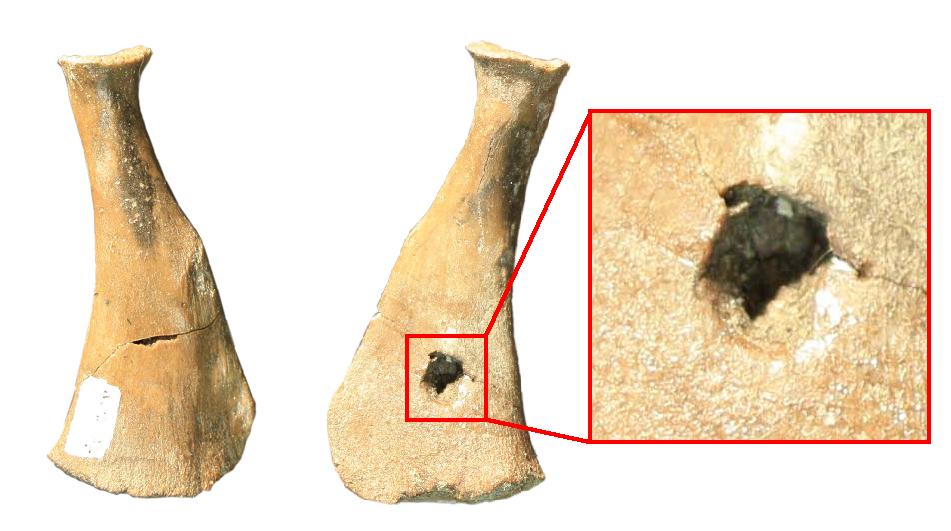
The fossil fur seal radius, UCMP 219009, in lateral (left), medial (center), and a magnified image of the bite mark (right).
When I prepared the bone from the soft shelly sandstone later that evening, I found a strange hole on the medial (medial means the side fo the radius closer to the body) side of the bone. This hole had a ring fracture around it, and a depressed ring of the bone's surface was adjacent to the hole itself. Pushed down into the hole was a fragment of the bone surface that had formerly occuppied the middle of the hole. Most importantly, when I prepared this fossil, there was sandstone filling in this feature, and because I was very careful and collected the bone in a block of sandstone, I knew that I had not damaged the specimen, and that this feature had not been formed after fossilization (i.e. it could not have been damaged when it was exposed, because the side with the puncture mark was embedded in sediment). Additionally, there were no hard objects such as a pebble or a shell that could have been pushed into the bone surface - sediment becomes compacted after burial, due to the immense pressures induced by trillions upon trillions of tons of rock overhead. Diagenetic compaction could push a pebble or an invertebrate shell into the bone surface and cause a similar puncture mark. Incidentally, bone can as well - a cranium of Herpetocetus bramblei I am working on describing with Jonathan Geisler has a similar puncture to those reported here, but the end of the jugal bone actually was lodged into the hole, probably as a result of diagenetic compaction. That would make a great paper, too, come to think of it...
Needless to say I was pretty confused at first, and I held off on interpreting it immediately, until I had read some more literature in order to come to a more informed decision on what I thought it was. I've written enough for now, so I'll continue this in a following post.
See also: Dr. Alton Dooley's blog post about this and other bite marks at Updates from the Vertebrate Paleontology Lab.
Boessenecker, R.W. and F.A. Perry. 2011. Mammalian bite marks on juvenile fur seal bones from the late Neogene Purisima Formation of Central California. Palaios 26:2:115-120. Abstract. Paper at Bioone.org.
Subscribe to:
Posts (Atom)