Showing posts with label fur seal. Show all posts

Saturday, January 7, 2012

Dead baby fur seals at the California Academy of Sciences

Well, it’s been over a month since I’ve posted anything. It’s been a busy winter – in the mean time, my wife and I have celebrated Thanksgiving in California with my family, and have been in Montana for the last week with her family. I’ve been typing like a beast (30 pages for one manuscript just since I’ve been back in Big Sky country) over the last month or so. I’ve been working on my longest manuscript yet (not including my thesis, however it will soon overtake it), which as of this morning reached 110 pages. Additionally, we’ve been trying to get certain things ready for our imminent move to New Zealand. Just prior to Christmas vacation, I spent a couple of days visiting the Ornithology and Mammalogy collections at California Academy of Sciences.

A menagerie of bird and mammal skeletons and mounts.

A giraffe skull sits next to the sign in book.

A row of shelving filled with fur seal and sea lion skulls and skeletons.

A beautiful mounted skeleton of a sea otter (Enhydra lutris).

I’ve been making a couple visits per year to Cal Academy since 2006; I originally visited when the new building was under construction, and the academy (exhibits, departments, and all) were at the temporary storage facility in SoMa (South of Market in Downtown San Francisco, for the non Bay Areans) to check out their collection of Purisima Formation fossils, and to utilize their ichthyology and mammalogy collections to identify shark teeth and pinniped bones from various Miocene and Pliocene strata from Northern California.

A bunch of large mysticete vertebrae awaiting curation.

A pilot whale (Globicephala macrorhinchus) skull in the CAS collections.

On previous visits, I’ve searched the Mammalogy collection of skeletons to make comparisons with modern and fossil bones and teeth of fur seals, walruses, pilot whales, porpoises, and baleen whales. In 2010, I collected some (relatively basic) data on the variation of tooth root lobe morphology in northern fur seals (Callorhinus ursinus) for comparison with fossil fur seals, which I published in JVP earlier this year. A current project I am working on is writing up an entire marine vertebrate assemblage (~200-300 fossils), and I am working on a lengthy manuscript on the marine mammal compliment of the assemblage. Needless to say, the large and very well curated collection of marine mammal skeletons at California Academy of Sciences has been indispensable throughout this endeavor, and has made many fossil identifications possible and paved the way towards insights into marine mammal osteology.

Many crania and jaws of the Northern Elephant Seal (Mirounga angustirostris) are too large for storage boxes and sit right on the shelves.

A walrus (Odobenus rosmarus) skull with two baculi thrown in for good measure (no pun intended).

A bunch of boxes full of Galapagos Sea Lion skeletons (Zalophus californianus wollebaeki).

On my most recent visits, my objectives were threefold: first, to take photographs of many extant species of otariids (fur seals and sea lions) for a morphobank project with my colleague Morgan Churchill; second, to photograph nearly every skeletal element from an adult northern fur seal in order for comparison with fossil fur seals from California (e.g. Thalassoleon, which has previously been hypothesized to be closely related to Callorhinus); and third, to photograph and examine lower jaws of neonatal and fetal fur seals and sea lions.
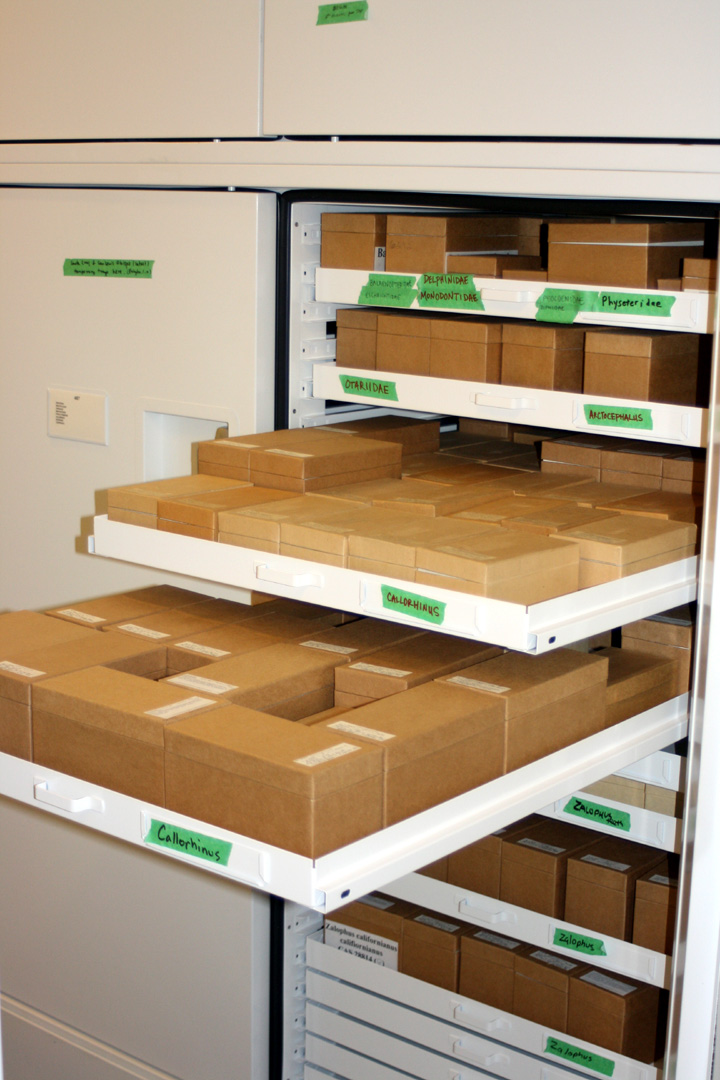
Several drawers filled to the brim with boxes of small (fetal, neonatal, and juvenile) otariid skulls. Most of these are Callorhinus ursinus.

I won’t get into the specifics quite yet, nor will I talk about the fossils that spurred my curiosity regarding the third subject – I’ll only say that it is pretty damn neat if I may say so myself. That being said – I am very interested in the morphology of deciduous (milk) teeth in young fur seals, as well as the timing of molar and premolar eruption in the lower jaws of these animals. I’ll briefly mention that modern pinnipeds are a bit weird in that they (like most) mammals have milk teeth, but they are often shed before birth, so that the pups are born with a full set of adult chompers. Their milk teeth have a very reduced functional period, and additionally are reduced to tiny little pegs (unlike the milk teeth of terrestrial carnivores). Although they still develop milk teeth, pinnipeds are trending toward monophyodonty – that is, having only one set of teeth as opposed to two (diphyodonty). Cetaceans are monophyodont, and pinnipeds are an excellent example of a second clade of marine mammals following the same evolutionary trend.

A baby fur seal head (Callorhinus ursinus).

A neonatal Callorhinus ursinus skull in lateral view.

In order to examine the tiny milk and permanent teeth of these pups and fetuses, I brought along my new toy – a small, portable, USB powered digital microscope which plugs into my notebook laptop (…another new toy, which I’m using from a secure location in Montana). It displays the image on the screen, and can acts as a camera as well. Fortunately, there is a button to take a picture with in the software, rather than having to manually press a button on the microscope (which, due to its small size, usually jiggles it and screws up the picture). At an earlier UCMP visit in October, I was able to take around 200 photos of 100 tiny fossil specimens in a little over two hours. With the digital microscope, I was able to take a bunch of photos of milk and permanent teeth from nearly a dozen or so specimens of northern fur seal (Callorhinus), California sea lion (Zalophus), and Steller’s sea lion (Eumetopias). Unfortunately, there weren’t any northern fur seal fetuses, or specimens with deciduous premolars – but the data for sea lion fetuses I collected was more than sufficient to answer my fossil-related queries.

Yours truly using my digital USB microscope to examine the morphology of
fetal and neonate fur seal teeth; this specimen is a Northern Fur Seal (Callorhinus ursinus).

Milk teeth and unerupted adult teeth in the lower jaw of a California sea lion (Zalophus californianus) fetus.

Tuesday, March 29, 2011

Fossil Fur seals from Northern California, part 2: The Gilmore Fur Seal

In 1948, Gretchen Burleson published a short article on some fossil pinniped jaws discovered in the Pliocene San Diego Formation, a sandstone mollusk-bearing unit that forms the hills of the San Diego area. These were some of the earliest pinniped fossils to be described from California - previously only a handful had been described, including the strange phocoid Allodesmus from the Sharktooth Hill Bonebed near Bakersfield, California, the woefully incomplete walrus (then assumed to be an otariid) Pliopedia pacifica from the Kettleman Hills, the hopelessly squashed fur seal Pithanotaria from Santa Barbara, and the even stranger Dusignathus santacruzensis from Santa Cruz.

All of these creatures were assumed then to belong to sea lions: most of them were large, and relatively robust, and differed markedly in many respects from true seals. Most of the early descriptions of pinnipeds we now know to be walruses are se
emingly obsessed with comparing them to sea lions, and no doubt early workers such as Kellogg were frustrated with the alien nature of many of the fossils: they were about the same size as sea lions, but there were just so many little differences. The answer would not come until much later when decidedly modern researchers like Charles Repenning realized the true walrus affinities of many of these critters (like Pliopedia and Dusignathus).

Unlike the rather large and aberrant jaws of Allodesmus kernensis and Dusignathus santacruzensis, the fossil jaws from San Diego looked like a perfect match for a modern sea lion or fur seal: it had a shallow jaw with small triangular cuspate teeth, and the jaw was rectangular (i.e. the dorsal and ventral margins are parallel). The larger jaws o
f other better known pinnipeds had too many specialized features to be ancestral to sea lions: Dusignathus had widely flaring jaws without incisors and a canine that projected anteriorly, while Allodesmus lacked cusps on its postcanine teeth, which looked instead like little onions or bulbs. Burleson (1948) assigned these specimens to Pithanotaria, despite the much older age of Pithanotaria starri material described by Kellogg (1922) and the lack of actual morphological characters that identified the jaw of Pithanotaria. Burleson (1948) thought this specimen had a morphology intermediate between Pithanotaria and the modern Northern Fur Seal, Callorhinus.

Skull and dentition of a modern female Callorhinus ursinus, showing
single rooted, cuspate teeth.

In a much later paper by the preeminent paleo-pinnipedologist Charles
Repenning and carnivoran researcher Richard Tedford (1977), this specimen was briefly discussed and they concluded that it did not represent Pithanotaria and was likely much closer to Callorhinus ursinus. After observing trends within the dental evolution of walruses like Imagotaria, Repenning and Tedford (1977) had identified the utility of the stage of root fusion as a taxonomic guide. For example, all modern otariids (fur seals and sea lions), the walrus, and some seals have single rooted teeth, while primitive pinnipeds and terrestrial carnivorans retain a number of double and triple-rooted teeth. For whatever reason, these root lobes coalesced through time and resulted in single rooted teeth in a number of taxa.

The dentary of the holotype of Callorhinus gilmorei, from Berta and Demere 1986.

Repenning and Tedford (1977) were surprised that Burleson (1948) had not noticed the interesting configuration of the tooth roots of this specimen: the third and fourth premolars and the molar were still double rooted, while only the first and second premolars were single rooted; in the modern Northern Fur Seal, Callorhinus ursinus, all the lower
premolars and molar are single rooted. It was indeed a fur seal, but retained some interesting primitive features.

In 1986, after an extensive excavation of a bonebed in the San Diego Formation that would be christened the Mission Hills Bonebed, additional remains of this fossil pinniped were discovered including several jaws, teeth, skull fragments, and postcranial bones
. The discovery of a partial skeleton of an immature female skeleton allowed Annalisa Berta (San Diego State University) and Tom Demere (San Diego Natural History Museum) to describe the San Diego fur seal as a new species - and sure enough, they found that its features placed it as a close relative of the modern Northern Fur Seal, Callorhinus. They named it Callorhinus gilmorei, named after Dr. Raymond Gilmore. In other regards, Callorhinus gilmorei was a relatively small fur seal - substantially smaller than modern skeletal remains, with less strongly developed cusps on postcanine teeth, and a more 'primitive' state of root fusion.
The new specimen of Callorhinus gilmorei from the Rio Dell Formation of Northern California described by Boessenecker (2011)

Subsequently, Kohno and Yanagisawa (1997) reported a tiny partial jaw from the late Pliocene of Japan. This jaw exhibited double rooted cheek teeth (although the anterior premolars were not preserved), and had accessory cusps on the cheek teeth, so they identified it as Callorhinus gilmorei. This extended the range of the Gilmore fur seal to the western Pacific - similar to the range of the modern Callorhinus ursinus.

Needless to say, I had a few ideas to follow once I started looking into Bushell's fur seal specimen. Fossils of C. gilmorei had so far only been found in Middle to Late Pliocene deposits, whereas in the late Miocene and earliest Pliocene of Japan, California, and Mexico the earlier fur seal Thalassoleon occurred (which has all double rooted teeth, and lacks cuspate cheek teeth, among other differences). The new specimen only has one cheek tooth - but it has a well developed accessory cusp, like C. gilmorei, and the first two premolars are both single rooted - also like C. gilmorei. In addition, it is relatively small - many other modern otariids are substantially larger. Furthermore, C. gilmorei appears to be the only middle-late Pliocene otariid in the entire Northeastern Pacific fossil record, which made the identification process somewhat easier.

Next up: Other fossil otariids from California and Oregon, and the Pleistocene Callorhinus
specimen.

References:

Berta, A., and T. A. Demere. 1986. Callorhinus gilmorei n. sp., (Carnivora: Otariidae) from the San Diego Formation (Blancan) and its implications for otariid phylogeny. Transactions of the San Diego Society of Natural History 21:111–126.

Boessenecker, R.W. 2011. New records of the fur seal Callorhinus (Carnivora: Otariidae) from the Plio-Pleistocene Rio Dell Formation of Northern California and comments on otariid dental evolution. Journal of Vertebrate Paleontology 31:2:454-467.

Burleson, G. L. 1948. A Pliocene pinniped from the San Diego Formation of southern California. University of California Publications in Zoology 47:247-254.

Kellogg, R. 1922. Pinnipeds from Miocene and Pleistocene deposits of California. University of California Publications, Bulletin of the Department of Geological Sciences 13:23–123.

Kohno, N., and Y. Yanagisawa. 1997. The first record of the Pliocene Gilmore fur seal in the Western North Pacific Ocean. Bulletin of the National Science Museum, Tokyo 23:119–130.

Repenning, C. A., and R. H. Tedford. 1977. Otarioid seals of the Neogene. US Geological Survey Professional Paper 992:1–87.

Saturday, March 26, 2011

Fossil Fur seals from Northern California, part 1: discovery

Earlier this week saw the publication of my third article, concerning fossil fur seals of the genus Callorhinus from the Pliocene and Pleistocene of Humboldt County in Northern California. This paper has been in the works since 2006; I presented a poster on this topic at SVP in 2007. I did some of the initial research in 2006 and 2007, and after my SVP poster, I tried a couple more drafts of the manuscript - but it, along with a couple of other projects, fell by the wayside until I started graduate school. It wasn't until I had the herpetocetine jaw paper off my plate that I returned to this project, and in may of last year I submitted my completed MS to the Journal of Vertebrate Paleontology after three years of intermittent research.

The first page of Boessenecker (2011)

The story really starts in 2004. My buddy Ron Bushell, who helped me identify many of my fossils when I was still in High School, was collecting at a fossil site in Humboldt County, California. At this particular locality, he was looking for large concretions from the Rio Dell Formation which occasionally bear beautiful scallops (Patinopecten) the size of dinner plates, and incredible 6-10" long gastropods.

Ron and his collecting partners walked down the riverbank looking for nodules bearing mollusks, and thought he had hit the jackpot when he found a large nodule, about 2 feet in diameter, just sitting there in the gravel bar. Now, Ron is an experienced nodule collector - he's spent a lot of time collecting nodules with mollusks from the Pliocene and Pleistocene of Humboldt County, and Eocene crabs from Oregon and Washington.

So, if you're a nodule collector, naturally you take out a sledge hammer and attempt to destroy the concretion. Many concretions have nothing in them, and it is better to crack them in the field rather than lug them home and find out later (at some crab localities, Ron knows well enough which concretions will have crabs, and which ones won't, and packs them all out, and cracks them in his garage). Well, he broke this concretion open, and instead of white shells being exposed, familiar (but much rarer) brown fragments flew out onto the river bank - he immediately knew that he had found bone.

Initial preparation of the Bushell specimen.

Normally, Ron would keep any vertebrate fossils from this locality, due to their rarity. However, he also noticed a tooth fragment - and he knew he had found something pretty important. So, just like any crab or mollusk fossil, he collected all the pieces, took them home, and glued them all together in his garage, and begun airscribing the fossil.

Continued preparation of the Bushell specimen.

As it turned out, Ron had found two associated lower jaws (left and right) of a small fur seal, preserved beautifully in relief in a large concretion. He posted these photos on the old "Collecting fossils in California" forum, and I was very interested once I saw it. After a few emails, he offered to let me study the specimen - an opportunity I was most excited for.

Finished preparation of the Bushell specimen.


The Bushell specimen as it was when I first saw it.

The following summer, my fiancee (then girlfriend) and I drove out to California for the summer, but took a detour through Oregon and Humboldt County in order to visit Ron and pick up this beautiful specimen. Thanks to Ron's generosity, this fossil was made available to study - and now (finally, five years later) Ron's wish that it be studied finally culminated in my paper in the Journal of Vertebrate Paleontology.

Next up - introduction to the "Gilmore Fur Seal", Callorhinus gilmorei.

Boessenecker, R.W. 2011. New records of the fur seal Callorhinus (Carnivora: Otariidae) from the Plio-Pleistocene Rio Dell Formation of Northern California and comments on otariid dental evolution. Journal of Vertebrate Paleontology 31:2:454-467

Saturday, February 26, 2011

New artwork II: 'rediscovered' specimen drawing

About two months ago, I was cleaning off my desk and found a sheet of vellum paper with an old specimen drawing I had done. This drawing was is of a pair of associated dentaries of the Pliocene fur seal Callorhinus gilmorei. I first presented on this fantastic specimen on my 2007 SVP poster at the Austin, TX meeting.


Unfortunately, I discovered this about three months after my manuscript describing this fossil was accepted in JVP, and there was no way to include it in the published article. To be honest, I could probably do better now, but I think it turned out reasonably well for a journal article figure. In the future I'm going to do a lot more technical illustrations of individual specimens, partly as practice, but also to showcase myself.

Stay tuned! The article will be published in the March 2011 issue of JVP: that's sometime in the next couple of weeks. (Holy god, it's March in only 48 hours!). More artwork is on its way.

Boessenecker, R.W. In Press. New records of the fur seal Callorhinus (Carnivora: Otariidae) from the Plio-Pleistocene Rio Dell Formation of Northern California and comments on otariid dental evolution. Journal of Vertebrate Paleontology 31:2. 14pp.

Wednesday, February 2, 2011

Mammal bite marks on fur seal bones, part 1

It's approximately four in the AM in beautiful Long Island, New York, and this most recent blog post is brought to you by insomnia! I tend to not fare well in unfamiliar hotel rooms unless I'm relatively exhausted. Even though I'm running on a total of four hours of sleep since the night before I flew out to New York, I fared pretty well today. Tomorrow, I have a visit to the American Museum of Natural History in NYC, and Jonathan Geisler and I will be examining globicephaline dolphin skulls; the Globicephalinae are a clade of delphinids (oceanic dolphins) including pilot whales (Globicephala), Risso's Dolphin (Grampus), and false killer whales (Pseudorca). We're working on a short article together on a very fragmentary large odontocete skull from the Purisima Formation in Santa Cruz that shares some features in common with Globicephala.

But I'll talk more about that project later. More importantly, over this last weekend my first article was published - "Mammalian bite marks on juvenile fur seal bones from the late Neogene Purisima Formation of central California", which I coauthored with my friend and colleague Frank Perry of the Santa Cruz Museum of Natural History. And, oddly enough, right as I am typing this up now, I see that my friend Dr. Alton "Butch" Dooley at the VMNH has already beat me to the punchline (thanks for the free publicity, Butch!), and has discussed my new paper on his blog, and compared it with some similar bite marks on proboscidean and chalicothere postcrania. Seeing as this is my first published article, I'll go a bit more in depth this time and post this in two or three parts.


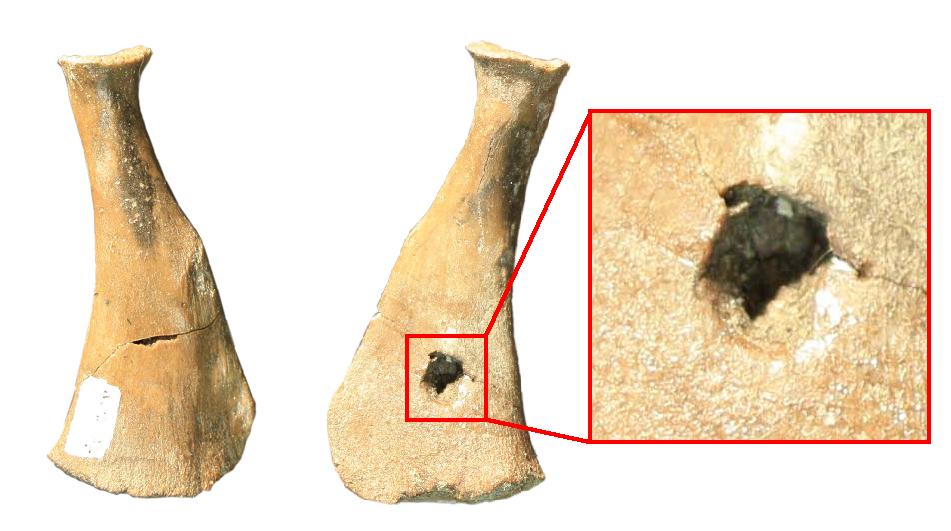
The story starts on Christmas day, 2008. As I've alluded to before, winter is one of the best times to go out to the coast and do fieldwork. I suffered through some pretty intense, cold, biting weather this winter - I do not advise wearing hiking sandals on the beach and crossing streams in 45 degree weather with 40mph wind. That hurts. Anyway, now I'm rambling. I left our annual (gigantic) family Christmas dinner in Marin County and went to bed early, planning to take advantage of a favorable tide the day after Christmas. While out on the coast, I saw a boulder of a shellbed that is not normally accessible that had fallen on the beach, and a cute little brown object sticking out of it. Enough was exposed to identify it as a radius (forearm bone) of a juvenile fur seal. The specimen is tiny, and is only 69mm in length; this specimen, however, is lacking the proximal and distal ("elbow" and "wrist" ends of the bone, respectively) epiphyses (epiphyses are the ends of long bones which at birth are unfused, and fuse onto the middle 'shaft' of the bone later in life; the joint they fuse at is sometimes called the 'growth plate', and the fusion of epiphyses is what results in the decreased number of bones in adults relative to the higher number of bones in infants).

The fossil fur seal radius, UCMP 219009, in lateral (left), medial (center), and a magnified image of the bite mark (right).

When I prepared the bone from the soft shelly sandstone later that evening, I found a strange hole on the medial (medial means the side fo the radius closer to the body) side of the bone. This hole had a ring fracture around it, and a depressed ring of the bone's surface was adjacent to the hole itself. Pushed down into the hole was a fragment of the bone surface that had formerly occuppied the middle of the hole. Most importantly, when I prepared this fossil, there was sandstone filling in this feature, and because I was very careful and collected the bone in a block of sandstone, I knew that I had not damaged the specimen, and that this feature had not been formed after fossilization (i.e. it could not have been damaged when it was exposed, because the side with the puncture mark was embedded in sediment). Additionally, there were no hard objects such as a pebble or a shell that could have been pushed into the bone surface - sediment becomes compacted after burial, due to the immense pressures induced by trillions upon trillions of tons of rock overhead. Diagenetic compaction could push a pebble or an invertebrate shell into the bone surface and cause a similar puncture mark. Incidentally, bone can as well - a cranium of Herpetocetus bramblei I am working on describing with Jonathan Geisler has a similar puncture to those reported here, but the end of the jugal bone actually was lodged into the hole, probably as a result of diagenetic compaction. That would make a great paper, too, come to think of it...

Needless to say I was pretty confused at first, and I held off on interpreting it immediately, until I had read some more literature in order to come to a more informed decision on what I thought it was. I've written enough for now, so I'll continue this in a following post.

See also: Dr. Alton Dooley's blog post about this and other bite marks at Updates from the Vertebrate Paleontology Lab.

Boessenecker, R.W. and F.A. Perry. 2011. Mammalian bite marks on juvenile fur seal bones from the late Neogene Purisima Formation of Central California. Palaios 26:2:115-120. Abstract. Paper at Bioone.org.