Showing posts with label balaenopteridae. Show all posts

Thursday, August 9, 2012

Parabalaenoptera baulinensis: the fossil baleen whale from Bolinas, Marin County, California


Until relatively recently, fossil balaenopterids have been avoided by modern paleocetologists like the plague. Modern balaenopterids include the humpback whale (Megaptera novaeangliae) and species of Balaenoptera, including the Minke, Blue, Fin, and Sei whales. Although balaenopterids have very distinctive and easy to identify crania, they are really only common in latest Miocene and Pliocene marine rocks, and early work by Kellogg and others yielded fossil baleen whales with much more primitive skulls, formerly called "cetotheres" sensu lato, also jokingly referred to by some paleocetologists as "Kelloggitheres".

Fossil balaenopterids have been plagued by a particularly nasty taxonomic situation since the late nineteenth century, when P.J. Van Beneden began describing fossil mysticetes collected during the construction of a series of forts around Antwerp. Unfortunately, many of these fossils which names like Plesiocetus and Herpetocetus are based upon were isolated finds, which were subsequently arranged into type 'series' with other skeletal parts based on a preconceived notion of what each taxon should have looked like. The end result was a series of chimaeras, some of which represented by potentially informative but often fragmentary material, lacking type specimens, the associated names of which have been dragged through the systematic mud by subsequent authors, and not allowed to simply die gracefully.

The skull and mandibles of the holotype specimen of Parabalaenoptera baulinensis from the late Miocene Santa Cruz Mudstone of Marin County, California.

Many of these fossil balaenopterids are difficult or impossible to diagnose: which specimen of the series would you designate as a lectotype? Is that specimen diagnostic? What do you do with the other specimens? Is an isolated mandible diagnostic or not? What about a piece of a braincase with unassociated bullae? According to Bosselaers and Post (2010), many of Van Beneden's taxa are based on "syntype" collections that are not possible to unambiguously diagnose: diagnostic syntype elements are either too incomplete, or include multiple diagnostic elements but from multiple individuals (and occasionally taxa; i.e. a balaenid bulla was grouped with the lectotype mandible of Herpetocetus scaldiensis by Van Beneden). Accordingly, Bosselaers and Post (2010) declared all of Van Beneden's Pliocene balaenopterid taxa to be nomina dubia: for the time being, I think this is probably the "safe", appropriate, and right thing to do.

The discovery and description of Parabalaenoptera baulinensis was one of the first important advances in balaenopterid paleontology: it was one of the first balaenopterids described from a nearly complete skull with associated mandibles and postcrania. Some other previously published fossil balaenopterids were described on somewhat complete remains: Megaptera miocaena (late Miocene of California), Megaptera hubachi (late Miocene of Chile), Protororqualus cortesii (Pliocene of Italy), "Balaenoptera" cortesi var. portisi (Pliocene of Italy), and Cetotheriophanes capellinii (...also Pliocene of Italy). Unfortunately, the holotype skeleton of Protororqualus was destroyed during bombing in World War II, and M. miocaena only includes earbones and a braincase; furthermore, the other Italian balaenopterids have been plagued with nomenclatural issues for over a century (see Demere et al. 2005).
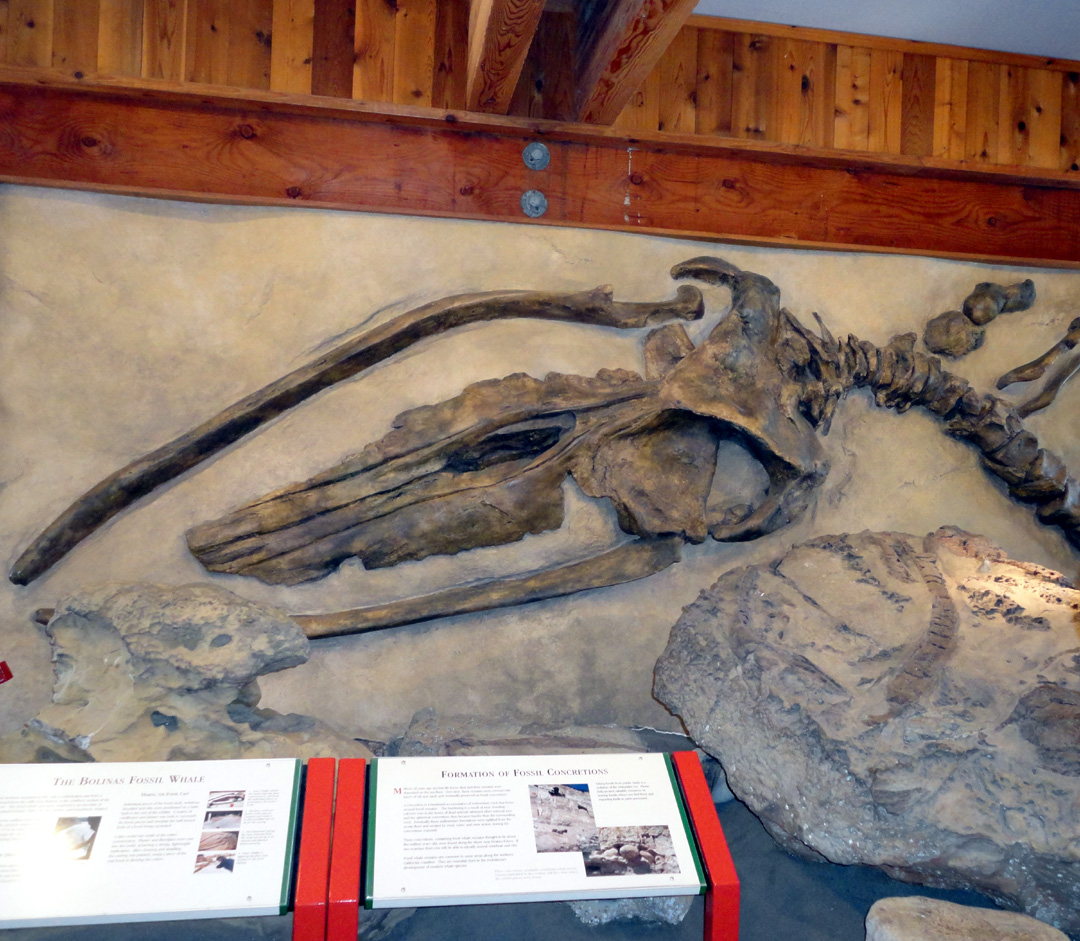
The exhibit at the Drakes Beach visitor's center showing the holotype skeleton of 
Parabalaenoptera baulinensis.

In 1973, a large mysticete skeleton was discovered by Carl Zeigler of the College of Marin, weathering out of cliffs near Bolinas in Marin County, California. Bolinas is a quaint artist community on the Marin County coast and has changed little since the 1960's and 70's; it is predominantly settled by ex-hippies, who generally don't like visitors from out of county, and have continually removed the exit sign for "Bolinas: 2 miles" off of highway 1, to the point where the California Dept. of Transportation (CalTrans) has given up putting up new signs. Tales abound of visitors with out of county or out of state license plates having car tires popped or vandalized, and nails and other tire-popping objects being intentionally laid out onto dirt roads in town. My car had a San Rafael Honda license plate holder, so I never had this problem.

The assembled holotype skull of Parabalaenoptera at California Academy of Sciences, photographed by fellow Otago Ph.D. student Felix Marx.

Exposed along the southern tip of Point Reyes is a unit formerly identified as the early late Miocene Monterey Formation; this was subsequently reevaluated after Domning (1978) suggested that sea cow fossils from the Bolinas locality were too derived to be from such an old unit. Afterwards, microfossils suggested a much younger age, closer to the Mio-Pliocene boundary (6-6.8 Million years old), and the formation was reidentified as the Santa Cruz Mudstone, which has only been mapped in Santa Cruz County.

Anterior view of Parabalaenoptera.
The fossil occurred in indurated, blocky mudstone, and was collected over a ten year period as the blocks incrementally eroded from the cliff. The lead authors - Gordon ("Gordie") Chan and Carl Zeigler of the College of Marin in Kentfield, and their field assistants - would have to travel over the hill and out to Bolinas (nearly an hour's drive through some of the windiest vomit-inducing roads in Northern California) on a monthly basis during the summer, and much more often during the winter during periods of intense erosion, and sometimes daily, anticipating falling blocks. After collection, the blocks were prepared, and some were glued together - but left as a series of blocks that could be lined up and assembled. The holotype was prepared at College of Marin, and eventually molded, casted, and donated to the California Academy of Sciences. Mounted casts of Parabalaenoptera baulinensis are currently on display at College of Marin in Kentfield and at the Drake's Beach visitor center at Point Reyes National Seashore. Sadly, before the paper could be published on the fossil - Carl Zeigler and Gordon Chan passed away. Chan passed away in 1996 of Lou Gehrig's disease; I could not find information on Zeigler, though I seem to recall hearing that he was killed by a drunk driver. Dr. Lawrence Barnes of the Los Angeles County Museum of Natural History finished the manuscript and brought it to publication in the California Academy of Sciences in 1997.

The braincase and vertex of Parabalaenoptera.
Parabalaenoptera baulinensis is a medium-sized balaenopterid with a 2.2 meter skull, slightly larger than minke whales (Balaenoptera acutorostrata; a 10 meter long whale with a 2m skull), but has a number of features that are too divergent to warrant inclusion within humpbacks (Megaptera) or Balaenoptera. These include the very elongate and somewhat swollen zygomatic processes, narrow intertemporal region (the skull is less 'telescoped than in modern balaenopterids), and extremely long and narrow nasal bones. The mandibles are strongly outwardly bowed like in Megaptera, and have an elongate coronoid process - somewhat like blue and fin whales (Balaenoptera musculus and physalus). Many of these features suggest that Parabalaenoptera baulinensis was capable of lunge feeding just like modern rorquals. It is additionally convergent with Balaenoptera musculus in having a supraorbital process of the frontal that is somewhat triangular and narrows laterally, whereas in Balaenoptera and Megaptera, the posterior and anterior margins are either parallel, or the posterior margin is perpendicular to the midline. Unfortunately, the holotype specimen is not preserved very well, and it appears that a significant amount of bone was accidentally removed or ground away during preparation, and details of the basicranium are almost totally indiscernible. Parabalaenoptera has been found in many phylogenetic analyses to be a stem-balaenopterid - in other words, a primitive member of the clade (family Balaenopteridae) that does not belong to the clade formed by humpback whales and modern species of Balaenoptera - the Megaptera + Balaenoptera clade, if you will. These two modern genera have been traditionally grouped into the "Megapterinae" and "Balaenopterinae" - Zeigler et al. (1997) even went so far as to name a new subfamily, the Parabalaenopterinae. However, given that none of these subfamilies have really shown to be stable or even consistent in cladistic analyses, it's unclear what the utility of such taxon names even is.

Reconstruction of the holotype skull and mandibles of Parabalaenoptera. Unfortunately, certain features (e.g. squamosal morphology) of the actual skull don't really look like how they're portrayed in this figure. From Zeigler et al. (1997).

Nevertheless, the description of Parabalaenoptera was a hallmark in balaenopterid paleontology; however, given the stagnated taxonomic situation of fossil balaenopterids, little else was published on fossil balaenopterids until Michelangelo Bisconti started revisiting Italian fossils starting in 2007. In the last five years, a number of informative balaenopterid finds have been described - but it is only the tip of the iceberg. Perusing late Miocene and Pliocene marine mammal assemblages in Museums, it is apparent that balaenopterids comprise nearly two-thirds of the more recent baleen whale fossil record (it is at least the case for California marine mammal assemblages). In California, at least four to five unpublished balaenopterids await description from the Pliocene alone. Additional fossils that may represent Parabalaenoptera - potentially a new and slightly younger species - have been collected from the Purisima Formation near Santa Cruz (and are in much better condition than the holotype). The future of balaenopterid paleontology is bright!

References

Bosselaers, M., and Post, K. 2010. — A new fossil rorqual (Mammalia, Cetacea, Balaenopteridae) from the Early Pliocene of the North Sea, with a review of the rorqual species described by Owen and Van Beneden. Geodiversitas 32:331-363. 

Deméré, T. A., Berta, A., and McGowen, M. R. 2005. — The taxonomic and evolutionary history of modern balaenopteroid mysticetes. Journal of Mammalian Evolution 12:99-143.


Domning, D. P. 1978. — Sirenian evolution in the North Pacific Ocean. University of California Publications in Geological Sciences 18:1-176.


Zeigler, C. V., Chan, G. L., and Barnes, L. G. 1997. — A new late Miocene balaenopterid whale (Cetacea: Mysticeti), Parabalaenoptera baulinensis, (new genus and species) from the Santa Cruz Mudstone, Point Reyes Peninsula, California. Proceedings of the California Academy of Sciences 50(4):115-138.


Tuesday, May 11, 2010

New Purisima Fm. mysticete skull

As promised, here are some photos of the skull that was discovered on thursday and excavated by the following monday. I apologize for the lack of posts lately; I've been damn busy the last few weeks, wrapping up my first semester of teaching, finishing classes and finals, and getting a lot of typing done; over the weekend I submitted a manuscript (my third now) to the Journal of Vertebrate Paleontology on some fur seal fossils from Humboldt County, California.

Anyway, Karl Heiman took all these photos and graciously let me pirate them and put them up here. Thanks Karl!

The skull is somewhere down in that trench the excavator dug. I imagine that's Dave Maloney up front, I can see one of the two lead engineers (both pretty cool guys). You can see that this fossil was only about a foot or so down below the wave cut platform; I must have walked right above this thing hundreds of times.

Here's all the bone that was poking out initially. Pretty ugly if you ask me. This is what you have to start with from heavy machinery - it often fractures a small zone of the bone. Waves and the fiercest winter storms are decidedly more gentle, and can expose bones that look nice enough to warrant collection. Nevertheless...

Hey, there's something there, all right! This is one of the first photos I saw of the thing, and I got pretty excited, and nervous; it looked like the trench had cut obliquely across the rostrum.

And further posterior at this stage of the excavation. You can see the occipital condyles to the left; a bit of the right side is gone, and it isn't clear what angle the cut goes to - obliquely to the left across the entire skull, it would seem.

Wow, I'm impressed - the left side of the skull looks beautiful. You can see much of the left maxilla, left frontal, and left squamosal here.

Holy cow! Here's the money shot. This thing is just beautiful! Fortunately, the trench went exactly parallel to the long axis of the skull, and didn't even cut across the rostrum; the anterior tip of the rostrum is intact, and aside from some minor damage to the left maxilla, is more or less complete (on the left side).

Here Dave Maloney (left) and Karl Heiman (right) pose while excavating Karl's beautiful new discovery.


At last, the plaster jacket is on the fossil. Apparently not two minutes after 5:00 Karl and Dave got the jacket on, a large wave came in and filled in the hole, which is now the size of a swimming pool. The specimen is probably now on its way (or already) to the prep facility. Luckily for these guys, the sediment is really soft and separates from the bone easily, and should make for a really easy prep job.

Thursday, April 15, 2010

Prep update: Purisima Formation mysticete skull 3

Here are some pictures of the balaenopterid skull after preparation was completed. I finished preparation the tuesday before spring break. On wednesday and thursday I made the cradles, and friday loaded it into my car to drive back to California (on saturday).


Oblique posterolateral view of the Purisima balaenopterid skull.
Ventral view of the Purisima balaenopterid skull.Lateral view of the Purisima balaenopterid skull.The skull with the completed ventral cradle.The skull with both ventral and dorsal cradles.

On Friday of Spring Break, I met UCMP Curator Mark Goodwin at the oversize storage facility to drop the specimen off. UCMP is getting a new storage facility which will be a vast improvement over the current warehouse at the Clark Kerr campus (conveniently located right on the Hayward Fault).

Tuesday, April 6, 2010

Prep update: Purisima Formation mysticete skull 2

Hey folks,

As I mentioned in a previous post, I've been preparing a fossil mysticete skull I collected from the Purisima Formation in 2005 for a long time (i.e. 4.5 years). This winter and spring I really stepped up preparation, and you can see in these photos what the specimen looked like in January. At this point, Tom Demere of the San Diego Natural History Museum, who specializes in fossil mysticetes, tentatively identified this specimen as belonging to "Balaenoptera" cortesii var. portisi, a medium sized balaenopterid from the Pliocene of Italy, Florida, and California (Demere et al. 2005). An undescribed cranium (UCMP) from the San Diego Formation and several crania I've seen in the Purisima Formation have this same morphology, but I did not realize this taxon was B. cortesii var. portisi, or that this specimen belonged in that taxon. "Balaenoptera" cortesii var. portisi is characterized by elongate, widely diverging zygomatic processes, which these other fossils have; it appears that the zygomatics of this specimen are damaged. It is also a taxon that needs a new genus, as it definitely has features that place it outside of Balaenoptera. Tom Demere and Michelangelo Bisconti are currently revising this taxon (Demere et al., 2005).

The new Purisima mysticete skull in posterolateral view.

The new Purisima mysticete skull in anterolateral view.

The new Purisima mysticete skull in dorsal view. note the wide, triangular supraoccipital shield, a typical feature of balaenopterids.
The new Purisima mysticete skull in anterodorsal view.

Anyway, quite a bit of matrix was left at this point. Soon, I'll post pictures of the specimen after preparation is completed.

Deméré, T.A., A. Berta, and M.R. McGowen. 2005.
The taxonomic and evolutionary history of fossil and modern balaenopteroid mysticetes. Journal of Mammalian Evolution 12:99-143.

Monday, March 1, 2010

Prep update: Purisima Formation mysticete skull 1

In 2005 I received a permit to collect vertebrate fossils from a locality in the Purisima Formation. This project lasted two summers, and resulted in the collection of dozens of shark teeth and vertebrae, calcified cartilage skate jaws, pinniped bones and teeth, several bird bones, odontocete and mysticete bones, including a handful of tympanics, a complete lower jaw of Herpetocetus, a porpoise cranium, and the big kahuna: a 300+ lb plaster jacket with some sort of mysticete skull inside. I wasn't really sure what it was in the field, although I suspected it was a balaenopterid (i.e. rorqual whale, like a Minke, Humpback, Fin, or Blue whale) on gut feeling alone.
The cranium prior to excavation, June 2005.

I first spotted the skull over thanksgiving break in November, 2004, with a flashlight just after sunset. I thought it was a skull at the time, but hadn't seriously thought about getting a permit yet. After I started the permit application process, I actually forgot entirely about the skull, and hadn't thought seriously about excavating it. When I finally stumbled across it again, I thought "why the hell not?" and up until the last few weeks, I've regretted the decision. Bottom line - I spent five months preparing the soft matrix from the ventral side, and in Spring 2006 I moved it to Museum of the Rockies, where I've been (intermittently, given my school schedule) preparing it with pneumatic airchisels since.

Day 1 of the excavation - we started at 5 in the afternoon, and stopped at about 10pm, digging by lantern, headlamp, and heavy metal.

Four years of preparing it with pneumatic tools - this skull was encased in a ridiculously hard concretion which only gets harder toward the center; concretions from elsewhere in the Purisima Formation are "nice" in that they 1) are of constant hardness throughout, and 2) the rock splits off the bone in these other cases. For this specimen, rock never splits off the bone, and in most cases I've had to prep all but 1-2mm of rock away and then grind it down with the airchisel, so some surfaces have definitely gotten a little scored. No matter, because all the sutures are visible, and it looks pretty nice anyway (unless you look at it with a hand lens). So shoot me; if I'd done it 'better', I'd have another year or two of prepwork to do. As it is, I'm leaving some matrix in the left temporal fossa, and elsewhere.

Vicki Jacklich and Liz Johnson (North Carolina State University) assist with the excavation, on Day 2.

A closeup of the skull, which is upside down. The rostrum is missing, and the vomer is the elongate bone pointing to the left. The frontal is the roughly triangular bone in the middle, the arcuate bone is the lateral crest of the supraoccipital shield, which slightly overhangs the temporal fossae (filled with matrix); the base of the squamosal is preserved at left.

I love surprises; this is a broken, partial basking shark (Cetorhinus maximus) gill raker found associated with the skull. I've found two more during preparation.

Here Vicki and I are putting the finishing touches on a preliminary jacket to protect some exposed bone.

Liz Johnson (NCSU) assisting with plaster jacketing.

The end of day 3: the skull is now trenched and tunneled under (see rock hammer) and ready for the rest of the plaster jacket to be applied.

Another view of the skull bearing pedestal after trenching and tunneling.

The completed top jacket prior to flipping on Day 4; I didn't have much time to take photos after this.

After the top jacket dried (which took over a day, due to the extremely humid air and my lack of jacketing experience), my temporary field assistant (and friend since 1st grade) Matt Berrini and I used what resources we had, and played 'egyptian' for a while: the ancient egyptians used earth for monument construction. For building pyramids, they built an earthen ramp; for raising obelisks, they had a chamber filled with sand; after the obelisk was raised by ropes, the obelisk was propped up by the sand in the chamber, which was slowly removed, allowing the obelisk to become upright with comparatively little further struggle. So - we built a fairly large 'ramp' of beach sand up to the jacket (as the skull was about 1 meter above the beach) so that the jacket did not break apart and collapse during flipping. In retrospect, the incredible density of the concretion probably indicated we could have probably let it fall anyway (although parts of the bones protruded from the concretion's boundaries, and may have broken).

Anyway, that's all for now, but soon I'll have another post about the prep process, and let you in on the last 5 years of my life.