Showing posts with label Purisima Formation. Show all posts

Thursday, August 9, 2012

Parabalaenoptera baulinensis: the fossil baleen whale from Bolinas, Marin County, California


Until relatively recently, fossil balaenopterids have been avoided by modern paleocetologists like the plague. Modern balaenopterids include the humpback whale (Megaptera novaeangliae) and species of Balaenoptera, including the Minke, Blue, Fin, and Sei whales. Although balaenopterids have very distinctive and easy to identify crania, they are really only common in latest Miocene and Pliocene marine rocks, and early work by Kellogg and others yielded fossil baleen whales with much more primitive skulls, formerly called "cetotheres" sensu lato, also jokingly referred to by some paleocetologists as "Kelloggitheres".

Fossil balaenopterids have been plagued by a particularly nasty taxonomic situation since the late nineteenth century, when P.J. Van Beneden began describing fossil mysticetes collected during the construction of a series of forts around Antwerp. Unfortunately, many of these fossils which names like Plesiocetus and Herpetocetus are based upon were isolated finds, which were subsequently arranged into type 'series' with other skeletal parts based on a preconceived notion of what each taxon should have looked like. The end result was a series of chimaeras, some of which represented by potentially informative but often fragmentary material, lacking type specimens, the associated names of which have been dragged through the systematic mud by subsequent authors, and not allowed to simply die gracefully.

The skull and mandibles of the holotype specimen of Parabalaenoptera baulinensis from the late Miocene Santa Cruz Mudstone of Marin County, California.

Many of these fossil balaenopterids are difficult or impossible to diagnose: which specimen of the series would you designate as a lectotype? Is that specimen diagnostic? What do you do with the other specimens? Is an isolated mandible diagnostic or not? What about a piece of a braincase with unassociated bullae? According to Bosselaers and Post (2010), many of Van Beneden's taxa are based on "syntype" collections that are not possible to unambiguously diagnose: diagnostic syntype elements are either too incomplete, or include multiple diagnostic elements but from multiple individuals (and occasionally taxa; i.e. a balaenid bulla was grouped with the lectotype mandible of Herpetocetus scaldiensis by Van Beneden). Accordingly, Bosselaers and Post (2010) declared all of Van Beneden's Pliocene balaenopterid taxa to be nomina dubia: for the time being, I think this is probably the "safe", appropriate, and right thing to do.

The discovery and description of Parabalaenoptera baulinensis was one of the first important advances in balaenopterid paleontology: it was one of the first balaenopterids described from a nearly complete skull with associated mandibles and postcrania. Some other previously published fossil balaenopterids were described on somewhat complete remains: Megaptera miocaena (late Miocene of California), Megaptera hubachi (late Miocene of Chile), Protororqualus cortesii (Pliocene of Italy), "Balaenoptera" cortesi var. portisi (Pliocene of Italy), and Cetotheriophanes capellinii (...also Pliocene of Italy). Unfortunately, the holotype skeleton of Protororqualus was destroyed during bombing in World War II, and M. miocaena only includes earbones and a braincase; furthermore, the other Italian balaenopterids have been plagued with nomenclatural issues for over a century (see Demere et al. 2005).
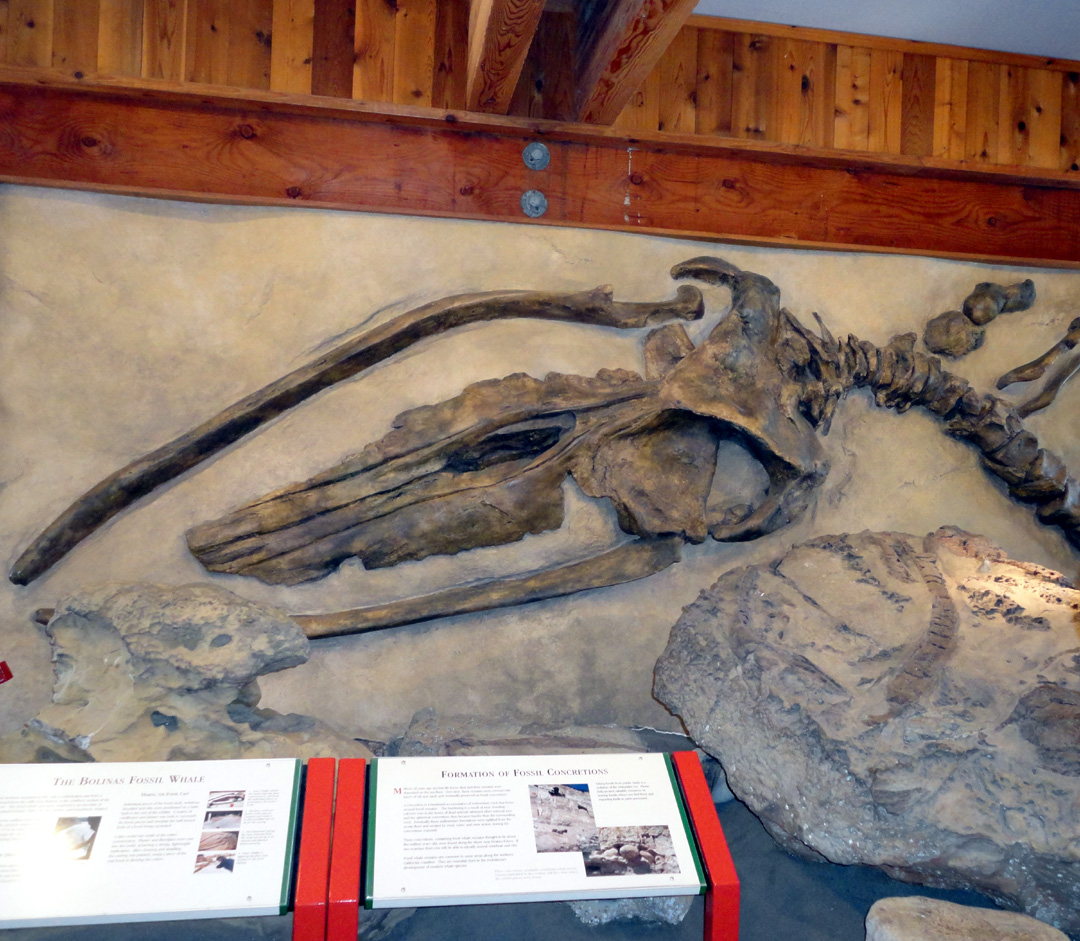
The exhibit at the Drakes Beach visitor's center showing the holotype skeleton of 
Parabalaenoptera baulinensis.

In 1973, a large mysticete skeleton was discovered by Carl Zeigler of the College of Marin, weathering out of cliffs near Bolinas in Marin County, California. Bolinas is a quaint artist community on the Marin County coast and has changed little since the 1960's and 70's; it is predominantly settled by ex-hippies, who generally don't like visitors from out of county, and have continually removed the exit sign for "Bolinas: 2 miles" off of highway 1, to the point where the California Dept. of Transportation (CalTrans) has given up putting up new signs. Tales abound of visitors with out of county or out of state license plates having car tires popped or vandalized, and nails and other tire-popping objects being intentionally laid out onto dirt roads in town. My car had a San Rafael Honda license plate holder, so I never had this problem.

The assembled holotype skull of Parabalaenoptera at California Academy of Sciences, photographed by fellow Otago Ph.D. student Felix Marx.

Exposed along the southern tip of Point Reyes is a unit formerly identified as the early late Miocene Monterey Formation; this was subsequently reevaluated after Domning (1978) suggested that sea cow fossils from the Bolinas locality were too derived to be from such an old unit. Afterwards, microfossils suggested a much younger age, closer to the Mio-Pliocene boundary (6-6.8 Million years old), and the formation was reidentified as the Santa Cruz Mudstone, which has only been mapped in Santa Cruz County.

Anterior view of Parabalaenoptera.
The fossil occurred in indurated, blocky mudstone, and was collected over a ten year period as the blocks incrementally eroded from the cliff. The lead authors - Gordon ("Gordie") Chan and Carl Zeigler of the College of Marin in Kentfield, and their field assistants - would have to travel over the hill and out to Bolinas (nearly an hour's drive through some of the windiest vomit-inducing roads in Northern California) on a monthly basis during the summer, and much more often during the winter during periods of intense erosion, and sometimes daily, anticipating falling blocks. After collection, the blocks were prepared, and some were glued together - but left as a series of blocks that could be lined up and assembled. The holotype was prepared at College of Marin, and eventually molded, casted, and donated to the California Academy of Sciences. Mounted casts of Parabalaenoptera baulinensis are currently on display at College of Marin in Kentfield and at the Drake's Beach visitor center at Point Reyes National Seashore. Sadly, before the paper could be published on the fossil - Carl Zeigler and Gordon Chan passed away. Chan passed away in 1996 of Lou Gehrig's disease; I could not find information on Zeigler, though I seem to recall hearing that he was killed by a drunk driver. Dr. Lawrence Barnes of the Los Angeles County Museum of Natural History finished the manuscript and brought it to publication in the California Academy of Sciences in 1997.

The braincase and vertex of Parabalaenoptera.
Parabalaenoptera baulinensis is a medium-sized balaenopterid with a 2.2 meter skull, slightly larger than minke whales (Balaenoptera acutorostrata; a 10 meter long whale with a 2m skull), but has a number of features that are too divergent to warrant inclusion within humpbacks (Megaptera) or Balaenoptera. These include the very elongate and somewhat swollen zygomatic processes, narrow intertemporal region (the skull is less 'telescoped than in modern balaenopterids), and extremely long and narrow nasal bones. The mandibles are strongly outwardly bowed like in Megaptera, and have an elongate coronoid process - somewhat like blue and fin whales (Balaenoptera musculus and physalus). Many of these features suggest that Parabalaenoptera baulinensis was capable of lunge feeding just like modern rorquals. It is additionally convergent with Balaenoptera musculus in having a supraorbital process of the frontal that is somewhat triangular and narrows laterally, whereas in Balaenoptera and Megaptera, the posterior and anterior margins are either parallel, or the posterior margin is perpendicular to the midline. Unfortunately, the holotype specimen is not preserved very well, and it appears that a significant amount of bone was accidentally removed or ground away during preparation, and details of the basicranium are almost totally indiscernible. Parabalaenoptera has been found in many phylogenetic analyses to be a stem-balaenopterid - in other words, a primitive member of the clade (family Balaenopteridae) that does not belong to the clade formed by humpback whales and modern species of Balaenoptera - the Megaptera + Balaenoptera clade, if you will. These two modern genera have been traditionally grouped into the "Megapterinae" and "Balaenopterinae" - Zeigler et al. (1997) even went so far as to name a new subfamily, the Parabalaenopterinae. However, given that none of these subfamilies have really shown to be stable or even consistent in cladistic analyses, it's unclear what the utility of such taxon names even is.

Reconstruction of the holotype skull and mandibles of Parabalaenoptera. Unfortunately, certain features (e.g. squamosal morphology) of the actual skull don't really look like how they're portrayed in this figure. From Zeigler et al. (1997).

Nevertheless, the description of Parabalaenoptera was a hallmark in balaenopterid paleontology; however, given the stagnated taxonomic situation of fossil balaenopterids, little else was published on fossil balaenopterids until Michelangelo Bisconti started revisiting Italian fossils starting in 2007. In the last five years, a number of informative balaenopterid finds have been described - but it is only the tip of the iceberg. Perusing late Miocene and Pliocene marine mammal assemblages in Museums, it is apparent that balaenopterids comprise nearly two-thirds of the more recent baleen whale fossil record (it is at least the case for California marine mammal assemblages). In California, at least four to five unpublished balaenopterids await description from the Pliocene alone. Additional fossils that may represent Parabalaenoptera - potentially a new and slightly younger species - have been collected from the Purisima Formation near Santa Cruz (and are in much better condition than the holotype). The future of balaenopterid paleontology is bright!

References

Bosselaers, M., and Post, K. 2010. — A new fossil rorqual (Mammalia, Cetacea, Balaenopteridae) from the Early Pliocene of the North Sea, with a review of the rorqual species described by Owen and Van Beneden. Geodiversitas 32:331-363. 

Deméré, T. A., Berta, A., and McGowen, M. R. 2005. — The taxonomic and evolutionary history of modern balaenopteroid mysticetes. Journal of Mammalian Evolution 12:99-143.


Domning, D. P. 1978. — Sirenian evolution in the North Pacific Ocean. University of California Publications in Geological Sciences 18:1-176.


Zeigler, C. V., Chan, G. L., and Barnes, L. G. 1997. — A new late Miocene balaenopterid whale (Cetacea: Mysticeti), Parabalaenoptera baulinensis, (new genus and species) from the Santa Cruz Mudstone, Point Reyes Peninsula, California. Proceedings of the California Academy of Sciences 50(4):115-138.


Monday, July 30, 2012

More photos from Purisima Formation field work, 2

 We were stuck behind these jerks riding three abreast for about 5-6 miles.

 Tule Elk! After many years living in southwestern Montana, I was surprised to learn that elk of this subspecies (Cervus canadensis nannodes) are the largest by body mass in North America; Northern California is also home to the smallest subspecies, the Roosevelt Elk.
 Small individuals of the giant green anemone (Arthropleura xanthogrammica) on an exposure of the Purisima Formation.

 A starved California Sea Lion (Zalophus californianus) yearling on the beach.

 It was very strange to come across a tarantula on a beach, within a couple hour's drive of San Francisco.

 A bunch of harbor seals (Phoca vitulina) basking on what's left of a sandbar in an estuary.

 A beautiful panorama taken by my wife.
 The first time my wife ever saw California Quail (Callipepla californica), hanging out on the road here.

 A crow (Corvus brachyrhynchos) on the beach.

 A western gull (Larus occidentalis) that got really close to my wife (I'm sure food was not involved).

 My wife and Dick Hilton prospecting for fossil marine mammals.

An articulated pinniped skeleton! We collected two pinniped skeletons over the weekend at this locality; one was disarticulated and jumbled together and took 7 hours to collect; this one was a much smaller individual preserved in a much smaller volume of rock, and took about 30 minutes. This is currently being prepared at Sierra College by Dick Hilton.

To finish off this set of photos, here's how my wife spent the day watching the waves go by and us excavating; no bitter feelings, there wasn't enough room for three at the "quarry" any way. Even though it was early October, holy hell was it hot: in the high 80's, and that white rock and sand reflected all the heat from the sun. Unlike all those poor bastard friends of mine baking in 110 degree heat in eastern Montana as I write this, I had the benefit of being able to wade out into the surf every hour or so to cool off.

Wednesday, July 25, 2012

More photos from Purisima Formation field work, 1

Since I haven't been out in the field much down here in New Zealand during the austral winter, I've decided to occasionally post photos from past field excursions. Here, I'll show some pictures from some fieldwork last fall with Dick Hilton (Sierra College) and buddy Paul Goldsmith.

Paul (right) and I (left) investigating the face (or what's left of it) of a decomposing California Sea Lion on a long walk back from the canoes.


One of the first finds of the weekend: a proximal femur of a large (dusignathine?) walrus from the Purisima Formation, just found right on the beach.

A phocoenid (true porpoise) periotic found on the beach as well, but in a cobble. This was one of about four or five phocoenid earbones found at this locality.
Paul made a friend. This guy was just sitting there near the beach.
A nice shark tooth! A specimen of Carcharodon sp. - the serrations are fine and smaller than in extant Carcharodon carcharias, and this is instead a "transitional" specimen, transitional between Cosmopolitodus/Isurus hastalis and the modern great white. This transition has been documented elsewhere in the Purisima Formation, the Capistrano Formation of Orange County, The Pisco Formation of Peru, and (potentially) the Senhata Formation of Japan. The occurrence of these teeth is chronologically similar across the Pacific basin, and can help constrain the age of a deposit to ~7-5 Ma.

Cetacean bones galore. This little bonebed yielded a bunch of other good fossils. I don't normally collect partial vertebrae like these, although it is possible that the small vertebrae represent a partial odontocete skeleton; the large bone on the right is part of a baleen whale vertebra.

What are these bones? These two were diving into the cliff, and touching when I uncovered them. I excavated these as the tide was coming in and lapping at my backpack and other gear, and after this was wrapped in tin foil, I couldn't leave the cove by walking as the water was too deep, and had to cut hand holds into the cliff. These bones ended up being a left/right pair of mandibles from the small baleen whale Herpetocetus - they are tiny, well preserved, and probably represent a very young individual based on their 'splintery' bone texture.

Paul getting ready to ferry some fossils and tools out of the cove while the tide rises.

A huge chunk of rock we collected, with a walrus skull inside. This was my first (complete) pinniped skull, and damn was I happy to find it. Actually, I take that back; at first I was pissed, because it was in a concretion the size of a refrigerator. We found this specimen in an area with nearly no fossils, and I found it on the end of our second day in the field (out of three). We were in a remote area, and we wanted to collect it - but we had no sledge hammer, and the local hardware store closed at 4. Luckily, we saw signs for a garage sale, and although we didn't find a sledge hammer, we found an old fashioned 5 lb pipe wrench, even with a hammer head on it. Dick Hilton and I spent about twenty minutes carefully sinking chisels into the nodule with the pipe wrench, and popped off the end with the skull. We then lifted the fossil in a cargo net, lowered it into the canoe, and took the specimen out by boat. The skull is now undergoing preparation at Sierra College.

A beautiful sight on our last day of fieldwork at the locality.

Tuesday, December 27, 2011

October pinniped excavations

Dick Hilton and I excavating a pair of fur seal (Thalassoleon) dentaries from the base of the cliff.

A famished yearling California Sea Lion on the beach.

The weekend before the annual meeting of the Society of Vertebrate Paleontology in Las Vegas, my wife and I joined Dick Hilton from Sierra College for what we assumed would be a routine visit to the Purisima Formation at Point Reyes. We drove up on a Friday night, and cooked hot dogs at the campground with Dick, and set up our tent for the weekend. The following morning, we set out along the shoreline, and within five minutes, found what appeared to be a pinniped skeleton. Since we wanted to get on to more prosperous localities further down, we left it there with the intention of digging it up the following day (Sunday).
My wife pointing to something tiny she is proud of finding...

It's a beautiful fur seal (Thalassoleon) molar! She has a real eye for finding things like tiny pinniped and shark teeth, which is why I keep her around.

Dick Hilton trying to explain something to my wife and I. At least I hope he was talking to my wife, because it sure looks like I wasn't paying attention.

As we headed further on down to the good section of shoreline, I found a well preserved porpoise earbone (petrosal), and a few other odds and ends. Not too long afterward, and nearly at the same time, Dick spotted a couple bones eroding out with an associated tooth, and my wife spotted a well preserved fur seal tooth (Thalassoleon), only a few meters away. It took us the better part of an hour to dig the bones up – which turned out to be a pair of associated fur seal dentaries! Unfortunately, neither specimen had any cheek teeth, but one did have a broken canine. Either way, only the middle chunk of the dentary is preserved in the holotype of Thalassoleon macnallyae (from the same locality), and these are the most complete and well preserved jaws of this taxon now known. We hiked down the beach a little further, and collected a couple of pinniped limb elements – a proximal end of a tibia, and a metatarsal. After collecting these, we headed back towards the cars. On our way back, I spotted a string of a dozen articulated pinniped vertebrae – a second skeleton we would have to excavate the following day.

A cast of the holotype skeleton of Parabalaenoptera baulinensis on display at the visitor center.

For comparison, there is also a skeleton of an adorably tiny (~15 feet long) minke whale (Balaenoptera acutorostrata) on display as well.

My wife examining some baleen (presumably from a balaenopterid) at the visitor center.

We also finally had a chance to visit the visitor’s center; previously, I had always been there on a weekday, when the center was closed. I was particularly excited to check it out because it has one of the only known casts of the holotype skeleton of Parabalaenoptera baulinensis (which was excavated from the Santa Cruz Mudstone at a nearby locality) on display – there is one other, but it is at the College of Marin in Kentfield, and is falling apart and badly needing repairs.

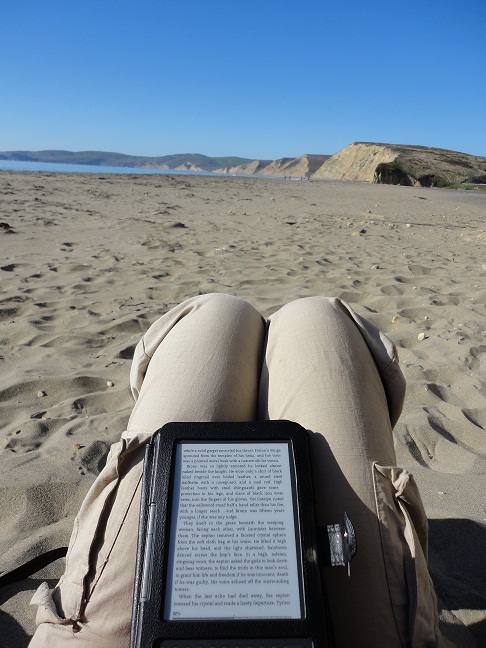
My wife decided she was done, and decided to spend the day reading A Game of Thrones on the beach and napping and taunting birds all day.

On the second day, we spent about seven hours excavating the first pinniped skeleton, which resulted in about 100 pounds of tin-foil jackets. This skeleton is probably of a large fur seal or small walrus, and the skeleton was completely disarticulated; as soon as we were close to removing one bone, another would be under it, or behind it. There were probably about two dozen or so bones in the cliff that we excavated. At about 4 in the afternoon, we wrapped up the first excavation, and walked down the beach to relocate the articulated skeleton. It took a while to relocate it, but as soon as we did, we started excavating it in a large block. Thanks to the specimen being articulated, we were able to finish this excavation in a little over an hour. Once we got back to the car, we loaded up nearly two hundred pounds of fossils we had collected in only two days in the field; furthermore, the most ridiculous aspect of the weekend was that by weight, cetacean fossils comprised less than 1% of our haul (only one specimen). For the uninitiated – pinniped fossils are relatively rare, and my master’s thesis sample of specimens indicates that there is a 4:1 ratio of cetacean fossils to pinnipeds, and that pinnipeds constitute only 8% of the marine vertebrate assemblage from the Purisima Formation at Santa Cruz. To collect a pair of associated dentaries, a tooth, a couple of associated hindlimb bones, and two skeletons (one being articulated) all in one weekend – is surprising, and tripled the number of major pinniped finds I’ve made. I’ll post some updates when some of this material gets prepared.

She nearly got this gull to come to her backpack. Sorry, no pictures of the pinniped excavation.

Tuesday, November 15, 2011

New mysticete excavation, part 2

On day two, we returned to continue the excavation process. We had mostly pedestaled the specimen on the first day, but we had not yet undercut the block. We thought we could get all of it out in one large jacket. Unfortunately, I knew this might be difficult because there were multiple fractures through the concretion - most concretions I've collected are very strong and have no cracks, but occasionally large ones are fractured, which could spell disaster during the jacketing process.

The skull on friday morning.

The tunnel I dug under the right side of the skull.

We got back to the locality on friday morning, and began to undercut the pedestal. Normally, a small jacket just requires a trench to be dug around the fossil, and then you undercut the bottom of the trench and dig under the fossil a bit - this allows a lip to be made on the bottom of the fossil with the plaster jacket, ensuring that the entire piece of rock (fossil included) leaves the excavation pit when you flip the jacket over. I've heard horror stories of jacket flipping where a stream of bone fragments pours out of the bottom of the jacket upon removal, and fortunately, this has never really happened to me. On larger specimens such as this, it is routine to dig a tunnel underneath part of it, to ensure that the jacket removes a cohesive block rather than half of it. So, I started doing this, digging from both sides, and after about an hour or so I had a cute tunnel underneath the skull where some strips of burlap could go when it came time to jacketing.

The fossil with dampened paper towel and after application of the jacket.

Late in the day on friday, we finally got to the jacketing process. In all honesty, I had not expected to get to start the jacket until saturday morning - we had scheduled a State Parks ranger to drive by on Sunday at 3pm for jacket pick up, so we knew we had until then. We finished up the plaster jacket right before dinner time.

The jacket right after flipping it.

On saturday morning, we quickly moved to undercut the rest of the jacket, "pop" it, and flip it over. This was particularly hairy, because there wasn't exactly any room to flip the jacket - usually you flip the jacket over, and have ample space to let it rotate along whatever surface you have available, which in paleontology fieldwork, is usually the ground. In our case, sure -we had opened up a large shelf we had dug out, but the fossil was already precariously positioned above a ten foot drop to the beach, more than enough distance for the fossil to break into many pieces if it were to fall. More importantly, if the jacket were to fall off the ledge, it would likely take one of us with it, which would really, really hurt. It would have really helped to have a third person, but we were barely able to lift and flip it between the two of us - we had to lift it and slowly rotate it nearly in place, move it to the side while lifting it, and while Des stayed there holding the jacket up from certain destruction, I ran up and down fetching pieces of wood to wedge it so it wouldn't fall off the ledge. During flipping, some of the fractures inside the concretion opened up, and we could feel the block 'flexing' a little bit. Fortunately, it all stayed together. Unfortunately, there were more bones going back into the cliff, which we will not be able to dig out. There was also a small part of the concretion and a possible bit of the skull left in the cliff, which we will have to return for.

The jacket after the bottom jacket was completed.

Wooden "backbone" for the sand ramp.

After flipping the jacket over, we were able to put on a plaster jacket over the bottom part of the block. Now that the jacket was completed, we had the problem of getting it down. The block appeared to weigh at least three hundred pounds, and was very heavy due to the concretion inside. There was no safe way to lift the skull down - the heaviest of a jacket that two people of my diminutive stature can manage is about 100 lbs (my friend Chris Pirrone and I once spent four hours moving a 100 lb jacket only 200 feet along a Santa Cruz cliff, while partially submerged at first, then up algae covered rocks, and along a 10 foot high, one foot wide ledge over the ocean, and up several eye-level ledges).

One thing I enjoy about paleontology fieldwork is thinking outside the box. I've had conversations with people who would have used some high-tech rope and pulley system which would have probably been a pain to put together and utilize. In my experience, when moving big (but manageable) pieces of rock, it's best to use methods developed by the masters of lugging around big rocks: the ancient Egyptians. Although it was up rather high, I thought "why not just build a big ramp?". To make it faster, we piled up a bunch of logs: sand usually moves to the angle of repose, and we needed something steeper (so we wouldn't end up with a cone of sand with a twenty foot wide imprint). The logs trapped the sand, and we were able to build a steeper ramp.

My wife with the beginning of the sand ramp, pretending it was her idea.

Des, myself, Ash Poust, and Liz Ferrer (clockwise, from upper left) start to
maneuver the block down the incline.

My wife (left, in red), Liz Ferrer (hiding in back), and Ash (white pants)
excavate a bit of the remaining concretion.

It only took us about a half hour to finish the ramp, and once we were done, we climbed up, and started to nudge the plaster jacket. Our friend Ash Poust, who was a friend of ours from MSU and now one of Kevin Padian's Ph.D. students at UC Berkeley, had brought along another one of Padian's students, Liz Ferrer, to help out. My wife sat out on this one, and took photos instead, while the rest of us muscled the jacket down. It worked like a charm, and I could not have been happier with my experiment in 'ancient methods'.

Stay tuned for the next installment!

Thursday, September 29, 2011

California shark teeth

Yesterday while doing fieldwork at one of my research localities, I spotted a beautiful shark tooth poking out of the cliff. Only a very tiny part of the serrated tooth blade could be seen, and initially I was unsure of how large it was. After a few minutes of chiseling, it was clear that this was a rather large specimen of the great white shark, Carcharodon carcharias, and upon removal, ended up being about 3 cm long - the second largest specimen I had collected from this locality. This was a good day, as I generally have only found about 3-4 of these teeth per year; they are not too hard to spot - in fact, they are fairly obvious due to the easy-to see enamel and serrations (unless a root lobe is all that is exposed). Altogether, I have collected perhaps 50 Carcharodon teeth from the Purisima Formation in total - they are relatively rare in comparison to marine mammal bones. And this is not for lack of trying: I've found that it generally takes about 3-4 trips to a given locality before I spot another specimen; whether this is due to examining exposures not covered by the previous trip, or erosion between trips, I'm not sure.
The Carcharodon carcharias tooth as found in the outcrop.

The prepared specimen.

I've found that shark teeth are nearly impossible to find during the summer months, and easy to find in the winter, when the cliffs are cleaned off by surf action. I rarely find teeth in the summer simply because I tend to pick the localities clean in the winter, and I have to wait until the erosion of the following winter to find anything. Shark teeth are so rare in west coast strata that it is not very fruitful to look for them on nearby beaches; indeed, I found one Carcharodon tooth in this manner, in 2006 - and I have not found another this way.

Certainly, the Purisima Formation is not the only shark-tooth yielding unit on the west coast. Two rock units that boast a healthy dose of shark teeth are the Sharktooth Hill Bonebed in the Round Mountain Silt near Bakersfield, one of the highest concentrations of fossil shark teeth in the world - and the Santa Margarita Sandstone near Santa Cruz. At both of these localities, one can find dozens of teeth with little work (Sharktooth Hill) or quite a bit of digging (Santa Margarita Sandstone). In high school, I played hooky one day and drove down to Santa Cruz, and spent 8 hours in a pit with a shovel and my screen, and collected 70 teeth - but only after ending up with enough screened sediment to fill a Volkswagen beetle.

Fossil mako teeth (Cosmopolitodus hastalis and Cosmopolitodus planus) from the Sharktooth Hill Bonebed, UCMP Collections (image borrowed from http://www.ucmp.berkeley.edu/).

In 2005, I was fortunate to contrast my west coast experience with that of Calvert Cliffs. I had three hours to check out the famous Brownie's Beach, where just looking through shelly debris on the beach, I found 80 shark teeth (mostly the reef shark Carcharinus), just on the surface of the beach, in an area smaller than one side of a tennis court. I've seen mason jars filled with shark teeth folks have scooped up from Florida beaches, and seen multitudes of shark teeth from the famous Lee Creek mine in North Carolina. Sure, there is plenty of lore and mysticism surrounding east coast shark teeth (and their collectors in particular!), but I have gotten the distinct impression that most shark-bearing strata on the west coast are depauperate compared to that on the east coast. Contrast nearly 100 teeth per 3 hours of work to 30 hours of work for one tooth, for example. Additionally, although I have not personally collected data on this, the obscene number of shark teeth from certain east coast units (i.e. 24,000 shark teeth from Calvert Cliffs from just 3 years of donations to the Calvert Marine Museum; Visaggi and Godfrey 2010) suggests that the ratio of sharks:marine mammals in the east coast is astronomically higher than in the Purisima Formation (which in my thesis, I determined it to be around 1:40) and other west coast units. How could this be?

A heap of shark teeth from Florida (image borrowed from www.sharkysshop.com).

A number of biological and taphonomic hypotheses can be made:
1) The fossil shark assemblages perhaps differ in their taxonomic composition, and perhaps there is some related preservation bias.
2) The western Atlantic had higher productivity and stronger upwelling in the Neogene, supporting a larger absolute population of sharks.
3) Sharks and marine mammals have a different preservation potential, which a large-scale taphonomic process could act upon.

Immediately dismissing out of hand absurd suggestions like fossil marine vertebrates were preserved differently along either coast or had different skeletal mineralogy between ocean basins, one can start to think about the above suggestions. For example, contrasting the Carcharodon carcharias-dominated shark assemblage of the Purisima Formation with that of the Calvert Formation which is dominated by carchariniforms like Carcharinus, Hemipristis, and Galeocerdo, this suggestion seems to have some merit. However, there is little difference in preservation potential between these different types of sharks, aside from differences in size. In general, marine vertebrate assemblages in bonebeds and the like are very poorly sorted, and all shark teeth are relatively small in comparison, to say, a whale jaw.


The second suggestion has some merit: the old skeletal supply v. concentration idea discussed by Susan Kidwell back in her 1985 paper (although she was talking about mollusks). She argued that skeletal concentrations are usually caused by changes in sedimentation rate - a slowdown in the rate of sedimentation eliminates the diluting effect on bioclasts, allowing them to form a shell or bonebed (or even just a zone where they are slightly more abundant). Kidwell also argued that computer modelling she used demonstrated that her concentration model still worked even when the skeletal supply rate changed. Is it reasonable to assume that the populations of organisms have not changed through time? Of course not. Can we, from a uniformitarian standpoint, work with this in mind? Using Kidwell's model, perhaps - perhaps not. This being said, I'm not sure that more teeth = more sharks. This is a relatively simplistic view of the fossil record, and in the past, interpreting the paleoecology of fossil organisms has been fraught with problems (usually of the taphonomic kind). Sharks aren't the only organisms who would enjoy higher productivity - you'd expect marine mammals to be going bat-shit crazy with all the extra fish, krill, etc. to feed on as well (and eventually dying, shedding their hard parts onto the seafloor as well along with shark teeth).
The sedimentologic fossil concentration model proposed by Kidwell (1985).

What about the third suggestion? Sharks and marine mammals clearly have different skeletal anatomy, and although some elasmobranchs have been found with preserved skeletal elements (including skates from the Purisima Formation - stay tuned!), all that typically preserve are teeth, and occasionally, dermal denticles. Marine mammals have teeth, skulls, earbones, and postcrania that get preserved frequently. Teeth are harder than bones, and probably have a higher preservation potential with respect to purely physical taphonomic processes (i.e. abrasion from winnowing, erosion, and transport). In fact, my data from my master's thesis indicate that shark teeth are less commonly abraded or fragmented relative to marine mammal bones, and therefore it is probably kosher to say they have a higher preservation potential.

Okay, so what? There is clearly some differential preservation potential. But the Atlantic and Pacific oceans are big places: any specific sedimentological process (i.e. bonebed formation) is going to vary along hundreds of miles of the continental shelf, and through geologic time, and it may be difficult to pinpoint one single phenomenon responsible. In fact, to really examine this, we have to zoom way far out, to the basin level. What is the single most obvious difference between Neogene strata of the east coast and the west coast? Again we turn back to the work of Susan Kidwell (1993). In general, because the east coast is a passive continental margin, most of the strata (i.e. Calvert Fm., Pungo Ls., Yorktown Fm., Bone Valley Fm.) are deposited in low subsidence settings ('low' sensu Kidwell, 1993). Most of the strata on the west coast, including the Purisima Fm., are deposited in smaller basins undergoing "wrench" tectonics (i.e. pull-apart basins) or even rifting (Imperial Group, southern California), which Kidwell (1993) classified as medium-high subsidence basins; most basins in California probably qualify under this category (and could be determined via deposition 'rates' and basin thickness/depth).

The concept of supply versus concentration in Kidwell's model can be extrapolated to an entire basin: basin subsidence controls the sedimentation rate, and instead of looking at the microanatomy of a single shellbed, the types of fossil concentrations and their thicknesses and lateral extent can be compared between formations and basins. Just like a longer pause in sedimentation may form thicker shell bed, a formation deposited under lower rates of sedimentation will result in more numerous, thicker, and more architecturally complex shell concentrations. The Calvert Formation in particular was Kidwell's example of a low-subsidence setting. In general, Neogene marine strata of the west coast in general have less numerous and thinner shell concentrations, a general proxy for the sedimentation rate.

A taphonomic process of this magnitude can then be imparted upon a given example of differential preservation: at the end of this, the generally lower sedimentation rate of the western Atlantic resulted in higher amounts of taphonomic damage, more widespread and longer-duration hiatuses/bonebeds, and could have effectively acted as a taphonomic "wedge". By wedge, I am referring to the eventual difference in the preserved abundances of shark teeth and marine mammal bones. Marine mammal bones, with their relatively lower preservation potential, perhaps lost out due to their greater susceptibility to damage by abrasion and fragmentation.

References Cited

Kidwell, S. M. 1985. Paleobiological and sedimentological implications of fossil
concentrations. Nature 318:457-460.

Kidwell, S. M. 1993. Influence of subsidence on the anatomy of marine siliciclastic
sequences and on the distribution of shell and bone beds. Journal of the Geological
Society, London 150:165-167.

Visaggi, C.C. and S.J. Godfrey. 2010. Variation in Composition and Abundance of Miocene Shark Teeth from Calvert Cliffs, Maryland. Journal of Vertebrate Paleontology 30:1:26-35.