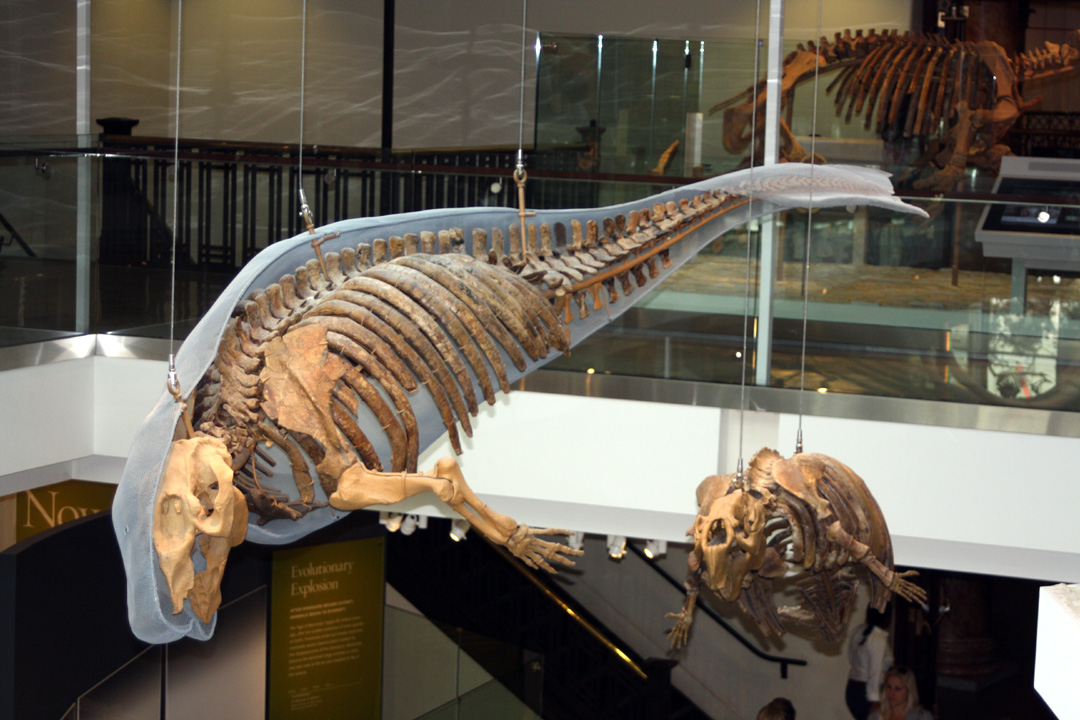
The hollywood hills can be seen very well from the prep lab, which is several floors up. You can just make out the hollywood sign below the top of the mountains.

The holotype "chin" of Pelagiarctos thomasi.

A referred lower left third or fourth premolar of Pelagiarctos, published by Barnes (1988).

My wife borrowed some of the clay we used for propping oddly shaped specimens up during photography and made a walrus and a manatee; the manatee even has
motorboat propeller scars (just for J. Velez-Juarbe!)
motorboat propeller scars (just for J. Velez-Juarbe!)

A referred lower jaw of Neotherium mirum from the Sharktooth Hill Bonebed, published by Barnes (1988); this is the only other early walrus from the middle Miocene bonebed.

My wife happened to find a book of 3D cat photos with 3D glasses. Don't ask.

Three different jaws of Allodesmus from the Round Mountain silt; but how many species? According to Barnes, there are three species: the topmost is the holotype of Allodesmus kelloggi, the middle is the holotype of Allodesmus kernensis, and the bottom one is Allodesmus gracilis. Others would lump all these in to Allodesmus kernensis (which would have taxonomic priority).

Three different early walruses! From left to right, they are Proneotherium repenningi from the Astoria Formation of Oregon (early Middle Miocene), Neotherium mirum from the Sharktooth Hill Bonebed of California (late Middle Miocene), and Imagotaria downsi from the Santa Margarita Sandstone (early Late Miocene) of Santa Cruz County, California.

The beautifully preserved holotype skull of Pacificotaria hadromma from the Astoria Formation of Oregon. According to Berta (1994), this may be a junior synonym of Pteronarctos.

Morgan and I conducting research amid a chaotic mess of fossil pinnipeds and other paleontological debris.

Downtown Los Angeles from the window in the prep lab. The US Bank tower can be seen in the middle. If you recall, it was blown to smithereens in Independence Day.

The rostrum and upper dentition of a referred snout of Desmatophoca oregonensis.

Morgan photographing the obscenely gigantic jaw of the bizarre double tusked behemoth of a walrus Gomphotaria pugnax. Seriously, that thing is offensively large.

The holotype skull of Allodesmus kelloggi, described by Ed Mitchell in the mid 1960's from the Sharktooth Hill Bonebed.

An undescribed late Pleistocene jaw of a California sea lion, Zalophus sp., from the Newport Bay mesa.

Last, but not least, another shot of those three walruses -
Proneotherium, Neotherium, and Imagotaria.
Proneotherium, Neotherium, and Imagotaria.
What's up next? One or two more posts on the southern CA trip including the Page Museum as well as the Santa Barbara Museum of Natural History, and eventually, I should probably try and cover some recent marine mammal research, I still have to cover a paper I got published on our wedding day, Kolponomos, and a bazillion other things.