


I’ve been making a couple visits per year to Cal Academy since 2006; I originally visited when the new building was under construction, and the academy (exhibits, departments, and all) were at the temporary storage facility in SoMa (South of Market in Downtown San Francisco, for the non Bay Areans) to check out their collection of Purisima Formation fossils, and to utilize their ichthyology and mammalogy collections to identify shark teeth and pinniped bones from various Miocene and Pliocene strata from Northern California.
A bunch of large mysticete vertebrae awaiting curation.

On previous visits, I’ve searched the Mammalogy collection of skeletons to make comparisons with modern and fossil bones and teeth of fur seals, walruses, pilot whales, porpoises, and baleen whales. In 2010, I collected some (relatively basic) data on the variation of tooth root lobe morphology in northern fur seals (Callorhinus ursinus) for comparison with fossil fur seals, which I published in JVP earlier this year. A current project I am working on is writing up an entire marine vertebrate assemblage (~200-300 fossils), and I am working on a lengthy manuscript on the marine mammal compliment of the assemblage. Needless to say, the large and very well curated collection of marine mammal skeletons at California Academy of Sciences has been indispensable throughout this endeavor, and has made many fossil identifications possible and paved the way towards insights into marine mammal osteology.

Many crania and jaws of the Northern Elephant Seal (Mirounga angustirostris) are too large for storage boxes and sit right on the shelves.

A walrus (Odobenus rosmarus) skull with two baculi thrown in for good measure (no pun intended).

On my most recent visits, my objectives were threefold: first, to take photographs of many extant species of otariids (fur seals and sea lions) for a morphobank project with my colleague Morgan Churchill; second, to photograph nearly every skeletal element from an adult northern fur seal in order for comparison with fossil fur seals from California (e.g. Thalassoleon, which has previously been hypothesized to be closely related to Callorhinus); and third, to photograph and examine lower jaws of neonatal and fetal fur seals and sea lions.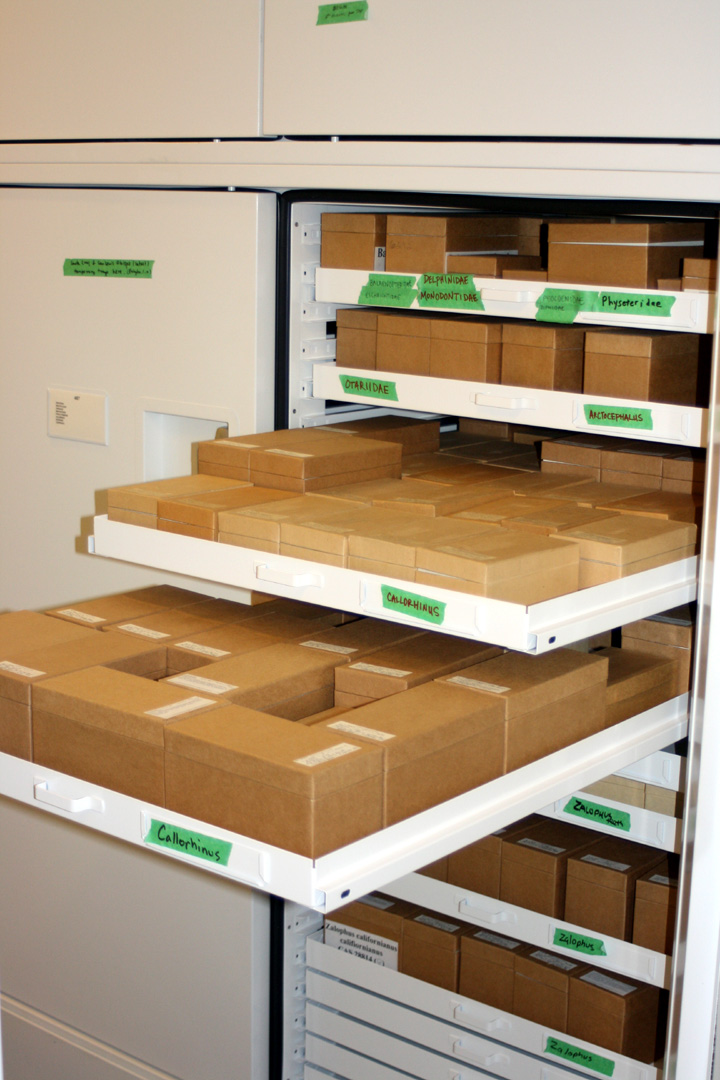
I won’t get into the specifics quite yet, nor will I talk about the fossils that spurred my curiosity regarding the third subject – I’ll only say that it is pretty damn neat if I may say so myself. That being said – I am very interested in the morphology of deciduous (milk) teeth in young fur seals, as well as the timing of molar and premolar eruption in the lower jaws of these animals. I’ll briefly mention that modern pinnipeds are a bit weird in that they (like most) mammals have milk teeth, but they are often shed before birth, so that the pups are born with a full set of adult chompers. Their milk teeth have a very reduced functional period, and additionally are reduced to tiny little pegs (unlike the milk teeth of terrestrial carnivores). Although they still develop milk teeth, pinnipeds are trending toward monophyodonty – that is, having only one set of teeth as opposed to two (diphyodonty). Cetaceans are monophyodont, and pinnipeds are an excellent example of a second clade of marine mammals following the same evolutionary trend.


In order to examine the tiny milk and permanent teeth of these pups and fetuses, I brought along my new toy – a small, portable, USB powered digital microscope which plugs into my notebook laptop (…another new toy, which I’m using from a secure location in Montana). It displays the image on the screen, and can acts as a camera as well. Fortunately, there is a button to take a picture with in the software, rather than having to manually press a button on the microscope (which, due to its small size, usually jiggles it and screws up the picture). At an earlier UCMP visit in October, I was able to take around 200 photos of 100 tiny fossil specimens in a little over two hours. With the digital microscope, I was able to take a bunch of photos of milk and permanent teeth from nearly a dozen or so specimens of northern fur seal (Callorhinus), California sea lion (Zalophus), and Steller’s sea lion (Eumetopias). Unfortunately, there weren’t any northern fur seal fetuses, or specimens with deciduous premolars – but the data for sea lion fetuses I collected was more than sufficient to answer my fossil-related queries.
 Yours truly using my digital USB microscope to examine the morphology of
  Milk teeth and unerupted adult teeth in the lower jaw of a California sea lion (Zalophus californianus) fetus.