Showing posts with label sirenia. Show all posts

Sunday, January 22, 2012

Southern California Research Trip, Part 2: Natural History Museum of Los Angeles County (exhibits)

After two and a half days at the San Diego MNH, Morgan, Sarah, and I said our goodbyes to our friends and colleagues there (Joe El Adli, Eric Ekdale, and Tom Demere), and piled into my tiny honda for the drive up to LA - we decided that spending another morning at SDNHM would allow us to drive up to LACM and miss all the morning traffic. We arrived at the museum at about 2 in the afternoon, and after chatting with Curator Emeritus Dr. Lawrence ('Larry') Barnes for a little bit, we got right to work examining fossil pinnipeds. I'll discuss the collections visit in the next post - first I'd like to talk a bit about the new mammal paleontology hall.

The new "Age of Mammals" hall has been in the works for several years, and has taken quite a bit of time on behalf of most of the Paleontology Dept. employees at LACM. I've seen a few photos on the internet prior to my visit, so I knew a little of what to expect. I don't have much of a research interest concerning terrestrial mammals - so, sorry terrestrial paleomammalogists who happen to be reading this blog (admittedly a very, very, very small fraction of humanity), but I'm going to ignore the land mammals. Some of the marine mammal highlights include a mounted skeleton of the sperm whale Aulophyseter morricei from the Sharktooth Hill Bonebed, as well as the holotype skeleton of the phocoid pinniped Allodesmus kelloggi (which, according to some, may be a junior synonym of Allodesmus kernensis), and adult and juvenile mounted skeletons of the late Miocene dugongid Dusisiren jordani, which were collected from the Santa Margarita Sandstone in Santa Cruz County. Lastly, and arguably the centerpiece of the marine mammal exhibits - is a beautiful new skeleton of Paleoparadoxia (which apparently may be named as a new genus in the near or distant future). Aside from these, there are a handful of skulls and pinniped fossils on display, including the world's oldest delphinid dolphin fossil - a complete skull from the Monterey Formation, unnamed and still undescribed. Overall, however - I must admit I was a bit underwhelmed. Certainly on the lower floor, there are plenty of fossil land mammals just packed in. But the top floor, which was an odd mix of La Brea specimens and marine mammals, there was just a lot of empty space, and there wasn't really that much marine mammal material on display, which is surprising given that the LACM holds one of the largest fossil marine mammal collections in North America.

Not in the Age of Mammals hall, but I had to include a picture of my favorite
pinniped, Callorhinus ursinus.

The juvenile skeleton of Aulophyseter morricei from the Sharktooth Hill Bonebed. This individual is under 50% adult size. The only known skeleton of this taxon.

This also was not taken in the Age of Mammals hall - but it goes to show that my wife likes to photobomb fossils all the time. I mostly put this up here to demonstrate to others that she is an awful person.

The holotype skeleton of Allodesmus kelloggi.

A cast of the holotype (and only known specimen) skull and jaw of the desmatophocid pinniped Atopotarus courseni. Atopotarus has occasionally been recombined as Allodesmus courseni, but desmatophocid taxonomy will have to be covered in a separate post.

A referred lower jaw of the Miocene sirenian Dioplotherium allisoni.
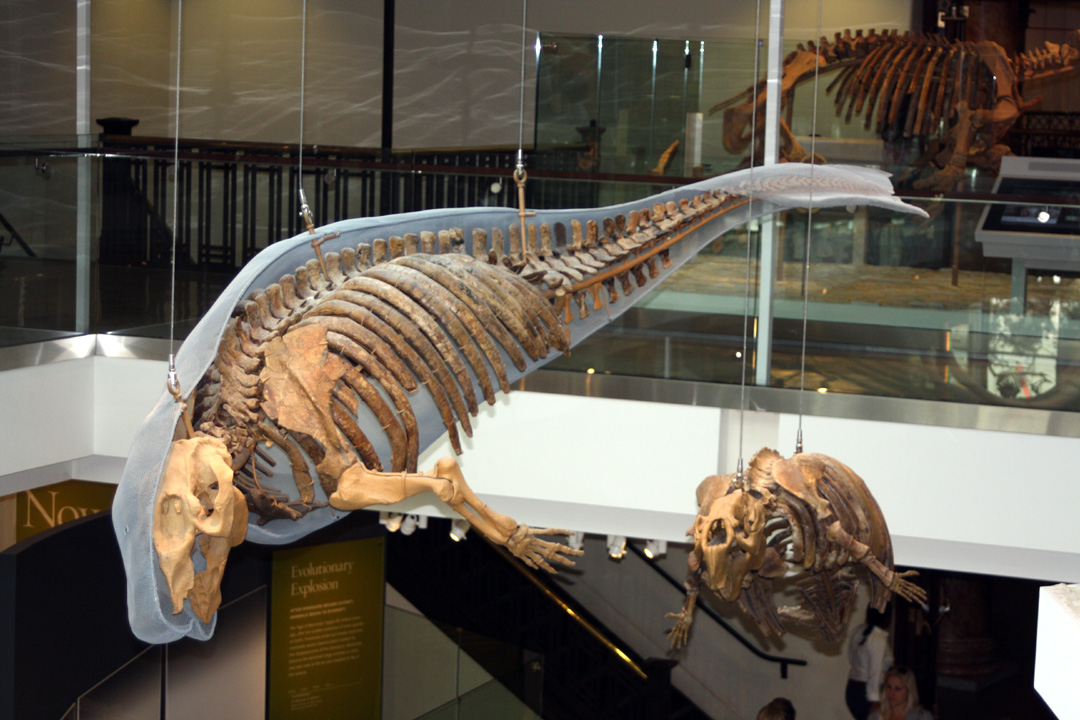
The adult female and juvenile skeletons of Dusisiren jordani from the Santa Margarita Sandstone in Santa Cruz County. The juvenile is so damn cute...

A Paleoparadoxia ulna with sharktooth bite marks. This specimen belongs to the mounted skeleton shown below.

A rather bizarrely portrayed fossil dolphin in some artwork related to sharktooth bite marks; I'm sure the artist was more interested and familiar with depicting sharks than cetaceans.

One of the exhibits I was looking forward to as a taphonomist - the gut contents of a Basilosaurus cetoides skeleton from Mississippi! It had as gut contents when it died
a mass of fish bones.


The articulated forelimb of the late Miocene delphinoid Albireo whistleri, originally described by Larry Barnes from the Almejas Formation at Cedros Island in Baja California.

The business end of the new Paleoparadoxia skeleton.

I'll leave you with this large size image of the Paleoparadoxia skeleton - my dslr camera doesn't have a wide angle lens, so I had to stitch these photos together for an ultra-size photo (I have a much larger version; contact me if you want it). And yes, that is the intrepid Morgan Churchill standing behind its ass.

Tuesday, June 21, 2011

Sixth Triennial conference on the Secondary Adaptation of Tetrapods to Life in the Water

Two weeks ago today, I delivered a presentation on the first day of the 2011 Aquatic Tetrapods conference in beautiful San Diego, California. I had eight hours on my drive down to San Diego the day before to worry about how screwed I was: the last time I gave that presentation, it was only 20 slides longer, and took 50 minutes to deliver. I practiced it once Monday morning in front of Joe El Adli (our gracious host), and Yale students Rachel Racicot and Daniel Field - I barely fit it into 20 minutes. It all worked out fine, and in the actual presentation, I finished the last conclusion slide right as it counted down to zero. This was a fresh break from SVP tradition, which dicates that cetacean research is presented on the afternoon of the last day, giving you all week to worry about the presentation. This time, I was able to relax during the entire meeting.

My title slide for my taphonomy presentation.

It would be very difficult to summarize all the research presented, but I might be able to summarize a few of the highlights that stick out in my mind. Julia Fahlke (University of Michigan) gave a fascinating talk Monday Morning about basilosaurid and protocetid cetaceans with asymmetrical crania, and implications for the evolution of hearing underwater. I'll admit, when I read the abstract I was skeptical, but her presentation was pretty compelling - I'll wait to say more until it gets published, though. Brian Beatty presented some details of his research on meningeal ossification in cetacea, which appears to not be homologous to that in many other mammals. Larry Barnes showed us a new Paleoparadoxia skeleton the LACM has been working on from the Monterey Formation; it's virtually complete, with a very large, gnarly looking skull. Olivier Lambert gave a talk coauthored by Giovanni Bianucci on a new large assemblage of bizarre ziphiid fossils dredged from the seafloor off the coast of Spain; boy, there are some real freaks. Our Australian colleague Erich Fitzgerald presented a new juvenile aetiocetid skull from the Oligocene of Washington State which he's been slowly preparing with acid; needless to say, it's a beautiful specimen. Manuel Martinez, a Peruvian who is Christian de Muizon's Ph.D. student, presented on an incredible new toothed mysticete from the Oligocene of Peru - I won't give any details, but lets just say this will be a very, very important specimen.
Frank Fish gives a mini presentation on locomotor adaptations of various marine mammals, using an assortment of articulated limbs (a walrus forelimb is seen in the foreground).

On wednesday, we went over to the San Diego Natural History Museum for an osteology workshop on aquatic tetrapods. Due to the research focus of Tom Demere (Paleo curator) and Annalisa Berta, the majority of material out on display was from modern and fossil marine mammals. There was a great assortment of wonderful stuff out, and it was amazing to be there with so many other marine mammal (and otherwise) researchers there.

Several cetacean researchers are in this photo: Toshiyuki Kimura (foreground), Mette Steeman (behind "Tosh"), and Giovanni Bianucci (background, left) and Joe El Adli (background, right).

At the workshop, I caught Brian Beatty red-handed demonstrating his very technical method to determine the relative height of the bony tentorium (here on a skull of the Amazon river dolphin, Inia geoffrensis).


For a while, Daryl Domning gave a short presentation on the locomotion and forelimb of sirenians (using a Manatee forelimb skeleton).

Here, some of the brightest minds in cetacean paleontology scrutinize one of the weirdest fossil mysticetes: a new species of Herpetocetus under study by Joe El Adli. From left to right: Mette Steeman, Joe El Adli (standing), Felix Marx (leaning over skull), Meredith Rivin (background), Giovanni Bianucci (in glasses), and Olivier Lambert (in red).

Manuel Martinez, a Peruvian researcher studying with Christian de Muizon in Paris, did not waste a chance to photobomb. Here he is photographed with a cast of the skull of the bizarre extinct edentulous* walrus Valenictus chulavistensis.

Daryl Domning again gives a short presentation, this time on sirenian crania. Here he is showing a cast of the skull of the world's largest sirenian, the extinct Pliocene species Hydrodamalis cuestae (the ancestor of the "modern" Steller's Sea Cow).

My (soon to be) coauthor Morgan Churchill photographs an articulated hindlimb of the modern walrus.
Rachel Racicot (and Daniel Field) hung out with me for a bit in the type room at the San Diego Natural History museum while I photographed some fossil pinniped material. Skulls of gigantic Hydrodamalis cuestae sit on the table behind Rachel.