
A couple of weeks ago Sarah and I spent three days in Hemet, California, attending our first 'PaleoCon' event at the Western Science Center. Hemet is a small suburban city in the easternmost part of the "Inland Empire", located about 20 miles northeast of Temecula, and about 25 miles southeast of Riverside/San Bernardino. Hemet is situated just below the formidable Mt. San Jacinto - the same enormous mountain you can see looking west from Palm Springs. In the mid 1990s, a new reservoir was being constructed at Diamond Valley. This valley is open at the west and east ends, and so two dams were needed to be built. During this project, a team of paleontologists led by Kathleen Springer and Eric Scott (then of the San Bernardino County Museum) ended up discovering a literal treasure trove of Pleistocene land mammals, including many skulls and partial skeletons of mastodons, mammoths, ground sloths, and many others. A new museum was funded and opened in 2006. My 'whaleontologist' colleague Dr. Alton Dooley Jr. was the curator at the Virginia Museum of Natural History, and in 2015, was brought on as the new director for the WSC. Shortly after arriving he realized that there were some stark morphological differences between "Max", the best preserved Diamond Valley mastodon specimen, and Mammut americanum specimens from the midwest and east coast. Dooley published an important monograph in 2019, naming "Max" as the holotype of the Pacific mastodon, Mammut pacificus, and reidentifying many dozens of west coast specimens to this new species.
Western Science Center has been hosting an event titled "PaleoCon" for a few years now, and we've attended two of them strictly as unofficial visitors, but this year, Sarah and I were invited to participate as visiting scientists. It's not an academic conference: if anything it feels more like paleontological summer camp. There are no scientific talks, and the days before the conference, we spend in the curation lab and collections room, looking at interesting specimens, getting ideas, and recording data. The summer camp vibe continued in the evening where we hung out in hotel rooms catching up, since we already happened to know most of the other attendees, many of whom are invited every year. Eric Scott, for example, who is now a mitigation paleontologist for Cogstone Resource Management - is a regular at this event (and for good reason, since he was a leader on the original excavation). Also in attendance was our longtime friend Brian Beatty from NYIT - Brian is another marine mammal paleontologist, and was a coauthor on our papers on Coronodon and Ankylorhiza. Both of "Mels" were present - Melissa Pardi from the Illinois State Museum, and mitigation paleontologist and giant ground sloth expert Melissa Macias (Duke CRM). Another sloth expert and mitigation paleontologist, Ascanio Rincon (Cogstone RM) was here this year, studying sloths. Meaghan Weatherell, an artiodactyl paleontologist, and Win McLaughin (who has worked on rhinos, artiodactyls, and walruses) who were grad students together at University of Oregon were also in attendance. Though our colleague Katy Smith, a mastodon expert from Georgia Southern University, was not present this year, her GSU colleague Christina Olson returned as the PaleoCon Poet in Residence.
This happened to be the 20th anniversary of the museum's opening, and also coincided with the opening of an art exhibit titled "Inspired Collections" - with Max the mastodon as the featured specimen from the collection. I worked on my own watercolor submission and completed it just in time. I was also invited to be the featured artist for this year's PaleoCon - and so I put together a half hour talk covering my own artistic background, summarizing my work - but not chronologically, but by subject. I finished the talk with some words of encouragement and noting that there's nothing special about the art I do, rather that I enjoy doing it, and learning from failed experiments and practicing. I don't consider talent to be a real thing - it's simply developing a skill. I finished on a note explaining that there's nothing keeping anyone in the audience from becoming similarly skilled - and that nobody needs AI to do it for them (which received a surprisingly enthusiastic applause).
Many thanks to Alton for inviting Sarah and I to participate - and major kudos to Brett Dooley for organizing the event! Also, thanks to WSC staff for hosting us. We had a blast and hope to return.


Visiting paleontologist Melissa Pardi (Illinois State Museum) and WSC director Alton Dooley having a discussion amongst a field of recently acquired plaster jackets.


The oversize racks at WSC. These are basically all elephants, whales, and jackets containing partial skeletons (e.g. bison, camel, ground sloth).

Several casts of the skull and jaws of "Max", the Pacific mastodon (Mammut pacificus) holotype, are placed on the oversize racks adjacent to heavier actual fossils.

Another Pacific mastodon (Mammut pacificus) specimen consisting of the palate and tusks, in the oversize collection.

Paleontologist Win McLaughlin (Southwestern Oregon Community College) pieces together some kind of fossil pig from one of her field sites in Kyrgyzstan.

The lovely original skull of "Max", the Pacific mastodon holotype (Mammut pacificus).

Win McLaughlin (left) shows Brian Beatty (New York Institute of Technology) a small giraffe specimen from one of her field sites in Kyrgyzstan. (Brian is a longtime friend of the blog and coauthored our papers on Coronodon and Ankylorhiza).

A closeup of Win McLaughlin's early giraffe mandible from Kyrgyztan.

Win McLaughlin and Alton Dooley discussing some small ungulate teeth.

Visiting paleontologist Ascanio Rincon studying a whole glut of fossil ground sloths - Ascanio is a paleontologist from Cogstone.

Meaghan Weatherell (University of Arizona) looking through a drawer of Carboniferous plant fossils from Mazon Creek in Illinois.

Meaghan Wetherell (lower left), Melissa Pardi (lower right on left) and Brittney Stoneburg (both images) perusing Mazon Creek specimens at WSC.

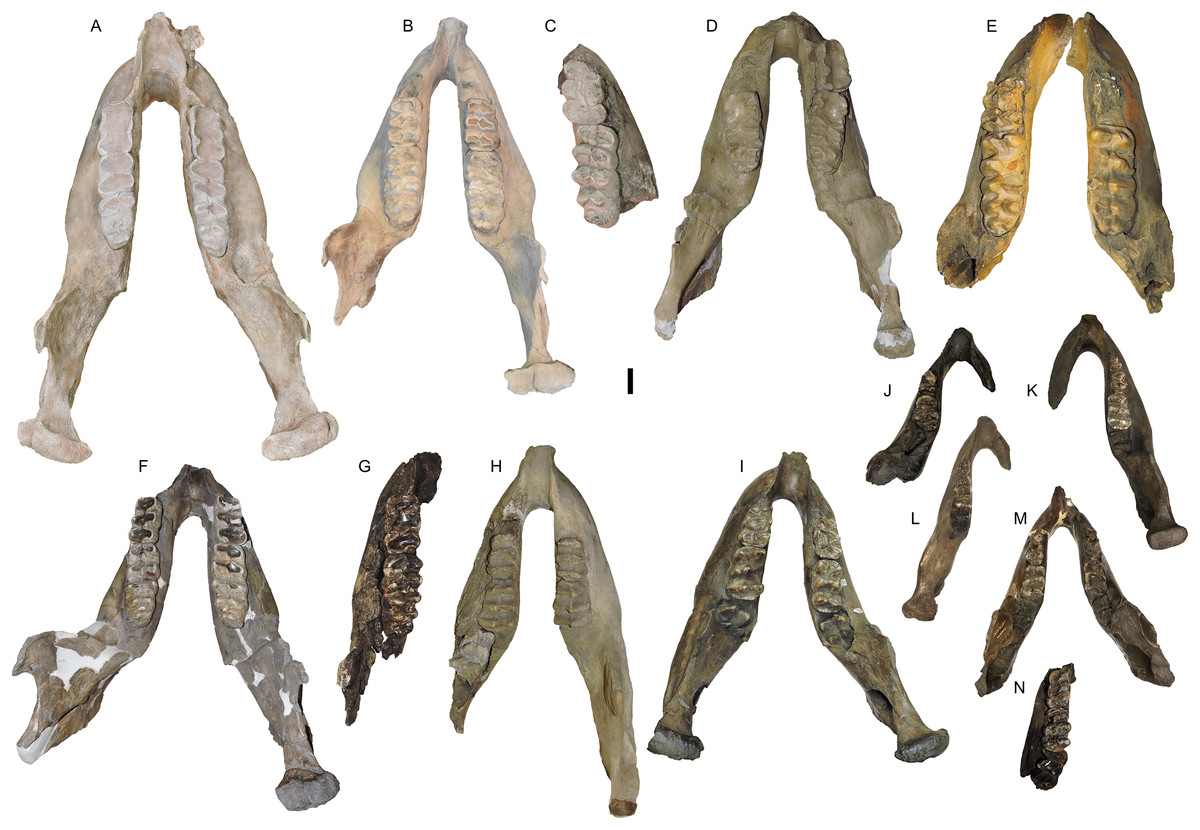
WSC collections manager Brittney Stoneburg and a lovely Pacific mastodon (Mammut pacificus) mandible that needs some more glue in spots. Melissa Pardi explained to me that it has really weird, steeply inclined wear facets on its teeth - which you can see here on the right side (left molars).

WSC preparator Leya Collins giving the same jaw some much needed TLC and applying some consolidant to some of the problem cracks on the specimen.

WSC preparator Leya Collins piecing together some hindlimb bones of a smaller Pleistocene land mammal.

Melissa Pardi (Illinois State Museum) and the same Pacific mastodon (Mammut pacificus) mandible.


The mounted skeleton of "Xena", a Columbian mammoth (Mammuthus columbi), from Diamond Valley.

The exquisitely preserved skull and tusks of "Xena" the Columbian mammoth (Mammuthus columbi).

A giant ground sloth skeleton under glass - I think this one is a Paramylodon.

Sarah and I holding a cast of a Diorocetus whale mandible from the Miocene of Virginia - which Alton produced before he left the Virginia Museum of Natural History. (This was actually from PaleoCon last year in 2025).


The Friday of PaleoCon I spoke with over a hundred middle school students about paleontological art and scientific illustration - while I did a still life watercolor of this Pacific mastodon (Mammut pacificus) tooth. Here it is after my first couple of coats of paint.

Yours truly working on my watercolor of the mastodon tooth. Photo by Sarah Boessenecker.


Yours truly at my table, fielding questions from a bunch of middle school students. I was quite surprised: about 90% of the girls said they liked to draw or paint, and about 2/3 of the boys as well; some even painted with acrylics, one boy and one girl even said they did digital painting/illustration! Not a single student, however, said a word about using AI. The kids are alright.

The opening reception of the "Inspired Collections" art exhibit - many visiting scientists are seen here, including Brian Beatty (far left), Meaghan Weatherell (up front and center), Melissa Macias (in black on right) talking to Ascanio Rincon (blue shirt, gray hat).

WSC director Alton Dooley gives some opening statements at the opening reception for "Inspired Collections".
Here is some of the lovely artwork from the exhibit:


This block print was made by WSC collections manager Brittney Stoneburg!


This is about 16" wide - large for me. I'm very pleased with how it turned out. The skull of the Pacific mastodon holotype "Max" is shown half submerged, a reference to the Diamond Valley reservoir itself - with the skyline to the east and Mount San Jacinto in the background. Altogether this one took me about ~20 hours or so to complete.

No comments:
Post a Comment