Tuesday, August 15, 2023

Excavation of a dwarf baleen whale, Herpetocetus, from the Pliocene Purisima Formation

Last December I paid a visit to one of my longtime research localities in the Purisima Formation in northern California - one I've been visiting for nearly 20 years now (I found the site in 2004 after getting a tip from a surfer), and have received three permits for collecting. I've published several articles on fossils from this site, and back in 2011 to 2013 published two papers providing an account of the entire marine vertebrate fauna. Since 2013, I've been seeking a permit to return to the locality and was awarded one earlier this year. In December, I was checking up on spots where I had found fossils in the past, and l came across a medium-sized concretion in the base of a cliff. The bone was difficult to see, but the fact that the concretion protruded from the top of the shell bed drew my attention to it. Once I got close, I could clearly see relatively porous bone, complicated structure, and symmetry - when combined with size, these told me that I was looking at a fossil skull. A relatively large skull - about 16 inches wide (~40 cm) - but belonging to one of the smallest baleen whales to ever evolve, Herpetocetus.

 The Herpetocetus skull as I first found it - the rock hammer (for scale) is sitting on top of it.

Unfortunately for the completeness of the specimen, the entire rostrum of the specimen as well as the orbits had eroded away. This was partially mediated by the structural geology of the locality: there is a small fault line with an unknown, but likely minor degree of slip here - perhaps calling it a fault is a bit grandiose, but either way, there is a bit of shearing going on here. We are only a mile or so off from the San Gregorio fault, one of the largest faults in the California coast range; as a result, there are loads of more minor fractures paralleling the cliff face with a few millimeters to about 20 cm of offset. In older parts of the section this can result in many parallel fractures spaced a few centimeters apart with some larger fossils fractured like an accordion! I usually leave those behind, but a couple of larger specimens I've collected from that end of the locality have required some challenging preparation as a result. Though less common in the sandier upper parts of the section, a fracture has cleaved the specimen in half and there is a deep sand-filled trench - I suspect there were several parallel fractures in this zone that resulted in weakening of the sandstone, and this zone was blasted out by wave action - including the remainder of our skull.

Explanation of the fossil as discovered in December 2022.

Fortunately for us, this meant that the fossil could be collected in one nice self-contained block that would certainly not exceed 100 lbs (45 kg). This is extremely fortunate, as the specimen was found about a mile from the nearest road! I knew it would take some creativity in physically removing the specimen from the beach. At the time of discovery I wondered how much it would weigh if I just popped the concretion out - I decided against it when I realized that in addition to the skull, there was at least one partial mandible and some ribs, meaning that a somewhat more careful excavation lasting at least a couple hours would be needed. In 2022 when I found this, I was by myself - Chris Pirrone joined me for a half day, but had other obligations. I would not have the help. Certainly, I could have excavated and jacketed the specimen by myself - it would have been a bit of a pain, but it would be doable. However, I would have been unable to move the specimen on my own. Sure, you can always leave a plaster jacket and come back for it another day - that's nearly standard practice in western interior paleontological fieldwork (e.g. Montana, Dakotas, Wyoming, Colorado). But all of those places lack something significant and irritating that I have to deal with: tides. The ocean is great when it's eroding fossils out for you to discover, but it's also dangerous and always trying to kill you and your team and can make life very difficult. As a result of this, I prefer to keep excavations short and remove specimens ASAP. Plaster jackets get blasted away by waves if left until tide cycles and weather catch up. Excavations in the intertidal zone can only last a few hours. We were well up out of the intertidal here, but a jacket would have been buried or blasted away by wave action if left for a few weeks. Plaster is also bright white and attracts attention: this section of beach is remote, but still attracts a few beachgoers and fishermen walking down every day. So, I made the decision to leave the specimen in the field without touching it. 

This decision gave me no shortage of anxiety. Two weeks after I left California, an incredible and unprecedented train of spectacular winter storms began hammering the coast. I spent my last semester of teaching here in Charleston with the *worst* case of FOMO ever, watching all of this incredible erosion take place and being unable to check out any of the freshly exposed fossils! And worse, fearing that this little baleen whale skull had eroded away. It wouldn't be until May 2023 that I visited the spot and confirmed that the skull was intact. I was also worried that the skull would be buried by several meters of beach sand.


 The distinctive lectotype mandible of Herpetocetus scaldiensis from the Pliocene of Belgium, illustrated by Van Beneden.

Before we continue with the excavation - what's the deal with Herpetocetus, anyway? Herpetocetus scaldiensis was first named in 1872 by Joseph-Pierre Van Beneden, a Belgian paleontologist who named a large number of (occasionally chimaeric) cetaceans from Miocene and Pliocene strata near Antwerp, Belgium. The fossils included a distinctive mandible with a tall joint (condyle) and a long angular process, the combination of which resembled a reptile mandible - hence the name, 'reptile whale'. For years the taxonomy of Herpetocetus was frozen because it became clear that the mandible and other elements such as the tympanic bulla (earbone) were not associated with one another and represented completely different families of mysticetes. Worse, the designation of type specimens had not yet fully caught on and Van Beneden did not select a type specimen. Starting in the 1960s and 1970s more specimens began to be collected in California, Japan, and North Carolina that either consisted of or included mandibles with the same distinctive morphology. Paleontologist and later Nazi Othenio Abel XXX. The long-awaited Lee Creek Mine Volume IV included an entire chapter on Herpetocetus and Nannocetus, written by Frank Whitmore and Larry Barnes in the 1970s and 1980s and submitted in the 1990s. The manuscript and volume were in press (somewhat analogous to 'development hell' in film) for over a decade, but it finally came out. In this study, Whitmore and Barnes (2008) reviewed the material belonging to Herpetocetus scaldiensis and XXX. Chief among these observations was that a skull fragment figured by Van Beneden and likely associated with the mandible included the highly diagnostic squamosal of Herpetocetus, permitting several new skull specimens to be referred to the genus even though they lacked the mandible. These authors also described Herpetocetus transatlanticus, based on a partial braincase from the lower Pliocene Yorktown Formation at the Lee Creek Mine, and Herpetocetus bramblei, based on a fragmentary skull and mandible from the Purisima Formation near Santa Cruz, California! It was good timing for them, because in 2007, I collected about 2/3 of a skull of Herpetocetus from a sandy bed near what would soon be the Herpetocetus bramblei type locality. I would have certainly named it as a new species at the time. I held off study because just when I completed preparation of the specimen, the Whitmore and Barnes (2008) paper had come out - and it was very clearly referable to Herpetocetus bramblei. The timing was further quite good, because just two years later a seawall was built over the entire section of cliffs. This specimen catapulted me down a road studying Herpetocetus and finding many more fossils - and virtually all of this is unpublished still! Now that I'm no longer teaching and my research fellowship has expired, I plan on returning to this research after leaving it for nearly 15 years. It was only a matter of time before I found more Herpetocetus remains.

Comparison of the erosional cross-section through the concretion (flipped upside down) with the CT scan of Herpetocetus bramblei from the Purisima Formation in Santa Cruz, and approximate location of the cross-section based on the reconstruction of Herpetocetus morrowi from the coeval San Diego Formation (from El Adli et al., 2014).

I managed to scrape together a small field crew before leaving for the east coast at the tail end of a vacation - Dr. Ash Poust (San Diego Natural History Museum), Sarah, and our amateur colleague (and friend of the blog) Chris Pirrone helped us. I knew between the four of us we'd be able to get it excavated and transported off the beach, hopefully with time to spare. We spent some time cleaning dust off of it to get our bearings, and then began trenching around it. The concretion stuck a bit further into the rock, but in most places the surrounding sandstone could easily be carved away. Within an hour we had found a couple of bones behind the skull and otherwise had a competent trench around most of it. We started undercutting it, which was surprisingly easy - like a hot knife through butter.

Chris and I exposing the concretion with this tiny brush. I neglected to bring along a whisk broom: my old whisk broom had plastic bristles, which finally decomposed and disintegrated in December after 20 years.

We encountered a couple of bones in one of the trenches pretty early on. Here Ash is trying to make sense out of what is exposed without attempting to 'field prep' the bone. We decided it was probably a rib - but it may have actually been a small mandible.

After 90 minutes, we had quite a bit of the specimen already trenched.

You really couldn't ask for a more scenic backdrop to an excavation than this. A gorgeous view of the Pacific ocean whenever we turned around.

Ash undercutting the whale block while Sarah labels bags containing some of the associated bones of our little whale.

After trenching was deemed complete, it was time to get ready for plaster jacketing. The first step is to make a barrier to keep the plaster from bonding directly to the bone or rock. I prefer paper towel as it is quite thick, has perforated lines for easy tearing (sometimes a liability), and if several layers are added it can give a slight extra bit of padding. Aluminum foil is also quite popular and requires no water. All of our water had to be carried in: saltwater will apparently make plaster cure extremely fast and generally cannot be used. I used my camelback hose to carefully drip water onto the paper towel so it would stick to the specimen.


After the separator is applied, we can now start the plastering process. I like to make my plaster runny (think about the viscosity of olive oil or melted ice cream), but I've found that on the cold, foggy, and humid coast of California the outer layer of the jacket never completely cures. Runny plaster means you get more working time - thicker plaster has considerably less working time, and the difference in water added can be quite small (a few table spoons worth). So, I decided instead this time to try an experiment: mix plaster at the viscosity of a milkshake in small batches. This worked great, and we had about 5-6 minutes working time, just enough for a few strips at a time. Also, not bad, because the relatively little volume of plaster and freshwater we had meant that precision was needed.

We ended up using every single ounce of plaster mix we carried out with us to finish the top jacket! After about 20 minutes of curing (during which I found a rather large palatoquadrate cartilage from a skate, and a nearly complete humerus of a fur seal), we flipped it and were delighted to find that there were no obvious broken bones in the pedestal. We expected that given the bones we found in the trench, but fractures made during excavation fortuitously manifested between the jacket and these bones. Ash quickly dug these out while Chris and I finished the jacket and tried rigging up our makeshift sled made out of a laundry basket and 60 feet of nylon cord. Sarah and I wrapped and labeled the associated bone blocks and we distributed these amongst the different backpacks.


At first we tried this admittedly clumsy approach with one person (Chris) stooped over and lifting the front of the laundry basket. We would make it about 100 feet at a time before the person in back would need to rest.


Chris and Ash were a bit skeptical of my engineering efforts and preferred this for a hundred yards. My shoulder was killing me when I took my turn so I insisted we try something else. The relative ease at which Chris and I had been able to move the sled with only one person pulling on the ropes gave me an idea.

 
I thought - what if we loop the rope forward and put it on a piece of driftwood to be used as a "yoke", like for oxen on the Oregon Trail? The front end of the sled just needs to be slanted up with the center of mass close to the back in order for it to be dragged efficiently. Ash got up in front and took the "reins", analogous to a husky, with Chris and I each lifting about 30-40 lbs continuously while advancing at a walking pace.
 

 This method worked so well that we did not bother trading off and we slid the jacket about an entire kilometer down the beach this way. We also had a convenient tire track in the sand that we could use as a rut for the 'sled'.


 By 4:30, only four hours after we parked, we had the plaster jacket in the back of the vehicle! Ash, half jokingly, suggested getting ice cream and I immediately agreed. It tasted very, very good.
 

Wednesday, August 9, 2023

More on maintaining research notebooks - some Q & A

I recently received these questions as a comment on a recent post by Dr. Aretha Guimaraes, a botanist at the Instituto Nacional de Pesquisas da AmazĂ´nia. Dr. Guimaraes writes: "Hey Robert, thanks for answering my comment! I have a few questions regarding the organization of your notes."

 
1) I’ve read that you divide your notebooks using tabs according to the specimen that you are describing. But how do you continue your note about a certain fossil if the pages that you left for that description are over? Do you continue in another notebook? And if you do continue to write in another notebook, how do you store the complete description later? 

Great question! This happens all the time - either I 1) have supplementary observations or 2) mitigating circumstances require me to interrupt an entry and begin a new entry. In this case, I write up at the top of the page "continued on page X" and typically write this at the very end of the entry as well. When I get a chance to get back to the original entry, I write in "continued from page X" at the very beginning, so it is clear where I should flip to. Now, this becomes a problem when you split an entry between two different notebooks - I tend to use roman numerals for my notebooks, so I can cross-reference entries between notebooks. For example, Notebook I is one I started in 2008 on fossil pinnipeds from California; Notebook II is chiefly on fossil cetaceans, and Notebook III is on miscellaneous marine vertebrates (birds, otters, sharks, bony fish, sea turtles) from California. I think I stopped there, though I have a single notebook dedicated to fossils of Herpetocetus, one or two more on Eomysticetidae from my Ph.D., and two full notebooks of descriptions I've made while at CCNHM in South Carolina.


2) By now you should have lots of notebooks stored. Do you keep a “master index” where you can check when you are looking for a particular description or info?

No, not yet, but in a few more years that might be needed!


3) Do you make any copies of these notebooks? Like a digital copy or something?

I have digitized my field notebooks, but have not bothered digitizing any of my research notebooks. I tend to type up my descriptions shortly after writing them out by hand, so in a way it gets digitized. I use the marked up photographs as guides to constructing my figures (which are generally based on the same edited photographs). 


4) I have the same problem that you described in one of your posts, where you told us you had to move to the US with a bag full of heavy notebooks. I’ve been moving a lot recently (Brazil – UK – Amazon and so on) and I’ll probably move a lot until I can become a full professor somewhere. I tried to use a digital notebook in order to be more practical to carry things around (since I’m not available to afford shipping all of my notebooks) but I didn’t like it. Did you manage to solve that problem?
 

I have not solved this problem - in my opinion this is a good, but intractable problem to have. I don't like staring at screens, and in my experience it is much easier to have a hard-drive failure than to lose your physical notebook or have them destroyed by water or fire.
 

5) Regarding the fieldnotes, do you have a field notebook or do you keep your notes in the same notebooks that you use every day?

I have a completely different set of field notebooks that are regionally or project specific: for example, I have two general field catalogues (1 and 2) for fieldwork in Santa Cruz county with the prefix RWB, a notebook for Point Reyes (RBPR), and an east coast field notebook (RBEC).
 

6) Are you still using A4 notebooks? When you have a drawing of something larger to stick in your notebook, how you do to prevent damage? 

I use the XL moleskine notebooks which measure 19x25cm (7.5x9.75"), just slightly smaller than "letter" size paper here in the US (letter = 8.5x11", 22x28cm). I do not paste in anything that is larger than the page in both dimensions - but I do paste in foldouts that unfold laterally. I'm not exactly sure what kind of damage you're referring to, but I prevent tearing and tattering of the edges by making sure everything pasted in is small enough so it doesn't protrude from the sides of the notebook.
 

7) Do you keep daily notes like research diary?

I do not - I am much too scatterbrained to do that consistently. I only take notes when I've blocked off some time to focus and pour my undivided attention onto one task.


Also, I’d like to tell you that I always share your notebook posts with my students so that I can convince them to keep their notes, especially my husband (who is also a scientist) and refused to take notes on stuff. I used your notebooks post to convince him of my point and now he keeps things more organized.
 

Thanks again for your content! I found you by randomly searching in google a few years ago and I always keep an eye on your posts.
Best wishes,
Aretha Guimaraes

I'm so glad you find these posts and tips helpful! Thanks for the great questions, Aretha!

Saturday, August 5, 2023

Lowcountry riverbank fossils from July 4

 One month ago I spent the day on my first paid river fossil tour with Ashby Gale and Charleston Fossil Adventures. Ashby recently got his captain's license, and can now take clients out along lowcountry waterways to collect fossils from hard-to-reach spots that cannot be walked to - and locations known only to the two of us and a couple others. Ashby had three tours back to back booked for July 4, and he was kind enough to not make me join him for the early morning tour at 9am! It was still a long day, though, with a heat index of 105. We took out a couple of different families and found some great stuff; this post will be more of a slideshow with commentary than anything else.


Ashby Gale and I, the first secondary tour guide hired for Charleston Fossil Adventures! I gotta say, this really beats the hell out of teaching introductory geology labs. The office is considerably nicer.


 An osteoderm of the extinct "beautiful" armadillo Dasypus bellus, which was slightly larger than the modern nine-banded armadillo (Dasypus noveminctus) often seen lying by the side of the road in South Carolina. Dasypus bellus is known only from the Pleistocene in North America. 

A tooth of the devil ray Plinthicus stenodon, my favorite batoid. When collecting with Ashby, Sarah, and I, it's basically illegal to not call out "Ooh a Plinthicus!" Plinthicus is only known from Oligocene through middle Miocene rocks, and was named by E.D. Cope. 


A single lower tooth of Galeocerdo aduncas/Physogaleus contortus, an Oligocene-Miocene tiger shark with long, twisted cusps- at least on its lower teeth. Whether or not these species are synonymous is a controversial topic in shark paleontology, and I've been yelled at by shark experts on facebook for daring to consider synonymy as likely.


 A rather large blade of a mako (Isurus) tooth found by a client - Isurus desori? flandricus? Clearly not I. hastalis or I. oxyrhinchus.


 Another Physogaleus contortus tooth amidst a field of phosphate, limestone, and oysters.


 A partial tooth of the extinct megatoothed shark Carcharocles angustidens with an incomplete root.

A large upper lateral tooth of the snaggletooth shark Hemipristis serra.

Another mako tooth (Isurus desori? flandricus? retroflexus?), although one with a complete root. This looks like it weathered directly out of the Ashley Formation rather than being derived from reworking.


 Another megatooth, this time a juvenile tooth of Carcharocles megalodon.  

An adorable lateral tooth of the megatoothed shark Carcharocles angustidens - I love finding tiny teeth of extinct giants.

The highlight find of the day – a beautiful tooth of Squalodon! And yes, an actual, factual tooth of Squalodon from South Carolina. Unlike Ankylorhiza, teeth of true Squalodon have highly rugose enamel rather than the more gently fluted enamel of its Oligocene relative. Found and donated for study by the Hammond family!


Wednesday, July 19, 2023

Fossil prep updates: beluga and fur seal specimens from the Purisima Formation of California

We had some great luck while on our May field trips in coastal California, as reviewed in my last couple of posts. Sarah and I have added a few more scientifically significant specimens to the faunal list for this locality. The fossil vertebrate assemblage from the Purisima Formation is certainly not the most numerous in terms of specimens, but is rapidly becoming the most completely published. In 2013 I published a hefty monograph on the marine mammal assemblage from the locality, following an earlier paper reporting all of the sharks, bony fish, and sea birds - and a followup that same year reporting the world's youngest well-dated bony-toothed bird fossil (Pelagornis). Localities like this are quite critical since they are the youngest diverse assemblages of marine vertebrate fossils from our coast: Pleistocene marine vertebrate assemblages are poorly known from the west coast and typically non-comparable in terms of diversity, given that they are typically 'singleton' records and not evenly sampled for both "lower" and "higher" vertebrates. The new records I'll be discussing in this post are marine mammals, though we've made some interesting new non-mammal additions which I'll cover in a later post. 


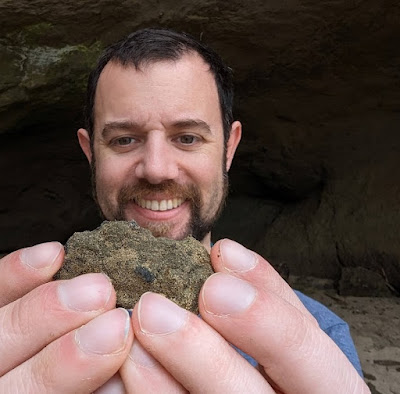
 This photo is unintentionally hilarious - I was *so* happy by this fossil! Sarah made no mention of the fact that you cannot tell what the hell I am actually holding, it just looks like a shitty little chunk of sandstone. Didn't matter, I was so happy, and this is far funnier than if it was this spectacular field glory photo.

The first noteworthy specimen is a partial mandible with teeth of a tiny little fur seal. Pinniped remains are quite rare, outnumbered by cetacean fossils in the Purisima Formation by at least 10 to 1 or 20 to 1 (they are over-represented in UCMP collections, but even then still outnumbered by cetaceans by 5 to 1). Most pinniped fossils from the Purisima Formation consist of isolated limb elements and teeth; skulls, mandibles, and fragments thereof are considerably more rare. Mandibles are frequently diagnostic within pinnipeds, and so I had always been on the look out for one at this locality. I had previously collected a partial radius of a dusignathine walrus (Dusignathus sp.) and a very nice calcaneum and upper third incisor from a small fur seal - along with specimens collected by Larry Oliveira (such as a nearly complete but very small humerus), I tentatively identified this fur seal as the extinct Callorhinus sp., cf. C. gilmorei.


The holotype (female) mandible of Callorhinus gilmorei from the Pliocene San Diego Formation.

Referred mandibles of Pithanotaria starri from the upper Miocene Monterey Formation of Orange County, CA. From Velez-Juarbe (2017: PeerJ 5:e3022) .

Callorhinus gilmorei just so happens to have a pretty distinctive mandible, even if the teeth aren't terribly distinctive. It is one of the few fossil otariids where only a couple of the premolars are single rooted, and the rest are double rooted; the original specimen is a fragmentary but nonetheless well-preserved female skeleton from the coeval San Diego Formation. Other mandibles show a bit of variation, and at least one mandible has all double-rooted teeth. You see, pinnipeds evolved from terrestrial mammals that had double rooted premolars and triple rooted molars, and this condition was retained in the earliest pinnipeds like Enaliarctos. Early fur seals and sea lions (Otariidae) from the middle and late Miocene, such as Eotaria, Pithanotaria, and Thalassoleon, mostly have double rooted teeth - though all modern fur seals and sea lions have single rooted teeth. 


 Partially prepared mandible fragment with in situ premolars collected back in May.

This new mandible I collected in May ended up having all double-rooted teeth, which alone would not prevent this specimen from representing Callorhinus gilmorei. However, unlike this Pliocene species, this specimen has relatively smooth enamel that lacks accessory cusps and completely lacks lingual cingulum: cingulum is a little ridge on the base of the tooth crown. Most modern fur seals and sea lions have cingulum along the tongue side (lingual = tongue side) and only a few sea lions have labial cingulum. This specimen, however, has neither labial nor lingual cingulum, and the one complete tooth is also a bit low crowned. These features make this specimen resemble Pithanotaria - which, so far, is only known from the late Miocene (Tortonian, ~9-11 Ma). This specimen is probably, but uncertainly early Pliocene in age.

Another such specimen I found ended up being the anterior (chin) end of a mandible of a relatively large fur seal, collected from a bonebed dating to the early Pliocene - and a bit further up-section. After a bit of preparation, it ended up having single-rooted first and second premolars, identifying the specimen as Callorhinus gilmorei, and likely confirming my earlier identification of specimens of Callorhinus sp., cf. C. gilmorei from these same layers.


 The beautiful beluga periotic I collected in May! My very first monodontid periotic. I've only been looking for one for 15 years. Even on the east coast where they're more common!


 The new associated periotic and bulla of a small monodontid, collected under permit from the Purisima Formation.

One of the other really interesting specimens that I collected was an associated periotic and tympanic bulla of a large odontocete - which I was immediately able to identify to the family level in the field, owing to its distinctive anatomy: it is from a white whale, family Monodontidae - closely related to modern belugas and narwhals (and probably more the former). If you're unfamiliar with the fossil record of monodontids - and, surprisingly, I've never ever covered them here before (I should change that) - they parallel the walrus fossil record in a few surprising ways. First, they show up during the late Miocene, and have a similar distribution in the temperate and even subtropical North Pacific and North Atlantic. Aside from a couple of fragmentary finds of fossil narwhals, most are attributable instead to "delphinapterines" - tuskless monodontids more closely resembling belugas (Delphinapterus) than the narwhal (Monodon). These include species like Denebola brachycephala from the latest Miocene of Baja California, Bohaskaia monodontoides from the early Pliocene of North Carolina, and the more recently named Haborodelphis japonicus from the early Pliocene of Japan. There is additionally an unnamed fragmentary monodontid from the Pliocene of Belgium briefly described by my colleague Olivier Lambert in 2007, and several unnamed species of monodontids in the late Miocene-Pliocene fossil assemblages of California known from partial to complete skulls, possibly representing two or more genera.


The fractured skull (left) and periotic (right) of the small pilot whale-convergent beluga Denebola brachycephala from the upper Miocene Almejas Formation of Baja California, Mexico. From Barnes (1984: PaleoBios 42:1-46).

The small beluga Haborodelphis japonicus from the lower Pliocene Embetsu Formation of Hokkaido, Japan. From Ichishima et al. (2019: Papers in Palaeontology 5: 323-342).


 The periotic and tympanic bulla of
Haborodelphis japonicus. From Ichishima et al. (2019: Papers in Palaeontology 5: 323-342).

Out of these three named fossil species, only Denebola and Haborodelphis have periotics preserved that can be directly compared with my new specimen. One unnamed monodontid from a different locality in the Purisima Formation a few miles away has periotics that are a bit dorsoventrally thicker than my new one. The new one seems to have a proportionally larger anterior process than Denebola, and more closely resembles Haborodelphis. The tympanic bulla, on the other hand, is perhaps a bit more informative: the thickened part of the bulla, the involucrum, is absurdly thick anteriorly in Denebola and bears a long anterior tip; the new specimen looks quite a bit more like Haborodelphis and many other delphinoids. The bulla of the new specimen is only 3/4 the size of Denebola, yet the periotic is somehow larger. These are cursory observations, but I'm inclined to identify the specimen as cf. Haborodelphis for the time being. Finding fossils of marine mammals in California belonging to species originally discovered in Japan should not be surprising: Desmostylus and Paleoparadoxia (now Neoparadoxia), Callorhinus and Eumetopias, Herpetocetus, Hydrodamalis, and many others have been found in both places.