Thursday, March 7, 2024

The Oligocene dolphin Xenorophus, part 2: new specimens of Xenorophus

Welcome to Part 2 of my series on Xenorophus. To read Part 1, click here, and here for Part 3.
 

We've been in the middle of buying a new house - which is very exciting! And, also, exhausting. We're preparing for our move in 2.5 months to sunny San Diego - so things are a bit hectic, and I haven't had as much time to devote to blogging. I had intended to write this post over a month ago, but the Valenictus paper dropped - early - and I had to write that one instead!

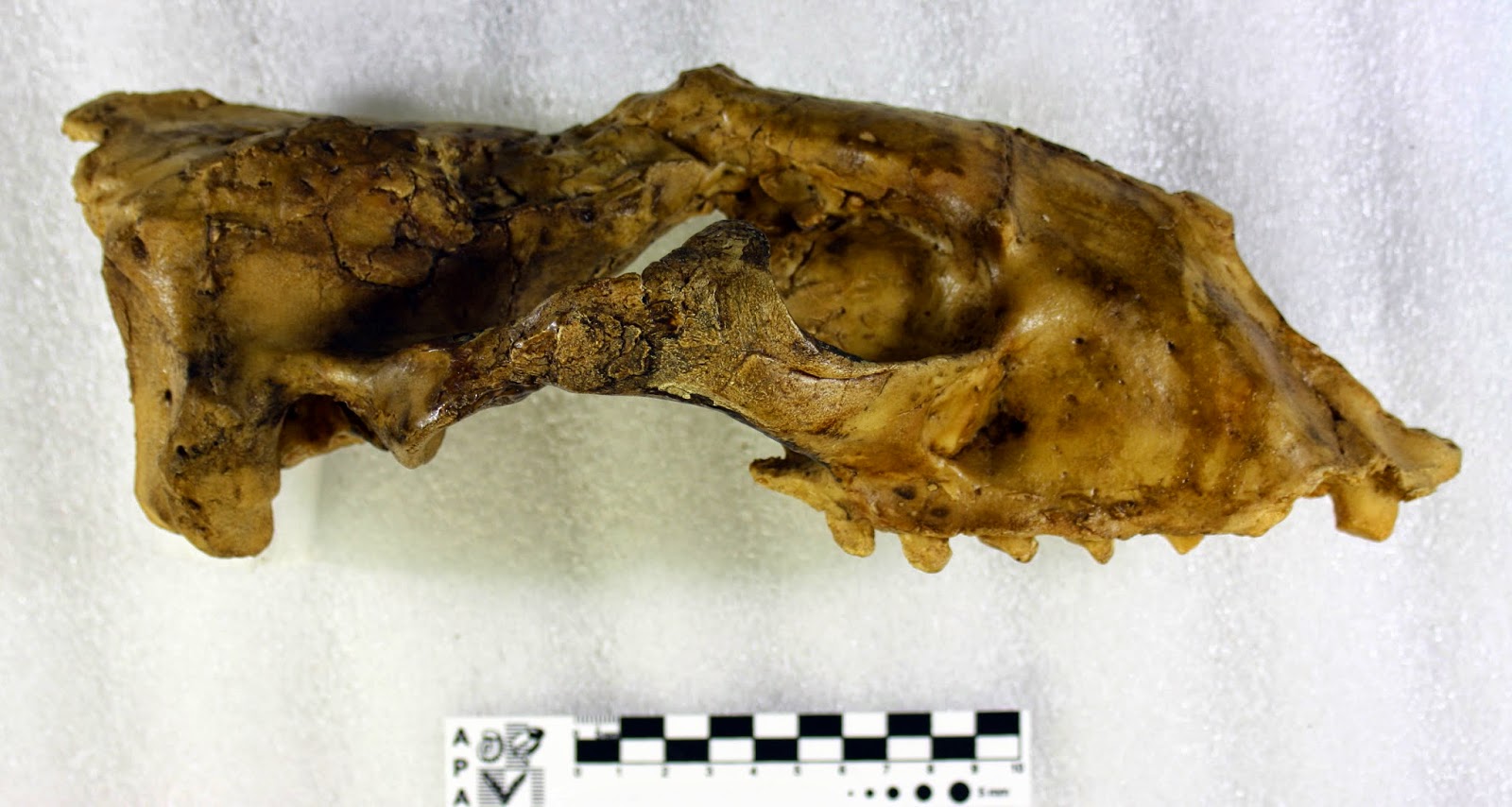
 ChM PV 4823, what is now the Xenorophus simplicidens paratype specimen - on display at Charleston Museum.

A quick note: type specimens for beginners

You're going to see 'holotype', 'paratype', and 'referred specimen' thrown about a lot in this post. This blog is directed towards an informed audience comfortable with at least semi-technical language. In some cases, precise wording exists because it would take too damn long to describe the concept in layman's terms. I also firmly believe that most people are smart enough to not need their hand held. So, to define these terms:

Holotype: the single best specimen known at the time when a new species is named. All future identifications need to based on comparisons and observations of the holotype specimen. You can only designate type specimens once - when the species is being named.

Paratype: often the second best specimen of a new species. In many cases the paratype will be designated as it preserves some bit of anatomy better than the holotype, even though it might be a bit worse for wear.

Referred specimen: all other specimens identified as (or 'referred' to) a particular species, either in the initial study, or in all followup studies. Remember a type specimen can only be named once - if you find a much more complete skull later on, it cannot be designated a holotype since one already exists. You've got yourself a referred specimen.

New discoveries

Over the past 30 years, a number of new specimens of Xenorophus had turned up - many of these ended up in Charleston Museum collections (ChM), and several collected since the late 1990s ended up at the Mace Brown Museum of Natural History (CCNHM). All told, when I started this project, there were over ten specimens including skulls - a phenomenal sample! Jonathan Geisler made it clear from an early stage that there was likely to be more than one species. Al Sanders had considered most of the new specimens to represent a new species - which he wanted to call Xenorophus simplicidens (an unpublished manuscript name which we ultimately used in recognition and honor of his work - keep reading). The most complete specimen that Al and Jonathan examined back in the early 2000s when Jonathan was working on his dissertation research (eventually published as Geisler and Sanders, 2003) was ChM PV 4823, a nearly complete skull collected from an unusual bed of the Chandler Bridge Formation near the Edisto River. Two additional braincases from the same stratigraphic unit were also present in ChM collections - ChM PV 4266 and 4822. Two additional specimens including a mostly complete juvenile skull, ChM PV 7677, and a somewhat deformed skull with much of the vertebral column, ChM PV 5022, had been collected from the Ashley Formation. A few partial mandibles with teeth, also from the Ashley Formation, were curated at ChM.

All of the skulls of Xenorophus from the Ashley Formation in lateral view. At the beginning of this project I was unsure if any were conspecific with the Xenorophus sloanii holotype specimen (USNM 11049, upper right). We ended up concluding that these are all one species (see below). From Boessenecker and Geisler (2023).

All of the skulls of Xenorophus from the Ashley Formation in dorsal and ventral view. From Boessenecker and Geisler (2023).
 
The "Jaap" specimen of Xenorophus, CCNHM 168. From Boessenecker and Geisler (2023).
 
 
Three skulls of Xenorophus from the Chandler Bridge Formation - eventually considered referable to Xenorophus simplicidens, the top skull being designated as the paratype specimen. From Boessenecker and Geisler (2023).
 
Same three skulls of Xenorophus from the Chandler Bridge Formation, in dorsal view. From Boessenecker and Geisler (2023).


Same three skulls of Xenorophus from the Chandler Bridge Formation - ventral view. From Boessenecker and Geisler (2023).

 
The upper dentition of CCNHM 168, Xenorophus sloanii. From Boessenecker and Geisler (2023).


The well-preserved basicranium of CCNHM 168, Xenorophus sloanii. From Boessenecker and Geisler (2023).

The basicranium and in situ periotic bone (inner ear bone) of CCNHM 1077, Xenorophus sloanii. From Boessenecker and Geisler (2023).

Periotics (inner ear bones) of Xenorophus sloanii in dorsal (top) and ventral (bottom) views.From Boessenecker and Geisler (2023).
 

 Mandibles of
Xenorophus sloanii that are associated with the key skulls reported in the paper. From Boessenecker and Geisler (2023).
 
 
Some of the isolated mandibles of Xenorophus sloanii we reported.From Boessenecker and Geisler (2023).

Meanwhile, a bunch of specimens were collected in the late 1990s and 2000s that ended up in CCNHM collections. These included two nearly complete skulls: CCNHM 104, the "Bailey" specimen, and CCNHM 168, the "Jaap" specimen - the latter is a virtually complete skull, missing only the right orbit, and also preserves left and right mandibles and some postcrania. Both of these specimens were from the Ashley Formation as well. A juvenile skull, CCNHM 5995, also from the Ashley Formation, was collected just before I got to Charleston. A few months after I arrived, Mace and I went to visit Mark Havenstein - a College of Charleston alumnus - and he agreed to donate a bunch of fossil cetaceans from his collection which he had earmarked for museums. Among these was a series of blocks including a massive block of limestone with a very large posterior skull and articulated mandibles; the rostrum had been taken off by a bulldozer. We had a nearly complete postcranial skeleton for this specimen - unfortunately, missing the flippers, of course.* Preparation of this specimen took about two years in fits and starts, and unfortunately an undergraduate taking a preparation class for credit destroyed much of the postcrania by waiting until finals week to get back to working on it, and pulled out many fragments from the blocks, did not write down where they went, and then just left all of the separated fragments in a pile and left for summer vacation. Moral of the story - never assign fossil preparation projects to undergraduate students for credit. I spent a lot of time searching desperately through the postcranial fragments for potential bits of vestigial pelvic elements - never found any.

*Flipper/forelimb elements are, frustratingly, not known for a single specimen of any xenorophid.

The Aylor specimen of Xenorophus, CCNHM 8720, after we pried off all of the globbed on plaster. This rather ugly looking lump of bone ended up becoming the Xenorophus simplicidens holotype.


 Preparator Shelley Copeland removing some of the chewing gum from a tooth of the Aylor
Xenorophus.
 

 Teeth emerging from the siltstone.

The palate of the Aylor Xenorophus starting to take shape.

A selfie Shelley took from her apartment during lockdown! This is about the first week of April, 2020. I'm glad we managed to get it to work - fossil prep is not the easiest 'work from home' opportunity for a student.

A year or two later (fall 2018), I was alerted to the existence of an unprepared skeleton in a couple of blocks that some local amateur collectors had found and were trying to sell for an exorbitant amount of money. They even brought it by the museum, and were confused when I explained that I was a college professor and didn't have any money, and that the museum didn't have an operating budget (not a dime; "you're lucky the school doesn't charge the museum rent" was the prevailing quote from superiors at the time). I told them, honestly - local blue collar workers like them probably made more money than I did, and that I couldn't help them. We would gladly take a donation though, and set them up with an appraiser for the purposes of getting a tax writeoff. They declined. It was a shame, because it was a real beautiful specimen - they had even gotten it CT scanned at a local hospital; nearly complete skull, with at least one earbone, partial postcranial skeleton, and much of one mandible. Eventually I forgot about this interaction or at least mentally suppressed it until Sarah got a phone call about a year later - early December, 2019 - and a local attorney (David Aylor*) was wanting to donate a specimen. A brief verbal description of the fossil on speakerphone, with the two of us listening in eagerly - suggested that it was the same specimen. We politely asked for some photos of the specimen to be emailed to the museum - and a few hours later, these photos confirmed that the specimen was the very same. We set up an appointment to visit David's house on the Ashley River - a gorgeous view! David signed the deed of gift, and we loaded as much of the specimen as we could into the trunk of our Honda accord and carefully drove it back to the museum, just a couple miles away - but there are speed bumps, and of course, lots of potholes (a South Carolina staple!). When we returned to get the skull block, we were horrified to learn that David was gone, and the two young gentlemen who told us they'd be back in one hour when we returned - had also vanished. We tried calling David's phone - no response, car gone, doors locked. The specimen was in his garage space, with an open door - but it weight like 200 lbs, way too much for Sarah and I to get by ourselves. We waited for about a half hour. Fortunately, his neighbor was walking by with his golden retriever and I politely explained the pickle we were in (it was also approaching 5pm, and I had to be back in the classroom for a 6pm lab). I gave him my business card to explain I wasn't a crazy person and offered to show the deed of gift, but he said it wasn't necessary - and agreed to help lift the fossil into the car, meanwhile muttering something about those two gardeners working for him as well and not being terribly reliable, which connected some dots (sounded like it was beer-thirty). We lifted the fossil, sitting on a plywood sheet, onto an old ass radio flyer toy wagon with all flat tires, and pulled the pathetic contraption to the back of the car, taking care not to let the fossil get jostled - and managed to make the last lift into the car. Once back at the college, we drafted some students into lifting it onto a cart and placed it safe and sound in the museum - and I hurried off to teach, just in time!

*Sadly, David Aylor passed away in January 2023.

The palate and dentition of the Aylor Xenorophus, almost at completion!

 
In September 2020 student employees were allowed back on campus and so Shelley spent a lot of time catching up on preparation of the skull.

 We cracked open the jacket a few days later - it was a mess. No burlap, three inches of plaster just globbed on over a layer of muddy sand that had been applied like play-dough over the bone, but separated from the bone by a single layer of tin foil. The silty sand had since dried, and hardened to nearly like rock; it was Chandler Bridge Formation matrix, which is soft as hell when wet, but hardens again when dry. So the plane of weakness was at the foil layer - the silty sand rock and plaster tended to come off in big chunks. Fortunately - and I don't say this lightly - either the plaster was so damn hot, or the muddy layer that had been applied contracted significantly when it dried out - there were some large cracks in the plaster. We couldn't saw through it because the plaster was too thick, so we had to actually chisel off the plaster in places where there were no contraction cracks. When we finally got through to the fossil, about a half dozen teeth had been coated with wads of chewing gum (trident cinnamon gum by my reckoning), which had since bonded to the teeth completely. My first fossil preparator, hired through funds I raised on my own, spent several days just carefully rehydrating the disgusting chewing gum and scraping it from the tooth enamel. Shelley continued on the skull block in January when classes resumed, and had the palate and upper dentition in pretty good shape by March 2020 - and you know what happens next - the Covid-19 pandemic. Shelley was in desparate need of work, so after I returned from our poorly timed spring break vacation to Turks and Caicos* I got permission to enter the museum and assemble a 'fossil preparation from home' kit and dropped off the detached rostrum block from the same specimen along with vinac, brushes, toothbrushes, dental picks, and even plaster and burlap if she needed to make a support cradle for it.

*We went snorkeling every day, but it was kind of hard to enjoy the trip while watching the world fall apart - two days in my parents texted me photos of downtown San Francisco without a single car or person on the street in front of my dad's office).

After Shelley graduated, Sam started out as our next preparator - and we flipped the jacket in summer 2021, and got most of the dorsal side prepped out - even if a few pieces were broken when a bunch of high school students were admitted to the laboratory by someone else.


 After Sam graduated, Megan Dia volunteered a couple days a week during spring 2022 - here we are trimming off excess plaster from our temporary jacket.

And lastly, Ana Sillsbury finished preparation of the specimen before SHE graduated! Sarah and I put the specimen out on exhibit in summer 2022.

Over the next two years, I had three additional preparators work on the specimen - Sam Czwalina, Megan Dia, and Ana Sillsbury - with the finishing touches done to the delicate mandible in Fall 2022. At this stage, I had already written about half of the eventual Xenorophus monograph, and at this stage I had planned on focusing on specimens from the Ashley Formation, and a separate paper later on Chandler Bridge specimens (more on that reasoning later). The prolonged preparation time of this specimen stretched my credulity, but at some stage I realized a few things that made me comfortable with including the specimen - chief among these was my inability to get the manuscript finalized well ahead of preparation. Once I realized the specimen would be completed in another couple of months, I got to work - starting with description of the skull, and then mandible, as soon as it was prepared and curated. With the cradle made for the mandible, all of the Xenorophus material was finally ready for study - after eight years of observations and waiting.

What defines Xenorophus?

In the prior post I surveyed xenorophid diversity - it's pretty clear what defines some of the oddballs like Inermorostrum (small size, short rostrum, toothlessness) and Cotylocara (deep postnarial fossa with median ridge, loss of the intertemporal constriction) but what about Xenorophus? At the outset, the taxon was basically restricted to the holotype - which admittedly is a bit of a weird specimen. I'll talk about the weirdness of the holotype skull below and what it means for species in Xenorophus, but for now, just focus on what features these specimens share with it and what makes the genus Xenorophus.

First and foremost, while the new specimens are large - indeed, the largest known xenorophids - the X. sloanii holotype is also large in comparison to other xenorophids, though not quite as big as some of the large specimens like CCNHM 1077, 168, and ChM PV 5022. This readily distinguishes these specimens from Inermorostrum, Albertocetus, and Echovenator. These specimens have a well-developed intertemporal region with a sagittal crest, have a flat plateau of the frontal bone between the eye sockets (lacking a postnarial fossa), and large teeth set into a wide rostrum - clearly differentiating these specimens from Cotylocara and an unnamed species represented by ChM PV 2758*. One thing that sets Xenorophus apart from all other xenorophids, aside from Albertocetus - are its small, rectangular nasals. They're somewhat more elongated in others, and rather than possessing a median ridge as in Cotylocara, they frequently have a median groove or furrow. The wide rostrum is very distinctive, being proportionally wider than in all other xenos. It's also got the absolutely and proportionally largest teeth of any xenorophid. Most critically, however, it has some unusual patterns of asymmetry - I'll cover these more in the third post, but for the purpose of defining Xenorophus - it has asymmetrical palatines with the right palatine being wider than the left and extending further forward by nearly a centimeter in most specimens.

*Somewhat ironically, this specimen was initially interpreted as a referred specimen of Xenorophus by Whitmore and Sanders (1977) as it was the first xenorophid discovered in over 50 years - but later realized by Sanders that there were in fact many xenorophids, and that specimen ended up being somewhat more distantly related to Xenorophus sloanii than others (such as those discussed in this post).

How many species of Xenorophus?

Regardless of what these specimens share with the type specimen of Xenorophus, they all look a bit different from it. Recall above - I mentioned that Al Sanders initially didn't think any of these specimens represented Xenorophus sloanii. I thought that the X. sloanii holotype was pretty weird looking - what exactly made it weird? A few things. First, it's got big teeth: the teeth are absolutely (and especially proportionally) large, fairly cuspate, and rugose - perhaps more rugose than other specimens, and larger and more ornate/cuspate than many others including the Jaap specimen (CCNHM 168), Havenstein specimen (CCNHM 1077), and the Crowfield ditch specimen (ChM PV 5022). However, CCNHM 168 and ChM PV 5022 didn't have the posteriormost 'molars' preserved, perhaps tainting our observations. Next up, the X. sloanii holotype has some pretty dinky nasal bones - they're very short and nearly rectangular. Lastly, and this is the one that started to make things click for me: it's small. Still bigger than Albertocetus and Echovenator, but quite a bit smaller than any other specimen. I did not appreciate this until I saw the specimen in person in May 2016 right after my colleague Dr. Rachel Racicot's wedding (like true scientists, Morgan Churchill, Sarah, and I bundled a wedding with a research visit to the Smithsonian).

The small size of the X. sloanii holotype finally clicked when I thought about the spacing between the teeth. Are the teeth absolutely large, or just proportionally large? Why are the teeth so crowded? An then it struck me one afternoon at home during Covid: it's weird and small with proportionally large teeth because it's a baby! Well, not a baby, but a juvenile. You see, xenorophids probably only had one set of teeth - like modern odontocetes. When mammalian permanent teeth erupt, they're usually in half-grown individuals, and so look comically big. My background in fossil pinnipeds gave me additional important background: in juvenile pinnipeds, the teeth erupt and are overlapping and crowded, eventually being pulled apart in a much larger adult mandible as it grew larger and larger - and because the teeth do not change size, the gaps between them grow during growth! The same was true for Xenorophus. After I connected these dots, I decided to measure tooth size and count the cusps on them:

The teeth of the X. sloanii holotype are certainly the largest out of the sample, at least on this chart (tooth length X number of distal accessory cusps) - but not by much, only by a millimeter or so. They also overlap in terms of cusp counts with specimens like CCNHM 168. Further, the teeth of CCNHM 104 are probably actually larger: the measure nearly the same length, despite being highly worn down. So, the holotype's teeth are on the periphery of variation in Xenorophus - but fall within the range of variation. What about the nasal bones? Nasals are short in most odontocetes, but long in the largest Xenorophus specimens. I had a hunch that the nasal bones might lengthen during growth - I demonstrated a lengthening of all rostral bones including the nasals during my PhD research on eomysticetid whales, and in particular, in the species Waharoa ruwhenua. Juvenile mammals typically have shorter, stubbier, 'cuter' rostra than the adults. Sure enough, the smallest specimens like the holotype have the shortest nasal bones. The largest specimens - like CCNHM 1077, ChM PV 5022, and CCNHM 168 - have the longest nasals. Other specimens that are somewhat larger - referred to conveniently as subadults - have intermediate length nasals (CCNHM 104, ChM PV 7677). One of these in particular, ChM PV 7677, has nasals that are only slightly longer - and critically, are starting to grow this posterolateral splint that really gets long and accounts for most of the length in the old, large specimens.

Nasal growth in Xenorophus. From Boessenecker and Geisler (2023).

Xenorophid biochronology in the South Carolina. From Boessenecker and Geisler (2023).
 

The holotype skull block of Xenorophus simplicidens with the skull in dorsal view. CCNHM 8720. From Boessenecker and Geisler (2023).

The holotype skull block of Xenorophus simplicidens with the skull in ventral view. CCNHM 8720. From Boessenecker and Geisler (2023).


 And another view with just the skull highlighted.
From Boessenecker and Geisler (2023).

 
The postcanine dentition and palate of the Xenorophus simplicidens holotype, CCNHM 8720. From Boessenecker and Geisler (2023).
 

 The exceptionally nice mandible of
Xenorophus simplicidens, CCNHM 8720, and a view of the postcanine teeth. From Boessenecker and Geisler (2023).

The Ashley and Chandler Bridge formations are about five million years apart: the Ashley dates to 28-30 myo and the Chandler Bridge to 24.5 or so. In this context, I typically think that it's unlikely to find the same species in each unit, and that stratigraphically separated species are likely. In two cases, I've found good evidence for species longevity: Ankylorhiza tiedemani, and Albertocetus meffordorum - at least based on published material; there are more specimens out there that may, of course, lead me or others to reinterpret these hypotheses. In this context, I started looking for any evidence of 1) difference between the Ashley and Chandler Bridge samples of Xenorophus and 2) any evidence of two, rather than one, species in either rock unit. I failed to find any evidence of multiple species, and noticed a number of differences between the Chandler Bridge and Ashley Formation specimens. Specimens from the Ashley Formation tended to be larger, with longer nasals, and somewhat more complex teeth - CCNHM 8720 and ChM PV 4823 in particular have fewer accessory cusps and one less double rooted tooth position than the Ashley Formation sample, as well as less rugose enamel throughout the dentition. Al Sanders chose the name Xenorophus simplicidens largely based on ChM PV 4823 - the Edisto river specimen - though the teeth are perhaps less extremely simplified than he let on privately. Nonetheless, we duplicated most of Al's observations in CCNHM 8720 (the Aylor Xenorophus). While CCNHM 8720 had a bit of a squashed and incompletely exposed skull, it does have two things the admittedly nicer skull of ChM PV 4823 lacked: a virtually complete upper dentition, a mandible, and a nearly complete lower dentition. So, we honored Al Sanders with using the species Xenorophus simplicidens for the species from the Chandler Bridge Formation with somewhat simpler teeth. We also found that the Chandler Bridge Formation skulls are somewhat smaller and less robust than Xenorophus sloanii. We chose ChM PV 4823 as a paratype specimen, since it is a very nice virtually complete skull though it critically lacks many of the teeth preserved in CCNHM 8720, which we chose as the holotype.

All told, this sample demonstrated that 1) there are two, stratigraphically separated species of Xenorophus and that all specimens from the Ashley Formation belong to Xenorophus sloanii; 2) all specimens from the Chandler Bridge Formation belong to the new species Xenorophus simplicidens; 3) there are some interesting ontogenetic trends including the lengthening of the rostrum and nasal bones, and other changes I'll talk about in part 3!

References

Boessenecker, R.W., and Geisler, J.H. 2023. New skeletons of the ancient dolphin Xenorophus sloanii and Xenorophus simplicidens sp. nov. (Mammalia, Cetacea) from the Oligocene of South Carolina and the ontogeny, functional anatomy, asymmetry, pathology, and evolution of the earliest Odontoceti. Diversity 15:1154.

Geisler, J.H., and Sanders, A.E. 2003. Morphological evidence for the phylogeny of Cetacea. Journal of Mammalian Evolution 10:23–129.


Sunday, March 3, 2024

Visit to the future office: San Diego Natural History Museum

Two weeks ago Sarah and I visited San Diego to do some house hunting - we're planning on doing our coast-to-coast move in mid-May, and already have a talk scheduled at the Museum of Texas Tech University in Lubbock, which is conveniently our half-way point; we can take a breather, hang out with our friend Aaron Pan (the MTT director) and then finish our trip through the desert of the American southwest. 

Bottom line is, our house hunting was a success - and we made a couple pit stops at the San Diego Natural History Museum. I'll be starting as the second Colclough Postdoctoral Research Fellow on June 1 - my best friend Dr. Ash Poust was the inaugural research fellow. Here are some photos from the trip!

 
Sarah and I stopped to say hello to an old friend in the terminal at O'Hare.
 

 SDNHM Curator Dr. Tom Demere picked us up at the airport and then showed us around the museum. The last time I visited was in January 2012 - 12 years prior! We went around exhibits for a bit. Here he is talking to visitors in front of the gigantic, as-yet-undescribed skull of
Hydrodamalis cuestae, the largest sirenian ever (Pliocene San Diego Formation).
 

Sarah admiring the paratype skull of
Valenictus chulavistensis. From the Pliocene San Diego Formation.
 

A beautiful undescribed skull of the Pliocene double-tusked walrus Dusignathus seftoni, with Sarah and Tom talking about Valenictus in the background. From the Pliocene San Diego Formation.
 

 Tom showing us the new exhibit on the controversial Cerutti Mastodon Site - controversial owing to its apparent extreme age for a human site in North America (100,000+ years). Here he is pointing at what looks to be a percussion flake on a mastodon bone (tibia, if memory serves).
 

A molar of
Mammut pacificus from the Cerutti Mastodon Site, broken into three pieces, and found several meters apart.  
 

 A spectacular collection of San Diego ammonites! I'm normally allergic to Cretaceous fossils - at least, Cretaceous fossils from far-off places taking up precious space where local fossils belong on display. These not only get a free pass, but I'll elevate them - because they ARE local fossils! The SDNHM does a fantastic job showcasing the local paleontology of San Diego.
 

 More San Diego ammonites.
 

 A terrible photo of a cast of Dorudon atrox on display...
 

...and next to it, a very detailed 3d print of the "controversial" toothed mysticete
Aetiocetus weltoni, the specimen with evidence of teeth and baleen at the same time.

The palatal foramina in Aetiocetus weltoni suggest that baleen was present in addition to teeth. This proposal by Tom and others in 2008 has remained surprisingly controversial for over 15 years.


 Tom made sure to show us my future office! This used to be Ash Poust's view. There's no windows, unlike my old office, but the workplace is a helluva lot nicer - and this office is bigger, and not shared. I basically worked out of a cubicle for the past 8 years.


 Sarah admiring the "half skull" of
Valenictus chulavistensis - an unpublished large adult make skull, one side of which was taken off by a bulldozer. Pliocene San Diego Formation.


 The main hall at SDNHM.

Cretaceous carrier shells - Xenophora hermax! Before seeing these I had no idea this genus ranged into the Mesozoic - I had seen Oligocene examples at Otago during my Ph.D. This species only cements rounded pebbles to its shell. Modern species cement other shells, bits of limestone, and basalt, and chiefly inhabit the Indo-Pacific.
 

And back at home, with the kitties. Jonesy has never been in a car for very long and is going to have a very confusing week in a couple of months.
 

Saturday, March 2, 2024

Fossil Walruses and Other Ancient Life in the Monterey Bay: recorded lecture for the Santa Cruz Museum of Natural History

 A couple of years ago on National Fossil Day I was invited to give an online talk for the Santa Cruz Museum of Natural History on fossil walruses from the Purisima Formation in Santa Cruz, and a bit more on the marine mammal fauna and what the fossils from the Santa Cruz cliffs tell us about their modern relatives. Click here for the museum page for the talk.

The talk is also up on youtube, and you can watch it here:

Monday, February 12, 2024

Valenictus sheperdi and friends: Miocene-Pliocene tusked walruses from the Purisima Formation in Santa Cruz, California

I had very much intended to be writing a part 2 of my Xenorophus blog series right now but the Journal of Vertebrate Paleontology jumped the gun and published our walrus paper without letting us know a publication date - I assumed it would be in March sometime [heads up to anyone else 'attempting' to put together a press release for an upcoming paper in JVP - also, you will have to ask them if your paper has been chosen as a feature/cover article, because they will not tell you at present]. Without further ado, a summary of our most recent paper on odobenine walruses from the Purisima Formation.

 
Infographic I made a few years ago combining my skull line drawings with a composite phylogeny.
 

Introduction

Walruses have a surprisingly long fossil record - and as bizarre as the modern walrus is, it's of course only logical that it must have looked less weird in the past (we're going to flip this idea on its head here shortly). What I mean by this is that walruses are pinnipeds - closely related to seals and sea lions, within the order Carnivora. Pinnipeds, along with cetaceans and sirenians, are one of the three "main" groups of marine mammals. Sea otters, aquatic sloths, the polar bear, and a couple other weirdos like Kolponomos are geologically more ephemeral experiments with marine existence - but pinnipeds are one of the 'long haulers', so to speak. Because the walrus is a highly specialized and unusual pinniped, it stands to reason that ancestral walruses must have been much more seal or sea lion like in the past - and for most of the Miocene - roughly half of their evolutionary history (from about 17 to about 8-9 million years) - they would have looked pretty similar to a seal or sea lion externally, and even internally as their skulls are quite similar. By the late Miocene (~8-5 million years), walruses diverge into a few groups - a few late-surviving "imagotariine" walruses like Pontolis and Titanotaria, the dusignathines or double-tusked walruses (Dusignathus, Gomphotaria) - and the odobenines, or true tusked walruses. If you want a slightly dated* recap of all of this, see my blog series "The Evolutionary History of Walruses" - part 1, part 2, part 3, part 4, part 5.

*OH MY GOD I cannot believe I wrote that series ten years ago.


 Cast of the skull of Aivukus cedrosensis from the Almejas Formation of Baja California.

Odobenine walruses are surprisingly diverse compared to today. The oldest named species is Aivukus cedrosensis, thought to be about 6-8 million years old - from the Almejas Formation of Isla Cedros off the coast of Baja California. It has a long seal-like snout and lacks tusks, but has several cranial features of the odobenines and a reduced dentition. The age of this taxon is uncertain - there is no good maximum date for the Almejas Formation. However, during this study we realized that all of the teeth of great white sharks reported from this unit are Carcharodon carcharias, according to the faunal list of Barnes (2008) - rather than unserrated teeth of Carcharodon hastalis. It's possible that these teeth could represent the transitional great white Carcharodon hubbelli and were misidentified as C. carcharias - but no C. hastalis teeth are reported from these localities. This strongly suggests that the Almejas Formation is likely to be younger than the base of the Purisima Formation at Santa Cruz, where C. hastalis teeth occur in a few layers that are approximately 6.3-6.7 million years old.

The holotype and only known skull of Protodobenus japonicus.

A somewhat more derived species, Protodobenus japonicus from the early Pliocene of Japan (4-5 mya), has a short stubby snout and short stubby tusks. These tusks look like regular canines externally, but critically possess a core of globular dentine (see following paragraph).  Protodobenus is small - harbor seal sized - and very likely to be a juvenile. The erupted parts of the canines are minimal but also broken, and the true extent of what is erupted is unclear. However, if it is indeed a juvenile, longer tusks were very likely present in adult forms. Unlike Aivukus, Protodobenus has a very deep and foreshortened skull and an inflated 'muzzle' that houses those elongated canine roots - roots that seem to be open, and perhaps continuously growing.

Thick core of globular dentine in tusks of modern and fossil walruses - from Ray (1975).

 
Sparse globules of dentine in teeth of modern elephant seal (left) and sperm whale (middle, right) - from Ray (1975).

Globular dentine is a dental tissue unique to some mammals - it consists of little beads of dentine fused together and occurs sporadically in sperm whale teeth but as a large rod running down the middle of the tusk in some walruses. In 1994, Tom Deméré named the new tribe Odobenini - a smaller clade within the Odobeninae - based on the possession of globular dentine. Aside from the modern species, Odobenus rosmarus, three other walrus genera are present in this clade: the fragmentary Pliopedia (which we'll sort of ignore for a while), the "toothless" walrus Valenictus, and Ontocetus from the North Atlantic and Japan. 

Early discoveries: Valenictus imperialensis (and a little about Pliopedia pacifica)

One of preeminent marine mammal paleontologist Remington Kellogg's earliest publications on any fossil marine mammal was a short paper naming a new "sea lion" which he called Pliopedia pacifica. He studied this specimen during a research visit to California with E.L. Furlong in 1920 and facilitated by the infamous ichthyologist David Starr Jordan of Stanford University. The holotype consisted of a handful of associated forelimb bone fragments - more on that later. 


The holotype humerus of Valenictus imperialensis from the lower Pliocene Deguynos Formation of Imperial County, California - just southwest of the Salton Sea and due east of San Diego. Sarah and I, and all three cats, will be driving by the type locality just off I-8 in a few months time when we make our cross-country trip back to the Pacific coast.

A complete humerus collected just after World War 2 from the desert in Imperial County near Plaster City - just a few miles from the US-Mexico border. This specimen was originally placed in the California Institute of Technology (CIT) collection and sometime before Ed Mitchell studied it, subsumed within LACM (Natural History Museum of Los Angeles County - formerly the Los Angeles County Museum). This incredibly stout and relatively small humerus was named as the holotype of Valenictus imperialensis by Ed Mitchell in 1961. Mitchell went to great lengths to defend his identification of the specimen as a new taxon, suggesting it may represent a new family but ultimately identifying it as a walrus - laying out many new observations on pinniped humeri. Chief among these is a tuberosity for the deltoid insertion that is separate from the deltopectoral crest of the humerus.


 A painted cast of the Burman walrus specimen on display at the Santa Cruz Museum of Natural History - recently described and identified as Valenictus sp., cf. V. chulavistensis.

Toothless walruses from Santa Cruz and San Diego, California

In the late 1980s Mr. Eric Burman was checking out some tidepools in Santa Cruz when he happened upon a large nodule with a skull inside. He brought the skull to my colleague Frank Perry, who recognized the specimen as a pinniped skull. It was sent to Larry Barnes at LACM, where it was prepared for study. Barnes reported it with Frank at the 1989 Marine Mammal Conference in Pacific Grove, California. They indicated that the specimen was similar to the modern walrus Odobenus rosmarus but completely lacked teeth aside from the sockets for the tusks, and that the skull was somewhat longer and sea lion like than the greatly foreshortened skull of Odobenus. Unfortunately, nothing aside from the conference abstract was ever published. A very nice painted cast of the skull is on display at the Santa Cruz Museum, which I saw during my very first research visit in 2005.


The fragmentary partial holotype skull of Valenictus chulavistensis -

Shortly thereafter - around 1990 I believe, but cannot recall the exact date - another toothless walrus was reported, this time from the contemporaneous (but slightly younger) San Diego Formation of southern California. This material included a partial skeleton of a large male (confirmed by a baculum), a juvenile male skull with both tusks, and some other isolated specimens including a juvenile maxilla and an isolated but complete adult tusk. This material formed a large component of the research material for Tom Deméré's Ph.D. dissertation - which was eventually published in 1994. At some point, hearing that another toothless walrus had appeared in Pliocene rocks of California, Barnes drove down to San Diego to check it out in person - and became convinced that they were not identical. In the mid-2000s, once I started finding difficult to identify Purisima Formation vertebrates in Santa Cruz and further north along the coast, I started meeting with Frank Perry at the Santa Cruz Museum of Natural History, who conveyed to me much of the history of these walrus fossils and explained the storied history of the cast of the spectacular skull in the SCMNH display that had, somehow, evaded formal published study for 16 years or so.

After a few more years of reading, I visited the San Diego Museum of Natural History for the first time in August 2007 - I had accumulated quite a collection of fossils from a couple of State Parks permits (all material now curated at UCMP Berkeley) and desperately needed to compare the marine mammals with other fossils - you see, virtually all of the anatomically informative specimens at UCMP had been taken on loan in the 1970s and 1980s to other institutions. I wanted to see many of these - on loan to LACM - and never heard back from anyone there despite repeated emails and phone calls. However, I did get a warm response from the SDNHM paleontology curator - and namer of Valenictus chulavistensis - Tom Deméré, who said if I can get myself down there and get a hotel I'd be welcome to spend as much time in collections as I wanted. He also reminded me that the famous San Diego Zoo was their neighbor, if I earmarked enough time to take an afternoon off from collections work. In addition to the permitted material I collected, I brought along many specimens from my then-private collection (obviously material all earmarked for donation to the Santa Cruz museum or to UCMP; they all mostly went to UCMP over the next couple of years). Tom was very generous with his time, and helped me identify many specimens - and he was particularly helpful with some of my baleen whale earbones and other specimens. This was foundationally important to me because up until this point, I had gotten a pretty prickly (read: outright hostile) response from other marine mammal paleontologists and then-Ph.D. students on the west coast, and was starting to doubt my chosen path.* Tom let me repeat something I did at UCMP: just open up every single cabinet and pull out specimens when they matched something I had, and see what the identification was. If he had a few minutes free, I'd ask him about the identification. In a few months' time, I'll be starting as the second Colclough postdoctoral researcher at the SDNHM, and I am very, very much looking forward to going drawer-by-drawer again and reacquainting myself with their collection - nearly 20 years later.

*The prior summer, I met Morgan Churchill while on a research visit at UCMP, then a master's student of Annalisa Berta, at San Diego State University - he was quite encouraging and we hit it off so well that he and I are still publishing together. He introduced me to Rachel Racicot, another master's student of Annalisa's at the time, and I finally realized that there were some very nice, rational and encouraging people in marine mammal paleontology. Now we all have our PhDs and are either professors or postdocs, still publishing together. And, matter of fact, Morgan coauthored the study that this blog post is summarizing! It's been a good ride so far. A little retrospective like this reminds me how far I've come.

One of the things I happened upon while rummaging through SDNHM collections was an unpainted cast of the Santa Cruz skull - labeled "Valenictus sp.". I asked Tom about this identification - and in his opinion, it was referable to Valenictus - and not very different at all from Valenictus chulavistensis in particular. I was amazed - and it clicked for me: of course there wouldn't be two different genera of toothless walruses in the California Pliocene. Occam's Razor and all that. 


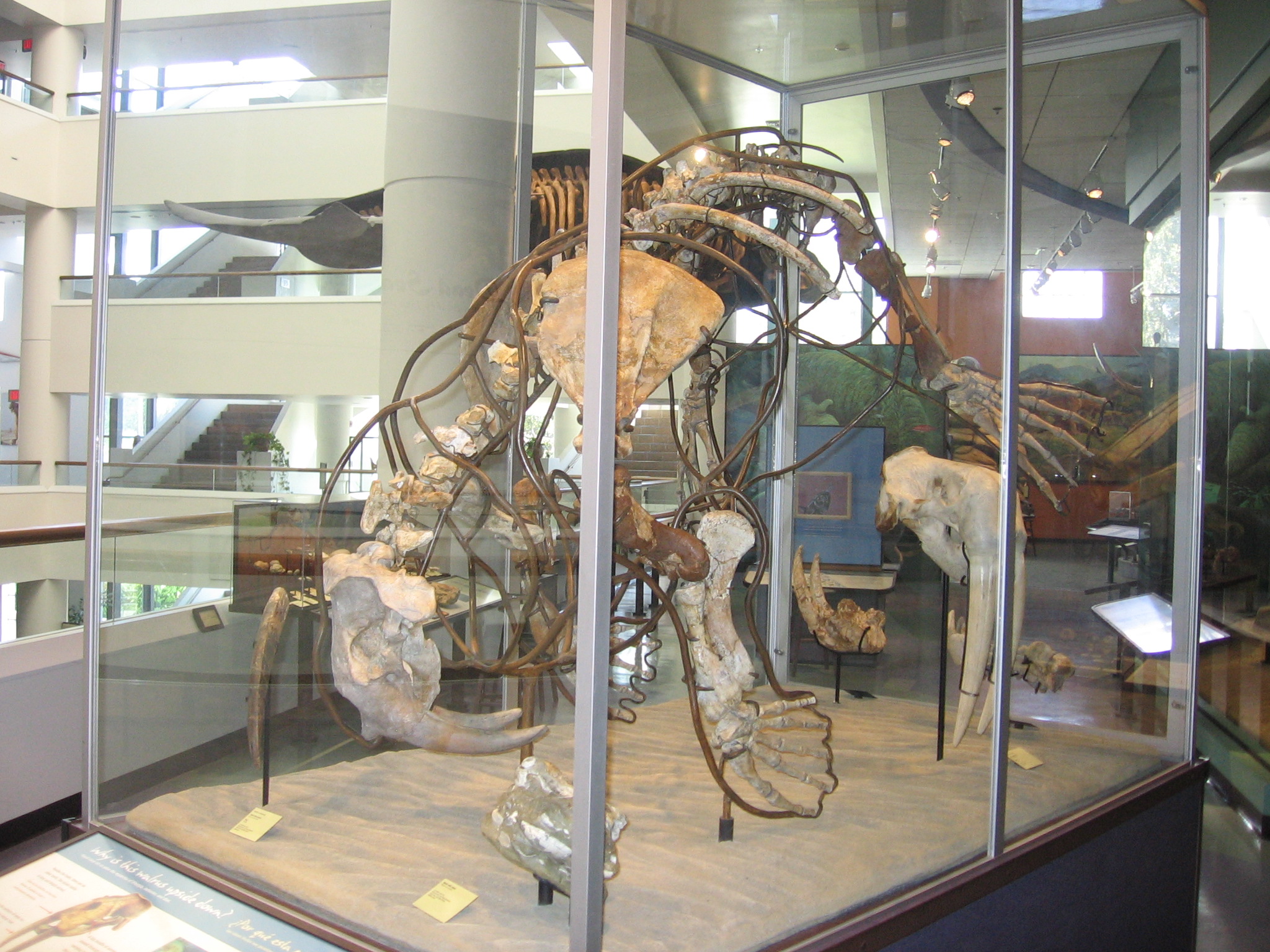
 Composite skeleton of Valenictus chulavistensis on display at SDNHM.

A closer look at Valenictus chulavistensis

The discovery of Valenictus chulavistensis was significant for multiple reasons. First, it was one of the few named marine mammals from the Pliocene of California - anything new is a great window into the evolution of marine mammals before the record goes 'dark' during the Ice Age. Second, it clarified what the rest of Valenictus looked like: the humerus was very close in shape to the relatively smaller and more stout humerus of Valenictus imperialensis reported by Ed Mitchell three decades prior. Indeed, the specimen was in fact a walrus, and an odobenine in particular. Humeri are somewhat diagnostic in pinnipeds, but they can't tell you much about the paleoecology of the animal - not like good skull material can, anyway.

 
The paratype skull of Valenictus chulavistensis, an immature male. It's been foreshortened a little bit by burial compaction, making it falsely look like the skull of Odobenus. All other Valenictus skulls are elongated like a stubby sea lion.

Valenictus, as it turns out, is pretty interesting in a number of ways. The first is the toothless condition: there are no sockets for upper incisors, premolars, or molars - just the two upper canines - and no sockets for any lower teeth at all. Toothlessness might seem counterintuitive - you need teeth to eat stuff, right? Wrong, actually - it depends upon what you eat. The modern walrus doesn't have any incisors (typically), and has lost or reduced some of its postcanine (cheek) teeth - typically not possessing upper molars. Though rightfully assumed to use its teeth in feeding, Francis Fay reported detailed accounts of feeding experiments with modern walruses - and they don't bite or chew anything with their teeth. Mollusk shells don't enter the oral cavity at all - walruses will purse their enormous lips, position a clam shell within the lips, suck the meat right off of the shell, and let the empty shells fall to the seafloor. The teeth in the modern walrus are however used for 'percussive' communication - the jaw is closed rapidly and you can hear a loud hammering sound - it almost sounds like two 2x4s being banged together. What's very interesting here is that Valenictus chulavistensis is more highly specialized than Odobenus rosmarus is for suction feeding.


 Another view of the composite skeleton of Valenictus chulavistensis.

The second curious aspect is the postcranial skeleton of Valenictus. The bones of Valenictus chulavistensis are very dense - like sea cow bones. This condition is called osteosclerosis, which is technically defined as the internal 'inflation' of the bony cortex (wall) by reduction of the marrow cavity. The bones of the modern walrus are indeed heavy, and the skull of modern Odobenus should probably be described as osteosclerotic as well, but the limb bones of Valenictus are quite a bit more dense (though this has never been quantified, to be honest). Some of them are also inflated externally - what is called pachyostosis. Increasing bone density is typically acknowledged as an adaptation for having 'bone ballast' - a way to help a marine tetrapod sink down to the seafloor. This is particularly important for any species of marine tetrapods that feed on the seafloor or need to dive shallowly, or have enormous buoyant guts that need to be counter-weighted. Sea cows (Sirenia) both feed on the seafloor and have enormous buoyant guts, and as a result have incredibly dense pachyosteosclerotic bones.* Walruses feed on the seafloor and are pretty hefty animals, so a bit of bone ballast helps. The dense skull, along with the heavy tusks, might help the modern walrus stay oriented in a stable orientation with the head down along the seafloor in order to efficiently cruise along and find mollusks. In the case of Valenictus, something else may have been going on given that modern walruses don't need such a high degree of bone ballast. Fossils of Valenictus have also been found in the proto-gulf of California/Sea of Cortez - V. imperialensis is one such example of this. There is evidence of hypersaline conditions in the proto-gulf - and perhaps V. chulavistensis inhabited subtropical embayments undergoing rapid evaporation causing hypersalinity. Hypersaline conditions make you more buoyant, and so perhaps the extra bone ballast in Valenictus is an adaptation against this.

*However, the recently extinct Hydrodamalis gigas - Steller's sea cow - fed on kelp at the surface and was apparently incapable of diving and its back stuck out of the water most of the time, according to the observations of Steller himself.

The third curious aspect of Valenictus chulavistensis is nothing anatomical, but rather its geographic location: San Diego, California, is not normally what comes to mind when you picture where walruses live. The modern species is chiefly Arctic in distribution, rarely straying south of the Alaska Peninsula or the Aleutians in the North Pacific, and in the Atlantic, rarely further south than the southern tip of Greenland. These are latitudes approximately 60*N - San Diego, on the other hand, is approximately the same latitude as Charleston, South Carolina, where I am typing from right now - 32*N. As alluded to earlier, walruses were formerly much more diverse and cosmopolitan in their past distribution. Adaptation for boreal seas and sea ice is apparently a very recent development in walrus evolution.

 
A photo of the skull taken by Forrest Sheperd shortly after lugging the 70 lb concretion off the beach. This is the photo sent to my MSU email account in early 2011.

A new fossil walrus from Santa Cruz - the discovery and laborious preparation of Valenictus sheperdi

In January 2011, a young fossil collector I had met a couple of times - 13-year-old Forrest Sheperd - was looking for fossils in Santa Cruz and happened upon a 70 lb sandstone concretion with bone sticking out. He recognized that a skull was presered inside the nodule, and that most of it remained entombed within the rock. After I saw some photos Forrest emailed me, I realized it was a walrus skull. I had already visited SDNHM and taken quick snapshots for future reference of many Valenictus skull specimens (three or four new skulls had surfaced in the 15 years since it was published) - and though I couldn't see the palate, the top of the skull and its size looked like a good match. I asked Forrest if he would be willing to donate the specimen, and so during my last semester of graduate school - March 2011 - I drove out to California from Bozeman Montana to visit family, do a little coastal fieldwork, and meet with Forrest. I also took the opportunity to drop off a carload of fossils at UCMP at Berkeley. I met with Forrest, felt immediately intimidated by the massive weight of the concretion, confirmed it was a walrus, and a few days later started the drive back to Montana. I spent a few months at Museum of the Rockies reducing the size of the concretion and a bit of airscribing to reveal some of the more shallowly covered parts of the skull. The late Bob Harmon dug out a tool he had been talking about for several years - a pneumatic scaler, which is a polite way of describing a handheld jack hammer. Now, I usually use that description for an airscribe, which is fair. However, a pneumatic scaler really is a handheld jack hammer - it packs a serious punch, and can chip off silver dollar sized chunks of the hardest, toughest sandstone I've ever encountered (which, actually, happens to be the rock the concretion around Forrest's walrus was enveloped by). By May 2011, I had successfully defended my Master's thesis and submitted my edits, had them approved, and Sarah and I started preparing to move out - we were ready to move on from Bozeman and start the next chapter of our lives down under.


 I just dug up this photo from March 2017 of me chipping away at the concretion out back behind "the old place". Given the upcoming, imminent move I am making to my next position, me wearing a "Property of San Diego Natural History Museum" is pretty hilarious and prophetic. Cosmic irony.

A few months later, I was accepted into the Ph.D. program at University of Otago to study with Ewan Fordyce. In retrospect, I probably could have taken the specimen with me - it was the only fossil I had considered bringing along - but another 50 lbs would have costed us several hundred additional dollars in overweight baggage fees, and we had to fit everything into 12 suitcases. I very easily could have prepared the specimen in Ewan's lab, but it would have stolen precious time away from my already brief three year program. The specimen had to wait back in California. Eventually, after graduating with my Ph.D. and getting more confident with acid preparation after getting hired at the Mace Brown Museum of Natural History, the fossil was sent to me on the east coast and I did a little bit of chiseling to reduce the volume of the concretion. I also did a bit more airscribing, but decided that I would just bathe the entire thing in a large acid bath - typically about 10 liters of 10% acetic acid. Thanks to the generosity of Jim Goedert, I was able to not only have the acid paid for by his donations, but also working on his fossils for nearly two years gave me the confidence I needed to try something so large. I generally had to replenish the acid once every three weeks, and I would fill up nearly every 4 liter acid bottle I had - for reference, this is about a half hour job. Not bad, but mixing that much acid down from glacial acetic acid - which, by the way, is 100% acetic acid - is a bit nerve wracking and relies a steady hand and focus. I've never burned myself with 100% acetic, but I have had my sinuses cleaned out a couple times and gotten a few drops onto my labcoat (which is why I was wearing a labcoat) and a couple spills up to a few milliliters (tablespoon size). 


 Progress photos of acid preparation, which took place from March 2017 to September 2018 or so.

For whatever reason, the reaction of Forrest's walrus to acid was quite slow; for Pysht Formation calcareous siltstone nodules from the Olympic Peninsula (donated by Goedert), I find that a once per week replenishment with fresh acid is best. You don't want to replenish too early and waste some of the potency of the acid, so I tend to drop a piece of one of Goedert's concretions - always the same piece - and see how reactive it is after a minute or so. If there are scarce bubbles, then it's time. Mother of vinegar also tends to accumulate on the surface, and in the case of some fossil sites, enough iron is freed and oxidized that the acid takes on a "lovely"  rusty hue right when it is just about spent. It's like taking a limit in Calculus - and I imagine that the acid potency curve is an exponential decay curve, like for calculating the age of a rock using ratios of radioactive isotopes. The line indicating 'spent acid' is going to be pretty close to flat at some point; the sooner you can replenish acid, the fossil will be subjected to stronger acidity for a greater proportion of the bath - thereby shortening preparation time. However, acid is sort of cheap - and I'm certainly 'cheaper' than the acid, so to speak - so at what point on the curve do you say "good enough, let's mix up a new batch"? It's a bit of a guessing game. If time is not of the essence, two weeks for anything in the ~1-3 kg size range is enough. Also recall that it's related to surface area. A sphere or cube will have the lowest surface area to volume ratio; however, many of these Olympic Peninsula concretions are all burrowed and have incredible nooks and crannies that dramatically increase the rate at which dissolution occurs because the surface area is much larger. For the walrus, it was sort of pill-shaped a low surface area. The tough matrix took about 18 months or so to come completely clean. Making matters worse was that the very center of the concretion seemed to be dolomitized: it no longer reacted to acid, and the matrix on the inside of the skull started to dissolve. So, I called off acid prep and started airscribing the remaining bits of stubborn matrix - you now see a pale oval 'tongue' in the middle of the palate, the permanent stain of this other rock type in the middle of the concretion. 

The holotype skull of Valenictus sheperdi in dorsal view.
 
The holotype skull of Valenictus sheperdi in lateral view.

Tusked walruses, and including the new species, from the Purisima Formation: what's new?

 We'll start with Valenictus sheperdi, because that's the most exciting material from the paper. The holotype specimen, UCMP 219091, is quite a bit larger (36 cm long) than the female skulls of Valenictus chulavistensis. We know that there are two morphotypes of V. chulavistensis - one with relatively narrow, dainty canines and skulls approximately 30 cm in length, and a robust canine morphotype with skulls pushing 35-40 cm and circular tusk cross-sections. This morphotype is confirmed to be male owing to the preservation of the baculum (penis bone) with the holotype. Generally speaking, bacula are nice, but it's generally uncontroversial to identify pinniped skulls with proportionally small canines and low muscle attachments as female - given how extremely sexually dimorphic pinnipeds are. Given that the V. sheperdi holotype skull is from a female, and it is about 18-24% larger than V. chulavistensis females, this suggests that V. sheperdi is a much larger walrus - perhaps close in size to modern walrus. There are a few anatomical distinctions as well. The paroccipital process of the squamosal has a sharp muscle attachment crest, whereas it is blunt in V. chulavistensis. There is a sharp, long crest along the maxilla below the orbit and behind the tusk socket - such a crest is not present in V. chulavistensis. Lastly, and perhaps most critically, the space between the canines is narrower in V. sheperdi - approximately 65-75% of the distance relative to the condition in V. chulavistensis. And, by the way, this is a comparison made only between females - so it's not caused by sexual dimorphism. We also report a titanic partial femur, collected by David Landes, that is a bit larger than the femora from the San Diego Formation; the width at the 'knee' end is about 160 mm, as compared to 120mm in the largest known San Diego Formation femora. The specimen is from just a few meters upsection relative to the holotype, so we identify it as Valenictus sp., cf. V. sheperdi. Also tentatively referred to the species is an astragalus that I reported back in 2017, collected by Wayne Thompson.

The holotype skull of Valenictus sheperdi in ventral view, showing that incredible toothless palate.

The holotype skull of Valenictus sheperdi in anterior and anterolateral view.


 A couple of postcranial bones we reported as Valenictus sp., cf. V. sheperdi - from just above the V. sheperdi type horizon; a big ass partial femur, and an astragalus I reported in 2017. Collected and donated by Dave Landes and Wayne Thompson (respectively).

Speaking of isolated postcrania - one of the reviewers asked "could Valenictus sheperdi be conspecific with V. imperialensis?" Indeed, an excellent question. The fossils are from different basins, so the thought hadn't crossed my mind - but the bigger clue is what had really initially separated the two: Valenictus sheperdi is larger than V. chulavistensis, and V. imperialensis is quite a bit smaller than V. chulavistensis. So I thought - exactly how different in size were V. sheperdi and V. imperialensis? The former is known only from a skull and the latter only from a humerus. Luckily, the holotype skeleton of V. chulavistensis is known from a fragmentary skull with an approximate length of 40 cm and a humerus measuring 31 cm long; this ratio suggests a humeral length of 27 cm, compared with the 24 cm long humerus of V. imperialensis. Add to this the fact that the V. imperialensis holotype is so robust it is likely to be a male - making V. imperialensis a decidedly small odobenine. Further, the predicted skull size of V. imperialensis is 32 cm. However, we really need more material of V. imperialensis to be sure!

Skull of Valenictus sp., cf. V. chulavistensis, the Burman specimen originally reported in a conference abstract by Barnes and Perry.

Higher up in the Purisima Formation, we also reported the skull originally studied by Barnes and Perry - and identified it as Valenictus sp., cf. chulavistensis - as we could not identify any features that distinguished it from the San Diego fossils. It is also a female, but not quite as well preserved - and a bit smaller in size, more like V. chulavistensis. Geochronologically, this also makes sense - this specimen is younger, and dated to about 4.89-3.59 Ma, which overlaps in time with the lower parts of the San Diego Formation. This suggests that this species lived along much of the Pacific coastline, as these localites are 700 km apart (a little added to reconstruct shortening by the San Andreas fault). 

The oldest well-dated record of Odobeninae, a first metacarpal from the left flipper of a walrus collected by yours truly in 2007, I believe.
 

In addition to the skulls, we also reported a couple of more partial specimens that nonetheless preserve some key features and are quite old. The first is a 'metacarpal I' collected from quite low down in the Purisima Formation, and is roughly 6-7 million years in age, likely close to about 6.9 Ma. This bone is somewhat diagnostic in pinnipeds - metacarpals are the largest bones in your hands, and the first metacarpal is the bone that connects your thumb to your wrist; the remaining metacarpals are in your palm (digit 1 = thumb, 2= index finger, 5= pinky). Since walruses are pinnipeds, all of the metacarpals and phalanges are embedded in the flipper. This specimen is massively inflated and also bent laterally - a feature only seen in odobenine walruses like Odobenus and Valenictus. However, it is grossly more inflated than any named walrus - but almost certainly represents an odobenine; dusignathines and all earlier "imagotariine" walruses have somewhat long, narrow metacarpals that really can't be confused with specimens like this. What's interesting is that this specimen has an older and better age determination than the previously oldest known odobenine, Aivukus cedrosensis from the Almejas Formation of Baja California.

The oldest well-dated record of the long tusked walruses, Odobenini - a tusk fragment with obvious globular dentine, collected by F.A. Perry.

The last specimen that is noteworthy is a hefty chunk of a large canine tusk collected from a stratum dating to about the Miocene-Pliocene boundary, roughly 6-5.2 Ma, but likely to be at the younger end and around 5.3 Ma. This specimen was collected in 1978 by my friend and colleague Frank Perry, and preserves a large core of globular dentine. This feature indicates that the specimen represents the Odobenini - long tusked walruses. It is possibly Valenictus, as it is only slightly older than Valenictus sheperdi - but ultimately we don't know, since isolated tusk fragments are not really diagnostic. But, that's fine! Because this specimen happens to be the oldest well-dated record of Odobenini anywhere. The previously oldest specimens were tusks from the early Pliocene Horokaoshirarika Formation of Japan - which now seems to be a bit younger than previously estimated, with a currently proposed maximum age of 4.5 Ma. What's further surprising is that this is entirely younger than the entire age control for Valenictus sheperdi, really underscoring how old such a specialized walrus is. This canine fragment indicates that the Odobenini already evolved prior to the Miocene-Pliocene boundary.

 
Phylogenetic analysis of walrus relationships from our new study.

Implications for the Relationships of Tusked Walruses

Any time a new pinniped taxon it's a good idea to revisit phylogeny - and in our case, Morgan and I published our walrus phylogenetic matrix 11 years ago and it's been tinkered with and added to by a few different papers since. At the time, we were describing a new specimen of Pelagiarctos, and trying to demonstrate the identification in an ironclad fashion, and needed a ton of dental characters. That matrix was never intended to be the primary walrus matrix in circulation, though that's certainly what happened; within a year or so we started adding additional taxa and more cranial and postcranial characters, and also simplified and streamlined some of the perhaps overly-parsed dental characters. We incorporated most of the new walruses named since then, including Archaeodobenus, Osodobenus, Pontolis kohnoi and Pontolis barroni, and Titanotaria orangensis - along with some proposed coding changes from earlier studies. Our matrix went from about 90 in the prior version to 143 - a dramatic 63% increase in the amount of character data. We also fixed some issues in character ordering and used a large number of ordered characters (n=46).

So, what did we learn from this new analysis? Surprisingly, the phylogeny didn't really change much from earlier work - either from our 2013 analysis, or from recent studies by Magallanes et al. (2018) and Biewer et al. (2020). We confirmed dusignathine monophyly - which of course will be investigated further with the reporting of many new unpublished dusignathine specimens from California. The dusignathine + odobenine clade, Neodobenia, is again very well supported and all the relationships within it are further well-supported. Support for many of the early branches within the "imagotariine" part of the tree are quite poorly supported - and I don't quite know how to proceed there, except perhaps to include additional outgroup taxa. We found decent support for a Valenictus + Pliopedia clade (see more below), though within this did not recover a subclade for just Valenictus - likely driven by the incompleteness of Pliopedia. Curiously, we did not find a sister taxon relationship between the Ontocetus sp. skull reported from Japan and Ontocetus emmonsi from the North Sea. Like Deméré (1994A), we found a sister taxon relationship between the modern walrus Odobenus and Valenictus (with Pliopedia in there as well). With that in mind, it seems as though every odobenine lineage has a North Pacific origin sometime in the Pliocene. 

The Kettleman Hills specimen of Pliopedia pacifica, from Repenning and Tedford (1977).

We further also included Pliopedia pacifica into our phylogenetic analysis. There are two main specimens - the holotype, originally reported by Kellogg (1921), and a partial skeleton including a well-preserved forelimb with complete humerus, radius, and ulna, and a skull cap reported by Repenning and Tedford (1977) from the lower Pliocene Etchegoin Formation of Kettleman Hills near Coalinga. The humerus is similar to Odobenus and Ontocetus in some respects, and the braincase is quite similar to Valenictus. Deméré (1994A) indicated that the flattened nuchal crest of the braincase and the deltoid insertion on the humerus identify this specimen to the Odobeninae. Barnes and Raschke (1991) cast doubt on the Kettleman Hills specimen belonging to Pliopedia pacifica, and restricted the species to the type specimen. We went a step further and coded this specimen into our phylogenetic analysis - all of the codings for features preserved in both specimens were identical, and most of the other informative codings were based on the Kettleman Hills specimen. Though the humerus is very different from Valenictus, the braincase has paired sulci on the midline, like Valenictus - a possible synapomorphy for these two genera. Regardless of the assignment of the Kettleman Hills specimen to Pliopedia, it, along with a couple specimens from the younger San Diego Formation, indicate that at least a second genus of odobenine was present in the Pliocene of California.

The last Valenictus - a giant molluskivore finds itself increasingly out of its element as embayments dry up and kelp forests proliferate, creating a perfect environment for sea otters to evolve into a million or two years later - but unfriendly to walruses. I had originally intended this to showcase some of the fauna known from the Purisima, but it's largely a softbottom depositional setting. Marine specialists will identify some unlikely associations - such as giant green anemones and California mussels this far down in the water column. Nevertheless, I wanted to underscore the occurrence of this fossil associated with many species found both in the Purisima as well as the modern Monterey bay.


The Extinction of Valenictus and Friends

We took a look at the biogeography faunal succession of Miocene-Pliocene walruses along the Pacific coast in the context of ecological change, climate change, and geographic change. 

We used paleogeographic maps to estimate the additional shelf space present in California during the late Miocene (5-8 Ma) and Pliocene (5-2 Ma). Many large embayments, including the enormous shallow embayment in the southern San Joaquin Valley (occasionally but informally called the "Temblor Sea") resulted in some 33,000 square kilometers of additional shelf, along with 27,000 km2 for the modern shelf, for about 60,000 km2 in total. This was reduced to about 48,000 km2 in the Pliocene, and to 27,000 km2 in the Holocene. Why is this important? Walruses only feed in shallow marine settings, well above 100 meters depth. Walruses are not pelagic, and are tied to eating mollusks on the seafloor. Gray whales have a similar ecology in that they suction feed in shallow settings - not for mollusks, but for amphipods and other small crustaceans in dense benthic (seafloor) communities. It's no coincidence that both gray whales and modern walruses graze in the same region - the Bering Sea - and both have close ancestors that inhabited a very different looking Pacific coast in just a few million years ago. These shallow marine embayments contrast strongly with the current California coast, which is dominated instead by rugged, rocky shorelines and thick, highly productive kelp forests - admittedly today, these kelp forests are considerably diminished relative to what they were prior to 18th-19th century Russian otter hunting.

Paleogeographic maps of California from the late Miocene to early Pliocene, late Pliocene, and Pleistocene, and changing marine carnivore diversity from each time slice.

These embayments hosted a bizarre cast of marine vertebrate species including low-latitude belugas (Monodontidae), the river dolphin-like Parapontoporia, the bizarre 'half beaked' porpoise Semirostrum and a host of other true porpoises taking up niche space now occupied by delphinids, the gigantic sea cow Hydrodamalis cuestae, double tusked walruses (Dusignathinae), several species of smallish rorquals (Balaenopteridae), dwarf right whales (?Balaenula), early gray whales (Eschrichtiidae), an early minke whale (Balaenoptera bertae), and the dwarf suction-feeding whale Herpetocetus. Notably absent from this list are sea otters (Enhydra), sea lions (Zalophus, Eumetopias), elephant seals (Mirounga), harbor seals (Phoca), killer whales (Orcinus), pilot whales (Globicephala), diverse delphinids (Delphinidae), and humpback whales (Megaptera) - these taxa either probably hadn't evolved yet or have fossils in other regions and likely invaded the eastern North Pacific sometime during the Pleistocene.

Pliocene marine vertebrate fauna from the Purisima Formation - from my 2013 marine mammal assemblage paper.

What happened to all of these shallow marine embayments - and this fauna? Uplift of the California Coast Ranges either directly lifted these embayments out of the Pacific Ocean, resulting in the large broad plains like the LA basin, San Diego, Salinas Valley, and others in San Luis Obispo, Marin, Sonoma, and Humboldt counties. In the case of the "Priest Valley Strait" - the body of water that connected the San Joaquin embayment to the proto-Monterey Bay - this shallow strait was sheared by movement of the San Andreas Fault, uplifted, and eventually completely pinched dry above sea level, turning the San Joaquin embayment into an inland sea. Within a million years, it turned into a freshwater lake, which eventually continued to dry out. Sometime after being stranded in the basin, the long-snouted Parapontoporia continued to inhabit freshwater environments. Uplift of the Sierra Nevada spelled further doom for the biggest of these embayments. As the Sierras were uplifted, they eroded and shed an incredible volume of sediment into the San Joaquin embayment. A one-two punch killed the basin: its connection to the Pacific was choked by the uplift of the Coast Ranges, and filled with sediment by the Sierras.

When did Valenictus go extinct? The youngest known specimens seem to date to strata within the San Diego Formation that are around 2.6 Ma, a bit younger than the youngest known specimens from the Purisima Formation; this, ironically, is actually about the time that the Purisima basins dry up and transition to nonmarine sediments. This coincides with the beginning of the estimated period of extinction in which many of these other strange Pliocene marine mammals went extinct - sadly, a minimum date is not yet available, since the early Pleistocene marine mammal record just sort of doesn't exist. By the middle Pleistocene (~1-0.7 Ma), most of the marine mammals belong to extant taxa.

What about climate change? Climate was certainly cooling, and while cooling seas may not be terribly critical to walrus distribution, it can greatly affect their prey. During the late Pliocene, rapid expansion and contraction of the newly formed northern hemisphere ice cap also began causing rapid 'glacioeustatic' changes in sea level. Ice cap volume increases, sea level decreases - and vice versa. This resulted in loss of embayment space, but more critically - fluctuating salinity in places like the San Joaquin embayment. Sea level fluctuations drove extinctions of mollusks on both the Pacific and Atlantic coasts of North America, resulting in lower diversity of oysters, scallops, and loss of gigantic mussels in California.

The molluskivore niche was filled during the Pleistocene by sea otters, sea ducks, and the extinct flightless goose Chendytes. Potential niche fillers also include bat rays, wolf eels, and sheepshead wrasses. Critically, sea otters and Chendytes did not newly appear prior to the extinction of Valenictus - rather, they appeared later, perhaps suggesting physical bottom-up drivers for the extinction of Valenictus and company, rather than competition; these vacant niches were then, in my opinion, likely passively filled later on during the ice ages. However - we really do need more fossils from the late Pliocene and Pleistocene, and better understanding of the niches and trophic structure of the Pliocene marine vertebrate fauna from the Pacific coast - otherwise this is all just informed speculation.

References

Barnes, L. G., and Perry, F. A. (1989): A toothless walrus from the Purisima Formation in California, U.S.A. [Paper presentation]. 8th Biennial Conference on the Biology of Marine Mammals, Pacific Grove, CA, U.S.A.

Barnes, L. G., and Raschke, R. E. (1991). Gomphotaria pugnax, a new genus and species of late Miocene dusignathine otariid pinniped (Mammalia: Carnivora) from California. Natural History Museum of Los Angeles County Contributions in Science, 426, 1–27.

Boessenecker, R. W. (2013). A new marine vertebrate assemblage from the Late Neogene Purisima Formation in Central California, Part II: pinnipeds and cetaceans. Geodiversitas, 35(4), 815–940. https://doi. org/10.5252/g2013n4a5 

Boessenecker, R. W. (2017). A new early Pliocene record of the toothless walrus Valenictus (Carnivora, Odobenidae) from the Purisima Formation of Northern California. PaleoBios, 34, 1–6. https://doi. org/10.5070/P9341035289

R.W. Boessenecker, A.W. Poust, S.J. Boessenecker & M. Churchill (2024): Tusked walruses (Carnivora: Odobenidae) from the Miocene–Pliocene Purisima Formation of Santa Cruz, California (U.S.A.): a new species of the toothless walrus Valenictus and the oldest records of Odobeninae and Odobenini, Journal of Vertebrate Paleontology.

Deméré, T. A. (1994a). The family Odobenidae: a phylogenetic analysis of fossil and living taxa. Proceedings of the San Diego Society of Natural History, 29, 99–123.

Deméré, T. A. (1994b). Two new species of fossil walruses (Pinnipedia: Odobenidae) from the Upper Pliocene San Diego Formation, California. Proceedings of the San Diego Society of Natural History, 29, 77–98.

Kellogg, R. (1921). A new pinniped from the Upper Pliocene of California. Journal of Mammalogy, 2(4), 212–226. https://doi.org/ 10.2307/1373555 

Magallanes, I., Parham, J. F., Santos, G. P., and Velez-Juarbe, J. (2018). A new tuskless walrus from the Miocene of Orange County, California, with comments on the diversity and taxonomy of odobenids. PeerJ, 6, e5708. https://doi.org/10.7717/peerj.5708 

Mitchell, E. D. (1961). A new walrus from the imperial Pliocene of Southern California: with notes on odobenid and otariid humeri. Los Angeles County Museum Contributions in Science, 44, 1–28.

Ray, C. E. (1975). The relationships of Hemicaulodon effodiens Cope 1869 (Mammalia: Odobenidae). Proceedings of the Biological Society of Washington, 26, 281–304.

Repenning, C. A., and Tedford, R. H. (1977). Otarioid seals of the Neogene. US Geological Survey Professional Paper, 992, 1–87. https://doi.org/10.3133/pp992