Sunday, December 2, 2012

US Research trip part 4: National Air and Space Museum

And now for something completely different: planes and rockets! No trip to DC is complete without a visit to the Smithsonian Air and Space Museum, especially for those interested or fascinated by aviation history. Ever since watching "The Right Stuff" and Apollo 13 as a young boy, I've been fascinated by experimental aviation and space exploration.


The single most stunning piece in the museum: the Bell X-1, aka "Glamorous Glennis", flown by Chuck Yeager in 1947, and the first flight to really break the sound barrier. There are some other possible cases of the sound barrier being broken during World War 2 by German and British pilots during dives, but none of these included sustained flight over Mach 1.


The Spirit of St. Louis, flown by Charles Lindbergh for his 1927 non-stop transatlantic flight from New York to Paris. In order to have improved center of gravity, the fuel tanks were placed in front of the cockpit - which also meant that no forward facing winshield could be used; Lindbergh navigated primarily from instruments, and a forward facing periscope was also installed.


The Apollo 11 command module capsule! They have it totally sealed off in plexiglass to keep heathens from touching it.

One of my favorite aircraft: the X-15, the grandson of the X-1. Both aircraft were carried while slung under the wing of a modified bomber like a giant bomb (B-29 mothership for the X-1, B-52 for the X-15), to be dropped off at high altitude; this was to conserve fuel which would normally be spent during takeoff. The X-15 not only set speed records at flying nearly 7 times the speed of sound, but also set altitude records, flying up to 100 km and past the Karman Line (i.e., officially into space). The shuttle program used a lot of the information generated by the X-15 later on during the 1970's.


A mockup of the Apollo-Soyuz test project in 1975, which ceremoniously 
marked the end of the space race.


A German V-1 'flying bomb' or 'buzz bomb', powered by a pulse jet engine; nearly 10,000 V-1s were fired from occuppied Europe at southeast England in 1944 and 1945.


The big brother of the V-1, the V-2 rocket, a short range liquid-propellant ballistic missile developed in Germany during the second world war. I've seen two of these: this rocket, and one at the British Military Museum in London.


Easily the sexiest aircraft in the museum: the Hughes H-1 racer, which Hughes flew himself and set world speed records in. The film "The Aviator" shows Hughes flying the H-1 during a flight in which he ran out of fuel and crash-landed; it was intended as a prototype and proof-of concept for next generation fighter planes, and Hughes later indicated he felt such military aircraft as the Japanese 'Zero' were ripped off from his plane. One of the innovations for this aircraft were flush rivets.

Tuesday, November 27, 2012

Introducing Miocaperea, a fossil pygmy right whale from Peru

I've interrupted my series of picture posts from the US trip in order to discuss a new paper that just came out this week on a new and exciting fossil mysticete from Peru. Previously organized programming will return shortly.

One of the strangest aspects of the fossil record of baleen whales is the apparent lack of fossil neobalaenids, or pygmy right whales. There is no shortage of fossil right whales (Balaenidae - e.g. Balaena ricei, Balaenula spp., Balaenella, Eubalaena shinshuensis), rorquals ("Megaptera" miocaena, Diunatans, Parabalaenoptera, Archaebalaenoptera, etc.), gray whales (Archaeschrichtius, Eschrichtioides, Gricetoides), and all manner of extinct groups (Cetotheriidae, Aetiocetidae, Mammalodontidae, Eomysticetidae, stem-balaenopteroids). Up until 2012, the only described pygmy right whale fossil is a single partial petrosal (earbone) from the latest Miocene of Beaumaris, Australia, recently published by my colleague Erich Fitzgerald. Those of us who are "in the know" are aware of a few tantalizing bits and pieces from here and there - including some Miocene material from Angola recently reported by SMU Ph.D. student John Graf (and colleagues) at the 2011 SVP meeting.


The late Miocene earbone of an indeterminate neobalaenid recently described by Fitzgerald (2012) from Australia.

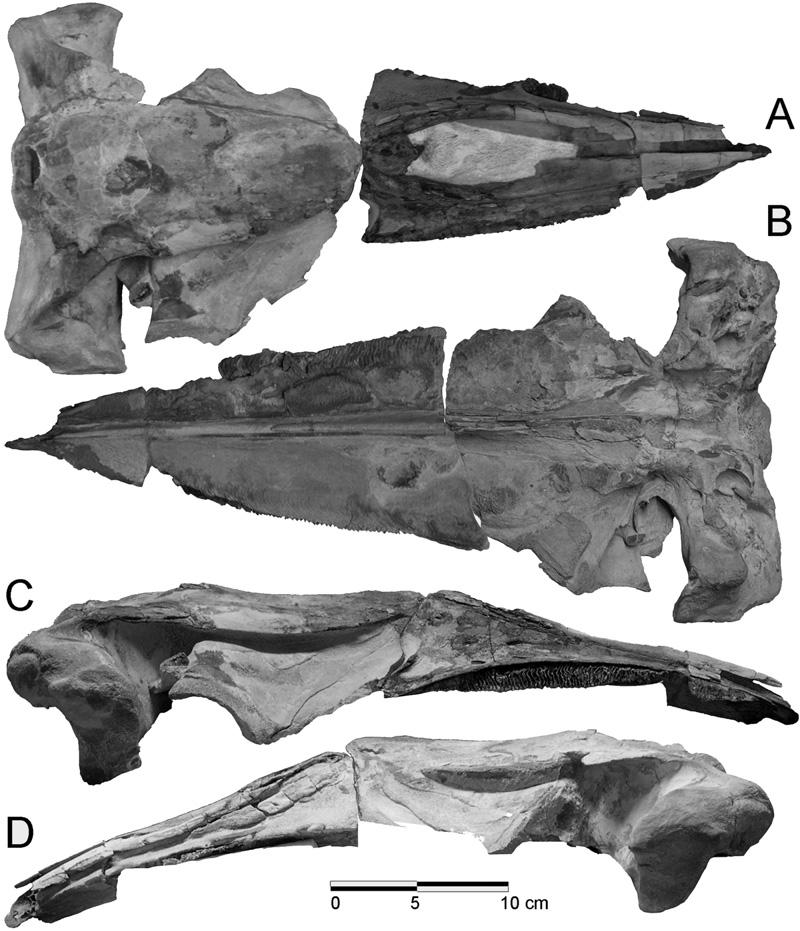
This new fossil from the late Miocene Pisco Formation of Peru is beautifully preserved, and includes a nearly complete skull with baleen preserved in situ. Baleen! The baleen racks have been left in place in "articulation" with the palate, and prepared out in three dimensions. The skull is tiny - approximately one meter in length, and 50 centimeters wide (roughly the size of a killer whale skull) - although somewhat wider, it is about the same length as tiny, dainty whales like Herpetocetus. It's age and similarity to Caperea, inspired the genus name Miocaperea, and pulchra ("beautiful" in latin) for the beautiful preservation of the specimen.


The holotype skull of Miocaperea pulchra from the late Miocene of Peru (from Bisconti 2012). 

It shares numerous hallmark features with modern Caperea, such as a short and attenuated rostrum that is somewhat arched, an extremely thrusted supraoccipital shield that is transversely arched, a bizarrely constructed squamosal which seems to lack a zygomatic process, and a huge posterior process of the petrosal that is inflated and broadly exposed on the lateral side of the skull.


 The earbone region of Miocaperea (from Bisconti 2012). 


It includes a number of differences from modern Caperea, however, such as a substantially more primitive (or should I say, less bizarre) earbone, lack of exposure of the alisphenoid bone on the braincase, and a foramen pseudovale that is located between the squamosal and pterygoid, rather than completely within the pterygoid (a unique feature of Caperea). Caperea also has a really unique postcranial skeleton, recently detailed by Buccholz (2010). Unfortunately, Miocaperea is not known from any postcranial elements.


 Side by side comparison of the skulls of Caperea (left) and Miocaperea (right), from Bisconti (2012). 

The fossil was collected in 1985 by Swiss private collector Jakob Siber from the Aguado de Lomas locality of the Pisco Formation in Peru, and later donated to the Staatliches Museum für Naturkunde in Stuttgart, Germany, along with the skeleton of Balaenoptera siberi described by Giorgio Pilleri and Siber several years later. Bisconti (2012:877) gives an interesting discussion of the legal status of the specimen:

"The new specimen is the holotype of Miocaperea pulchra gen. et sp. nov., found from the upper Miocene Pisco Formation at Aguada de Loma, Peru (Fig. 1), and is now permanently housed in the Staatliches Museum für Naturkunde, Stuttgart, Germany, as specimen no. 46978 of the palaeontological collection. The specimen was excavated by Jakob Siber in 1985, and was legally exported by the Siber+Siber Aathal/Zürich company (E.P.J. Heizmann, pers. comm.). Mr Siber confirmed the legal status of the specimen before the Society of Friends of the Natural History Museum Stuttgart bought it (E.P.J. Heizmann, pers. comm.). The legal documentation can be provided by Siber+Siber Aathal/Zürich. The specimen came to the Stuttgart collection as a present from the Society of Friends of the State Museum of Natural History (SMNS), together with further Peruvian material (e.g. the skeleton of Balaenoptera siberi Pilleri, 1989, which is exhibited in the Schloss Rosenstein building of the SMNS)."

I'll confess that I am wholly ignorant of Peruvian fossil/artifact exportation laws, but this section did pique my curiosity. I can't comment on anything specific about this specimen, but there must have been some question from someone to include this statement in the paper in the first place - If fossil exportation is illegal from Peru, then clearly private fossil dealers have not heeded it at all, given the sheer abundance of Peruvian Pisco Fm. fossils for sale on the internet. Another example of a beautiful South American fossil collected by private fossil collectors and later donated (although under what circumstances I'm unclear) to a museum is the type specimen of Pelagornis chilensis described by Mayr and Rubilar Rogers (2010) from Bahia Inglesa, Chile. The above listed website maintains that its Peruvian fossils were acquired years ago, and also indicates that Peru currently considers fossil export to be illegal. China and Mongolia have as well, but it's clear that commercial fossil dealers don't really care either.

Edit: I received a nice email from Dave Bohaska, who informed me that when he started working at the USNM in 1989 fossil export from Peru was still legal - but that sometime after he started, it was outlawed. It indeed appears that the type of Miocaperea was legally collected, as outlined by Bisconti (2012).


Three-dimensionally preserved baleen in Miocaperea (from Bisconti 2012). 

So, what exactly does this tell us about the evolution of the pygmy right whale? Given how derived the fossil is, and how similar it is to Caperea (aside from some minor earbone characters, I'm hard pressed to point at any one character of the skull that would really preclude it from being included even within Caperea itself, but I'm a bit conservative, taxonomically speaking) - it doesn't really give us too much information regarding morphological transformations that culminated in the bizarre morphology of Caperea. It's a fairly advanced cetacean, although it is from the Aguado de Lomas locality, and therefore about 7-8 million years old or so. In the eastern North Pacific, for example, we have species of baleen whales that are beginning to show features that are about as advanced as modern balaenopterids and balaenids, but have different configurations of skull features - indicating they do not belong to modern genera or species, but are essentially modern in terms of architecture (as opposed to the clearly primitive skulls of "kelloggitheres" during earlier parts of the Miocene).


 Comparison of the skulls of Balaenoptera (left), Caperea (middle), and Balaena (right), from Churchill et al. (2012).

Bisconti also spent a fair amount of the paper discussing previously published phylogenies with varying positions of Caperea among the mysticetes. Most studies have agreed upon Caperea having a sister taxon relationship with right whales - forming a clade called the Balaenoidea. Examples include Demere et al. (2005), Churchill et al. (2012), and Ekdale et al. (2011). One of my labmates - Felix Marx - published a paper in the Journal of Mammalian Evolution regarding the phylogeny of modern and fossil mysticetes, in which he included a large number of species. Instead of the typical Balaenoidea, his analysis resulted in a novel position of Caperea as the sister taxon of the rorqual-gray whale clade - separated from balaenids by all "Kelloggitheres" and the Cetotheriidae. This topic came up at the Aquatic Tetrapods (SATLW) conference last year in San Diego, and there was an interesting dialogue between Felix, Nick Pyenson, and some of the San Diego researchers. In these analyses, the way characters are defined and coded is of the utmost importance, and the different phylogenetic position of Caperea in Marx (2010) and other studies is probably due to differences in character selection, definition, and coding. I won't go into the specifics, as the minutiae of phylogenetics and cladistics are perhaps a tad too dull for the general audience. Nevertheless, the phylogenetic analyses of Churchill et al. (2012) and Ekdale et al. (2011) both responded to the novel relationship which Marx (2010) published.


Different phylogenetic hypotheses for neobalaenid and balaenid relationships 
(from Churchill et al., 2012).

What implications does this have for understanding the fossil record of cetaceans? Although the fossil baleen whale assemblage of the Pisco Formation is very poorly known, and thus far represented only by a few described species (Piscobalaena nana, Piscocetus sacaco, Balaenoptera siberi, and now Miocaperea pulchra), it is one of the largest marine mammal fossil assemblages yet amassed by researchers. The large assemblage already includes numerous pinnipeds (Acrophoca, Piscophoca, Hydrarctos), a slew of dolphins (Brachydelphis, Lomacetus, Australithax, Piscolithax, Belonodelphis, Scaphokogia, Acrophyseter, Livyatan, Messapicetus gregarius, Nazcacetus, Ninoziphius, Atocetus, Odobenocetops, Hemisyntrachelus, Pliopontos, Incacetus), and aquatic sloths (Thalassocnus). There are abundant balaenopterids known from the Pisco Formation that await description (several undescribed taxa were used in the phylogenetic analysis of another recent paper by Bisconti, and also occur in the supplementary info for the Lambert et al. 2010 paper on Livyatan). Given what we know of the current fossil record of baleen whales from Peru - published and unpublished - most are balaenopterids, and the cetotheriid Piscobalaena, and there aren't multiple skeletons of this little neobalaenid. One could certainly make the case that fossils of neobalaenids are rare (N=2 published specimens, worldwide). Both specimens are from the southern hemisphere; likewise, no neobalaenid fossils are yet known from the northern hemisphere, including well-sampled rocks from California, Italy, Japan, and the eastern USA. Assuming this point to be generally accurate, I'll make the case that even in large and "well known" fossil assemblages like the Pisco, there will always be little 'surprises' like this waiting for us. Another example of this is Livyatan - although in that case, there were previous discoveries of mysterious gigantic physeteroid teeth, and the embarrassingly large rostrum named Ontocetus oxymycterus by Kellogg (1925) - another topic for a blog post... some day. Comparable examples of weird, rare taxa in fossil assemblages from California would include the "killer" walrus Pelagiarctos from Sharktooth Hill, and the Pelagornis fossil I described with N. Adam Smith from the Purisima Formation. Discoveries like this serve to remind us that no matter how well-sampled and heavily collected a productive locality is, there is always going to be something surprising waiting for us.

References-

Bisconti, M. 2012. Comparative osteology and phylogenetic relationships of Miocaperea pulchra, the first fossil pygmy right whale genus and species (Cetacea, Mysticeti, Neobalaenidae). Zoological Journal of the Linnean Society 166: 876-911.

Buchholtz, E. 2010. Vertebral and rib anatomy in Caperea marginata: Implications for evolutionary patterning of the mammalian vertebral column. Marine Mammal Science 27: 382-397.


Churchill, M., Berta, A., Deméré, T.A. 2012. The systematics of right whales (Mysticeti: Balaenidae). Marine Mammal Science 28: 497-521.

Deméré, T. A., Berta, A., and McGowen, M. R. 2005. The taxonomic and evolutionary history of modern balaenopteroid mysticetes. Journal of Mammalian Evolution 12: 99-143.

Ekdale, E. G., Berta, A., and Deméré, T. A. 2011. The comparative osteology of the petrotympanic complex (ear region) of extant baleen whales (Cetacea: Mysticeti). PLoS ONE 6:1-42.


Fitzgerald, E.M.G. 2012. Possible neobalaenid from the Miocene of Australia implies a long evolutionary history for the pygmy right whale Caperea marginata (Cetacea, Mysticeti). Journal of Vertebrate Paleontology 32:976-980.

Graf, J., Jacobs, L., Polcyn, M., Mateus, O., Schulp, A. 2011. New fossil whales from Angola. Society of Vertebrate Paleontology 2011 meeting abstracts: 119A.

Marx, F. G. 2011. The more the merrier? A large cladistic analysis of mysticetes, and comments on the transition from teeth to baleen. Journal of Mammalian Evolution 18:77-100.

Thursday, November 22, 2012

US Research trip part 3 and 1/2 - fossil & modern mysticetes

Given my dissertation topic - fossil eomysticetids - I planned this trip so that I'd be able to see a lot of fossil mysticetes. Cenozoic marine sediments of the Atlantic coastal plain are densely fossiliferous, with several important 'classic' fossil localities: Bone Valley, Florida (late Miocene to Pliocene), Charleston, South Carolina (late Oligocene and Pliocene; Ashley, Chandler Bridge, Goose Creek Formations), Calvert Cliffs (early Miocene to late Miocene; Calvert, Choptank, St. Marys, Eastover Formations), Lee Creek/PCS Phosphate Mine, Aurora, North Carolina (middle Miocene, Pliocene; Pungo River Limestone, Yorktown Formation). With the exception of the South Carolina and Florida localities, all other strata are parts of the "Chesapeake Group" (for the uninitiated, an assemblage of formations that typically co-occur across a basin can be categorized into a group; groups can even be categorized into supergroups - such as the Proterozoic age Belt Supergroup of Montana.

In the early and mid 20th century, the preeminent paleocetologist Remington Kellogg described a large number of "cetotheres" from the Calvert and Choptank Formations of Maryland, including Aglaocetus patulus, Diorocetus hiatus, Halicetus ignotus, Parietobalaena palmeri, Pelocetus calvertensis, and Thinocetus arthritus. All of these specimens are at the USNM offsite facility at Suitland, Maryland - and I got to see most of them. Most of these are well preserved and morphologically informative - although some have been extensively reconstructed. For example, I examined the holotype of Diorocetus hiatus - and I was hard pressed to find any foramina or cranial sutures that appeared to be real. Much of the braincase was plaster or some other material that had painted the same color as the bone - there is a slight difference in color, but the telltale sign are the paintbrush striations, which contrast strongly with the natural bone texture. The holotype specimen has complete squamosals, a good vertex, and so on, but the rest of the braincase consists of non-overlapping fragments separated by wide expanses of sculpted and painted plaster. Because of issues like this, I don't feel terribly comfortable interpreting much about certain aspects of the anatomy of Diorocetus - which makes coding the taxon for phylogenetic analyses a big issue.


One of the few cetotheres named by none other than Edward Drinker Cope - Metopocetus durinasus, from either the Calvert Formation or the St. Mary's Formation (nobody really knows). Metopocetus has been considered to be a close relative of my favorite whale, Herpetocetus. Metopocetus was redescribed and reanalyzed by Kellogg in the 1960's, and more recently by Frank Whitmore and Larry Barnes.


Examination of modern mysticete skeletons is imperative for studying those of fossil mysticetes. It's even better when you can occasionally find modern crania sawn in half, to help make aspects of the internal osteology  more apparent. This is a sagittally sectioned skull of the minke whale, Balaenoptera acutorostrata.


 The heavily reconstructed skull of Diorocetus hiatus, named by Kellogg. The lighter brown areas are sculpted and painted; however, sculpted areas of the braincase are less obvious than the large patches on the rostrum.


Not exactly a mysticete - the petrosal (earbone) of the basilosaurid archaeocete Zygorhiza kochii from the Eocene of the southeastern US. Basilosaurids are important as they are typically used as outgroup comparisons for phylogenetic analyses of mysticetes; I've spent the last 7-8 months familiarizing myself with basilosaurid cranial anatomy, as I will include several in my Ph.D. analyses (Basilosaurus spp., Dorudon, Zygorhiza). This one in particular was ground away by Gerald Fleischer for his study of the evolution of the cetacean cochlea and hearing. We have a cast of this specimen here at Otago, but it was nice to see the original specimen.


The petrosal of the large Miocene balaenopterid, "Megaptera" miocaena; this same earbone morphotype (i.e. not necessarily the same species, but the same genus at least - although it needs a new genus, as it clearly doesn't belong in Megaptera) is also present in a number of other late Miocene and Pliocene rock units in California, including the Purisima Formation and Santa Margarita Sandstone (Santa Cruz County), San Mateo and San Diego Formations (San Diego County). I didn't look at the skull, but I saw the size of the storage jacket- I was not aware how enormous the skull is; it's basically nearly the size of a modern humpback whale.


The petrosal of Thinocetus arthritus, one of Kellogg's cetotheres or as some of us affectionately call them, "Kelloggitheres".


Even more earbones! A small part of the USNM's large collection of Balaenoptera physalus (Fin Whale) tympanic bullae. Samples like this help paleontologists interpret ranges of variation in modern cetaceans so that we may better interpret samples of fossil earbones.
 

 When available, fetal skulls are very useful for paleontologists. Little is known about ontogenetic skull changes in modern or fossil mysticetes - it's not that we don't have the data, it's just that few researchers have ever bothered studying it. However, ontogenetic information from modern mysticetes (and most modern taxa, for that matter) can inform us not only about the ontogeny of fossil mysticetes, but also lend critical data regarding possible growth changes related to paedomorphism/neoteny, as well as giving us an "ontogenetic polarity" for different features, a la "ontogeny recapitulates phylogeny" of Haeckel.


 One of the most important cetaceans within USNM collections - the holotype and only known specimen of Aetiocetus cotylalveus from the late Oligocene Yaquina Formation of Oregon (Yaquina, for those marine mammal paleontologists not in the know - is pronounced by local Oregonians as Ya-kwinna, not Yah-keena; I only found out after a trip to Oregon with Ray Troll and Kirk Johnson). Although originally described as an archaeocete in 1966, it was shortly thereafter correctly interpreted as an early toothed mysticete by Leigh Van Valen, who interpreted it as a morphological intermediate between basilosaurid archaeocetes and later toothless mysticetes. This was also the only fossil that my hero Douglas Emlong published upon, which he published and named at the age of 24 (and prior to that, had it collected and prepared).

Lastly, the ribs of Aetiocetus cotylalveus. One of these ribs was examined by Beatty and Dooley (2009) and found to be osteosclerotic (meaning thick cortical bone and reduced medullarity cavity) - unlike modern mysticetes which have osteoporotic ribs, but also unlike basilosaurid archaeocetes, which had osteosclerotic and pachyostotic ("inflated" bones, or outward growth/hypertrophy of cortical bone) ribs.

Next up: photos from the Smithsonian Air and Space Museum.

Monday, November 19, 2012

US Research trip part 3 - the Garber facility


The Garber facility is the large offsite storage facility for the Smithsonian, and many of the different departments and branches of the Smithsonian have their own warehouse or warehouses. Garber is located out at Suitland, Maryland, about a 30 minute drive from the main museum on the national mall. Fossil and modern whales are stored together, and it is a total sensory overload for a marine mammal paleontologist. There is simply too much to look at and photograph – it’s really easy to lose track of time and lose your focus here.


One of the walls of odontocete crania.


A large collection of beaked whale crania (Ziphiidae), many with that troublesome rostrum sawn off.


 Here’s a photo taken from the top of a two story tall ladder – it was pretty intimidating being so high up. You can just about make out Mizuki working in the middle of the photo at the other side of the warehouse.


 A bunch of taxidermied odontocetes.


An extremely large collection of pilot whale (Globicephala) crania.
 

More beaked whales. I believe these are Ziphius cavirostris.

Up next: fossil myticetes, and many more picture-rich posts about the east coast trip. Also on the roster: conclusion to the series of posts about Osedax borings and taphonomy.

Sunday, November 18, 2012

US Research trip part 2 - snapshots from USNM research

About two weeks ago I returned from my epic, month and a half-long trip to the US. Unfortunately, I was far too busy during the rest of my trip to regularly update the blog, and I’ve been swamped trying to catch up since I’ve been back in New Zealand. Aside from the normal activity and trying to get back on track with everything I put on hold before my trip, last Monday I wrapped up final edits on a short manuscript which I submitted to Biology Letters. I had written the manuscript during some of my downtime during my east coast trip, and am pleased to have something to show for myself in addition to all of the photographs and data I collected. In other news, Morgan Churchill and I were busy over the last week finalizing revisions for a separate manuscript in PLoS… which you will hopefully be hearing more about in the near future.

With regards to my east coast adventure, I’m going to continue on and dedicate a series of picture-rich blog posts detailing my experiences and some of the stuff I saw.


 One of the benefits of visiting the USNM is that other like-minded folks are always visiting for research, especially prior to or after nearby conferences. Upon my arrival I was pleased to meet up with Mizuki Murakami, a Ph.D. student at Waseda University in Japan who has been studying fossil odontocetes from the Miocene and Pliocene of Japan. He recently published a couple of excellent papers on fossil porpoises (Phocoenidae) in the September issue of the Journal of Vertebrate Paleontology (back to back, and in the same issue, no less). Here, Mizuki is pictured with the holotype skull of Bohaskaia monodontoides, published recently by Jorge Velez-Juarbe and Nick Pyenson.


What’s Ewan looking at? This big ugly lump is a subfossil right whale (Balaenidae) braincase from Holocene dune deposits. I’m not sure if it’s Balaena or Eubalaena.


 In this photo, Ewan is examining the temporal region of the USNM skull of Balaenoptera musculus – the blue whale. I had to stand about 15’ away to get this all in the frame.

 
Mizuki working on vertebral measurements next to a pilot whale (Globicephala) skeletal mount.

  
The holotype braincase of the fossil baleen whale Herpetocetus transatlanticus from the Yorktown Formation of North Carolina, also at the oversize facility.


One of the curatorial benches for material that needs to be reintegrated with the main collection. In the foreground, you can see the Simocetus rayi type specimen, a bunch of casts of Oligocene NZ cetaceans I hand carried to the US, and some other odds and ends.

 
An amusing chart to help visitors make some sense out of the nomenclatural mess of eurhinodelphinids that, while now sorted out thanks to the careful work of Olivier Lambert, can still plague some museum collections with outdated labeling. In this case, the USNM collection has updated all of the labels – but for purposes of tracking down specific specimens to which other names have been used, it’s always important to refer to the history of applied names. In this case, many of the names in the left hand columns are “unpublished” names of eurhinodelphinids from Myrick’s Ph.D. dissertation, which was never published. Lambert subsequently sorted out the group.


Look how happy I was! This is the complete skeleton which Annalisa Berta and colleagues referred to Enaliarctos mealsi, from the Jewett Sand at Pyramid Hill (California). This specimen was collected by none other than Doug Emlong.


The gigantic skull of Pelocetus calvertensis – okay, it’s only three meters long, but that’s gigantic for “cetothere” (or, in this case, the group some of us affectionately refer to as “Kelloggitheres”).

Thursday, October 11, 2012

US Research trip part 1


Last week I flew from New Zealand to California, and spent a few days in the SF bay area and Lake Tahoe relaxing with my family, as well as fitting in a few museum visits to UCMP (Berkeley) and Sierra College. Things have progressed quickly over the last few weeks – within a few days of leaving the southern hemisphere, I submitted a long manuscript I had been toiling over for a year – not the longest period of time spent on a manuscript, but over the past year I have not focused on much else – since arriving in NZ in march, I had gone through about ten drafts – including receiving preliminary reviews and comments from my adviser and labmate Felix Marx (…thanks, guys!). The manuscript is 120 pages or so in length, and concerns fossil marine mammals from a late Pliocene marine mammal assemblage from the Purisima Formation. Within 24 hours of leaving Dunedin, Morgan Churchill and I also completed major revisions for a manuscript regarding the extinct walrus Pelagiarctos; we had received excellent reviews (by that I mean high-quality) which really, really improved multiple aspects of our paper – including our phylogenetic analysis. Thirdly, I was able to complete a bunch of figures for an in-prep manuscript on Herpetocetus with Joe El Adli and Tom Deméré I’ve been helping with – including a life restoration, which I’ve shown below.

Life restoration of Herpetocetus I just completed for a study with Joe El Adli and Tom Deméré (SDNHM). This illustration took about 30 hours to complete, between switching from graphite and digital.


 One of the fossil specimens I had to re-photograph. I've learned some excellent tips from my adviser. This is a Pliocene periotic of a globicephaline dolphin from the Purisima Formation near Santa Cruz. Although hundreds of odontocete periotics have been found in the Purisima, this is one of only two globicephalines. Jonathan Geisler (NYCOM) and I are writing up this along with a battered globicephaline skull.

At UCMP, I spent some time re-photographing a bunch of fossils I donated/curated at UCMP over the last year. Many of them I had originally photographed with a makeshift photo setup at my parent’s house in California, where my wife and I stayed during the months leading up to our move down under. Many of them were pretty crappy, so I definitely needed to take better pictures on a light stand, with proper focus, lighting direction, and backlighting. I mostly photographed fossil cetacean earbones and skulls – but also spent some time photographing some specimens I had not yet seen. At Sierra College, I visited to photograph an unusually (geologically) young Herpetocetus specimen… and spent the weekend at Tahoe writing up a short manuscript on the fossil. And… it’s mostly done. I’ll try to have it submitted shortly after I return to the south and am able to construct figures.

One of the reasons for visiting Sierra College - a partial skeleton of an adult male fur seal Thalassoleon macnallyae skeleton from the Purisima Formation in Marin County that Dick, my wife, and I collected last October on a scorching day. The pieces are all glued back together (mostly) but still need some work; understandably, new dinosaurs have commanded lab space at SC.

My visit to the Smithsonian will be roughly a total of two and a half weeks – spread over this and next week, and the last week of October. I arrived in DC yesterday – flew in to Dulles – and took the metro bus from the airport to downtown DC. It took an hour and 20 minutes, on a bus in traffic with standing room only – and I had to hold on to my roller suitcase the whole time so it wouldn’t roll away when the bus turned or slowed down. But, it only cost me 6 bucks (a cab ride would’ve been 65 bucks). I still had to drag my damn luggage from L’enfant plaza (~0.5 miles south of the Smithsonian, and up four flights of stairs without an ADA accessible ramp), and across the mall (which is all sand/gravel, perfect for dragging something heavy with tiny wheels), but I finally made it to the museum, where I finally met collections manager Dave Bohaska – who has been very accommodating and helpful so far (and entertaining). After getting signed in, I had a quick tour of the museum, ran into fellow marine mammal student Mizuki Murakami, and found Ewan shortly thereafter, who introduced me to long time ziphiid expert Jim Mead (who is on the other side of the building, in the Dept. of Mammals). After eating lunch at a diner across the street from Ford’s theater (FYI the place where Abraham Lincoln was shot, and two doors down from where he died), I spent much of the afternoon perusing the collections for fossil pinnipeds. I was able to check out specimens of Pteronarctos, Proneotherium, Pontolis, Pinnarctidion, and several other critters who aren’t brought to you by the letter P. Upon leaving the museum and waiting for my buddy Ben, who is graciously letting me sleep on his very comfy couch – I ran into my longtime friend and colleague Rachel Racicot, and several of her fellow Yaleys.

The paratype skull of Proneotherium repenningi, in USNM collections. Believe it or not, but this tiny little seal-like pinniped is one of the earliest (and most primitive) walruses. Some subtle features of its basicranium provide the telltale clues. This specimen was, of course, collected by my hero, Douglas Emlong.

Today (Wednesday) I spent the morning checking out fossil pinnipeds, and went to the Dept. of Mammals coffee break – a weekly activity, where I met a bunch of fascinating folks who work on things not quite extinct just yet. Mizuki, Ewan, and myself met up for lunch with Ewan’s former student Daniel Thomas, who published a series of articles on paleontological applications of Raman spectroscopy. After lunch, we all went to MSC – the Museum Support Center – in Suitland, Virginia – also known as the Garber facility, where the big whales are. Actually, most of the whales, and all of the modern marine mammal collections. It was pretty damn cool. We’ll be heading back out there tomorrow, and will talk about it in a later post.


 The big whales. Yes, that's a blue whale (Balaenoptera musculus) towering over a veritable congregation of behemoths. The racks on the left have nothing but gigantic vertebrae. For purposes of scale, the skull up front is a "tiny" (~2m long) minke whale skull (Balaenoptera acutorostrata).

 Coming soon - more updates from the east coast, and Bone eating worms part 4 (and 5?).

Wednesday, October 10, 2012

Boessenecker paleo illustration prints at SVP auction

It's that time of year again, as we desperately try to crank out two weeks of work into our last week before the SVP meeting. This year, SVP is in Raleigh, North Carolina.


As the last few years, I will be dropping off several prints of my illustrations for the annual benefit auction - which raises a bit of money for the Society of Vertebrate Paleontology to sponsor memberships, among other activities. You can see above that I'm delivering 8 prints, including a large 11x20" print of my Sei Whale (Balaenoptera borealis) skull illustration. So, take a look at the auction, and make some bids if interested! See you there.