It's been a month since my last post, and I apologize: I have plenty of new material and topics to discuss, so stay posted. I've been busy juggling two manuscripts, preparation work, and catching up on new literature. An interesting problem hit me last night while manuscript writing, and I thought it would be an excellent talking point.
Writing up a manuscript for journal submission naturally takes a bit of time, patience, and lots of energy - because it can take so damn long, you should expect your ideas to evolve - I'll give an example. I've been working on this juggernaut of a manuscript for one year (started last June) and have more or less been working constantly on it since then, without taking much longer than a week at a time away from it. In cases like this, most of the material stays relatively fresh in your mind - even still, you'll look back and be puzzled why you wrote something a certain way, and want to change it. At the same time you should ask yourself "well... I must have said this for a reason; what was it?" and if you didn't write it down, then you've got a minor problem. These sorts of 'bugs', if you will, crop up all the time while writing - so it's best to save multiple versions of your document file as you go, so in case you need to go back and look at an older version - you can, as a sort of manual backup. Note that this is a separate issue from just backing up documents on a flash drive or an external hard drive - that should be done as well. With this long ass manuscript, I now have about twenty versions saved, all with the same title, with v.1.0-1.20 on the end. When in the course of writing should you move on to the next version? I tend to save the next version after typing up a few pages or more, or work on one file version for about a week or two (i.e. I don't save unless I've typed more than a few pages). If you want, you could keep with v.1.0 until you had all of the major parts of the manuscript filled in (abstract, intro, methods, results/systematic paleo, discussion/conclusions, acknowledgements, references) and only update it once you're revising and tweaking the "completed" manuscript - this works, but I only do this for really short articles where I can get all of that done after a week or so.
What if you have coauthors? I get the impression that despite things like google documents, cloud-based services, and new shiny stuff like that, the easiest thing - if you have only two main authors - is to just email it back and forth. Each time Morgan Churchill and I email a draft, the version number increases by one. Or, alternatively, I'll send a manuscript file titled "pinnipeds are awesome v.1.12 RWB comments" - something like that. This actually works out quite nicely, and you can separate out the individual drafts for easy access. Most people know about this, but 'track changes' (i.e. in microsoft word) is the best way to send an updated manuscript to a coauthor so they know exactly what you've changed.
Now comes the problem. Lets say you have three versions of your file - "pinnipeds are awesome v.1.19", on your flash drive, laptop at your office on campus, and another on your home computer (actually, this is me as of yesterday). You have forgotten to save the newest version (the one on the flash drive) with a new number: this version and the one on the laptop have the most recent round of revisions, but have the same version number as the un-updated, un-revised version on your home pc. And you remember "Ah, I need to update the figure captions, because I annoyingly added a figure after fig. 15, and everything after I needed to increase the number by one (e.g. fig. 16 becomes fig. 17). This is exactly what happened to me last night - and I spent a good hour updating all of the figure numbers, only to realize that I had done it on a manuscript file lacking the most recent round of revisions.
Fortunately, there is a nifty tool called "document compare" in microsoft word which can help you if you screw it up like this. Go to Tools>Compare and Merge Documents, and an "open document" folder will pop up; check the box that says "legal blackline" and your document will show up, with the changes highlighted in the same way changes appear with the "track changes" tool. You'll see every change between the two, and will be able to reject/accept each one; in this case, all I need to do is reject all of the changes involving figure citations, and accept all of the other changes - which are the most recent revisions. It depends upon what version you open up first and which you compare it to; say you make revisions A to document 1, and revisions B to document 2; if you open up document 1 and compare with document 2, you will need to reject all revisions A and accept the rest from revisions B (whatever revisions are already in document 1 will be overwritten when doc. 2 is opened up in document compare), and vice versa. If that makes any sense - it may seem confusing now, and maybe for the first few minutes of trying document compare, but it's not too complicated after thinking about it and experimenting with it for a few minutes. Now, if you'll excuse me, I've got a boatload of figure captions to fix.

perspectives on marine vertebrate paleontology
Wednesday, June 13, 2012

Sunday, May 13, 2012
Parallel evolution in gigantic teleosts and baleen whales: filling the filter feeding niche during the Mesozoic
When people usually think of gigantic filter feeding critters in the
sea, most people think of humpback whales - and the general group of
marine mammals that I work on. Few marine mammal biologists could tell
you much from a deep time perspective on the evolution of large filter
feeding marine vertebrates - and few paleontologists in general even
think about other marine organisms occupying a similar niche. In the
oceans today, we also have a number of gigantic filter feeding sharks-
the megamouth shark, discovered only in the late 1970's (Megachasma pelagios), the basking shark (Cetorhinus maximus), the whale shark (Rhincodon typus), and the manta ray (Manta birostris).
Each of these groups (Mobulidae, Cetorhinus, Rhincodontidae, and
Megachasmidae) all have relatively deep roots: early filter feeding
devil rays and whale shark-like elasmobranchs are known from the
Paleocene, and basking sharks from the Eocene. Megamouth sharks are
known from the Pliocene and Miocene, and I am aware of some specimens in
UCMP collections from the Oligocene and Miocene of Oregon. In 2007,
Kenshu Shimada reidentified a tooth from the Cretaceous Greenhorn Fm. of
Colorado he had originally published as Johnlongia sp. as a megamouth, and named it Megachasma comanchensis
- which at the time was fascinating, because this was the first
(possible) fossil record of a filter feeding shark prior to the
Cenozoic. Baleen whales would not evolve until the latest Eocene.

This has been an issue, because many researchers have noted or at least wondered about why the Mesozoic seas seemed to be devoid of gigantic filter feeders. Certainly, we know from the fossil record that there was no shortage of planktonic organisms to gulp up. How else could food webs be so drastically different between the Cretaceous and Paleogene? Nobody had a clear answer, and thus far it doesn't really look like any marine reptile we know of was really evolving towards a gigantic filter feeding ecology (there is one exception, the southern plesiosaur Aristonectes, which has a lot of tiny teeth that could have functioned as a sieve, and has generally been interpreted as a filter feeder). It was something I thought quite a bit about over the last few years - and to know avail. Aside from this Cretaceous species of Megachasma, the gigantic fish Leedsichthys was well known to be a gigantic (~10m) filter feeding teleost- but that was one genus known from a few fossils in the Jurassic.

In
February 2010, I was fairly excited (about as excited I can get for
anything older than the Paleogene...) a new article published in Science
by Matt Friedman and others, publishing several new genera and records
of other gigantic filter feeding pachycormid fishes, similar to Leedsichthys, and from numerous continents. These included Rhinconichthys from the Lower Chalk (Upper Cretaceous) of the southeastern UK,
an unidentifed toothless pachycormid from the Inferior Oolite (Upper Jurassic) of Dorset in the southwestern UK (for American readers - Dorset is a county along the southern coast of England, and is the home of Lyme Regis and the famed Mary Anning - along with being the setting of Jane Austen's novel Persuasion, and the setting of the book and movie The French Lieutenant's Woman starring Jeremy Irons and Meryl Streep, but I digress). They also reported the much better preserved Bonnerichthys from the Upper Cretaceous Niobrara Chalk in Kansas, and a Rhinconichthys-like fossil from the Upper Cretaceous Yezo Group of Hokkaido, Japan. Importantly, they identified fossils of this taxa from three different continents, indicating they were very geographically widespread. Secondly - and most importantly - they documented that these poorly known fishes were not just known from the Late Jurassic - but from the Middle Jurassic until the close of the Cretaceous.


Interestingly, the fossil record now appeared to show that from the Jurassic onwards, that gigantic filter feeding vertebrates had continuously inhabited the earth's oceans until the present day. Prior to this study, the big question had been "Why did Mesozoic oceans lack abundant gigantic filter feeders?" I'll continue the dialogue by asking the opposite: Say we didn't have these, and with a hypothetically much better sampled record, had concluded the Mesozoic did not have any gigantic filter feeders. What sort of hypothetical situation could cause that? This may seem like a nonsensical and arbitrary question to ask, but I'll remind you that we don't really have any large Triassic filter feeders. I don't necessarily have an answer - but, one could easily surmise that there are a ton of morphological adaptations needed in order to even try filter feeding. Whatever morphology you start with is probably going to be something like piscivory - catching individual fish (or, crustaceans or cephalopods if you like). It's difficult to go from raptorial feeding to bulk feeding, and once a taxon is in a committed filter feeding niche - it's probably a one-way ticket; it is pretty hard to catch fast and maneuverable single prey items with a slow-closing mouth the size of pickup truck (Humpback whales do catch fish, and accidentally birds- but fish catching is simply done the same way they commit krill genocide). Some adaptations for filter feeding can probably be categorized as evolutionary 'ratchets' - development of a straining apparatus, and loss (or reduction) of teeth, both of which characterize all groups of gigantic filter feeding marine vertebrates. It is a little more clear-cut with fish, which already have a filtering apparatus needing little modification, and many fish already filter feed even at small body sizes, such as salmon; but for marine tetrapods, a really serious facelift needs to be performed, as teeth by themselves are not as efficient as, say, baleen is. This transition may necessitate some pretty weird transitional exaptations - we're still unclear on how baleen whales did it, for one. There have been and will be many more papers published on this particular topic, hopefully some from myself (regarding eomysticetids).


The holotype and paratype teeth of Megachasma comanchensis, from Shimada 2007.
This has been an issue, because many researchers have noted or at least wondered about why the Mesozoic seas seemed to be devoid of gigantic filter feeders. Certainly, we know from the fossil record that there was no shortage of planktonic organisms to gulp up. How else could food webs be so drastically different between the Cretaceous and Paleogene? Nobody had a clear answer, and thus far it doesn't really look like any marine reptile we know of was really evolving towards a gigantic filter feeding ecology (there is one exception, the southern plesiosaur Aristonectes, which has a lot of tiny teeth that could have functioned as a sieve, and has generally been interpreted as a filter feeder). It was something I thought quite a bit about over the last few years - and to know avail. Aside from this Cretaceous species of Megachasma, the gigantic fish Leedsichthys was well known to be a gigantic (~10m) filter feeding teleost- but that was one genus known from a few fossils in the Jurassic.

A depiction of Leedsichthys problematicus by Ray Troll.
an unidentifed toothless pachycormid from the Inferior Oolite (Upper Jurassic) of Dorset in the southwestern UK (for American readers - Dorset is a county along the southern coast of England, and is the home of Lyme Regis and the famed Mary Anning - along with being the setting of Jane Austen's novel Persuasion, and the setting of the book and movie The French Lieutenant's Woman starring Jeremy Irons and Meryl Streep, but I digress). They also reported the much better preserved Bonnerichthys from the Upper Cretaceous Niobrara Chalk in Kansas, and a Rhinconichthys-like fossil from the Upper Cretaceous Yezo Group of Hokkaido, Japan. Importantly, they identified fossils of this taxa from three different continents, indicating they were very geographically widespread. Secondly - and most importantly - they documented that these poorly known fishes were not just known from the Late Jurassic - but from the Middle Jurassic until the close of the Cretaceous.


The
new stratigraphic range of known pachycormid fishes on the left (Figure
3 from Friedman et al. 2010) and the skull and partial skeleton of Bonnerichthys (Figure 2 from Friedman et al. 2010).
Interestingly, the fossil record now appeared to show that from the Jurassic onwards, that gigantic filter feeding vertebrates had continuously inhabited the earth's oceans until the present day. Prior to this study, the big question had been "Why did Mesozoic oceans lack abundant gigantic filter feeders?" I'll continue the dialogue by asking the opposite: Say we didn't have these, and with a hypothetically much better sampled record, had concluded the Mesozoic did not have any gigantic filter feeders. What sort of hypothetical situation could cause that? This may seem like a nonsensical and arbitrary question to ask, but I'll remind you that we don't really have any large Triassic filter feeders. I don't necessarily have an answer - but, one could easily surmise that there are a ton of morphological adaptations needed in order to even try filter feeding. Whatever morphology you start with is probably going to be something like piscivory - catching individual fish (or, crustaceans or cephalopods if you like). It's difficult to go from raptorial feeding to bulk feeding, and once a taxon is in a committed filter feeding niche - it's probably a one-way ticket; it is pretty hard to catch fast and maneuverable single prey items with a slow-closing mouth the size of pickup truck (Humpback whales do catch fish, and accidentally birds- but fish catching is simply done the same way they commit krill genocide). Some adaptations for filter feeding can probably be categorized as evolutionary 'ratchets' - development of a straining apparatus, and loss (or reduction) of teeth, both of which characterize all groups of gigantic filter feeding marine vertebrates. It is a little more clear-cut with fish, which already have a filtering apparatus needing little modification, and many fish already filter feed even at small body sizes, such as salmon; but for marine tetrapods, a really serious facelift needs to be performed, as teeth by themselves are not as efficient as, say, baleen is. This transition may necessitate some pretty weird transitional exaptations - we're still unclear on how baleen whales did it, for one. There have been and will be many more papers published on this particular topic, hopefully some from myself (regarding eomysticetids).

A painting of Bonnerichthys, an elasmosaurid, and some cephalopods by Robert Nicholls.
A
more recent study by Matt Friedman (2011) expanded more on the
evolution of pachycormiform fishes, and reinterpreted the Lower Jurassic
fish Ohmdenia (from the Posidonia Shale of Germany) as an early
pachycormiform, preserving an intermediate morphology between the
ancestral condition and the derived, gigantic filter feeding condition.
Derived pachycormiforms are toothless, with elongate, narrow jaws and a
very large oral cavity, along with gigantic size. Ohmdenia also
bore an elongate jaw, was relatively large (~2.5 m), but, like other
basal pachycormiforms - retained a dentition. Its dentition had been
reduced to a series of extremely tiny and stout teeth, which Friedman
(2011) suggests were adapted for grasping soft bodied prey, rather than
piercing the flesh of fish or other harder-bodied organisms. Two
belemnites were found near the abdominal region of the skeleton of Ohmdenia,
and these may represent gut contents- but the skeleton is
disarticulated, so it is unclear if they arrived on the seafloor after
the giant fish did. The elongate jaws of Ohmdenia also suggest comparatively weaker bite force than earlier pachycormiforms.

The holotype skeleton of the early pachycormiform fish Ohmdenia. From Friedman (2011).
To
investigate the role of Ohmdenia in pachycormiform evolution, and to
compare the evolution of filter feeding in these enigmatic fish and
baleen whales, Friedman (2011) took a set of measurements reflecting
various aspects of feeding in a number of different fossil and modern
mysticetes, and pachycormiforms, and conducted a principal coordinates
analysis. This allowed him to construct a "morphospace" - effectively, a
field whose coordinates correspond to varying morphological
characteristics (i.e. those which are measured by the researcher). A
long while ago, in my Macroevolution course at MSU, we discussed the
concept of "adaptive peaks" - regions of morphospace that are adaptive
ideals; whether or not an organism or a clade achieves an adaptive peak,
who knows - there are always circumstances that could preclude an
organism from occupying some part of morphospace (i.e. anatomical
constraints). Friedman's analysis showed that, interestingly -
pachycormiforms and mysticetes, although originating at different
regions of morphospace in the analysis - both converged onto the same
adaptive peak. Furthermore, Friedman (2011) showed that in both cases,
each group followed the same changes in this sequence: changes in
dentition and mandibular geometry, loss of teeth, and evolution of giant
body size. All in all, a rather impressive and fascinating study.

Phylogeny
of pachycormiforms (A), transition of lower jaws in mysticetes and
pachycormiforms (B), and morphospace analysis; pachycormiforms in red,
mysticetes in blue - solid circles = ancestral forms, triangles = Ohmdenia and
transitional mysticetes, and open circles = filter feeding
pachycormiforms and mysticetes, convering in the lower right hand corner
(C). From Friedman (2011).
References-
Friedman,
M. 2011.Parallel evolutionary trajectories underlie the origin of giant
suspension-feeding whales and bony fishes. Proceedings of the Royal
Society B: 279:944-951.
Friedman,
M., Shimada, K., Martin, L.D., Everhart, M.J., Liston, J., Maltese, A.,
and Triebold, M. 2010. 100-Million-year dynasty of giant planktivorous
bony fishes in the Mesozoic seas. Science 327:990-993.
Shimada,
K. 2007. Mesozoic origin for megamouth shark (Lamniformes:
Megachasmidae). Journal of Vertebrate Paleontology 27:512-516.
Thursday, May 10, 2012
Elephant seal vertebra
So this image came up last week when I was searching in google images for "elephant seal vertebra". (From photographersdirect.com)

Yeah, this wasn't quite helpful. Adorable, though. In recent news, I just submitted a manuscript to Palaios on barnacle encrusted sea lion bones, so hopefully that'll plug through peer review just fine and in an orderly time frame.
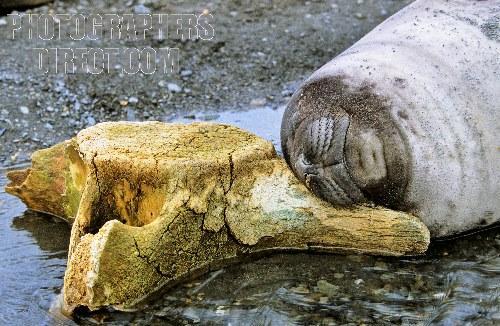
Yeah, this wasn't quite helpful. Adorable, though. In recent news, I just submitted a manuscript to Palaios on barnacle encrusted sea lion bones, so hopefully that'll plug through peer review just fine and in an orderly time frame.
Saturday, May 5, 2012
Help the VMNH raise funds for an excavation
Hello, everyone - I thought I would quickly mention that my friend Dr. Alton Dooley at the Virginia Museum of Natural History is trying to raise funds for excavations at the Carmel Church Quarry in Virginia. If you can spare a few bucks, check out Dr. Dooley's webpage.
Thursday, May 3, 2012
Fossil vertebrates of New Zealand, part 1: the controversy of the "Cape Kidnappers Fur Seal"
Given my new geographic location, I've decided to start a series of blog posts spotlighting various fossil vertebrates from New Zealand. I'll tackle things like moas, Waipatia, Haast's Eagle, Mauicetus, Kaiwhekea, Kekenodon, and other extinct vertebrates. These won't be in any particular order, and they will be intermittently posted - but I'll cover those over the course of my Ph.D. program here on the south island. To start, I've decided to cover the controversial history of the "Cape Kidnappers Fur Seal".
In 1922, Mr. W. D. Southcott of Hastings, New Zealand, discovered the remains of a fossil pinniped at Cape Kidnappers on the North Island of New Zealand. The fossil included a partial lower jaw, with all premolars and molars, both lower canines (isolated), and a fragment of one of the maxillae ("snout"). The fossil was collected about 20 feet above the beach on the lower bank of a tall cliff. This partial fossil was brought to the attention of the the paleontologist J. Allan Berry. Berry apparently spent quite an effort trying to pinpoint the exact locality and stratigraphic horizon, which he concluded to have been collected from sandstones of Opoitian age, just below the "Black Reef Limestone'. At the time, Berry considered the sandstones to be of early Pleistocene age. In 1928, he published the find in the Transactions of the New Zealand Institute, and named it Arctocephalus caninus. At the time, he considered it to be morphologically closest to the New Zealand Sea Lion, Phocarctos hookeri - which at the time was known to Berry as Arctocephalus hookeri. Although the genus name Phocarctos was named in 1866 - the taxonomy of otariids (fur seals and sea lions) has been volatile in the past, and although there is finally a consensus on what names to use now (see Berta and Churchill 2011), nearly every genus name in existence for fur seals and sea lions has been used for nearly every species, regardless of the names of modern usage. Berry compared the specimen with a number of New Zealand sea lion skulls and jaws, and concluded based on the presence and lack of various cusps on the cheek teeth and the shorter and apparently more robust canines, that it was distinct from Phocarctos hookeri. Additionally, the small size and gracile nature of the jaw suggested to Berry (1928) that the fossil represented a female - but the teeth were so much larger than modern females of Phocarctos, and it must have been a separate species.

Many years later, the Australian pinniped zoologist Dr. Judith E. King examined the holotype specimen of Arctocephalus caninus, after Berry had passed away. She was given access to his notes and unpublished manuscripts, and before his death had apparently come to the conclusion that Arctocephalus caninus was a synonym of Phocarctos hookeri. From her own research experience, King had come to the same conclusion, and in 1970, published an article in 'The Tuatara' where she gave Berry a posthumous first-authorship in recognition of his previous work on the subject. Berry and King (1970) synonymized Arctocephalus caninus with Phocarctos hookeri. They noted that the canines are relatively robust, and actually indicate that the holotype specimen was a male, and not a female; pinnipeds are extremely sexually dimorphic, and the females generally have skinny and shorter canines, while males have more robust canines. Canine size can typically be used to identify the sex of a modern pinniped specimen, and has been used in many cases to identify the sex of a fossil pinniped. However, to my knowledge, there has not yet really been a statistical or morphometric study of canine robustness in pinnipeds, which could certainly be useful. That being said - the fact that Arctocephalus caninus was reinterpreted as a male indicated that the teeth were of an appropriate size to be a male Phocarctos hookeri. Additionally, Berry and King (1970) observed that the cusp development in Phocarctos was so variable that the dental diagnosis for Arctocephalus caninus was unreliable as it fell within the range of variation of modern Phocarctos. This degree of dental variation is common in otariids (Boessenecker, 2011), and is probably due to the fact that otariids (along with other pinnipeds) do not have upper and lower teeth that interlock like terrestrial carnivorans, and thus have undergone a functional release (Miller et al., 2007). Berry and King (1970) also indicated that the Opoitan Stage was of early Pliocene age (5-3 Ma), and thus the south Pacific must have been an early theater for otariid evolution.

Three years later, a study published by Weston et al. (1973) contended that the Arctocephalus caninus holotype specimen was not even a fossil. This began with the suspicion by the late Charles Repenning (one of the coauthors and expert on early otariid evolution) that Arctocephalus caninus appeared a little too derived or modern in its anatomy for an early Pliocene sea lion, and they concurred with Berry and King's (1970) reidentification of the fossil. A fully modern sea lion in the early Pliocene really does stand out - and Repenning noted (in Weston et al. 1973) that no Pliocene otariid known at the time (including unnamed fur seals with Repenning was studying, and eventually named Thalassoleon in 1977) exhibited a dentition completely composed of single-rooted teeth. Thalassoleon, and the earlier Pithanotaria (described in the 1920's by Remington Kellogg) all exhibited double rooted cheek teeth. Terrestrial carnivores like dogs, cats, and bears, which pinnipeds evolved from (and are thus a member of the group Carnivora)- exhibit double rooted premolars and triple rooted molars (most have a triple rooted upper fourth premolar as well - which is one of the carnassial teeth, but I digress), so cheek teeth with multiple tooth roots is the primitive condition for pinnipeds. Furthermore - Weston et al. (1973) note that no sea lion fossils assignable to modern genera are known until the middle Pleistocene, worldwide (an assertion that has more or less held true; there may be fossils of modern sea lion genera from the Pliocene of Japan). Repenning was a smart dude, and many of his ideas regarding fossil sea lions and walruses have stood the test of time.

This skepticism led Weston et al. (1973) to re-reexamine Arctocephalus caninus, and one of the first tests that they did was to do the "flame test" - an old fashioned, tried and true field test to see if a bone is modern or fossil. The idea is that modern bones still retain enough of an organic component that they will smell like shit if you hold a lit match or lighter up to them - for anyone who's ever smelled burning hair - it smells like that. Really, really, really nasty; I've only smelled it once, and that was to provide a control for the flame test - I cut off a tiny bit of my hair and lit it on fire, and damn it smelled bad (and so did the bone in question). To make a long story short, the "Cape Kidnappers Fur Seal" failed the test, and reeked of burning bone smell. Apparently the source is fumes from burning collagen; at the time (we know better now, with collagen being preserved in Cretaceous dinosaur fossils) it was thought that this test indicated an age younger than 10,000 years. It probably does, to a degree- trace amounts of collagen in Cretaceous bones likely would not be sufficient enough to produce a stink, and the test probably indicates abundant collagen remaining in the bone rather than absolute presence or absence. Weston et al. (1973) extracted collagen from bone samples of the Arctocephalus caninus holotype and conducted a thin-layer chromatographic analysis, and compared it with results for a number of other finds of known pre-Holocene age and several other finds that had been radiocarbon dated. Their results indicated that it had an intermediate amount of surviving collagen between a modern bone and a bone from a midden dated at 878 years before present, thus indicating that the Arctocephalus caninus holotype is younger than 1,000 years old and a subfossil. Weston et al. (1973) further indicated that at the discovery site, there is a late Holocene midden with Maori artifacts, and bones and shells from the midden frequently wash down the cliff. The Maori are known to have colonized New Zealand only within the last 800 years or so. Weston et al. (1973) suggested that Arctocephalus caninus is a modern Phocarctos hookeri that washed down from midden deposits and came to rest in loose Pliocene age talus on the side of the exposure, making it appear as though it had genuinely weathered out of Pliocene rocks.
Ironically, when you think about it - at the time of discovery, most holotype specimens of fossils have never been seen before by any human - except in this case, where the evidence points toward an ancient Maori hunter who not only saw the sea lion many hundreds of years ago - but probably killed the animal, long before Mr. Southcott came along and made his own discovery. Also, ironically, I chose to start off this series with something that is most likely not even a fossil. I would have said this at the beginning, but I didn't want to spoil the story.
References -
J. A. Berry. 1928. A new species of fossil Arctocephalus from Cape Kidnappers. Transactions of the New Zealand Institute 59:208-211.
J. A. Berry and J. E. King. 1970. The Identity of the Pliocene Seal from Cape Kidnappers, New Zealand, Previously Known as Arctocephalus caninus. Tuatara 18(1):15-18
Boessenecker, R.W. 2011. New records of the fur seal Callorhinus (Carnivora: Otariidae) from the Plio-Pleistocene Rio Dell Formation of Northern California and comments on otariid dental evolution. Journal of Vertebrate Paleontology 31(2):454-467.
Miller, E. H., H. Sung, V. D. Moulton, G. W. Miller, J. K. Finley, and G. B. Stenson. 2007. Variation and integration of the simple mandibular postcanine dentition in two species of phocid seal. Journal of Mammalogy 88:1325–1334.
Weston, R.J., Repenning, C.A., and Fleming, C.A. 1973. Modern age of supposed Pliocene seal, Arctocephalus caninus Berry (= Phocarctos hookeri Gray), from New Zealand. New Zealand Journal of Science, 16:591-598.
In 1922, Mr. W. D. Southcott of Hastings, New Zealand, discovered the remains of a fossil pinniped at Cape Kidnappers on the North Island of New Zealand. The fossil included a partial lower jaw, with all premolars and molars, both lower canines (isolated), and a fragment of one of the maxillae ("snout"). The fossil was collected about 20 feet above the beach on the lower bank of a tall cliff. This partial fossil was brought to the attention of the the paleontologist J. Allan Berry. Berry apparently spent quite an effort trying to pinpoint the exact locality and stratigraphic horizon, which he concluded to have been collected from sandstones of Opoitian age, just below the "Black Reef Limestone'. At the time, Berry considered the sandstones to be of early Pleistocene age. In 1928, he published the find in the Transactions of the New Zealand Institute, and named it Arctocephalus caninus. At the time, he considered it to be morphologically closest to the New Zealand Sea Lion, Phocarctos hookeri - which at the time was known to Berry as Arctocephalus hookeri. Although the genus name Phocarctos was named in 1866 - the taxonomy of otariids (fur seals and sea lions) has been volatile in the past, and although there is finally a consensus on what names to use now (see Berta and Churchill 2011), nearly every genus name in existence for fur seals and sea lions has been used for nearly every species, regardless of the names of modern usage. Berry compared the specimen with a number of New Zealand sea lion skulls and jaws, and concluded based on the presence and lack of various cusps on the cheek teeth and the shorter and apparently more robust canines, that it was distinct from Phocarctos hookeri. Additionally, the small size and gracile nature of the jaw suggested to Berry (1928) that the fossil represented a female - but the teeth were so much larger than modern females of Phocarctos, and it must have been a separate species.

The holotype of Arctocephalus caninus. From Berry and King (1970).

Comparison of a modern subadult male Phocarctos hookeri jaw (above) and Arctocephalus caninus (below). From Berry and King (1970).

The alleged type locality of Arctocephalus caninus, with the midden at the top of the cliff.
From Weston et al. (1973).
This skepticism led Weston et al. (1973) to re-reexamine Arctocephalus caninus, and one of the first tests that they did was to do the "flame test" - an old fashioned, tried and true field test to see if a bone is modern or fossil. The idea is that modern bones still retain enough of an organic component that they will smell like shit if you hold a lit match or lighter up to them - for anyone who's ever smelled burning hair - it smells like that. Really, really, really nasty; I've only smelled it once, and that was to provide a control for the flame test - I cut off a tiny bit of my hair and lit it on fire, and damn it smelled bad (and so did the bone in question). To make a long story short, the "Cape Kidnappers Fur Seal" failed the test, and reeked of burning bone smell. Apparently the source is fumes from burning collagen; at the time (we know better now, with collagen being preserved in Cretaceous dinosaur fossils) it was thought that this test indicated an age younger than 10,000 years. It probably does, to a degree- trace amounts of collagen in Cretaceous bones likely would not be sufficient enough to produce a stink, and the test probably indicates abundant collagen remaining in the bone rather than absolute presence or absence. Weston et al. (1973) extracted collagen from bone samples of the Arctocephalus caninus holotype and conducted a thin-layer chromatographic analysis, and compared it with results for a number of other finds of known pre-Holocene age and several other finds that had been radiocarbon dated. Their results indicated that it had an intermediate amount of surviving collagen between a modern bone and a bone from a midden dated at 878 years before present, thus indicating that the Arctocephalus caninus holotype is younger than 1,000 years old and a subfossil. Weston et al. (1973) further indicated that at the discovery site, there is a late Holocene midden with Maori artifacts, and bones and shells from the midden frequently wash down the cliff. The Maori are known to have colonized New Zealand only within the last 800 years or so. Weston et al. (1973) suggested that Arctocephalus caninus is a modern Phocarctos hookeri that washed down from midden deposits and came to rest in loose Pliocene age talus on the side of the exposure, making it appear as though it had genuinely weathered out of Pliocene rocks.
Ironically, when you think about it - at the time of discovery, most holotype specimens of fossils have never been seen before by any human - except in this case, where the evidence points toward an ancient Maori hunter who not only saw the sea lion many hundreds of years ago - but probably killed the animal, long before Mr. Southcott came along and made his own discovery. Also, ironically, I chose to start off this series with something that is most likely not even a fossil. I would have said this at the beginning, but I didn't want to spoil the story.
References -
J. A. Berry. 1928. A new species of fossil Arctocephalus from Cape Kidnappers. Transactions of the New Zealand Institute 59:208-211.
J. A. Berry and J. E. King. 1970. The Identity of the Pliocene Seal from Cape Kidnappers, New Zealand, Previously Known as Arctocephalus caninus. Tuatara 18(1):15-18
Boessenecker, R.W. 2011. New records of the fur seal Callorhinus (Carnivora: Otariidae) from the Plio-Pleistocene Rio Dell Formation of Northern California and comments on otariid dental evolution. Journal of Vertebrate Paleontology 31(2):454-467.
Miller, E. H., H. Sung, V. D. Moulton, G. W. Miller, J. K. Finley, and G. B. Stenson. 2007. Variation and integration of the simple mandibular postcanine dentition in two species of phocid seal. Journal of Mammalogy 88:1325–1334.
Weston, R.J., Repenning, C.A., and Fleming, C.A. 1973. Modern age of supposed Pliocene seal, Arctocephalus caninus Berry (= Phocarctos hookeri Gray), from New Zealand. New Zealand Journal of Science, 16:591-598.
Saturday, April 28, 2012
Glauconite, mosasaurs, and asteroids: does the taphonomy of a bonebed in New Jersey really indicate preservation of a catastrophic assemblage?
During the course of my master's thesis research, I attempted to find and read every paper ever written on the taphonomy of marine vertebrates so that I could not only get a good idea of what ideas had stood the test of time and which ones hadn't (or for that matter, were profoundly embarassing even to read), but also so that I could identify which areas in marine taphonomy that we had no answers or even hypotheses for yet. For example: we know extremely little about the everyday processes on the continental shelf that affect fossil preservation, from an actualistic perspective. I found that we have two areas where we do in fact have quite a bit of actualistic data: the beach (where we can walk around and poke dead stuff) and the offshore environment (i.e. outer shelf through abyssal plain - where we can send down a submersible to go and poke dead stuff). Everything in between - from ~10 through ~100 meters water depth - we have very little data, except for a couple of failed whale fall experiments. There is now quite a lot of data generated through whale fall studies for the deep sea, and plenty of actualistic taphonomists have walked around and watched dead vertebrates decay, disarticulate, and have their skeletons dispersed across the seashore. The likely reason we don't know much about the shelf is because in the intervening environments, currents and sediment transport processes likely cover/uncover/transport carcasses or bones too quickly to make a submersible visit really feasible. Using submersibles is damned expensive - and even scuba diving is expensive as well (let alone dangerous), and quite frankly, there probably aren't enough people in marine vertebrate taphonomy who care enough to try and get those sorts of funds. It is quite a bit easier to look at the fossil record in continental shelf settings and go from there and what we know about shelf sedimentation - which is exactly what my master's thesis focused on.
Even though I finished my thesis about a year ago now, I'm still quite keen to learn more and read more articles - and there have certainly been a flurry of articles recently, which I'll have to cover later on. Not only because I am quite obsessed with the subject of taphonomy, but also because I still haven't published my thesis yet, and will need to update it with citations to some of these new studies. If all goes well, I'll be presenting at SVP this year on my thesis, and hopefully will be putting a shorter version of it together for submission to "Geology". That all being said - I was quite interested to see this paper come up in a search on Georef: "Obasi et al. 2011. Glauconite composition and morphology, shocked quartz, and the origin of the Cretaceous? Main Fossiliferous Layer (MFL) in southern New Jersey, U.S.A. Journal of Sedimentary Research 81:479-494. Reading the abstract, the authors had apparently used a combination of glauconitic mineralogy, mineralogy of shocked quartz, and taphonomic evidence to identify a marine vertebrate bonebed in New Jersey as representing a catastrophic assemblage - and not just any catastrophic assemblage, but at the K/Pg boundary (for the unitiated - formerly K/T, meaning Cretaceous-Tertiary boundary) and representing a mass death assemblage from the end Cretaceous extinction.

Now, keep this in mind as you read: I do not study catastrophic extinctions, and I generally do not read literature on the K/Pg extinction unless (as in this case) it deals with taphonomy. Otherwise, given my background- the entirety of my reading focuses on the Cenozoic; but with taphonomy, there have been marine vertebrates dying and being moved around by sediment and other phenomena for nearly half a billion
years. Taphonomy has, in the past, been used as a means to an end to try and substantiate catastrophic hypotheses, and has even been used in weird ways by young earth creationists. So when I read a taphonomy article that does not seem sober, I immediately become skeptical. My last point - I have read a lot of other articles about catastrophic assemblages and their taphonomy, and very few ever really make a great case (especially in marine rocks). So it's not that I don't believe in catastrophic assemblages per se - it's that I haven't read very many good articles on them. They certainly do exist, but there is a substantial volume of evidence you need to provide in order to fully eliminate alternative hypotheses. In the past, people have identified many criteria for identifying catastrophic assemblages - are the fossils all preserved on the same bedding plane? Is there no evidence of post-mortem destruction or transport of bones? Can the fossil assemblage reasonably attributed to one event of short duration? Are the fossils well-preserved and reasonably complete (i.e. articulated or associated)? Is the assemblage biased, and can it reasonably be interpreted as a death assemblage? These are all questions that must be asked. I've probably forgotten a few, and there are certainly others that other researchers have demanded as requirements.

Now, to get to the paper. The authors studied the Main Fossiliferous Layer (MFL), which is a bonebed in the lowermost Hornerstown Formation, which is a 10cm thick concentration of invertebrate and vertebrate skeletal elements, including fish, sharks, mosasaurs, and marine birds. These fossils co-occur with Paleocene microfossils. Previous studies (cited within Obasi et al. 2011) have identified the MFL as a major sedimentary hiatus or unconformity (and even as a sequence boundary), and the fossils from the MFL as being reworked from Cretaceous strata into the Paleocene. There has not been a consensus with the placement of the K/PG boundary within the local section - either at the base of the Hornerstown, within, or above the MFL (referenes within Obasi et al. 2011). The Hornerstown Formation and underlying New Egypt and Navesink Formations are very rich in a mineral called glauconite, and the sediment can probably be characterized as greensand (more on this later). Interestingly, within the MFL, are bivalves infilled with sediment from underlying strata, gray rip-up mud clasts, shocked quartz grains (within a single burrow below the MFL). The MFL and associated underlying and overlying strata are also intensely bioturbated. Lastly - vertebrate fossils from the MFL occur as isolated bones and teeth which are occasionally abraded, as well as partially articulated and associated specimens.
Seeing as the author's primary contribution is in the form of mineralogical analysis of glauconite, I'll discuss that first. Glauconite is an authigenic mineral that forms as small sand-grain size pellets, often around fecal pellets or foraminifera, and other tiny organic elements. I am no mineralogist, but if there is one thing I have consistently read in nearly every publication regarding glauconite - it forms during periods of very low sedimentation or during sedimentary hiatuses, often in concert with phosphogenesis (formation of phosphate nodules), and it generally forms on the continental shelf in upwelling regimes. Glauconite often occurs in marine bonebeds, hiatal surfaces, transgressive surfaces of erosion, and sequence boundaries. Using geochemistry and exhamining the morphology of glauconite grains, Obasi et al. (2011) determined that the "maturity" of glauconite grains (i.e. features indicating how well-formed and long the glauconite was able to form for) increased up section through these strata that contain the MFL. Maturity - FYI - is a term applied to mineral grains in sedimentology (and probably other fields in geology); for example (the most widely known use of 'maturity'), the relative maturity of a sandstone is identified based on what proportion of the rock is composed by quartz (the most durable and stable type of grain in sandstone) or not, as opposed to less-stable rock fragments and feldspar grains. Less mature sandstone includes more unstable fragments and grains and less quartz, indicating it is 'fresher' and has not been subjected to as much weathering. The same concept applies to glauconite - mature glauconite has had a long residence time on the seafloor, and vice versa. Lastly, the authors make the case that the sedimentation rate - while already low to form glauconite at all - must have decreased even further through time during "Hornerstown" time.

The authors then discuss the formation of the MFL and what processes could have led to its genesis. They begin by trying to evaluate whether or not the MFL represents a transgressive lag deposit. A transgressive lag, for those of you not versed in the arcane ways of sequence stratigraphy - forms during a period of sea level rise; during this time sediment becomes trapped within estuaries (which are backed-up rivers common during periods of sea level rise, whereas deltas are more common during periods of sea level fall), and sedimentation slows down on the continental shelf. The fairweather and storm currents that normally happen on the shelf then erode and rework older sediment instead of transporting around and depositing new sediment that would normally be shed off the continental margin. This erosion can rework fossils from multiple stratigraphic levels into a single bonebed/shellbed (but does not always happen). It is worth noting that transgressive lags are typically identified based on their position within a stratigraphic sequence, in addition to features indicating erosion or lack of deposition. Obasi et al. (2011) argue that because vertebrate fossils do not appear to be reworked based upon analysis of rare earth element concentrations in bones (published in Staron et al. 2001), the presence of partially articulated marine reptiles, the lack of primary sedimentary structures related to sedimentary reworking, and the fact that the MFL does not co-occur with the slowest sedimentation rate (as determined from glauconite maturity). They do acknowledge, however, that there are reworked invertebrate fossils within the MFL, supporting the identification of it as a transgressive lag. They also argue that the middle-outer shelf setting (inferred from glauconite presence) is too deep for a transgressive lag to form and state "Transgressive lags form as the surf
zone and wave base migrate inland during transgression".
The authors then discuss the possibility of the MFL representing a condensed deposit. A condensed deposit is formed by low to zero net sedimentation, as opposed to erosion, and fossil assemblages may appear fairly similar, and may not be associated with a sharp erosional surface. They admit that the intense bioturbation supports this interpretation, as does the preservation of fossil vertebrates, but the steady increase in glauconite maturity does not- in theory, it should peak at the time of lowest sedimentation rate, which should be the MFL under this hypothesis. Finally, they discuss the reasons why they interpret the MFL as being a thanatocenosis formed by the K/Pg bolid impact. Although the authors have not found any evidence for the famed iridium anomaly in their study area (Obasi et al. 2011:491), they argue that the presence of shocked quartz grains in a single burrow below the MFL. Although not found elsewhere in the section, the shocked quartz appears to have been reworked form the Hornerstown Fm. down into the burrow, which extends down into the Navesink Fm. (Shocked quartz is often used as evidence of a bolide impact, as it is a high-pressure low-temperature type of deformation that happens to quartz). They argue that the gray rip up clasts are mud rip-ups from the tsunami wave from the bolide impact, and the shocked quartz is evidence of the bolide impact as well coinciding with bonebed formation. In total, they argue that the MFL formed as marine vertebrate carcasses littered their remains across the seafloor after being killed by the event, leaving some isolated bones and some associated specimens.
There are a lot of serious problems with this study, and I'll try to deal with them quickly so that this post doesn't get any longer. First and foremost, transgressive lags can occur in quite deep environments, and certainly glauconite-producing middle and some outer shelf environments, and glauconite has been identified at sequence boundaries and other large-scale sequence stratigraphic surfaces before. Transgressive lags are not confined to the 'surf zone', and storm waves can rework sediment at the depths which glauconite forms at. Secondly - you cannot make the argument that the lack of primary sedimentary structures (erosional surfaces, cross-bedding, etc.) indicates anything if you also note that the strata are massive and bioturbated (except perhaps that the strata are structureless because they are bioturbated!). Bioturbation is not an alternative mode of sedimentation - it is a process which erases certain physical information and overprints it with biogenic information.
What about the glauconite and taphonomy? We already know that A) glauconite forms during periods of slow sedimentation, B) there are clearly reworked invertebrate fossils, C) some of the vertebrate fossils are abraded, D) the vertebrates are probably not reworked, E) the vertebrates are not concentrated onto a single resolvable bedding plane as a number of clearly complete skeletons. Taken in full, the evidence does not really look that good for a catastrophic assemblage. Relatively little of the negative evidence cited by Obasi et al. (2011) for physically-controlled modes of formation are negative. Instead, nearly all of the evidence cited would positively support a physical control on bonebed formation. My alternative and less hyperbolic interpretation would go something like this: 1) slowdown in sedimentation results in glauconite formation; 2) vertebrates concentrated into 10cm interval due to current reworking of sediment at sea floor surface and transport and abrasion of some bones and disarticulation of skeletons (other elements shed from carcasses over protracted period of time); 3) slow sedimentation allows pervasive bioturbation, deleting the physical sedimentary structures from the strata; 4) K/Pg impact happened sometime before or after, or possibly during. We just don't know when given the evidence, and I don't think that Obasi et al. (2011) really have sufficient evidence to point at any one part of the strat column and say "here!".

Interestingly, Liebig et al. (2007) reported on the taphonomy of a mass assemblage of false killer whales, and found that not too long after the mass death, the skeletal remains were extremely variable in their taphonomic mode and would not be identifiable as a mass death assemblage if it were in the fossil record. Does this mean that an assemblage with variable taphonomy like that can be identified as catastrophic? No - it means in cases like that, we cannot tell, one way or the other. Clearly, there has been some residence time of the fossils on the seafloor - not all are articulated, and some are even abraded, meaning they have been transported around on the seafloor. We also know that there are other cases of many articulated skeletons concentrated onto what appears to be a single bedding plane (Peters et al. 2009) - in the case I'm referring to, a series of basilosaurid skeletons in Eocene strata at Wadi Al Hitan, Egypt- but sequence stratigraphy identified it as a maximum marine flooding surface. An MMFS is a period of low sedimentation, and in this case it was muddy deposition, and essentially a condensed deposit with a concentration of well-preserved whales on what otherwise would look like a mass death assemblage. So - even in a case where all of the questions I asked above might be addressed positively - you still may not be able to tell the difference. The taphonomic support for the catastrophic interpretation of Obasi et al. (2011) just doesn't really hold up very well.
Edit: I realize that I ran out of steam a bit and neglected to mention some of the most serious reasons why the results of Obasi et al. (2011) do not hold up, taphonomically speaking. For one - the premise that a fossil assemblage deposited in glauconite can be interpreted in any way except that it is extremely time averaged to some degree or another (and thus preserving a physical depositional signal - and any purely biological/catastrophic signal being deleted permanently from the rock record) - is absurd. Glauconite is de facto geologic evidence (i.e. independent of the taphonomic evidence, which in the case of the MFL is just as strong) of time averaging and slow sedimentation. Secondly - what taphonomic characteristics need to be positively addressed in order to accurately demonstrate a catastrophic death assemblage in the marine realm? I guess I will start by asking (and answering) a third question - how many previously published marine tetrapod assemblages can realistically be interpreted to represent a catastrophic death assemblage? I can really only think of one well-published example: the death assemblage of Shonisaurus published by Hogler (1992). There may be a couple of others preserved under similar circumstances - but in this case, all of the Shonisaurus skeletons are articulated, in a small geographic area on a single bedding plane, not preserved in a concentration that appears to be caused hydraulically or by changes in sedimentary budget, etc. Virtually none of these variables are present in the assemblage from the MFL in New Jersey (Obasi et al., 2011), and even many of these have been argued to be of variable utility by taphonomists.
Lastly, I get the impression that the identification of this exact horizon as the MFL rests solely on the shocked quartz grains in a single burrow. This would correlate the death assemblage with the K/Pg boundary, and voila! There's your cause of death. Once again, here's a perfect example of where correlation and causation may not necessarily be linked, and in this case - there isn't sufficient evidence to link them.
Refs-
Hogler, J. A. 1992. Taphonomy and Paleoecology of Shonisaurus popularis (Reptilia:
Ichthyosauria). Palaios 7:108-117.
Liebig, P. M., K. W. Flessa, and T. A. Taylor. 2007. Taphonomic variation desite
catastrophic mortality: analysis of a mass stranding of false killer whales (Pseudorca
crassidens), Gulf of California, Mexico. Palaios 22:384-391.
Obasi, C.C., Terry, D.O., Myer, G.H., and D.E. Grandstaff. 2011. Glauconite composition and morphology, shocked quartz, and the origin of the Cretaceous(?) Main Fossiliferous Layer (MFL) in southern New Jersey, U.S.A. Journal of Sedimetnary Research 81:479-494.
Peters, S. E., M. S. M. Antar, I. S. Zalmout, and P. D. Gingerich. 2009. Sequence
stratigraphic control on preservation of late Eocene whales and other vertebrates at Wadi
Al-Hitan, Egypt. Palaios 24:290-302.
Even though I finished my thesis about a year ago now, I'm still quite keen to learn more and read more articles - and there have certainly been a flurry of articles recently, which I'll have to cover later on. Not only because I am quite obsessed with the subject of taphonomy, but also because I still haven't published my thesis yet, and will need to update it with citations to some of these new studies. If all goes well, I'll be presenting at SVP this year on my thesis, and hopefully will be putting a shorter version of it together for submission to "Geology". That all being said - I was quite interested to see this paper come up in a search on Georef: "Obasi et al. 2011. Glauconite composition and morphology, shocked quartz, and the origin of the Cretaceous? Main Fossiliferous Layer (MFL) in southern New Jersey, U.S.A. Journal of Sedimentary Research 81:479-494. Reading the abstract, the authors had apparently used a combination of glauconitic mineralogy, mineralogy of shocked quartz, and taphonomic evidence to identify a marine vertebrate bonebed in New Jersey as representing a catastrophic assemblage - and not just any catastrophic assemblage, but at the K/Pg boundary (for the unitiated - formerly K/T, meaning Cretaceous-Tertiary boundary) and representing a mass death assemblage from the end Cretaceous extinction.

Map of K/Pg strata in New Jersey. From Obasi et al. (2011).
years. Taphonomy has, in the past, been used as a means to an end to try and substantiate catastrophic hypotheses, and has even been used in weird ways by young earth creationists. So when I read a taphonomy article that does not seem sober, I immediately become skeptical. My last point - I have read a lot of other articles about catastrophic assemblages and their taphonomy, and very few ever really make a great case (especially in marine rocks). So it's not that I don't believe in catastrophic assemblages per se - it's that I haven't read very many good articles on them. They certainly do exist, but there is a substantial volume of evidence you need to provide in order to fully eliminate alternative hypotheses. In the past, people have identified many criteria for identifying catastrophic assemblages - are the fossils all preserved on the same bedding plane? Is there no evidence of post-mortem destruction or transport of bones? Can the fossil assemblage reasonably attributed to one event of short duration? Are the fossils well-preserved and reasonably complete (i.e. articulated or associated)? Is the assemblage biased, and can it reasonably be interpreted as a death assemblage? These are all questions that must be asked. I've probably forgotten a few, and there are certainly others that other researchers have demanded as requirements.

Stratigraphic column of the late Cretaceous and early Paleogene of New Jersey. From Obasi et al. (2011).
Seeing as the author's primary contribution is in the form of mineralogical analysis of glauconite, I'll discuss that first. Glauconite is an authigenic mineral that forms as small sand-grain size pellets, often around fecal pellets or foraminifera, and other tiny organic elements. I am no mineralogist, but if there is one thing I have consistently read in nearly every publication regarding glauconite - it forms during periods of very low sedimentation or during sedimentary hiatuses, often in concert with phosphogenesis (formation of phosphate nodules), and it generally forms on the continental shelf in upwelling regimes. Glauconite often occurs in marine bonebeds, hiatal surfaces, transgressive surfaces of erosion, and sequence boundaries. Using geochemistry and exhamining the morphology of glauconite grains, Obasi et al. (2011) determined that the "maturity" of glauconite grains (i.e. features indicating how well-formed and long the glauconite was able to form for) increased up section through these strata that contain the MFL. Maturity - FYI - is a term applied to mineral grains in sedimentology (and probably other fields in geology); for example (the most widely known use of 'maturity'), the relative maturity of a sandstone is identified based on what proportion of the rock is composed by quartz (the most durable and stable type of grain in sandstone) or not, as opposed to less-stable rock fragments and feldspar grains. Less mature sandstone includes more unstable fragments and grains and less quartz, indicating it is 'fresher' and has not been subjected to as much weathering. The same concept applies to glauconite - mature glauconite has had a long residence time on the seafloor, and vice versa. Lastly, the authors make the case that the sedimentation rate - while already low to form glauconite at all - must have decreased even further through time during "Hornerstown" time.

The trenches, stratigraphic sections, glauconite (middle two rows) and shocked quartz (lower right) from Obasi et al. (2011). Note the green color of the sediment in A and B.
zone and wave base migrate inland during transgression".
The authors then discuss the possibility of the MFL representing a condensed deposit. A condensed deposit is formed by low to zero net sedimentation, as opposed to erosion, and fossil assemblages may appear fairly similar, and may not be associated with a sharp erosional surface. They admit that the intense bioturbation supports this interpretation, as does the preservation of fossil vertebrates, but the steady increase in glauconite maturity does not- in theory, it should peak at the time of lowest sedimentation rate, which should be the MFL under this hypothesis. Finally, they discuss the reasons why they interpret the MFL as being a thanatocenosis formed by the K/Pg bolid impact. Although the authors have not found any evidence for the famed iridium anomaly in their study area (Obasi et al. 2011:491), they argue that the presence of shocked quartz grains in a single burrow below the MFL. Although not found elsewhere in the section, the shocked quartz appears to have been reworked form the Hornerstown Fm. down into the burrow, which extends down into the Navesink Fm. (Shocked quartz is often used as evidence of a bolide impact, as it is a high-pressure low-temperature type of deformation that happens to quartz). They argue that the gray rip up clasts are mud rip-ups from the tsunami wave from the bolide impact, and the shocked quartz is evidence of the bolide impact as well coinciding with bonebed formation. In total, they argue that the MFL formed as marine vertebrate carcasses littered their remains across the seafloor after being killed by the event, leaving some isolated bones and some associated specimens.
There are a lot of serious problems with this study, and I'll try to deal with them quickly so that this post doesn't get any longer. First and foremost, transgressive lags can occur in quite deep environments, and certainly glauconite-producing middle and some outer shelf environments, and glauconite has been identified at sequence boundaries and other large-scale sequence stratigraphic surfaces before. Transgressive lags are not confined to the 'surf zone', and storm waves can rework sediment at the depths which glauconite forms at. Secondly - you cannot make the argument that the lack of primary sedimentary structures (erosional surfaces, cross-bedding, etc.) indicates anything if you also note that the strata are massive and bioturbated (except perhaps that the strata are structureless because they are bioturbated!). Bioturbation is not an alternative mode of sedimentation - it is a process which erases certain physical information and overprints it with biogenic information.
What about the glauconite and taphonomy? We already know that A) glauconite forms during periods of slow sedimentation, B) there are clearly reworked invertebrate fossils, C) some of the vertebrate fossils are abraded, D) the vertebrates are probably not reworked, E) the vertebrates are not concentrated onto a single resolvable bedding plane as a number of clearly complete skeletons. Taken in full, the evidence does not really look that good for a catastrophic assemblage. Relatively little of the negative evidence cited by Obasi et al. (2011) for physically-controlled modes of formation are negative. Instead, nearly all of the evidence cited would positively support a physical control on bonebed formation. My alternative and less hyperbolic interpretation would go something like this: 1) slowdown in sedimentation results in glauconite formation; 2) vertebrates concentrated into 10cm interval due to current reworking of sediment at sea floor surface and transport and abrasion of some bones and disarticulation of skeletons (other elements shed from carcasses over protracted period of time); 3) slow sedimentation allows pervasive bioturbation, deleting the physical sedimentary structures from the strata; 4) K/Pg impact happened sometime before or after, or possibly during. We just don't know when given the evidence, and I don't think that Obasi et al. (2011) really have sufficient evidence to point at any one part of the strat column and say "here!".

Glauconite in the Santa Margarita Sandstone at Limantour Beach, Point Reyes. This is glauconite from a transgressive surface of erosion in California, which apparently should not exist.
Edit: I realize that I ran out of steam a bit and neglected to mention some of the most serious reasons why the results of Obasi et al. (2011) do not hold up, taphonomically speaking. For one - the premise that a fossil assemblage deposited in glauconite can be interpreted in any way except that it is extremely time averaged to some degree or another (and thus preserving a physical depositional signal - and any purely biological/catastrophic signal being deleted permanently from the rock record) - is absurd. Glauconite is de facto geologic evidence (i.e. independent of the taphonomic evidence, which in the case of the MFL is just as strong) of time averaging and slow sedimentation. Secondly - what taphonomic characteristics need to be positively addressed in order to accurately demonstrate a catastrophic death assemblage in the marine realm? I guess I will start by asking (and answering) a third question - how many previously published marine tetrapod assemblages can realistically be interpreted to represent a catastrophic death assemblage? I can really only think of one well-published example: the death assemblage of Shonisaurus published by Hogler (1992). There may be a couple of others preserved under similar circumstances - but in this case, all of the Shonisaurus skeletons are articulated, in a small geographic area on a single bedding plane, not preserved in a concentration that appears to be caused hydraulically or by changes in sedimentary budget, etc. Virtually none of these variables are present in the assemblage from the MFL in New Jersey (Obasi et al., 2011), and even many of these have been argued to be of variable utility by taphonomists.
Lastly, I get the impression that the identification of this exact horizon as the MFL rests solely on the shocked quartz grains in a single burrow. This would correlate the death assemblage with the K/Pg boundary, and voila! There's your cause of death. Once again, here's a perfect example of where correlation and causation may not necessarily be linked, and in this case - there isn't sufficient evidence to link them.
Refs-
Hogler, J. A. 1992. Taphonomy and Paleoecology of Shonisaurus popularis (Reptilia:
Ichthyosauria). Palaios 7:108-117.
Liebig, P. M., K. W. Flessa, and T. A. Taylor. 2007. Taphonomic variation desite
catastrophic mortality: analysis of a mass stranding of false killer whales (Pseudorca
crassidens), Gulf of California, Mexico. Palaios 22:384-391.
Obasi, C.C., Terry, D.O., Myer, G.H., and D.E. Grandstaff. 2011. Glauconite composition and morphology, shocked quartz, and the origin of the Cretaceous(?) Main Fossiliferous Layer (MFL) in southern New Jersey, U.S.A. Journal of Sedimetnary Research 81:479-494.
Peters, S. E., M. S. M. Antar, I. S. Zalmout, and P. D. Gingerich. 2009. Sequence
stratigraphic control on preservation of late Eocene whales and other vertebrates at Wadi
Al-Hitan, Egypt. Palaios 24:290-302.
Thursday, April 26, 2012
The "King Lizard" and the origin of cranial asymmetry in whales
Whales and
dolphins are among the most bizarre and derived of all modern mammals, to the
point where it took a while for a consensus to develop that they were even
mammals. To skip all of the obvious soft tissue features that the average joe
can point out, and get to the part most paleontologically minded folks are
interested in - the skull of cetaceans is extremely weird in a number of ways.
From cranial telescoping and the posterior location of the blowhole, the
strangely indistinct orbit, homodont and polyodont dentition (in odontocetes),
a series of complex basicranial sinuses, and the straplike jugal bone - the
skulls of cetaceans bear little similarity to other mammals. Toothed whales -
the suborder Odontoceti - are further perplexing in the asymmetry of their
skulls. Baleen whales - mysticetes - are at least more normal in having
symmetrical skulls. The asymmetry of toothed whale skulls occurs in a number of
ways. Firstly - asymmetry is confined to the facial bones of the skull, and
primarily the premaxilla and maxilla (the bones that form the middle and sides
of the snout or rostrum, respectively). Secondly, the foramina or holes in the
facial region (for nerves and arteries) are differently positioned on each
side. Thirdly, bones of the right side of the face are wider than their
counterparts of the left side, and the very top of the skull (called the
vertex) is accordingly displaced to the left side. Fourthly - in some modern
toothed whales, the whole posterior facial region has undergone a clockwise rotation.
The skulls of sperm whales and ziphiids in particular are among the most
asymmetrical of odontocetes, while porpoises, some delphinids, and the
Franciscana (Pontoporia) have what appear to be symmetrical skulls (but still
exhibit slight asymmetry).

A new reconstruction of Basilosaurus isis by the folks at University of Michigan, with small and edible child for scale. From http://www.theophoffs.com
Asymmetry of the
odontocete skull has been conclusively tied to their unique mode of sound
production. The left nasal passage is unmodified and retained for breathing,
while the right nasal passage is hypertrophied and has a host of soft tissue
structures and muscles which produce the sounds (i.e. the well-known whistles
and clicks of bottlenose dolphins) used during echolocation. These facial muscles attach to the skull, and
because they are larger on the right side - these bones are enlarged on the
right side, resulting in asymmetry. And thus, odontocetes exhibit soft-tissue
facial asymmetry as well. Cranial asymmetry shows up in different manners in
different groups of odontocetes - the basal odontocete Simocetus shows
slight asymmetry in the shape and proportions of some of the skull bones, as do
certain other Oligocene odontocetes. It has been argued before that cranial
asymmetry has evolved multiple times within odontocetes, while facial asymmetry
is probably a shared derived feature of all odontocetes. The obvious lack of
asymmetry in mysticetes and apparent symmetry of archaeocete skulls suggested
for the longest time that cranial and facial asymmetry was unique to
odontocetes.
Much to my (and
everyone else's) surprise, I saw an abstract at last year's conference on
Secondary Adaptations of Tetrapods to Life in the Water (SATLW) by friend and
colleague Julia Fahkle on the discovery of cranial asymmetry in archaeocetes. I
was skeptical at first - suggestions of looking for asymmetrical archaeocetes
and mysticetes were murmured in the mid 1990's regarding the provocative and
absurd hypothesis that sperm whales were more closely related to baleen whales
(rendering Odontoceti paraphyletic), and I've read elsewhere about people
speculating that ichthyosaurs and plesiosaurs may have echolocated and cranial
asymmetry should be looked for in these groups (taking the ecological analogy a
bit far, I think). When I saw Julia's talk, though, I was surprised, impressed,
and dumbfounded- and no longer skeptical. I was happy to see the paper (Fahlke
et al. 2011) come out only a couple of months later (although it's taken me
about 6 or 7 months to get around to posting about it).

The skull of Basilosaurus isis, from www.umich.edu
After taking CT scans of a skull and lower jaws
of Basilosaurus isis from the Eocene of Egypt, Julia thought that the
twisting of the snout was due to post-burial deformation, and attempted to
correct for deformation and modeled the skull to be symmetrical. However, the
digital model of the jaws would not close properly - she discovered when the
non-modified skull scan was used, the jaws would close properly - suggesting
that it was natural. In Basilosaurus, she noticed that the snout was
curved a little to the left (insert inappropriate joke here), and that the midline
of the skull was deviated to the right side behind the orbits; Fahlke et al.
(2011) characterized cranial asymmetry in Basilosaurus as 'curvature and
axial torsion of the cranium'. Furthermore - there are thin parts of the
lateral wall of the lower jaw called the 'pan bone', which in modern
odontocetes are symmetrical in their thickness; In Basilosaurus, the
thinnest parts of the pan bone are placed differently - in the left jaw, the
thinnest part is placed further forward than on the right.

Fig. 4 from Fahlke et al. (2011), showing the different placement of the thinnest part of the pan bone in the lower jaws of Basilosaurus isis.
The 'pan bone' is an extremely thin wall of
relatively dense bone in the lower jaw, which is placed alongside the very
enlarged 'mandibular foramen' (a hole in the jaw that transmits arteries and
nerves), which in modern toothed whales is filled with a large lens-shaped body
of fat, termed the mandibular fat pad. The enlargement of the bony opening has
resulted in the loss of bone on the inside of the jaw - so that looking at the
medial surface, there is a boneless window exposing the mandibular fat pad.
This structure has been implicated as a key innovation in cetacean evolution as
an adaptation for directional hearing in water. Land mammals - including humans
- have earbones that are firmly sutured to the skull, and airborne sounds
travel slowly and bounce off of soft tissue and are funneled into the ear
canal. The 'bouncing' of sound waves is called acoustic impedance, and only
occurs when there is a strong contrast in the density of a given material. In
water, sounds travel much faster, and because soft tissue is nearly the same
density as water - waterborne sounds travel extremely quickly and because there
is little to no acoustic impedance between water, flesh, and bone - sounds
travel through (rather than bouncing off) soft tissue and bone, arriving at
each ear too quickly for the direction of the sound to be determined by the
brain. This is called bone-conducted hearing, and most (if not all)
non-cetacean mammals hear through this manner when underwater. Next time you're
in a pool, try an experiment in functional morphology and close your eyes and
have a friend make noises (talking or yelling works), and try to correctly tell
the direction of the sound - I challenge you!
The expansion of the mandibular foramen and the mandibular fat pad forms
an acoustic pathway to each ear. In addition to this, modern cetaceans exhibit
a series of extremely complex air-filled sinuses which surround each set of
earbones, and the earbones have lost their bony connections to the skull, which
are ways that the ears of cetaceans are acoustically isolated (these sinuses
and loss of bony connections appear in baleen whales as well). The pan bone,
air sinuses, and earbones separated from the skull are all features that have
been previously identified as adaptations for directional hearing underwater.
In her talk last June, Julia showed a slide that
further solidified the identification of asymmetry as natural rather than just
deformation in archaeocetes - they identified, in a number of protocetid and
basilosaurid skulls (roughly a dozen well-preserved specimens from different
ages, localities, formations, and countries) - that the direction of torsion
and curvature of the snout was the same in each specimen. Fahlke et al.
(2011) argued that the appearance of cranial asymmetry in archaeocetes followed
closely after the ability to hear directionally underwater, and that it must
somehow be related. Pan bones and enlarged mandibular foramina (a bony
correlate of a mandibular fat pad) are found in nearly all cetaceans with the
exception of Pakicetids; if I recall correctly, the earliest appearance of a
pan bone is in the "crocodile-otter" remingtonocetids, and pan bones
are known in protocetid and basilosaurid archaeocetes, in addition to archaic
mysticetes (read more about that here). Fahlke et al. (2011) argue that the asymmetry in archaeocetes is
possibly analogous to that in owls - which enhances the hearing ability of owls
in the dark.

Figure 1 from Fahlke et al. (2011).
While Fahlke et al. (2011) convincingly establish
archaeocetes as having cranial asymmetry - an extraordinary and provocative
discovery - they didn't spend much time in the article contrasting cranial
asymmetry of archaeocetes and odontocetes. They do explain that cranial
asymmetry in archaeocetes is NOT related to echolocation, as archaeocetes
clearly lack many of the facial features of odontocetes. A major point worth
stating is that asymmetry in archaeocetes is related to sound reception,
while in odontocetes, these types of asymmetry are lacking, and the facial
asymmetry is instead related to sound production. While this point was
not elaborated on much by Fahlke et al. (2011) - which is certainly no problem
anyone should complain about, given the page limits of the journal PNAS in
which it was published - it certainly complicates the picture, and if anything
- certainly makes early whale evolution much more interesting. It implies that
cranial asymmetry might even be decoupled from echolocation altogether, but
also that there are now two known modes of cranial asymmetry in cetaceans -
longitudinal curvature and torsion, versus facial asymmetry. It suggests that
cranial asymmetry predated echolocation and facial asymmetry in odontocetes;
perhaps cranial asymmetry as documented by Fahlke et al. (2011) laid the
structural blueprints for the derived form of asymmetry in odontocetes. Secondly
– Fahlke's discovery implies that mysticetes are secondarily symmetrical,
because they evolved from ancestors (basilosaurids) with asymmetrical crania. So
then, what is going on in toothed mysticetes? Do they have symmetrical skulls,
or not? If not, then why did they lose the asymmetry seen in archaeocetes? Were
they already hearing at low frequencies like modern cetaceans, rendering
directional symmetry less useful? If not in toothed mysticetes – then when was
asymmetry lost in baleen whales? Julia Fahlke's exciting discovery really
throws a giant wrench in what previously appeared to be a simpler view of
cetacean hearing evolution, and leaves us asking more questions - and most
excitingly, a series of weird questions we did not expect.
Edit: There is another hypothesis for cranial asymmetry that has been proposed, which this discovery (among other fossils) demolishes. But, that's a topic for another time.
Edit: There is another hypothesis for cranial asymmetry that has been proposed, which this discovery (among other fossils) demolishes. But, that's a topic for another time.
Fahlke, J.M., P.D. Gingerich, R.C. Welsh, and A.R. Wood. 2011. Cranial asymmetry in Eocene archaeocete whales and the evolution of directional hearing in water. Proceedings of the National Academy of Science 108:35:13545-13548.
Subscribe to:
Posts (Atom)