Saturday, January 7, 2012

Dead baby fur seals at the California Academy of Sciences

Well, it’s been over a month since I’ve posted anything. It’s been a busy winter – in the mean time, my wife and I have celebrated Thanksgiving in California with my family, and have been in Montana for the last week with her family. I’ve been typing like a beast (30 pages for one manuscript just since I’ve been back in Big Sky country) over the last month or so. I’ve been working on my longest manuscript yet (not including my thesis, however it will soon overtake it), which as of this morning reached 110 pages. Additionally, we’ve been trying to get certain things ready for our imminent move to New Zealand. Just prior to Christmas vacation, I spent a couple of days visiting the Ornithology and Mammalogy collections at California Academy of Sciences.

A menagerie of bird and mammal skeletons and mounts.

A giraffe skull sits next to the sign in book.

A row of shelving filled with fur seal and sea lion skulls and skeletons.

A beautiful mounted skeleton of a sea otter (Enhydra lutris).

I’ve been making a couple visits per year to Cal Academy since 2006; I originally visited when the new building was under construction, and the academy (exhibits, departments, and all) were at the temporary storage facility in SoMa (South of Market in Downtown San Francisco, for the non Bay Areans) to check out their collection of Purisima Formation fossils, and to utilize their ichthyology and mammalogy collections to identify shark teeth and pinniped bones from various Miocene and Pliocene strata from Northern California.

A bunch of large mysticete vertebrae awaiting curation.

A pilot whale (Globicephala macrorhinchus) skull in the CAS collections.

On previous visits, I’ve searched the Mammalogy collection of skeletons to make comparisons with modern and fossil bones and teeth of fur seals, walruses, pilot whales, porpoises, and baleen whales. In 2010, I collected some (relatively basic) data on the variation of tooth root lobe morphology in northern fur seals (Callorhinus ursinus) for comparison with fossil fur seals, which I published in JVP earlier this year. A current project I am working on is writing up an entire marine vertebrate assemblage (~200-300 fossils), and I am working on a lengthy manuscript on the marine mammal compliment of the assemblage. Needless to say, the large and very well curated collection of marine mammal skeletons at California Academy of Sciences has been indispensable throughout this endeavor, and has made many fossil identifications possible and paved the way towards insights into marine mammal osteology.

Many crania and jaws of the Northern Elephant Seal (Mirounga angustirostris) are too large for storage boxes and sit right on the shelves.

A walrus (Odobenus rosmarus) skull with two baculi thrown in for good measure (no pun intended).

A bunch of boxes full of Galapagos Sea Lion skeletons (Zalophus californianus wollebaeki).

On my most recent visits, my objectives were threefold: first, to take photographs of many extant species of otariids (fur seals and sea lions) for a morphobank project with my colleague Morgan Churchill; second, to photograph nearly every skeletal element from an adult northern fur seal in order for comparison with fossil fur seals from California (e.g. Thalassoleon, which has previously been hypothesized to be closely related to Callorhinus); and third, to photograph and examine lower jaws of neonatal and fetal fur seals and sea lions.

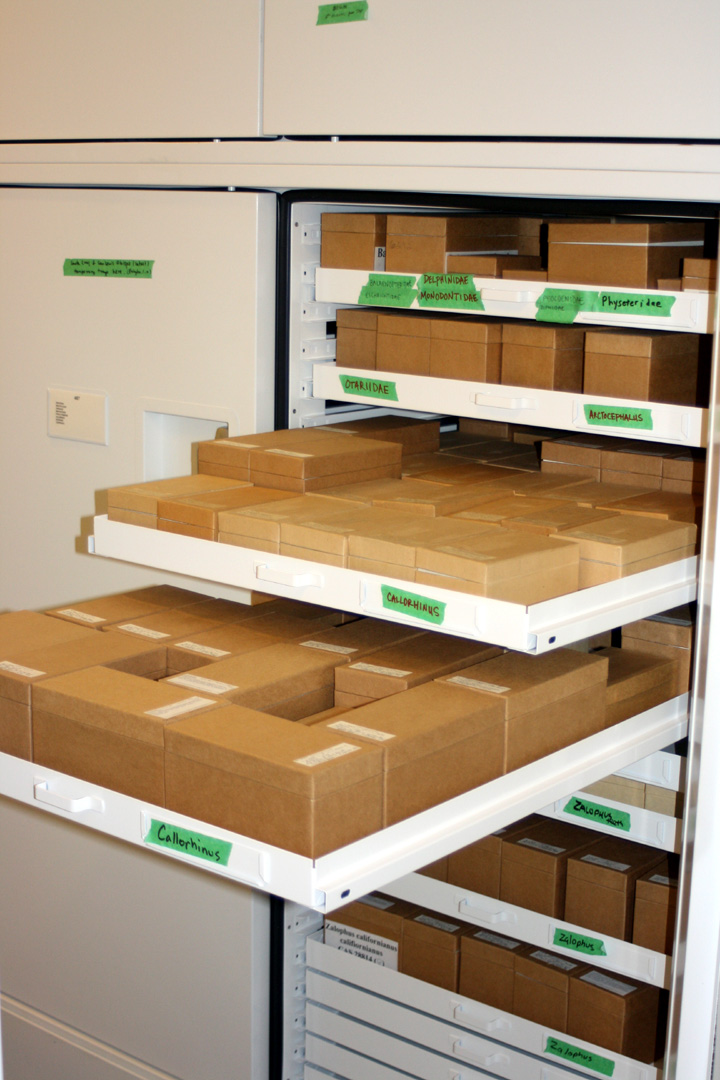
Several drawers filled to the brim with boxes of small (fetal, neonatal, and juvenile) otariid skulls. Most of these are Callorhinus ursinus.

I won’t get into the specifics quite yet, nor will I talk about the fossils that spurred my curiosity regarding the third subject – I’ll only say that it is pretty damn neat if I may say so myself. That being said – I am very interested in the morphology of deciduous (milk) teeth in young fur seals, as well as the timing of molar and premolar eruption in the lower jaws of these animals. I’ll briefly mention that modern pinnipeds are a bit weird in that they (like most) mammals have milk teeth, but they are often shed before birth, so that the pups are born with a full set of adult chompers. Their milk teeth have a very reduced functional period, and additionally are reduced to tiny little pegs (unlike the milk teeth of terrestrial carnivores). Although they still develop milk teeth, pinnipeds are trending toward monophyodonty – that is, having only one set of teeth as opposed to two (diphyodonty). Cetaceans are monophyodont, and pinnipeds are an excellent example of a second clade of marine mammals following the same evolutionary trend.

A baby fur seal head (Callorhinus ursinus).

A neonatal Callorhinus ursinus skull in lateral view.

In order to examine the tiny milk and permanent teeth of these pups and fetuses, I brought along my new toy – a small, portable, USB powered digital microscope which plugs into my notebook laptop (…another new toy, which I’m using from a secure location in Montana). It displays the image on the screen, and can acts as a camera as well. Fortunately, there is a button to take a picture with in the software, rather than having to manually press a button on the microscope (which, due to its small size, usually jiggles it and screws up the picture). At an earlier UCMP visit in October, I was able to take around 200 photos of 100 tiny fossil specimens in a little over two hours. With the digital microscope, I was able to take a bunch of photos of milk and permanent teeth from nearly a dozen or so specimens of northern fur seal (Callorhinus), California sea lion (Zalophus), and Steller’s sea lion (Eumetopias). Unfortunately, there weren’t any northern fur seal fetuses, or specimens with deciduous premolars – but the data for sea lion fetuses I collected was more than sufficient to answer my fossil-related queries.

Yours truly using my digital USB microscope to examine the morphology of
fetal and neonate fur seal teeth; this specimen is a Northern Fur Seal (Callorhinus ursinus).

Milk teeth and unerupted adult teeth in the lower jaw of a California sea lion (Zalophus californianus) fetus.

Monday, January 2, 2012

Is Puijila a pinniped?

Back in February 2009, Natalia Rybczynski and colleagues surprised the paleomammalogy community with their Nature paper naming a new genus and species of early pinniped, Puijila darwini. The holotype skeleton is relatively complete, and include fore- and hind-limbs along with much of the vertebral column, both jaws, and a well preserved skull. Puijila was about one meter long, and would have appeared relatively similar to a modern river otter. It had a short snout and a wide head, with large eyes and relatively high-crowned teeth. The teeth of Puijila still retain many of the cusps lost in modern pinnipeds, and also exhibit pits in the roof of the mouth for the lower teeth (embrasure pits). Unlike modern pinnipeds, it had a long tail, and did not have its fore- and hindlimbs modified into flippers. Puijila was discovered in 2007 from the Haughton Formation on Devon Island in Nunavut (formerly Northwest Territories in Canada). The Haughton Formation was deposited in an impact crater – the impact has been dated to 24-21 Ma (earliest Miocene), and fossil mammals from the Haughton Formation corroborate an early Miocene age. The Haughton Formation was deposited in an ancient lake that filled in the impact crater. In fact – if it were not for the impact, there would be no sedimentary rocks of Miocene age preserved that far North – all the young rocks have been eroded away by glaciation.
The skull and jaw of Puijila darwini, from Rybczynski et al. (2009).

The holotype skeleton of Puijila darwini (from http://nature.ca)

Previously, the earliest diverging pinniped (and arguably more derived than Puijila) is Enaliarctos, a fur seal sized pinniped from the latest Oligocene and early Miocene of California and Oregon. Enaliarctos retains carnassials, although many of the other dental features are very simplified and reduced, trending toward the condition in modern pinnipeds. Enaliarctos also exhibits limbs developed into flippers – and is very clearly a pinniped. But the relationships of Puijila – to pinnipeds and other carnivores – are not so clear. Because of the older age of Enaliarctos and its marine occurrence, Puijila is hypothesized to represent a lineage of early pinnipeds that stayed in their freshwater niche while marine pinnipeds like Enaliarctos evolved, remaining otterlike. It suggests that pinnipeds went through an otterlike freshwater stage before invading the ocean. Prior to this, Enaliarctos suggested a direct to saltwater invasion – although due to the absence of intermediates, it was not exactly clear one way or the other.

The skeleton and life restoration of Enaliarctos mealsi, from Berta et al. (1989).

Before we continue – I must also be specific about some clade names. Although Rybczynski et al. (2009) refer to Puijila as a member of the Pinnipedia – which is not really the traditional cladistic nomenclature for basal pinnipeds. Annalisa Berta and colleagues (1989) proposed the clade Pinnipedimorpha, for Enaliarctos and all later diverging pinnipeds. Berta (1994) later proposed the name Pinnipediformes for Pteronarctos and all later diverging pinnipeds. Pinnipedia is nested within Pinnipediformes, and Pinnipediformes within the Pinnipedimorpha. Within this traditionally accepted and utilized framework, Puijila’s obviously more primitive morphology than Enaliarctos indicates it should be referred to as a pinnipedimorph.

Rybczynski et al. (2009) listed six characteristics that unite Puijila with Enaliarctos and other pinnipeds. These are: a posteriorly expanded palate (the palate extends posteriorly past the upper toothrow in pinnipeds), an enlarged infraorbital foramen (occurring within pinnipeds due to larger whiskers and greater innervation of the snout), a shelf-like protocone on the upper fourth premolar (occurring in basal pinnipeds and some related arctoids), an upper second molar that is reduced and positioned medially to the upper first molar (reduction of the molariform teeth to conical teeth is a major dental transition within the pinnipedimorpha), a posterodorsally expanded scapula (a feature of pinnipeds, which often have very broad scapulae, an adaptation for swimming), and an expanded deltopectoral crest of the humerus (another feature in pinnipeds related to swimming).

Some of these features may be of only limited use in hypothesizing a close relationship between Puijila and pinnipeds. First, an enlarged infraorbital foramen (the small hole below the eye socket in a skull) also occurs in many mustelids, such as badgers (Taxidea), weasels (Mustela), and most (if not all) otters (e.g. Lontra, Enhydra); in badgers and weasels, this is due to a more innervated and sensitive snout, an adaptation for digging in burrows. This characteristic may not be useful in identifying early pinniped relatives, as otters (another hypothesized pinniped sister taxon) exhibit this feature – presumably evolving for the same purpose. The two postcranial features – an enlarged deltopectoral crest and a posterodorsally expanded scapula – may not be coded correctly in Puijila. To be quite honest, based on the available photographs – these features do not appear too different between Puijila and a river otter (Lontra), and don’t really exhibit the derived condition, which is much more extremely developed in Enaliarctos and other fossil and modern pinnipeds). This leaves only three reliable characters behind.

Skeletons of Enaliarctos (A), Puijila (C), and Lontra (D).

One of these features – a posteriorly expanded hard palate – also appears in the aberrant arctoid Kolponomos, as well as Pachycynodon and Allocyon (Tedford et al., 1994). This feature appears to be more widely distributed than previously admitted, although it is worth mentioning that it is probably an adaptation towards aquatic feeding. The two dental characteristics are probably more reliable, although it is odd to note that these two dental characteristics are also found in Kolponomos. Kolponomos will feature more in part two of this post, as it is both a fascinating creature which I have not yet properly covered on this blog, and it is also extremely topical to the subject of Puijila.

A wonderful reconstruction of Kolponomos by Ken Kirkland, published in Neptune's Ark by David Rains Wallance.

There are a whole host of pinniped characteristics that Puijila does not have, or features that were not described in enough detail to independently evaluate. Cranial and dental features that characterize pinnipeds (either at the level of the Pinnipedimorpha, Pinnipediformes, or Pinnipedia) include a reduced upper first molar, reduced cingulum on the upper first molar, an absent or reduced metaconid, loss of the embrasure pit between the upper fourth premolar and first molar, closely spaced mastoid and paroccipital processes, a reduced nasolabialis fossa, reduced cingulum on the upper third incisor, and a reduced trigonid cusp on the lower molars. None of these derived conditions appear to be present in Puijila. A number of postcranial features which characterize pinnipeds (either at the level of the Pinnipedimorpha, Pinnipediformes, or Pinnipedia, as above) include a short and robust humerus, enlarged tuberosities of the humerus, a flattened radius and ulna that are longer than the humerus, emphasis of certain digits in the hand and foot (i.e. largest digit in the hand being the first or “thumb”, and the lateral and medialmost digits of the foot being largest and the smallest being the middle digit), a short, flattened femur with an enlarged greater trochanter and medially inclined condyles, a reduced tail, and a short ilium (bone in the pelvis). Curiously, none of these features are present in Puijila – although nearly all of them (perhaps all – I can’t remember off the top of my head) occur in Enaliarctos.

In summary, there are very few features that actually unite Puijila and pinnipeds. The cladistic analysis of Rybczynski et al. (2009) was relatively limited, both in terms of the number of fossil and modern species used, and also with regard to the number of morphological characters used in the analysis. An earlier study – considered to be the landmark phylogenetic analysis of pinnipeds, Berta and Wyss (1994) – utilized 143 characters, while Rybczynski et al. (2009) only used 42. Granted, the earlier study focused on relationships within pinnipeds – and many of those characters may or may not apply to Puijila and other similar arctoids.

Because of the above, I am skeptical that Puijila has a close relationship with pinnipeds – and although I’m not convinced, I am equally receptive to the idea pending further analyses. There is much we’ve been waiting for – a detailed description of its anatomy and large, detailed figures of its skeleton were not included in the original study, which is understandable given the short length of Nature papers (however, it was not included as supplementary info either). There is certainly more work to be done, and there are rumors of a more detailed phylogenetic analysis in the works; such a study should include a comprehensive description of the skull and skeleton of Puijila accompanied by exhaustive figures (formerly difficult, but several modern journals have made this a far less difficult prospect), sample a broader variety of caniform carnivorans as well as more fossil and modern pinnipeds (fossil pinnipeds with postcranial skeletons such as Allodesmus, Thalassoleon, Leptophoca, Acrophoca, Piscophoca, Imagotaria, Neotherium, and Proneotherium) as well as the “beach bear” Kolponomos (which was not included in the original analysis or discussed by Rybczynski et al. 2009). Puijila certainly could belong to some group of otterlike “protopinnipeds” as hypothesized, but given the few characters uniting them, it very well could be some sort of mustelid or other aquatic carnivore.

Further reading

Official Puijila website (Canadian Museum of Nature)

Puijila, a very basal 'pinnipedimorph' (this blog)

Commentary by Ed Yong (Not exactly Rocket Science)

Commentary by Brian Switek (Laelaps)

Literature cited

Berta, A., C.E. Ray and A.R. Wyss. 1989. Skeleton of the oldest known pinniped, Enaliarctos mealsi. Science 244:60-62

Berta, A. 1991. New Enaliarctos* (Pinnipedimorpha) from the Miocene of Oregon and the role of "Enaliarctids" in Pinniped Phylogeny. Smithsonian Contributions to Paleobiology 69.

A. Berta. 1994. New specimens of the pinnipediform Pteronarctos from the Miocene of Oregon. Smithsonian Contributions to Paleobiology 78:1-30

Rybczynski, N., Dawson, M.R., Tedford, R.H. (2009). "A semi-aquatic Arctic mammalian carnivore from the Miocene epoch and origin of Pinnipedia". Nature 458 (7241): 1021–24

R. H. Tedford, L. G. Barnes, and C. E. Ray (1994). "The early Miocene littoral ursoid carnivoran Kolponomos: Systematics and mode of life". Proceedings of the San Diego Society of Natural History 29:11-32.

Tuesday, December 27, 2011

October pinniped excavations

Dick Hilton and I excavating a pair of fur seal (Thalassoleon) dentaries from the base of the cliff.

A famished yearling California Sea Lion on the beach.

The weekend before the annual meeting of the Society of Vertebrate Paleontology in Las Vegas, my wife and I joined Dick Hilton from Sierra College for what we assumed would be a routine visit to the Purisima Formation at Point Reyes. We drove up on a Friday night, and cooked hot dogs at the campground with Dick, and set up our tent for the weekend. The following morning, we set out along the shoreline, and within five minutes, found what appeared to be a pinniped skeleton. Since we wanted to get on to more prosperous localities further down, we left it there with the intention of digging it up the following day (Sunday).
My wife pointing to something tiny she is proud of finding...

It's a beautiful fur seal (Thalassoleon) molar! She has a real eye for finding things like tiny pinniped and shark teeth, which is why I keep her around.

Dick Hilton trying to explain something to my wife and I. At least I hope he was talking to my wife, because it sure looks like I wasn't paying attention.

As we headed further on down to the good section of shoreline, I found a well preserved porpoise earbone (petrosal), and a few other odds and ends. Not too long afterward, and nearly at the same time, Dick spotted a couple bones eroding out with an associated tooth, and my wife spotted a well preserved fur seal tooth (Thalassoleon), only a few meters away. It took us the better part of an hour to dig the bones up – which turned out to be a pair of associated fur seal dentaries! Unfortunately, neither specimen had any cheek teeth, but one did have a broken canine. Either way, only the middle chunk of the dentary is preserved in the holotype of Thalassoleon macnallyae (from the same locality), and these are the most complete and well preserved jaws of this taxon now known. We hiked down the beach a little further, and collected a couple of pinniped limb elements – a proximal end of a tibia, and a metatarsal. After collecting these, we headed back towards the cars. On our way back, I spotted a string of a dozen articulated pinniped vertebrae – a second skeleton we would have to excavate the following day.

A cast of the holotype skeleton of Parabalaenoptera baulinensis on display at the visitor center.

For comparison, there is also a skeleton of an adorably tiny (~15 feet long) minke whale (Balaenoptera acutorostrata) on display as well.

My wife examining some baleen (presumably from a balaenopterid) at the visitor center.

We also finally had a chance to visit the visitor’s center; previously, I had always been there on a weekday, when the center was closed. I was particularly excited to check it out because it has one of the only known casts of the holotype skeleton of Parabalaenoptera baulinensis (which was excavated from the Santa Cruz Mudstone at a nearby locality) on display – there is one other, but it is at the College of Marin in Kentfield, and is falling apart and badly needing repairs.

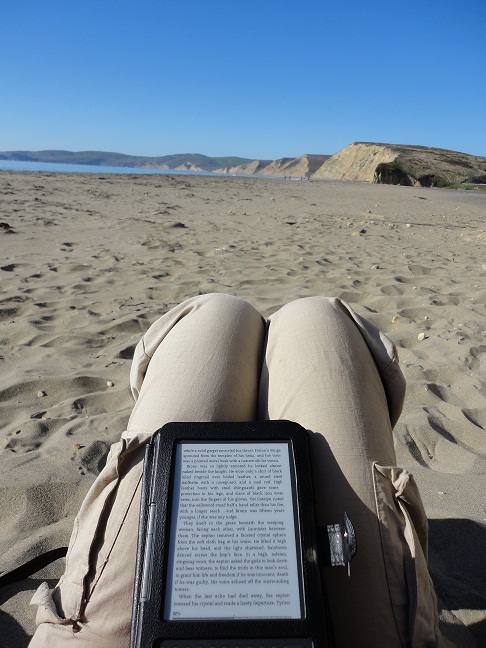
My wife decided she was done, and decided to spend the day reading A Game of Thrones on the beach and napping and taunting birds all day.

On the second day, we spent about seven hours excavating the first pinniped skeleton, which resulted in about 100 pounds of tin-foil jackets. This skeleton is probably of a large fur seal or small walrus, and the skeleton was completely disarticulated; as soon as we were close to removing one bone, another would be under it, or behind it. There were probably about two dozen or so bones in the cliff that we excavated. At about 4 in the afternoon, we wrapped up the first excavation, and walked down the beach to relocate the articulated skeleton. It took a while to relocate it, but as soon as we did, we started excavating it in a large block. Thanks to the specimen being articulated, we were able to finish this excavation in a little over an hour. Once we got back to the car, we loaded up nearly two hundred pounds of fossils we had collected in only two days in the field; furthermore, the most ridiculous aspect of the weekend was that by weight, cetacean fossils comprised less than 1% of our haul (only one specimen). For the uninitiated – pinniped fossils are relatively rare, and my master’s thesis sample of specimens indicates that there is a 4:1 ratio of cetacean fossils to pinnipeds, and that pinnipeds constitute only 8% of the marine vertebrate assemblage from the Purisima Formation at Santa Cruz. To collect a pair of associated dentaries, a tooth, a couple of associated hindlimb bones, and two skeletons (one being articulated) all in one weekend – is surprising, and tripled the number of major pinniped finds I’ve made. I’ll post some updates when some of this material gets prepared.

She nearly got this gull to come to her backpack. Sorry, no pictures of the pinniped excavation.

Sunday, November 20, 2011

New mysticete excavation, part 3

Hey Folks,

I already told the whole story of the excavation in the last two posts. However, if you'd like to see a recap of the whole dig, check out the animation I made below:


Enjoy!

Tuesday, November 15, 2011

New mysticete excavation, part 2

On day two, we returned to continue the excavation process. We had mostly pedestaled the specimen on the first day, but we had not yet undercut the block. We thought we could get all of it out in one large jacket. Unfortunately, I knew this might be difficult because there were multiple fractures through the concretion - most concretions I've collected are very strong and have no cracks, but occasionally large ones are fractured, which could spell disaster during the jacketing process.

The skull on friday morning.

The tunnel I dug under the right side of the skull.

We got back to the locality on friday morning, and began to undercut the pedestal. Normally, a small jacket just requires a trench to be dug around the fossil, and then you undercut the bottom of the trench and dig under the fossil a bit - this allows a lip to be made on the bottom of the fossil with the plaster jacket, ensuring that the entire piece of rock (fossil included) leaves the excavation pit when you flip the jacket over. I've heard horror stories of jacket flipping where a stream of bone fragments pours out of the bottom of the jacket upon removal, and fortunately, this has never really happened to me. On larger specimens such as this, it is routine to dig a tunnel underneath part of it, to ensure that the jacket removes a cohesive block rather than half of it. So, I started doing this, digging from both sides, and after about an hour or so I had a cute tunnel underneath the skull where some strips of burlap could go when it came time to jacketing.

The fossil with dampened paper towel and after application of the jacket.

Late in the day on friday, we finally got to the jacketing process. In all honesty, I had not expected to get to start the jacket until saturday morning - we had scheduled a State Parks ranger to drive by on Sunday at 3pm for jacket pick up, so we knew we had until then. We finished up the plaster jacket right before dinner time.

The jacket right after flipping it.

On saturday morning, we quickly moved to undercut the rest of the jacket, "pop" it, and flip it over. This was particularly hairy, because there wasn't exactly any room to flip the jacket - usually you flip the jacket over, and have ample space to let it rotate along whatever surface you have available, which in paleontology fieldwork, is usually the ground. In our case, sure -we had opened up a large shelf we had dug out, but the fossil was already precariously positioned above a ten foot drop to the beach, more than enough distance for the fossil to break into many pieces if it were to fall. More importantly, if the jacket were to fall off the ledge, it would likely take one of us with it, which would really, really hurt. It would have really helped to have a third person, but we were barely able to lift and flip it between the two of us - we had to lift it and slowly rotate it nearly in place, move it to the side while lifting it, and while Des stayed there holding the jacket up from certain destruction, I ran up and down fetching pieces of wood to wedge it so it wouldn't fall off the ledge. During flipping, some of the fractures inside the concretion opened up, and we could feel the block 'flexing' a little bit. Fortunately, it all stayed together. Unfortunately, there were more bones going back into the cliff, which we will not be able to dig out. There was also a small part of the concretion and a possible bit of the skull left in the cliff, which we will have to return for.

The jacket after the bottom jacket was completed.

Wooden "backbone" for the sand ramp.

After flipping the jacket over, we were able to put on a plaster jacket over the bottom part of the block. Now that the jacket was completed, we had the problem of getting it down. The block appeared to weigh at least three hundred pounds, and was very heavy due to the concretion inside. There was no safe way to lift the skull down - the heaviest of a jacket that two people of my diminutive stature can manage is about 100 lbs (my friend Chris Pirrone and I once spent four hours moving a 100 lb jacket only 200 feet along a Santa Cruz cliff, while partially submerged at first, then up algae covered rocks, and along a 10 foot high, one foot wide ledge over the ocean, and up several eye-level ledges).

One thing I enjoy about paleontology fieldwork is thinking outside the box. I've had conversations with people who would have used some high-tech rope and pulley system which would have probably been a pain to put together and utilize. In my experience, when moving big (but manageable) pieces of rock, it's best to use methods developed by the masters of lugging around big rocks: the ancient Egyptians. Although it was up rather high, I thought "why not just build a big ramp?". To make it faster, we piled up a bunch of logs: sand usually moves to the angle of repose, and we needed something steeper (so we wouldn't end up with a cone of sand with a twenty foot wide imprint). The logs trapped the sand, and we were able to build a steeper ramp.

My wife with the beginning of the sand ramp, pretending it was her idea.

Des, myself, Ash Poust, and Liz Ferrer (clockwise, from upper left) start to
maneuver the block down the incline.

My wife (left, in red), Liz Ferrer (hiding in back), and Ash (white pants)
excavate a bit of the remaining concretion.

It only took us about a half hour to finish the ramp, and once we were done, we climbed up, and started to nudge the plaster jacket. Our friend Ash Poust, who was a friend of ours from MSU and now one of Kevin Padian's Ph.D. students at UC Berkeley, had brought along another one of Padian's students, Liz Ferrer, to help out. My wife sat out on this one, and took photos instead, while the rest of us muscled the jacket down. It worked like a charm, and I could not have been happier with my experiment in 'ancient methods'.

Stay tuned for the next installment!

Wednesday, October 12, 2011

New mysticete excavation, part 1

Note: I feel like I've been doing this a lot recently, but sorry for the long lapse in posts. I just got back from SVP a week ago, and I've been sick during most of the intervening time. Before SVP, I was working like a fiend trying to get work done for a couple of presentations at SVP, and doing even more fieldwork in Marin County. I'll get some more blog work done now that things have calmed down.

Last August I had the fortune of excavating a Pliocene mysticete skull from one of my fossil localities in the Purisima Formation. I actually discovered this skull back in 2005, but had already found another that I preferred to excavate instead. I went ahead and excavated that other specimen instead, and left this one here. There were several reasons why I left this one alone. First, the other specimen was much closer to where we could park, whereas it was a mile walk to the skull featured below. Secondly, I only had the funds (and space in my small car) for one large plaster jacket, so this one had to wait.
The skull as it appeared prior to excavation, and in a basically identical
state at the time of discovery in 2005.


My permit for the locality was good for another year, so why didn't I collect it in 2006? Well, I was still preparing the 2005 whale (which I would be preparing for another four more years), and there wasn't lab space available for it. So my 2006 permit expired, and I didn't get another one until last fall. To be honest, I hadn't intended on collecting it this year either because I had no funding, no crew, and no vehicle to remove it with. One day a well known "personality" posted a question about fossil whales in concretions on the shores of some of the Channel Islands, and he was legitimately surprised by how many whales there are out there languishing, despite the number of able bodied vertebrate paleontologists in southern CA. I went on a bit of a rant and explained that it's the rule rather than the exception with regards to California fossil whales: there are uncollected bones and concretions littering Northern and Central California beaches, just asking to be put into a museum. I didn't think much of my email, until I got an email from Dr. Desmond Maxwell at University of the Pacific in Stockton, who explained that he had grown tired of taking his field crews all the way to Utah and Montana, and wanted some local prospects, and that he had plenty of funding, volunteers, and lab space for large marine mammal fossils. I gladly took him up on his offer, and this whale excavation was the "maiden voyage" of our field/lab collaboration.

The fossil, with estwing superpick for scale.

We arrived on the Thursday of the last week of August, with the intention of spending four days on the excavation. I met Des early in the morning at his hotel, and we drove out to the coast. The first day felt like two, both in terms of how much rock we went through and how long it was. The skull was in a concretion about ten feet up off the sand, and fortunately, had not been eroded at all since I found it in 2005 - at this locality, erosion is particularly slow, and the cliff erodes inch by inch, instead of being cut at the base and having blocks fall down, like at Capitola. Fossils that are over ten feet above the base of the cliff erode very slowly - a large baleen whale vertebra at another locality had the tip of its neural arch exposed in summer 2004, and as of October 2011, one half of the ventral side of the centrum is left (body of the vertebra).

Footholds cut into place for the excavation.

The first order of business was to cut footholds and ledges for us to stand on. Unlike the 2005 baleen whale excavation, the sandstone was very soft and friable; its height above the base of the cliff meant it spends more time out of the year being weathered and not waterlogged by high tides one half of the year. This made the excavation on the first day go remarkably fast.

Initial excavation of the skull, and cleaning of the exposed surfaces.

There were also several plants growing in the concretion, which we quickly plucked and removed. Fortunately, the roots did not penetrate the bone and destroy it, which has happened in some cases. After some early cleaning, it was apparent that the concretion was very thin over some parts of the skull, which would make life considerably easier than the previously excavated whale from this locality.

Des excavating the mysticete skull.

What exactly was it? It's convenient to just throw around the term 'whale' because it's huge, and you're not really quite sure. Well, initially I identified it as a right whale (balaenid), because I thought that the skull shape was consistent with that - wide braincase with a supraoccipital shield that did not extend very far forward. A few weeks later, I looked at more pictures of right whales, and I'm no longer too convinced my ID was accurate by any stretch of the imagination. Right whales have 'backswept' squamosals, and whatever this thing is, it's squamosals (it is sadly missing the lateral extremities of them) are relatively close to the vertex (top of the skull). More likely, it is a primitive balaenopterid with a short supraoccipital shield: the squamosals of balaenopterids are closer to the vertex than in balaenids, and are oriented laterally (not posterolaterally). Another possibility is that it could belong to a balaenopterid-like gray whale, which is known from the Pliocene San Diego Formation.


The skull after the first day of work. Not much appears obvious, but I'll talk more about it in the next installment.

Sunday, October 9, 2011

Update: The coastal paleontologist gets married, and goes down under?

The last couple of weeks have been pretty great, and due to being so busy in relation to recent events, I've been a little slow on posting new material on here. First and foremost, I got married to my longtime girlfriend/fiancee Sarah Michalies on September 17 up at beautiful Lake Tahoe, California. The wedding was fantastic, and a lot of fun - and there were many paleontology students from around North America in attendance. Sarah and I have been together since spring 2005, and it was about time to tie the knot. Sarah and I met as undergraduates in the paleontology program at Montana State University, and have gone on all sorts of paleo field trips together.

This is not our boat, we just borrowed it for cool pictures.

The second awesome thing that happened - I was recently (i.e. on Thursday) accepted into the Doctoral program at the University of Otago in New Zealand. I applied back in late July, and the plan is to start in January. I have the fantastic opportunity to work with Dr. R. Ewan Fordyce, who has offered me a chance to study eomysticetid fossils from the south island of New Zealand. Eomysticetids are a thus far poorly known group of early baleen whales, and constitute the earliest known and earliest diverging toothless baleen whales. So far, the only eomysticetids that have been described include Eomysticetus whitmorei and Eomysticetus carolinensis from the Oligocene of South Carolina, described by Larry Barnes and Al Sanders in 2002 in the Clayton Ray memorial volume. However, in that same volume, Barnes and Sanders name another new family of early diverging mysticetes they term the Micromysticetidae; they remove Cetotheriopsis tobieni from said genus and place it in the new genus Micromysticetus, to which they also name a new species from South Carolina, Cetotheriopsis rothauseni. This family also includes the taxon Cetotheriopsis lintianus. Anyway, Micromysticetus has almost always occurred as a sister taxon to Eomysticetus wherever included in phylogenetic analyses, and I would not be surprised if the Eomysticetidae were to include these even smaller taxa.


The holotype skull of Eomysticetus whitmorei from South Carolina (borrowed from the morphobank account for Ekdale et al., 2011).

The new material from New Zealand includes a collection of eight partial and complete crania, many with dentaries, earbones, and postcrania. In addition, two species of Mauicetus may be referable to the Eomysticetidae, and part of this project will revolve around trying to ascertain whether any of these new specimens represents referable material of Mauicetus; the skulls of the two holotypes of two Mauicetus species (not including Mauicetus parki, which is not an eomysticetid) are very incomplete or have been lost, but are still known from some earbones and postcrania (and photos of the skulls). One of my tasks will almost certainly be to determine whether or not any of this new material could be designated as a neotype specimen.


The clocktower at University of Otago.

All of that interesting paleocetaceanology aside, Sarah and I are going to New Zealand!!! We'll be living in the city of Dunedin on the south island. Above you can see a photo of the clock tower at the university; the campus there looks absolutely beautiful. Granted, Traphagen Hall at MSU Bozeman is a neat old building (but totally shitty inside), but I've seen photos of the Geology Building at OU, and it looks just like another Tudor stone castle like the main building pictured above. It looks totally awesome. Furthermore, unlike my previous 8 years of schooling in Montana, it doesn't get anywhere near as cold on the south island (although Dunedin is about as far south as you can get on the south island). And lastly, there are penguins that live there! There are penguins that have rookeries on the Otago Peninsula, within a 30 minute drive from campus! Blue/Fairy penguins, the smallest known species of penguin!

This is going to be a blast, and I have a lot of work to do to get there.