Earlier this week Sarah and I flew home to the SF Bay Area to visit family and find some fossils. We've done several days of chilly fieldwork along the beautiful but cold and foggy California coast and are now enjoying a weekend day indoors with my folks (though we'll be visiting one last locality for an hour or so this afternoon). We're lightly sunburned, sore, and surprisingly bruised after lots of up-and-down hiking over rock exposures and boulder falls. Fortunately, neither of us has come into contact with poison oak, been slammed by a wave, or sustained any moderate injuries (though I was about a second away from losing my big toenail, and Sarah did slip at one point - see below).
I won't reveal the exact location as it is not in Santa Cruz, but it is protected and I have received a permit to collect here, with specimens destined for UCMP collections - and a permit is required. It's admittedly a reasonably remote site, perhaps my favorite locality, and one I've been visiting now for nearly 20 years - and I'm on my third permit for the locality. I had a bit of luck here in December, and I hoped to have similar luck this week.
Jorge Vazquez explaining their findings and dating of the Putah Tuff-correlative ash bed forming this ledge in the Purisima Formation.
We met USGS/Stanford geologists Jorge Vazquez and Marsha Lidzbarski out along the coast along with our buddy Wayne Thompson (retired teacher and CEO of Pacific Paleontology, LLC) for a long day of fieldwork. Jorge and Marsha have been working on dating ash beds in the Purisima. I was familiar with Andre Sarna-Wojcicki's efforts to chemically fingerprint ash deposits, linking them to the volcanic deposits, lava flows, and tuff beds near the volcanic vent where the rocks were dated better - this is a form of geochemical correlation of ashes without directly dating the ash beds themselves. Only two ash beds out at this section had previously been dated - one correlated with the ~2.5 Ma Ishi Tuff in the southernmost cascades and another correlated with the 3.35 Putah Tuff from the Sonoma Volcanics. Rather than just being chemically fingerprinted, Jorge, Marsha, and others were directly dating the ash layers within the Purisima section.

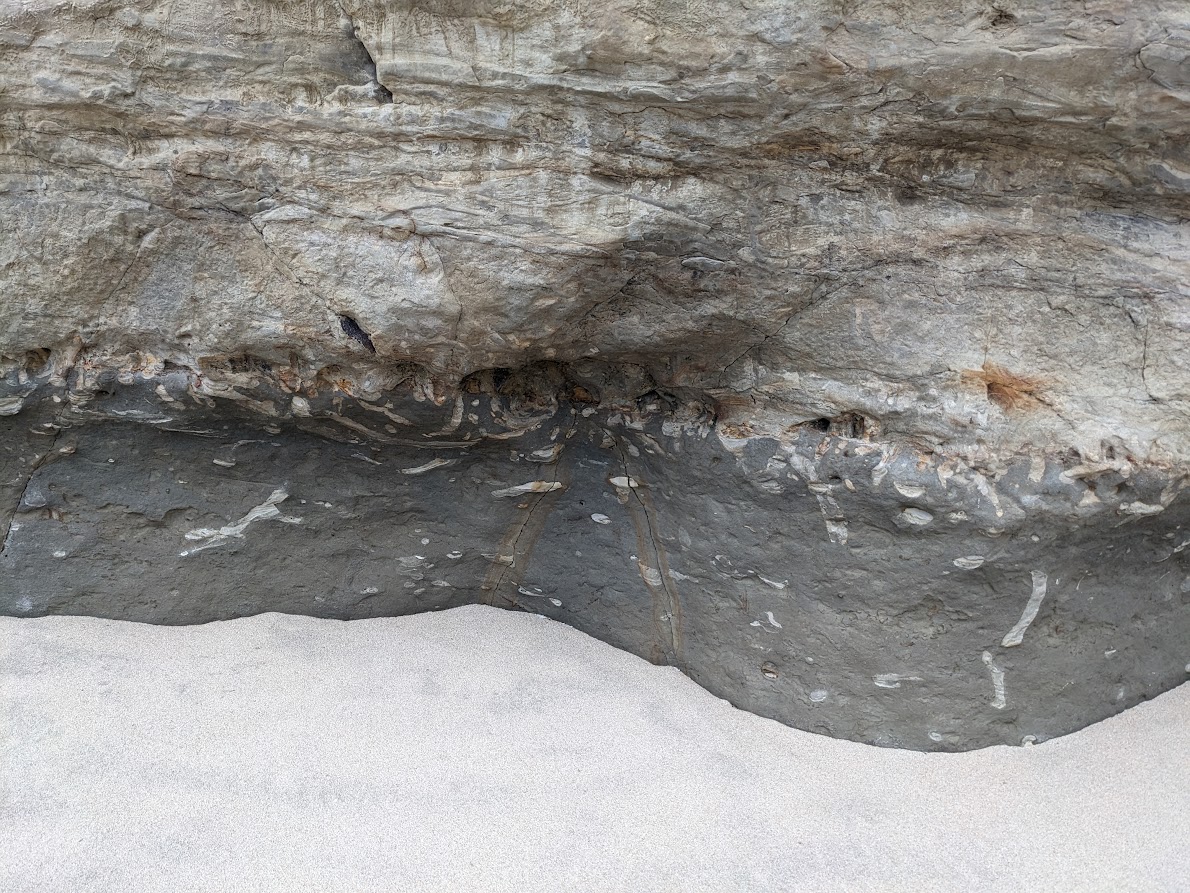
Incredible high-contrast fossil burrows infilled with volcanic ash from a thick ash bed correlated with the Ishi Tuff.
About two years ago I was invited to review a paper reporting ash dates directly from this section of the Purisima Formation I had labored for years over - these geologists were unaware of the paleontological significance of the section (e.g. documenting the chronology and faunal changes over the past three million years) and I was completely unaware that anyone else cared about this locality! I had a robust list of suggested changes, which ironically led Jorge, Marsha, and others to seek out more and more ash beds to sample. We've been intermittently chatting over the past few months and decided to meet up - go out to the cliffs, and compare notes. I was absolutely floored by how many additional ash beds there were out there, and many of them have since been sampled! I'm not used to geological study on the Pacific coast being so vigorous and rapid... usually west coast geologists seem to work on 'geologic time'. Some of my vertebrate localities now have incredible dates constraining their ages to intervals as brief as 200,000 years!

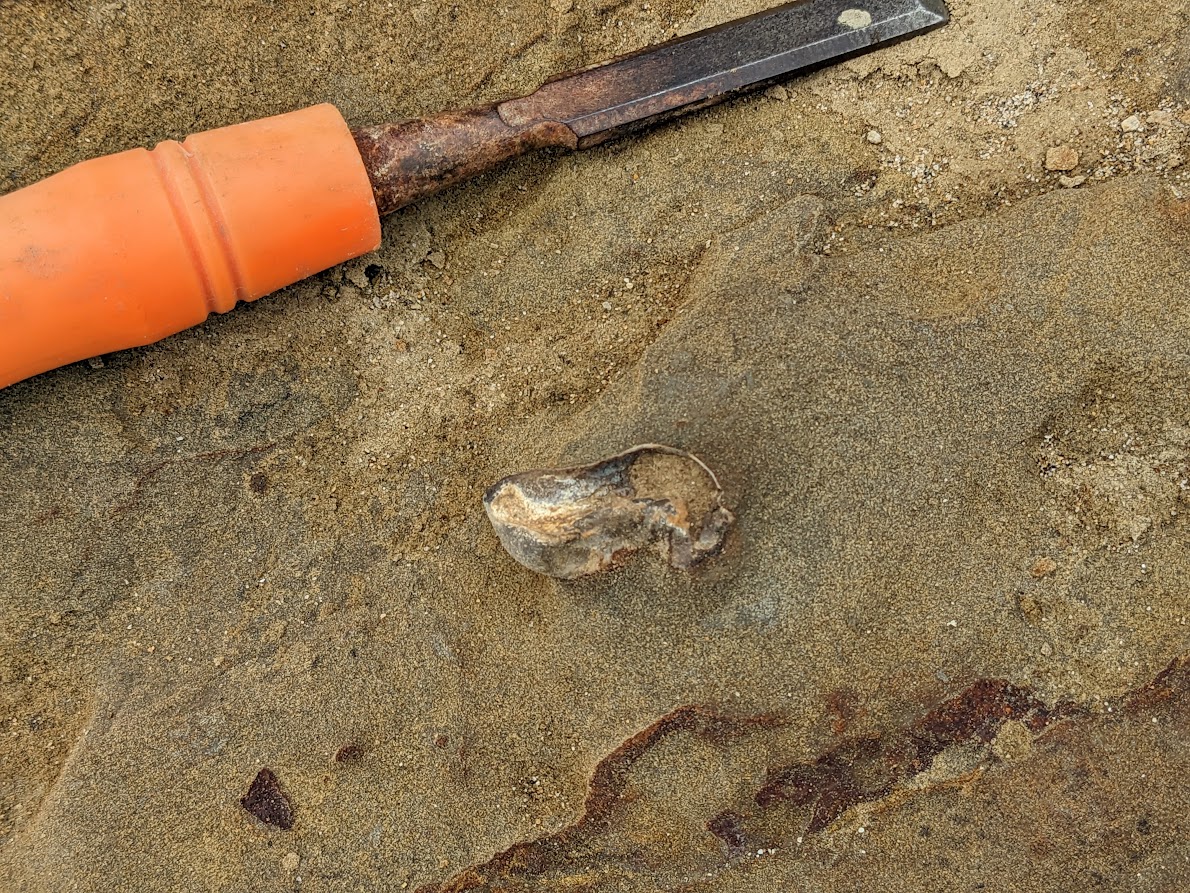
A small pinniped finger bone, likely a metapodial or phalanx.
We had two main goals: 1) check out as many different vertebrate-bearing horizons as possible and recover whatever we could and 2) walk though as much of the section as possible and exchange notes. Wayne's job as a permit co-signer was to become familiarized with the best localities so that he could sample them intermittently while I'm on the east coast. I expect to extend this permit a year into mid-late 2024, and can only afford to make it out here a couple times per year.
Every time I visit the Balaenoptera bertae type locality I have to stop by and pose with it. It's my first named species! And I found it, excavated, prepared and studied it. It doesn't get much better than that.
We started off in the uppermost part of the section, and showed everyone the type locality of Balaenoptera bertae - owing to extreme winter erosion from January through March, caused by back to back atmospheric river storms, the sand level was quite a bit lower than typical and the hole, once about a meter above the beach when I discovered and collected the skull in August 2005, was now about five meters above the beach! We walked a ways along the beach, hopeful to survey a large section of cliffs that are typically easily accessible at high tide - but got turned back as the waves were crashing down upon the only real 'choke point' here, a spur of rock that stuck out about 200' from the main line of the cliffs into the Pacific. On our side of the spur, I relocated two baleen whale mandibles I hadn't seen in years. The first was a humpback whale sized mandible I first spotted in 2005, which had the mandibular condyle protruding from the cliff. This mandible was sticking straight into the cliff and would have required a hole approximately three meters deep to excavate - far too much effort for a single mandible. Then, when I returned for more fieldwork in 2010 on my second permit, I couldn't relocate the mandible. I spotted it for the first time in 18 years because the cliffs had been cleaned off - the mandible had fractured flush with the cliff face, and the cliffs here are frequently quite covered with dust.

Sarah and the re-discovered baleen whale mandible. There's about three more meters of bone sticking straight into the cliff.
The second was a much smaller mandible which I spotted in December 2016, but as I didn't have a permit, I took some photos and intended to return with a permit sometime and collect it. It was the posterior half of a mandible of a small baleen whale, very likely to be my favorite dwarf baleen whale Herpetocetus. When I tried finding it in December 2022, I couldn't relocate it. I had a strong feeling that I would easily find it on this trip, so I ascended the bluff - and couldn't find it. Weird! Maybe it had eroded away. I walked further, looking for other fossils - and then spotted it, about 10 meters further up the bluff than I had remembered. Quite a bit of the mandible had eroded away, but fortunately the diagnostic posterior end, including the coronoid process, angular process, and mandibular condyle were intact - and their morphology confirmed my identification of the specimen as Herpetocetus. If I hadn't scored the rest of this specimen it would have almost certainly eroded away.

A mandible sketch in the sand I did to explain what we were looking at.
I routinely make sketches from memory in the sand - why not? It's the world's biggest white board! And it usually erases itself at the next high tide.
Wayne helping Sarah off the beach while I was being super helpful and taking pictures...
We drove down to another spot and took a trail down one of the larger gullies - one other spot afforded a trail down nearly a mile closer to the best fossil-bearing spot, but unfortunately this more conveniently located trail is typically overgrown with poison oak. We chatted about the Putah tuff-correlative ash exposed in this gully, here nearly a meter thick - Jorge explained that while the Ishi tuff-correlative ash further up-section within the Purisima Formation is several meters thick, the actual ash layer near the volcanic vent itself is only around 10-15 cm thick. This means that the ash layer has been dramatically exaggerated through sedimentation - this ash was likely deposited inland and redeposited as a thick layer on the continental shelf by a river mouth on the periphery of the Purisima depositional basin, perhaps the ancient opening of the San Joaquin embayment (the extinct "Priest Valley Strait", which used to connect the marine San Joaquin embayment to the formerly marine Salinas River Valley) to the southeast.

A great exposure of the ash bed correlative with the 3.35 Ma Putah Tuff - white ash-filled burrows extend downwards into the brownish gray Purisima sandstone, and brownish-gray sediment infills burrows extending into the top of the ash. The ash bed iself is about 1-1.5 meters thick and cross-bedded - hummocky cross-beds, I believe - indicating rapid sedimentation, too rapid for the sediment to be bioturbated by burrowers.
An impression of a large scallop, likely Patinopecten healyi
- a Pliocene index fossil in California.
A fractured boulder with a bed of slipper snails (Crepidula princeps
) -
these gastropods lived in large clusters and are hermaphroditic, often forming small patch reefs. Shell beds like this can be a few meters across. In this case, the shell has been dissolved away - common in this section. However, these shells are also frequently bored into owing to their non-burrowing ecology - the little rice grain sized blobs are the infill of boring sponges (Clionidae), the trace fossil Entobia
.On our way to the best collecting area we encountered our first rockfall - a brand new one that must have occurred in the past five months since I had not seen it on my December visit. Some of the boulders exposed shell bed layers that had in the past (like, in 2006) produced some rare teeth (e.g. a sawshark rostral tooth) and a tympanic bulla of a true porpoise (Phocoenidae). I saw some interesting crustacean parts and then immediately found two different tympanic bullae - one appeared to be from a phocoenid or perhaps a delphinid (oceanic dolphin), and the other one was very clearly from Parapontoporia, the "river dolphin" from the Purisima Formation that is most closely related to the recently extinct Chinese river dolphin (Lipotes vexillifer). I was quite pleased - in just a few minutes, I raised the number of dolphin bullae from three to five, nearly doubling it! These were somewhat more common than the more taxonomically informative periotic bones - only two of which had ever been found: one I found in 2010 or 2011, and another that Chris Pirrone had found with me.

Walking down along the cliffs to the best collecting area.
Formidable cliffs.We visited the two most promising localities, and unfortunately neither produced much: I was hoping for a couple of shark teeth or marine mammal teeth, maybe a periotic bone. Nada; just a few bone fragments. The cliffs here didn't look too different than in December, and even more erosion would likely be needed. I had hoped that by bringing Sarah along she'd find some teeny tiny little skate or stingray teeth from one micro-tooth bearing shell bed, but she had been quite cold and tired and wasn't in her prime. I managed to do somewhat better than past visits and found three or four 1-2mm wide skate (Raja) and/or stingray (Dasyatis) teeth - so that was nice.
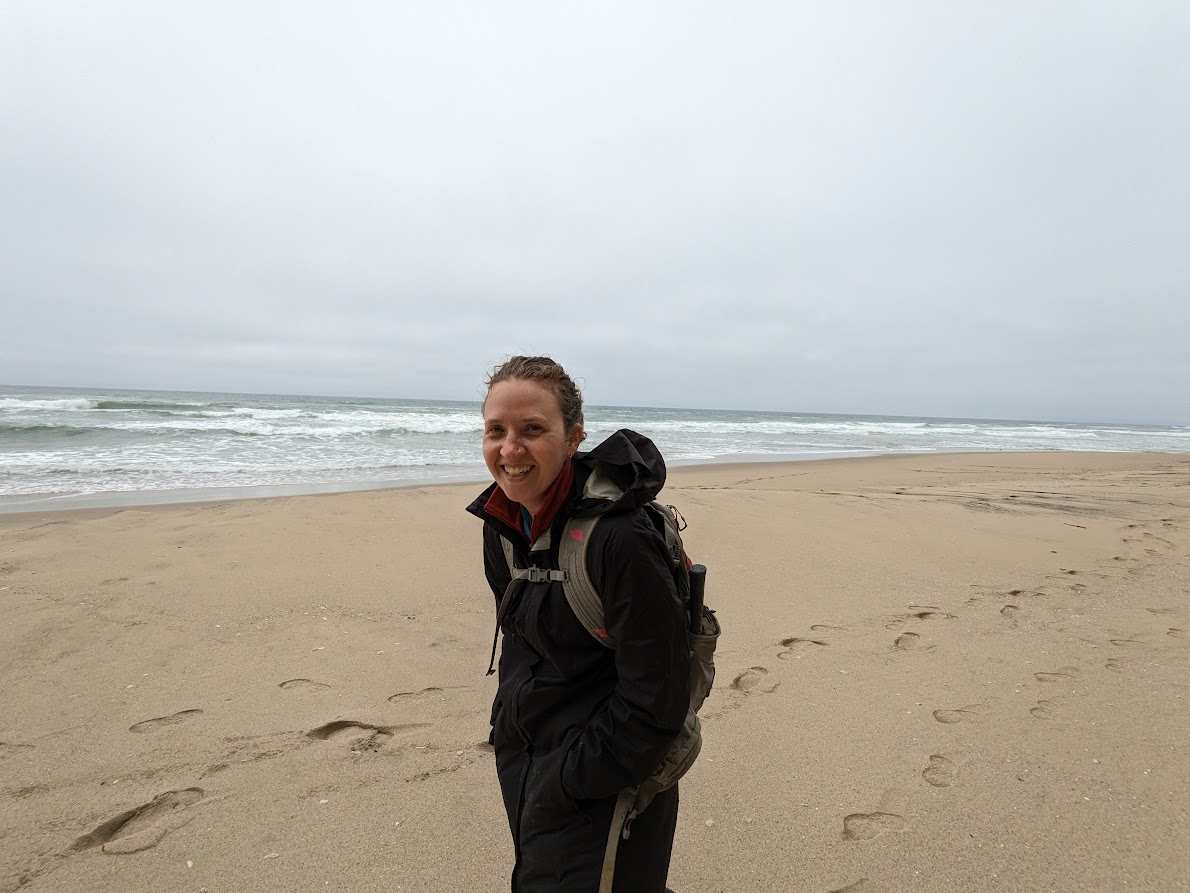
Sarah smiling despite being quite chilly on the walk down.
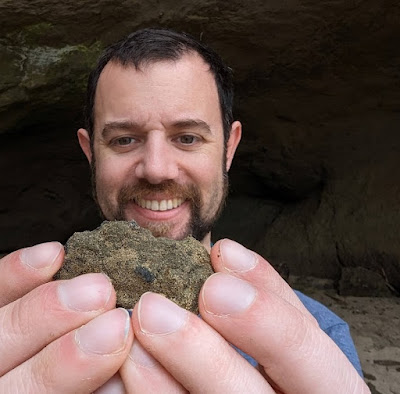
Yours truly with a tiny little fur seal mandible! I'll post more photos once it's prepared. Easily the find of the day.
Luck finally changed when we made it down to the last stop, which was a sea cave that has grown considerably since I first found bones in it in 2005. In December I had collected an unusual looking bone and upon pulling it out, realized it was the rostrum of a dolphin, probably Parapontoporia - I did not have the time or equipment to collect the rest of the skull, so I hoped it would survive the winter storms that were brewing on the horizon. As I entered the cave and saw how low the sand was and how high the ceiling was, my heart sank a bit. No trace of the dolphin could be located after about 20 minutes of desperate searching. Few newly exposed bits of bone looked enticing. I finally spotted a tiny bone about 8 feet above the sand that looked intriguing. After a few failed attempts of scaling the wall of the cave I almost gave up, but on the last try I used some footholds I had carved in years ago and scaled the wall and traversed over to it - I stuck my chisel in and gave it a couple of taps and saw that it was coming loose. I put my hammer back on my belt, and while precariously balanced, I used one hand to cradle the specimen and the other hand to delicately push and leverage the chisel into the rock and the little bone tilted over gently into my hand. I briefly caught glinting of enamel; before I thought I might lose my balance, I pocketed my chisel and looked more closely - I saw two teeth. "Holy shit I found something great" I exclaimed as I hopped down to the sand. I held it up and realized I was staring at a tiny little fragment of mandible with two teeth in place - teeth clearly identifiable as pinniped - and probably a fur seal. My luck had finally turned around! "I could leave right now and be happy with today!" Sarah, who was happy for me but quite chilled, snidely remarked "let's leave now then." I showed the find to the rest of the group and explained how rare pinniped fossils are, and that I had been desperately looking for such a fossil from this site for nearly 20 years. This specimen now marks the fourth pinniped mandible from the Purisima I've collected in the past 16 months! We walked a bit further to take a look at some ash beds, and then headed back up towards the trail.

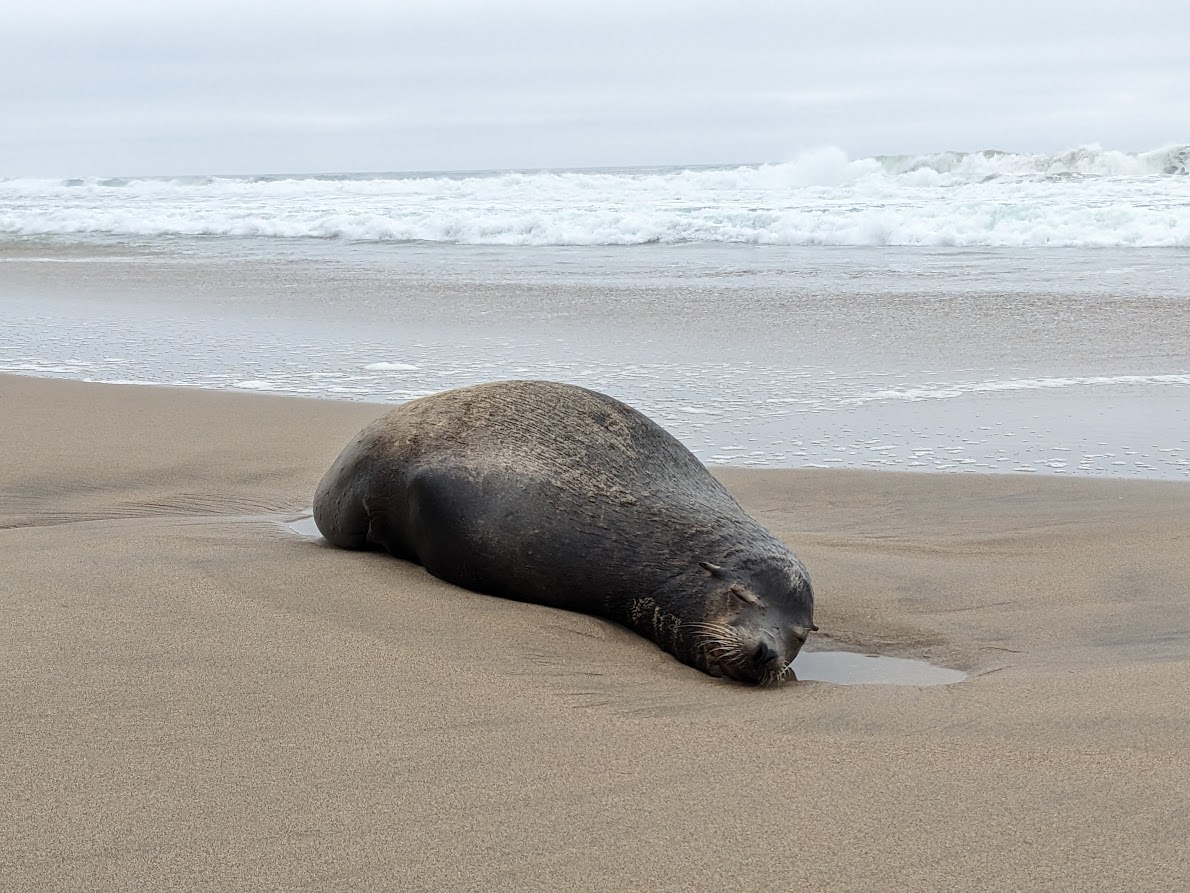
When we got back to the gully we were going to walk back up, we saw a sea lion on the beach - I thought at first that it was a very fresh carcass. Then, I saw it breathe and its nostrils flared. It seemed to be a 2-3 year old male, and not aware of us - assuming it was a carcass, we got within 15 feet - until we realized it was unconscious. It was not starving (no ribs/scapulae/knees protruding) and had no obvious lesions or bite marks on it - I assumed that it was sick. Wayne Thompson observed that it was shallowly breathing - indeed, breathing quite slowly, and called the Marine Mammal Center. Normally, when you approach a sea lion, they open their eyes and will shift their weight while they're judging whether or not you're a threat - and even if they're not aware of you, they often snort and scratch themselves while asleep.
The tympanic bulla of a monodontid as first located after Sarah slipped.
The periotic of the monodontid, found about a meter away. The white weathered bit - the posterior process - was all that was exposed.
A bit of chiseling...
...and voila! Happy whaleontologist with a new record for the locality.We started heading back up the gully, and I tried to help Sarah up a small ledge out of some rancid water (water backed up behind a sandbar in the gully that was filled with decomposing Velella velella, by-the-wind-sailors). While I was pulling her up, one of her feet slipped and she banged up her knee pretty good - she cussed for a couple minutes but was otherwise OK. While she was rubbing her knee and resting for a moment, I noticed what I first thought was the mold of a mollusk shell - and then realized it was actually a pretty chunky tympanic bulla from an odontocete! My third one for the day. As I chiseled it out I noted that it's a bit larger than the most common tympanic bullae from the Purisima, meaning that it's not Parapontoporia or from a phocoenid porpoise - or a small delphinid. I thought at first it might be from a globicephaline, like a pilot whale, which I already documented from this locality a decade ago. While I was chatting with the others and wrapped the specimen up, I saw a little 1 cm wide bit of bone sticking out - it had some distinctive little spurs and longitudinal grooves that I immediately recognized as part of the posterior process of another earbone, about a meter away. At first I thought this was likely the other tympanic bulla. As I looked closer, I remarked "No %%%-ing way" and began to carefully chisel: it was a periotic! The periotic is the more informative of the two earbones. After a minute I confirmed that this was a large odontocete, possibly a pilot whale or maybe from a beluga (Monodontidae). As the periotic popped out without fracturing, I saw the dorsal side - confirming it to be from a monodontid! With this associated pair of earbones, I had doubled the sample of odontocete bullae, and increased the sample of odontocete periotics from this locality from two to three. Further, this is the first confirmed monodontid from this locality in the Purisima Formation. Needless to say, I was elated! So, I thanked my dear wife for falling and getting a bruised up knee for a couple days: I think I'll have to list her as a co-finder for her role in the find.


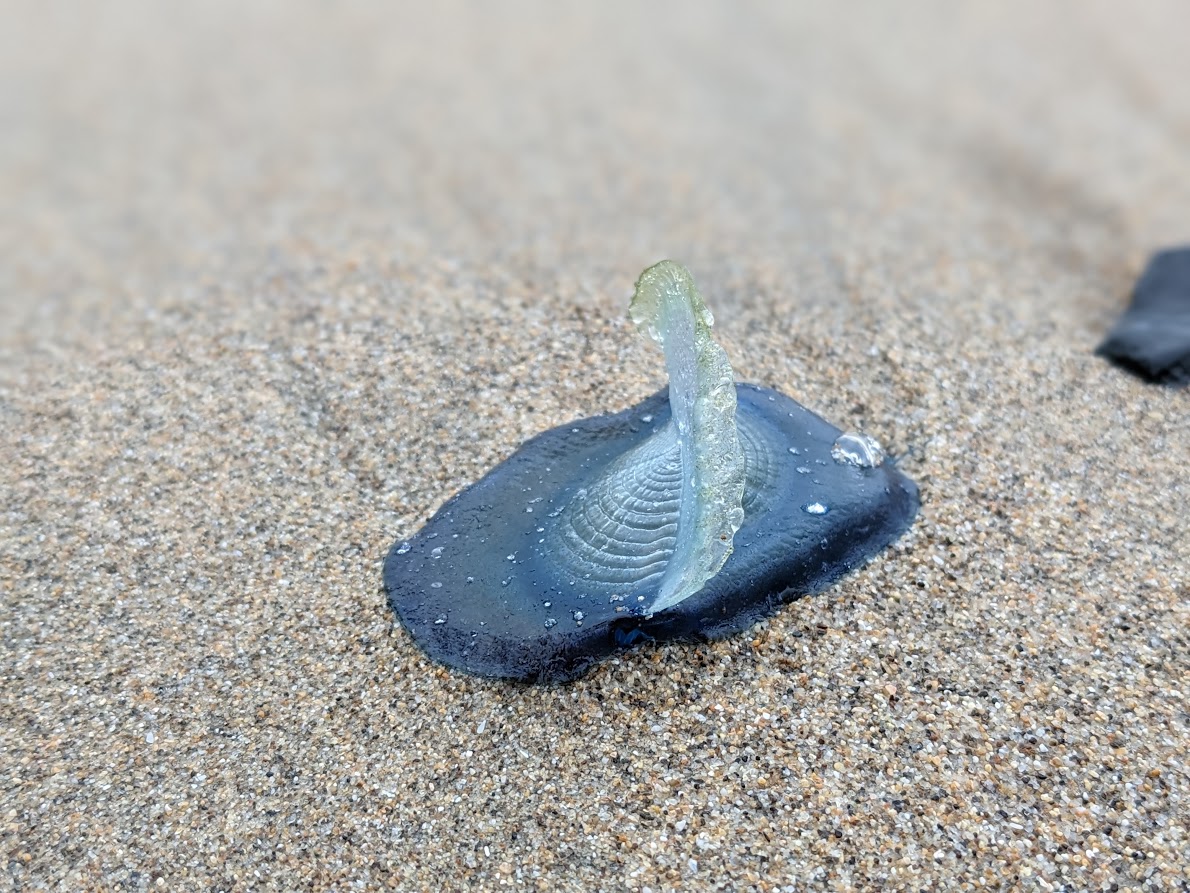
As everywhere else along the Pacific coast, there was no shortage of by-the-wind-sailors (Velella velella) washing up along the beach here.
A minute later, Wayne indicated that he had found some fish bones - he brought over a chunk of rock he had chiseled out with a couple of vertebrae. "And there's more in the rock!", he said. I came over there, and sure enough, there were a few additional bones including something that looked symmetrical - perhaps a braincase. The vertebrae were about 2 cm long or so. Wayne and I collected the last few bits and bagged them up. At this point, Sarah noticed that the sea lion had woken up and was standing up at attention, looking at us with mild concern. It was getting a bit late in the afternoon and Wayne parted ways - the rest of us headed a bit further north to get to the localities we had wanted to check earlier in the morning, but were barred by waves. Sarah was a bit cold and tired (she informed us we had hit five miles of walking a bit earlier) and opted to stay in the car while Jorge, Marsha, and I walked south. Jorge and Marsha pointed out different ash beds they had sampled, and I checked the last few localities.

The Herpetocetus skull, still in its faithful concretion, waiting patiently for us to excavate it on a followup visit later in the summer.
A partial palatoquadrate cartilage of a skate, Raja binoculata
. This is the lower jaw, and is composed of calcified cartilage - often fibrous but with a layer of prismatic (tesselated) cartilage.
A partial rostrum of a medium-sized cetacean - most likely a small mysticete, but something about it looks odd to me. I confirmed that the Herpetocetus skull I found last year survived all of the winter erosion, which was a relief! And further yet, not covered in sand. A few feet away I found a nice palatoquadrate cartilage of a skate (Raja). A few minutes later I found an unusual bone that had not been exposed in December, which came out in a few pieces. A bit further on down the beach I pointed out a minke whale-sized mandible which I had wanted to excavate, but half of it was removed by a fossil poacher. I then located what appeared to be a relatively flat looking rostrum from a cetacean - which is either from a dwarf whale like Herpetocetus or perhaps from a monodontid. A follow up visit is necessary to excavate this.
A greenish chunk of metaconglomerate, likely from the Franciscan complex - the rocks that make up the hills in San Francisco, much of the east bay, Angel Island, Alcatraz, and the Marin Headlands.
A cluster of sand dollars, probably Merriamaster.
A much younger ecentric sand dollar (Dendraster excentricus
) with a huge red striped acorn barnacle (Paraconcavus pacificus
) stuck to it, with several additional barnacles. A common occurrence along this section of the coast!
A closeup of some slipper snail colonies (Crepidula princeps), along with a large scallop.
The entire shell bed - a concretion about 1.5x2 meters in size, 99% of the fossils belonging to a single species. This would be a 'community bed' according to Richard Norris' (1986) research on the taphonomy of the Purisima Formation.