Showing posts with label Pleistocene. Show all posts

Sunday, January 29, 2012

Southern California Research Trip, Part 4: Page Museum at the La Brea tar pits

After our last day of research at NHMLAC, Sarah, Morgan, and I drove to LAX to drop Morgan off for his flight back to the rockies. Sarah and I continued on, and had a two day trip planned ahead: first, we would visit the Page Museum of La Brea Discoveries in Hollywood, and then we'd drive north on Highway 1 from Santa Monica north through Malibu, Oxnard, Santa Barbara, Santa Maria, San Luis Obispo, Big Sur, and eventually through Monterey on our way back to the San Francisco area. We took a ton of great photos at the Page Museum which we arrived at just before opening; I've included some of the better and more informative photos here.

The front of the uniquely designed Page Museum. The museum is shaped like a square with a botanical garden courtyard, and above the museum, a large bas-relief is supported by that scaffolding.
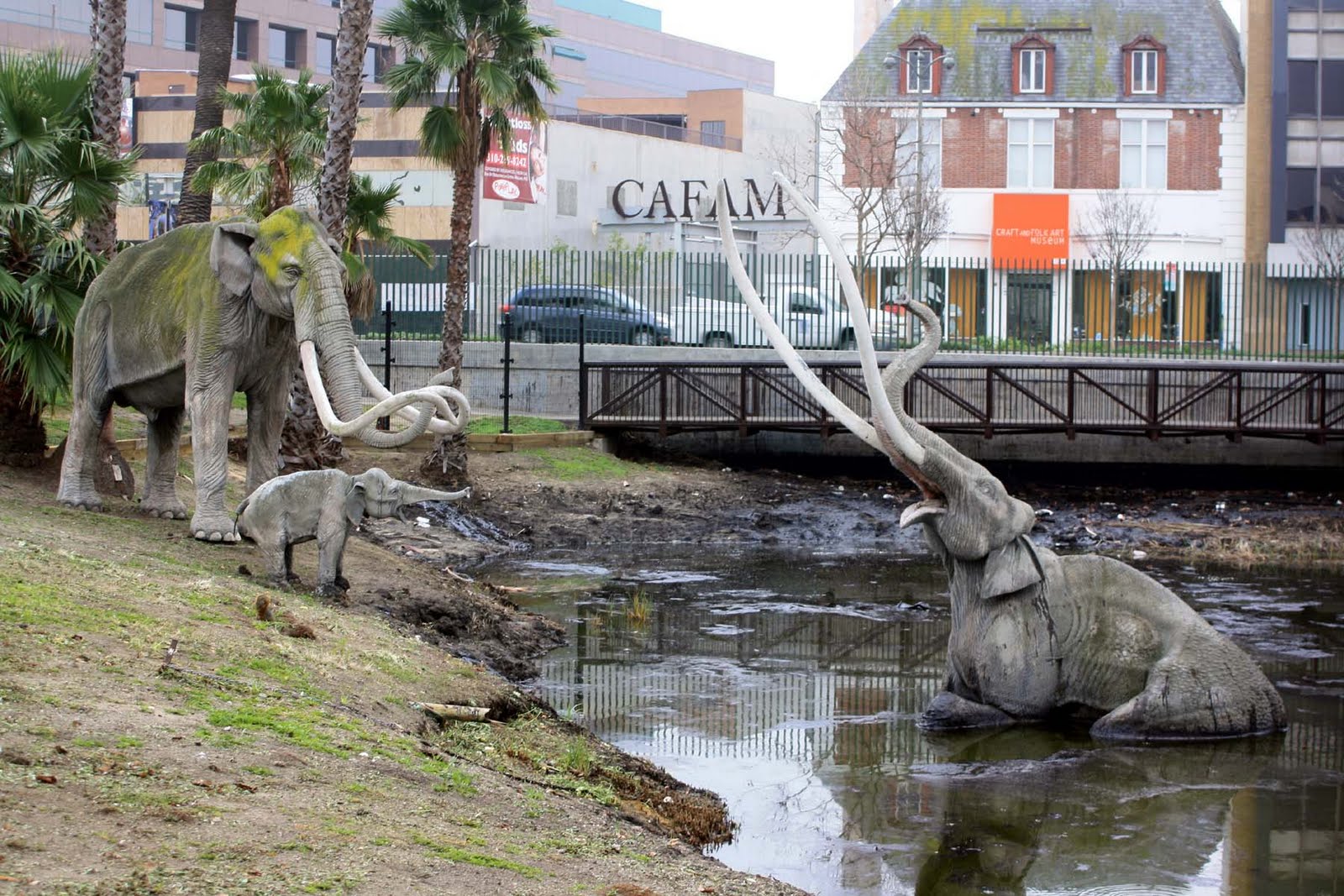
A poor Columbian Mammoth is in deep... stuff.

My wife snapped this photo of tar bubbling up outside the museum. It's amazing how much tar is still seeping up. On my last visit in 2004, I didn't see anything around the park that was half this good; you can clearly see here the leaf litter and detritus that covers and camouflages the tar, while also seeing some obviously viscous, black, cartoon style tar bubbling up.

The famous Pit 91 excavation, which is temporarily on hold during the project 23 excavation a stone's throw away.
One of the panels from the bas relief above the museum, depicting a teratorn confronting a ground sloth.
A Columbian Mammoth skeleton, which I look way too happy to see (considering it's not marine, that is).
One of these things is not like the other ones...
My wife attempting to pull the plunger, showing how damned difficult it is.
The right canine is not the thing that's important in this shot, it's the left canine; although this is not a marine carnivoran, I'm interested in tooth eruption in carnivorans in general, and this made my day.
Skull and life restoration of Merriam's giant condor, Teratornis merriami. Still not as big as Pelagornis, but impressive and terrifying none the less.
Lots and lots of dire wolves (Canis dirus). This has to be my favorite display in the entire museum... it's beautifully constructed.
The spectacularly large and robust skeleton of the American Lion, Panthera atrox.
What? I thought this was the American Lion? Some recent studies have indicated the skull and mandibular morphology of Panthera atrox is more similar to the extant Jaguar (Panthera onca) than it is to African Lions (Panthera leo). There is a conflicting molecular study done with ancient DNA, however, but I'll save that for another time. Here's a question for any readers in the know: who the hell is Naegele? Joseph Leidy named the damn thing after all, so why isn't it named Leidy's Giant Jaguar?

A new American Lion specimen named "Fluffy" was recently excavated, and there was this temporary case which had in it what I thought was one of the better exhibits in the whole place: a three dimensional representation of the skeleton, using the same skeletal elements of a housecat. As a taphonomist, I particularly enjoyed this.
The bubble prep lab at the Page.
I love seeing stuff like this in prep labs. Apparently Arctodus is a patriot.
Is that a walrus in there? Damn, it's just a Smilodon. I really loved this display showing the three dimensional configuration of bones.
Smilodon again.
A bee outside the Page Museum. This has no relevance to the rest of the post, but it is a pretty picture, no?
A composite of two panoramic shots my wife took showing the bas relief.

A great shot taken by my wife of the wall of dire wolf skulls.
Hollywood!

Up next: Southern California Research Trip, Part 5 - detailing the Santa Barbara Museum, the coast, and the conclusion of the series of posts.

Thursday, January 26, 2012

Southern California Research Trip, Part 3: Natural History Museum of Los Angeles County (collections)

The purpose for our trip to visit the LACM collections was to examine a large collection of pinniped fossils housed there. Curator Emeritus Dr. "Larry" Barnes has been studying fossil pinnipeds since his master's thesis in the late 1960's (which he published in 1972, on Allodesmus and other desmatophocid pinnipeds), and has researched a wide variety of fossil pinnipeds including the early diverging and 'primitive' enaliarctines (a paraphyletic group of early pinnipeds), the relatively large and aberrant desmatophocids (an extinct group of phocoids known only from the North Pacific), all manners of fossil walruses, and fossil sea lions and fur seals. Larry has named quite a few fossil pinniped taxa from the northeastern Pacific region (Enaliarctos mitchelli, Pteronarctos goedertae, Pteronarctos piersoni, Pacificotaria hadromma, Desmatophoca brachycephala, Allodesmus gracilis, Proneotherium repenningi, Pelagiarctos thomasi, Gomphotaria pugnax, and Proterozetes ulysses), and there are a whole slew of holotype specimens to look at at the LACM - including a number of other important finds, including crania and jaws of the walrus Imagotaria downsi and the even earlier Neotherium mirum (but not quite as old as Proneotherium...). Our goal was to photograph all of these skulls and jaws, and take all sorts of measurements of them for our research. Between Morgan and I, we took about 5 gigabytes of photographs of these fossils. At the moment, we have two concurrent research projects which will soon be culminating in submittable manuscripts: a phylogenetic analysis of fossil and modern sea lions and fur seals (Otariidae; Morgan gave a talk on this at SVP this last fall), and another project describing some new material of the extinct "killer" walrus Pelagiarctos, originally described by Larry Barnes from the Sharktooth Hill Bonebed, and discovered by LACM head preparator and all around fun guy Howell Thomas. At bare minimum, we needed to examine, photograph, and measure the holotype "chin" and the referred teeth. Anything else we got done was a bonus - and our bonus included looking at dozens and dozens of skulls, jaws, and teeth of various other pinnipeds.

The hollywood hills can be seen very well from the prep lab, which is several floors up. You can just make out the hollywood sign below the top of the mountains.

The holotype "chin" of Pelagiarctos thomasi.

A referred lower left third or fourth premolar of Pelagiarctos, published by Barnes (1988).

My wife borrowed some of the clay we used for propping oddly shaped specimens up during photography and made a walrus and a manatee; the manatee even has
motorboat propeller scars (just for J. Velez-Juarbe!)

A referred lower jaw of Neotherium mirum from the Sharktooth Hill Bonebed, published by Barnes (1988); this is the only other early walrus from the middle Miocene bonebed.

My wife happened to find a book of 3D cat photos with 3D glasses. Don't ask.

Three different jaws of Allodesmus from the Round Mountain silt; but how many species? According to Barnes, there are three species: the topmost is the holotype of Allodesmus kelloggi, the middle is the holotype of Allodesmus kernensis, and the bottom one is Allodesmus gracilis. Others would lump all these in to Allodesmus kernensis (which would have taxonomic priority).

Three different early walruses! From left to right, they are Proneotherium repenningi from the Astoria Formation of Oregon (early Middle Miocene), Neotherium mirum from the Sharktooth Hill Bonebed of California (late Middle Miocene), and Imagotaria downsi from the Santa Margarita Sandstone (early Late Miocene) of Santa Cruz County, California.

The beautifully preserved holotype skull of Pacificotaria hadromma from the Astoria Formation of Oregon. According to Berta (1994), this may be a junior synonym of Pteronarctos.

Morgan and I conducting research amid a chaotic mess of fossil pinnipeds and other paleontological debris.

Downtown Los Angeles from the window in the prep lab. The US Bank tower can be seen in the middle. If you recall, it was blown to smithereens in Independence Day.

The rostrum and upper dentition of a referred snout of Desmatophoca oregonensis.

Morgan photographing the obscenely gigantic jaw of the bizarre double tusked behemoth of a walrus Gomphotaria pugnax. Seriously, that thing is offensively large.

The holotype skull of Allodesmus kelloggi, described by Ed Mitchell in the mid 1960's from the Sharktooth Hill Bonebed.

An undescribed late Pleistocene jaw of a California sea lion, Zalophus sp., from the Newport Bay mesa.

Last, but not least, another shot of those three walruses -
Proneotherium, Neotherium, and Imagotaria.

What's up next? One or two more posts on the southern CA trip including the Page Museum as well as the Santa Barbara Museum of Natural History, and eventually, I should probably try and cover some recent marine mammal research, I still have to cover a paper I got published on our wedding day, Kolponomos, and a bazillion other things.

Saturday, March 26, 2011

Fossil Fur seals from Northern California, part 1: discovery

Earlier this week saw the publication of my third article, concerning fossil fur seals of the genus Callorhinus from the Pliocene and Pleistocene of Humboldt County in Northern California. This paper has been in the works since 2006; I presented a poster on this topic at SVP in 2007. I did some of the initial research in 2006 and 2007, and after my SVP poster, I tried a couple more drafts of the manuscript - but it, along with a couple of other projects, fell by the wayside until I started graduate school. It wasn't until I had the herpetocetine jaw paper off my plate that I returned to this project, and in may of last year I submitted my completed MS to the Journal of Vertebrate Paleontology after three years of intermittent research.

The first page of Boessenecker (2011)

The story really starts in 2004. My buddy Ron Bushell, who helped me identify many of my fossils when I was still in High School, was collecting at a fossil site in Humboldt County, California. At this particular locality, he was looking for large concretions from the Rio Dell Formation which occasionally bear beautiful scallops (Patinopecten) the size of dinner plates, and incredible 6-10" long gastropods.

Ron and his collecting partners walked down the riverbank looking for nodules bearing mollusks, and thought he had hit the jackpot when he found a large nodule, about 2 feet in diameter, just sitting there in the gravel bar. Now, Ron is an experienced nodule collector - he's spent a lot of time collecting nodules with mollusks from the Pliocene and Pleistocene of Humboldt County, and Eocene crabs from Oregon and Washington.

So, if you're a nodule collector, naturally you take out a sledge hammer and attempt to destroy the concretion. Many concretions have nothing in them, and it is better to crack them in the field rather than lug them home and find out later (at some crab localities, Ron knows well enough which concretions will have crabs, and which ones won't, and packs them all out, and cracks them in his garage). Well, he broke this concretion open, and instead of white shells being exposed, familiar (but much rarer) brown fragments flew out onto the river bank - he immediately knew that he had found bone.

Initial preparation of the Bushell specimen.

Normally, Ron would keep any vertebrate fossils from this locality, due to their rarity. However, he also noticed a tooth fragment - and he knew he had found something pretty important. So, just like any crab or mollusk fossil, he collected all the pieces, took them home, and glued them all together in his garage, and begun airscribing the fossil.

Continued preparation of the Bushell specimen.

As it turned out, Ron had found two associated lower jaws (left and right) of a small fur seal, preserved beautifully in relief in a large concretion. He posted these photos on the old "Collecting fossils in California" forum, and I was very interested once I saw it. After a few emails, he offered to let me study the specimen - an opportunity I was most excited for.

Finished preparation of the Bushell specimen.


The Bushell specimen as it was when I first saw it.

The following summer, my fiancee (then girlfriend) and I drove out to California for the summer, but took a detour through Oregon and Humboldt County in order to visit Ron and pick up this beautiful specimen. Thanks to Ron's generosity, this fossil was made available to study - and now (finally, five years later) Ron's wish that it be studied finally culminated in my paper in the Journal of Vertebrate Paleontology.

Next up - introduction to the "Gilmore Fur Seal", Callorhinus gilmorei.

Boessenecker, R.W. 2011. New records of the fur seal Callorhinus (Carnivora: Otariidae) from the Plio-Pleistocene Rio Dell Formation of Northern California and comments on otariid dental evolution. Journal of Vertebrate Paleontology 31:2:454-467

Sunday, October 24, 2010

SVP 2010: barnacle and sea lion taphonomy

Hey Folks, I know it's been a while (I feel like I say this a lot...), but I've been really, really busy. The semester has been really busy - I've been working on four different papers since I got back to school - but postings will be much more frequent for the remainder of fall. The entire month of September was spent writing a new manuscript, and getting revisions done for a manuscript that is most likely accepted for publication in the Journal of Vertebrate Paleontology. The last week of September and first week of October were spent coding characters for a poster I had with my good buddy Morgan Churchill and his advisor Mark Clementz (on pinniped phylogeny), my own poster, and two art projects I was involved with for two of the Romer Prize Presentations at SVP (by MOR/MSU students Denver Fowler and John Scannella, who between the two of them requested 9 or 10 drawings of ceratopsid skulls).Barnacles!!! (not that you've actually read about them yet). Isn't that cool?!

Six days before SVP started, I finally got the chance to work on my own poster, titled "Barnacle colonization of Middle Pleistocene Sea Lion (Carnivora:Pinnipedia) bones elucidate the biostratinomy of a fossil marine mammal". And no.... this is still not part of my thesis, although it is very similar to what I am doing. And actually, getting the poster done and now recapping on it have really helped me get reinvigorated about my thesis; I consider any time spent thinking about taphonomy is more or less time spent toward my thesis. Because this week I am starting to devote 100% of my research time to my thesis, more of my future posts this fall will be taphonomy related (and specifically marine vertebrate taphonomy, one of the most understudied and underpublished aspects of taphonomy).
But enough about my thesis. It's time for barnacle-on-bone action.

My poster from SVP (locality information is blocked out).

I had my poster presentation on Monday, day two of SVP, which was comforting because marine mammal talks and posters are usually the very last day of SVP, and during the afternoon at that (late afternoon/evening if you give a poster!). Anyway, a couple of years ago (June 2008) I was prospecting a marine Pleistocene locality in Oregon and found a couple of bones in concretions - no big whoop. Because of that, I didn't do anything with the bones for about two months, until I set 'em down in my parent's driveway and sprayed them down with a garden hose. As the soft outer rind of sediment began to wash away, I saw little white things I quickly identified as minuscule barnacles. Due to the library of papers on marine vertebrate taphonomy I've amassed for my thesis, I did a quick mental search, and quickly realized that these had never been reported as encrusting bone before. This made me really excited.

A beautiful sea lion femur with barnacles only encrusting one side.

A less cursory glance at the literature shows that these associations have indeed been recorded before in the literature, but never figured. Two examples have been figured, but either the photos are so god-awful or the item in question probably isn't even a barnacle. Otherwise, it's been mentioned as a sentence (or a part of one) before here and there. There are plenty of examples of modern barnacles encrusting old bones: I see that almost on a daily basis in the intertidal zone in Santa Cruz. To clarify, these are fossil barnacles.

The specimen where I first saw the barnacles.

So, into the nitty gritty. There are 1400+ barnacles distributed over three ones (the femur had ~200, and one of the two vertebrae is hogging 700+ to itself). They appear to be of two size classes: big ones (4-7mm with a few outliers) and small ones (~1-2mm). The big ones do not occur on any articular surfaces or in the neural canal, and predominantly only on the neural arch (i.e. few on the centra). The small ones occur pretty much everywhere, and in many cases are growing on the bigger ones. This indicates at least two colonization events. Dr. R. Van Syoc at California Academy of Sciences was gracious enough to identify the barnacles for me over the summer; they appear to be cf. Hesperibalanus hesperius. It is a species that is still extant, and is a prolific fouler of shells.

Closeup of the neural arch (left) and transverse process of the vertebrae (right).

Another interesting tidbit is the presence of barnacle attachment scars: here they are on the bone as oval-polygonal shaped traces, that are only excavated along the periphery. This has been reported before for rocks and invertebrate shells, but not bone.

So, what else can we infer? Because we know the ontogeny of modern Hesperibalanus hesperius, we can reasonably infer a gross estimation of minimum time averaging (i.e exposure time on the seafloor), given the barnacle size (basal plate diameter). The modern species only has a lifespan of 7 months, and seeing as none of these are full grown, they probably only represent 2-4 months. This is, however, assuming that barnacle basal plate diameter is constant: it is well documented that crowded barnacles only achieve a certain diameter until their basal plates are all touching and cramped (such as many on these specimens). So, it is possible that some of these were full grown, and so a time of ~ 2-7 months or so, ballpark.

The lack of any barnacles on some surfaces suggest that the surface was uninhabitable due to being smothered in sediment, or by the adherance of tissue. The femur lacks barnacles on the distal condyles, strongly suggesting the retention of articular cartilage there. Also, the femur only has barnacles on its posterior side, suggesting that the anterior side lay in the substrate and was never flipped. On the contrary, the vertebrae have barnacles more evenly distributed, so that it would be difficult not to smother barnacles at any position the bone was situated at. This suggests that the fossil was rolled around on the seafloor frequently enough to keep individual barnacles from smothering, very similar to the balanulith concept recently published in Palaios and Palaeontology. Anyway, there's much more to type about, but you'll have to wait for the paper, lest I retype everything on here.

On another note, I just got a paper on taphonomy (unrelated to this, but slightly related to my thesis) accepted in publication for Palaios, so you may be able to hear about that sometime early next year, perhaps.

Thursday, March 11, 2010

Mystery Pleistocene bones

Hey folks, I've been rather busy preparing for spring break (which I leave for in about 30ish hours), and I've actually gotten quite a bit accomplished - I finished preparing the whale cranium from the aforementioned post (there will be more follow up posts to that soon), and as of this afternoon, finished the second plaster/fiberglass cradle for the skull, which I will eventually be able to sink bolts through to keep the two halves together. Tommorrow I'll be attaching foam to the inside of the cradles, and then lugging the whole monstrosity to my (rather small) car. However, as this thing now weighs around 100 lbs or so, it is still only 1/3 of its original weight, so my car can do it.

Other than that, I submitted a manuscript this week (late monday night), about bite marks on some bones from the Purisima Formation; you'll hear more about it later on down the line.

Mystery marine fossils from the Pleistocene.

Anyway, as part of my mental preparation for spring break and looking at marine Pleistocene "rocks", here are some Middle Pleistocene fossils from a marine unit in California. I haven't been able to ID them, but they were originally ID'd by the collector as sea turtle claws. I'm naturally skeptical of that, but I'd like to see what you folks think, or if anyone can come up with something better (or, validate that ID).