Showing posts with label San Diego Formation. Show all posts

Wednesday, January 18, 2012

Southern California Research Trip, Part 1: San Diego Museum of Natural History

After a ten day visit with my wife's family for Christmas in Billings, Montana, my wife and I flew back to California, and had two days to get ready for a research trip to southern California with our friend and colleague Morgan Churchill. Except that we both got sick with a nasty two day cold - we got back on a thursday night around midnight, and were supposed to leave on sunday morning (which also happened to be January 1st). Needless to say, neither of us really were able to get ready for the trip on account of how crappy we both felt, and miraculously, waking up on sunday morning for the trip, I finally felt okay to drive, and the trip was a go (only we still had to pack, and didn't get out of town until close to 1pm). It's an 8 hour drive from San Francisco to San Diego (without traffic), so we were looking at a pretty late arrival. That being said, we had just driven up to Montana a couple weeks prior, and 8 hours seemed miniscule compared to two 10 hour days across the American west. We got to Los Angeles around 7pm, and stopped in for a couple hours to visit our best friend, Lee Hall, and his awesome girlfriend Ashley Fragomeni, which was refreshing (and far too brief). We finally pulled into east San Diego to pick up Morgan at about 12:30am (after driving through the densest coastal fog I've ever seen - and that's coming from a San Francisco native!). We pulled up to the house of our gracious host (and my coauthor) Joe El Adli, who also hosted me during the SATLW meeting in June at SDSU.
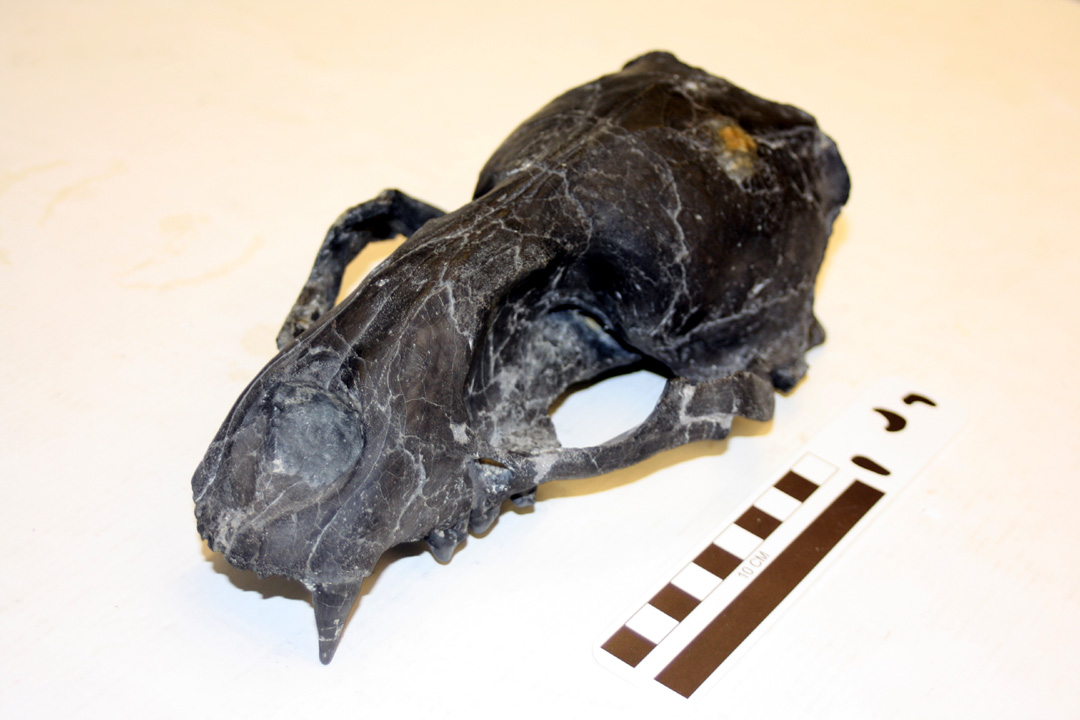
Morgan measuring a skull of Valenictus chulavistensis, the "toothless" walrus from the Pliocene San Diego Formation.

We had several goals for our visit - Morgan and I are studying a new specimen of the middle Miocene walrus Pelagiarctos, which Larry Barnes descibed in 1988 from the "chin" end of a pair of mandibles and some teeth, and suggested some interesting hypotheses regarding its paleoecology. At San Diego in particular, Morgan needed to spend some time photographing and measuring every pinniped skull and jaw he could (and it took up nearly the entire time of our visit). When not helping Morgan with measurements, I was chatting with Tom Demere (paleontology curator at the SDNHM) and Joe El Adli (lead preparator of the paleo department at SDNHM) about the fossil mysticete Herpetocetus, as well as photographing some earbones and crania of balaenopterids that occur in both the Purisima and San Diego Formations.

A mounted skeleton of Allodesmus (kernensis? gracilis? depends on who you talk to) at the SDNHM, while the tail and claspers of a giant Carcharocles megalodon loom ominously above.

A closeup of the business end of Allodesmus.


A skull of Desmatophoca oregonensis, a smaller and earlier relative of Allodesmus from the Astoria Formation of coastal Oregon. This specimen was collected by Douglas Emlong, and described by Tom Demere and Annalisa Berta in 2002.

Two pinniped skulls in particular that we definitely needed to see are on display in a huge cabinet out in the Fossil Mysteries hall. During my 2007 visit, I had been let into the cetacean display case to examine and photograph a porpoise skull, but that case actually had an entire door and you could walk around in it; this display case with the walruses had a 150 pound sheet of glass that required four of us (Morgan, Joe, myself, and the SDNHM collections manager, Kesler Randall) to use large suction cups to lift the ~7 foot tall sheet off of the case (which required Joe and Kesler to go up on ladders on either side). It was quite the performance, all done prior to the museum opening.

Joe (left) and Kesler (right) brainstorming about removing the sheet of glass from the walrus exhibit.

Joe placing the suction cups on the glass. The two walrus skulls in
question
- Dusignathus seftoni on the left, and Valenictus chulavistensis on the
right - can be
seen at the bottom of the case.

We needed to see two specimens in particular - one is the nearly complete and well preserved paratype skull of Valenictus chulavistensis, and the other is a referred skull of the dusignathine "double tusked" walrus Dusignathus seftoni. I had really ought to blog about each of these taxa, as they are truly wonderful and bizarre creatures. The new skull of Dusignathus was collected about 6 or 7 years after Tom Demere described and named the species in 1994, and is in much better shape than the holotype specimen, which is substantially smaller, and is missing the palate (although this new larger male specimen is missing the top of the skull). Although I've seen this display several times before, I must admit I was very surpised with 1) how small the Valenictus paratype is in comparison to other skulls, 2) how light the paratype is (Tom stated that it was very poorly mineralized and held together primarily with consolidant), and 3) how damn huge the Dusignathus skull is in comparison to other skulls in collections.

Joe (in brown) and Kesler (left) set the walrus crania down onto foam, while Morgan (right) and I (gray) watch.

While Morgan was taking photos, I decided to get a different angle on some of the fossils while I had a ladder available. Here I am shooting the Allodesmus photos seen above.

Here's a nice shot I got from the ladder of a new species of balaenopterid mysticete from the Pliocene San Diego Formation (this taxon is being studied by SDSU student Jessica Martin). So far as I can tell, I've not yet seen this animal from the Purisima Formation.

A neat mount of a fossilized wing of an albatross, Diomedea sp. (but should probably be identified as Phoebastria sp.). Albatrosses are definitely huge birds - but the partial humerus of Pelagornis sp. I recently published, which was only 1/2 complete, was the same length as the complete humerus of this specimen.

My wife always makes friends on research trips.

By the end of the San Diego visit, we had each taken several gigabytes of photos, and dozens of measurements for our research. My wife had spent a fair amount of time next door at the San Diego Zoo, and at the Museum of Man. We spent wednesday morning at the SDNHM to wrap up everything before driving to LA, where we would spend our first afternoon of research at the Natural History Museum of Los Angeles County (NHMLAC), but known to paleontologists simply as "LACM" - which will be the subject of the next post.

Tuesday, June 21, 2011

Sixth Triennial conference on the Secondary Adaptation of Tetrapods to Life in the Water

Two weeks ago today, I delivered a presentation on the first day of the 2011 Aquatic Tetrapods conference in beautiful San Diego, California. I had eight hours on my drive down to San Diego the day before to worry about how screwed I was: the last time I gave that presentation, it was only 20 slides longer, and took 50 minutes to deliver. I practiced it once Monday morning in front of Joe El Adli (our gracious host), and Yale students Rachel Racicot and Daniel Field - I barely fit it into 20 minutes. It all worked out fine, and in the actual presentation, I finished the last conclusion slide right as it counted down to zero. This was a fresh break from SVP tradition, which dicates that cetacean research is presented on the afternoon of the last day, giving you all week to worry about the presentation. This time, I was able to relax during the entire meeting.

My title slide for my taphonomy presentation.

It would be very difficult to summarize all the research presented, but I might be able to summarize a few of the highlights that stick out in my mind. Julia Fahlke (University of Michigan) gave a fascinating talk Monday Morning about basilosaurid and protocetid cetaceans with asymmetrical crania, and implications for the evolution of hearing underwater. I'll admit, when I read the abstract I was skeptical, but her presentation was pretty compelling - I'll wait to say more until it gets published, though. Brian Beatty presented some details of his research on meningeal ossification in cetacea, which appears to not be homologous to that in many other mammals. Larry Barnes showed us a new Paleoparadoxia skeleton the LACM has been working on from the Monterey Formation; it's virtually complete, with a very large, gnarly looking skull. Olivier Lambert gave a talk coauthored by Giovanni Bianucci on a new large assemblage of bizarre ziphiid fossils dredged from the seafloor off the coast of Spain; boy, there are some real freaks. Our Australian colleague Erich Fitzgerald presented a new juvenile aetiocetid skull from the Oligocene of Washington State which he's been slowly preparing with acid; needless to say, it's a beautiful specimen. Manuel Martinez, a Peruvian who is Christian de Muizon's Ph.D. student, presented on an incredible new toothed mysticete from the Oligocene of Peru - I won't give any details, but lets just say this will be a very, very important specimen.
Frank Fish gives a mini presentation on locomotor adaptations of various marine mammals, using an assortment of articulated limbs (a walrus forelimb is seen in the foreground).

On wednesday, we went over to the San Diego Natural History Museum for an osteology workshop on aquatic tetrapods. Due to the research focus of Tom Demere (Paleo curator) and Annalisa Berta, the majority of material out on display was from modern and fossil marine mammals. There was a great assortment of wonderful stuff out, and it was amazing to be there with so many other marine mammal (and otherwise) researchers there.

Several cetacean researchers are in this photo: Toshiyuki Kimura (foreground), Mette Steeman (behind "Tosh"), and Giovanni Bianucci (background, left) and Joe El Adli (background, right).

At the workshop, I caught Brian Beatty red-handed demonstrating his very technical method to determine the relative height of the bony tentorium (here on a skull of the Amazon river dolphin, Inia geoffrensis).


For a while, Daryl Domning gave a short presentation on the locomotion and forelimb of sirenians (using a Manatee forelimb skeleton).

Here, some of the brightest minds in cetacean paleontology scrutinize one of the weirdest fossil mysticetes: a new species of Herpetocetus under study by Joe El Adli. From left to right: Mette Steeman, Joe El Adli (standing), Felix Marx (leaning over skull), Meredith Rivin (background), Giovanni Bianucci (in glasses), and Olivier Lambert (in red).

Manuel Martinez, a Peruvian researcher studying with Christian de Muizon in Paris, did not waste a chance to photobomb. Here he is photographed with a cast of the skull of the bizarre extinct edentulous* walrus Valenictus chulavistensis.

Daryl Domning again gives a short presentation, this time on sirenian crania. Here he is showing a cast of the skull of the world's largest sirenian, the extinct Pliocene species Hydrodamalis cuestae (the ancestor of the "modern" Steller's Sea Cow).

My (soon to be) coauthor Morgan Churchill photographs an articulated hindlimb of the modern walrus.
Rachel Racicot (and Daniel Field) hung out with me for a bit in the type room at the San Diego Natural History museum while I photographed some fossil pinniped material. Skulls of gigantic Hydrodamalis cuestae sit on the table behind Rachel.

Tuesday, March 29, 2011

Fossil Fur seals from Northern California, part 2: The Gilmore Fur Seal

In 1948, Gretchen Burleson published a short article on some fossil pinniped jaws discovered in the Pliocene San Diego Formation, a sandstone mollusk-bearing unit that forms the hills of the San Diego area. These were some of the earliest pinniped fossils to be described from California - previously only a handful had been described, including the strange phocoid Allodesmus from the Sharktooth Hill Bonebed near Bakersfield, California, the woefully incomplete walrus (then assumed to be an otariid) Pliopedia pacifica from the Kettleman Hills, the hopelessly squashed fur seal Pithanotaria from Santa Barbara, and the even stranger Dusignathus santacruzensis from Santa Cruz.

All of these creatures were assumed then to belong to sea lions: most of them were large, and relatively robust, and differed markedly in many respects from true seals. Most of the early descriptions of pinnipeds we now know to be walruses are se
emingly obsessed with comparing them to sea lions, and no doubt early workers such as Kellogg were frustrated with the alien nature of many of the fossils: they were about the same size as sea lions, but there were just so many little differences. The answer would not come until much later when decidedly modern researchers like Charles Repenning realized the true walrus affinities of many of these critters (like Pliopedia and Dusignathus).

Unlike the rather large and aberrant jaws of Allodesmus kernensis and Dusignathus santacruzensis, the fossil jaws from San Diego looked like a perfect match for a modern sea lion or fur seal: it had a shallow jaw with small triangular cuspate teeth, and the jaw was rectangular (i.e. the dorsal and ventral margins are parallel). The larger jaws o
f other better known pinnipeds had too many specialized features to be ancestral to sea lions: Dusignathus had widely flaring jaws without incisors and a canine that projected anteriorly, while Allodesmus lacked cusps on its postcanine teeth, which looked instead like little onions or bulbs. Burleson (1948) assigned these specimens to Pithanotaria, despite the much older age of Pithanotaria starri material described by Kellogg (1922) and the lack of actual morphological characters that identified the jaw of Pithanotaria. Burleson (1948) thought this specimen had a morphology intermediate between Pithanotaria and the modern Northern Fur Seal, Callorhinus.

Skull and dentition of a modern female Callorhinus ursinus, showing
single rooted, cuspate teeth.

In a much later paper by the preeminent paleo-pinnipedologist Charles
Repenning and carnivoran researcher Richard Tedford (1977), this specimen was briefly discussed and they concluded that it did not represent Pithanotaria and was likely much closer to Callorhinus ursinus. After observing trends within the dental evolution of walruses like Imagotaria, Repenning and Tedford (1977) had identified the utility of the stage of root fusion as a taxonomic guide. For example, all modern otariids (fur seals and sea lions), the walrus, and some seals have single rooted teeth, while primitive pinnipeds and terrestrial carnivorans retain a number of double and triple-rooted teeth. For whatever reason, these root lobes coalesced through time and resulted in single rooted teeth in a number of taxa.

The dentary of the holotype of Callorhinus gilmorei, from Berta and Demere 1986.

Repenning and Tedford (1977) were surprised that Burleson (1948) had not noticed the interesting configuration of the tooth roots of this specimen: the third and fourth premolars and the molar were still double rooted, while only the first and second premolars were single rooted; in the modern Northern Fur Seal, Callorhinus ursinus, all the lower
premolars and molar are single rooted. It was indeed a fur seal, but retained some interesting primitive features.

In 1986, after an extensive excavation of a bonebed in the San Diego Formation that would be christened the Mission Hills Bonebed, additional remains of this fossil pinniped were discovered including several jaws, teeth, skull fragments, and postcranial bones
. The discovery of a partial skeleton of an immature female skeleton allowed Annalisa Berta (San Diego State University) and Tom Demere (San Diego Natural History Museum) to describe the San Diego fur seal as a new species - and sure enough, they found that its features placed it as a close relative of the modern Northern Fur Seal, Callorhinus. They named it Callorhinus gilmorei, named after Dr. Raymond Gilmore. In other regards, Callorhinus gilmorei was a relatively small fur seal - substantially smaller than modern skeletal remains, with less strongly developed cusps on postcanine teeth, and a more 'primitive' state of root fusion.
The new specimen of Callorhinus gilmorei from the Rio Dell Formation of Northern California described by Boessenecker (2011)

Subsequently, Kohno and Yanagisawa (1997) reported a tiny partial jaw from the late Pliocene of Japan. This jaw exhibited double rooted cheek teeth (although the anterior premolars were not preserved), and had accessory cusps on the cheek teeth, so they identified it as Callorhinus gilmorei. This extended the range of the Gilmore fur seal to the western Pacific - similar to the range of the modern Callorhinus ursinus.

Needless to say, I had a few ideas to follow once I started looking into Bushell's fur seal specimen. Fossils of C. gilmorei had so far only been found in Middle to Late Pliocene deposits, whereas in the late Miocene and earliest Pliocene of Japan, California, and Mexico the earlier fur seal Thalassoleon occurred (which has all double rooted teeth, and lacks cuspate cheek teeth, among other differences). The new specimen only has one cheek tooth - but it has a well developed accessory cusp, like C. gilmorei, and the first two premolars are both single rooted - also like C. gilmorei. In addition, it is relatively small - many other modern otariids are substantially larger. Furthermore, C. gilmorei appears to be the only middle-late Pliocene otariid in the entire Northeastern Pacific fossil record, which made the identification process somewhat easier.

Next up: Other fossil otariids from California and Oregon, and the Pleistocene Callorhinus
specimen.

References:

Berta, A., and T. A. Demere. 1986. Callorhinus gilmorei n. sp., (Carnivora: Otariidae) from the San Diego Formation (Blancan) and its implications for otariid phylogeny. Transactions of the San Diego Society of Natural History 21:111–126.

Boessenecker, R.W. 2011. New records of the fur seal Callorhinus (Carnivora: Otariidae) from the Plio-Pleistocene Rio Dell Formation of Northern California and comments on otariid dental evolution. Journal of Vertebrate Paleontology 31:2:454-467.

Burleson, G. L. 1948. A Pliocene pinniped from the San Diego Formation of southern California. University of California Publications in Zoology 47:247-254.

Kellogg, R. 1922. Pinnipeds from Miocene and Pleistocene deposits of California. University of California Publications, Bulletin of the Department of Geological Sciences 13:23–123.

Kohno, N., and Y. Yanagisawa. 1997. The first record of the Pliocene Gilmore fur seal in the Western North Pacific Ocean. Bulletin of the National Science Museum, Tokyo 23:119–130.

Repenning, C. A., and R. H. Tedford. 1977. Otarioid seals of the Neogene. US Geological Survey Professional Paper 992:1–87.

Sunday, November 8, 2009

Reconstructing a fossil walrus, part 2: the finished product

So, quick rehash of part 1, in case you're really that lazy. To reconstruct the cranium and jaws of Dusignathus santacruzensis (which has an 'exploded' holotype cranium with isolated parts that don't quite match up well), I used more complete material of a younger species, Dusignathus seftoni, from the late Pliocene San Diego Formation. I used the skull of D. seftoni as a template to 'hang' the various parts of D. santacruzensis on to.
Cranial mosaic of Dusignathus seftoni with holotypic fragments of Dusignathus santacruzensis 'hung on'.

From here, it was pretty much an exercise in printing it off, tracing it, and inking it out (followed of course by scanning and some image editing). Below is the finished product.

New cranial restoration of Dusignathus santacruzensis.


Cranial restoration of Mitchell (1975).

Compare this with the older cranial restoration of Dusignathus santacruzensis by Mitchell (1975); there are some obvious differences, including a significantly smaller orbit, and a dorsoventrally shallower cranium, which serves to make the dentary appear much more massive.


Cranial reconstruction of Dusignathus santacruzensis with photos of crania
of
Dusignathus seftoni and Gomphotaria pugnax. Not to scale.

So... that's basically that. During my lifetime, I want to test this hypothesis of what this animal looked like by finding a new cranium of D. santacruzensis; this won't be easy, and will probably take a lot more searching (i.e. decades). Wishful thinking, I know... Otherwise, I hope that this gives you folks some ideas on how to tackle similar problems with incomplete material you may be studying.

Mitchell, E.D., jr. 1975. Parallelism and convergence in the evolution of the otariidae and phocidae. In Biology of the Seal, p. 12-26.

Monday, November 2, 2009

New lower jaw of the extinct lipotid Parapontoporia

Before I dive back into fossil odobenids, I'd like to show off something I just finished preparing. I collected this specimen from underwater in July in Santa Cruz County; I arrived at the exposure several days after I initially discovered it and coated it with vinac. Unfortunately, upon my return when I intended to collect it, the tide wasn't low enough; the specimen was exposed on the apron of a cliff, and was about 6" underwater. Unfortunately, I was there at low tide, and in the intervening days, the sand on the beach had locally eroded, allowing waves to go *just* a bit higher on this 5m stretch of beach.

Oblique view of the lower jaw of Parapontoporia wilsoni.

Anyway, after forty minutes of carving out a pedestal, cursing like mad because I thought I was going to destroy the fossil, and being investigated (and probably secretly laughed at) by a sea otter and a sea lion, I decided to undercut the pedestal. The pedestal was about 14" long and 5" wide, and I was worried that it might crack in half during undercutting - any bone exposed in that crack might fall out (and be swept away by the surf), and then I wouldn't be able to connect the bone from the two pieces of the pedestal back together. Needless to say I was shocked (and endlessly pleased) when the pedestal popped off perfectly.

Dorsal aspect of the fused dentaries of Parapontoporia wilsoni.

Lateral aspect of the fused dentaries of Parapontoporia wilsoni.

Parapontoporia is a very conspicuous member of late Neogene marine vertebrate assemblages in California and Baja California, and has also been reported from Japan. In California, it is known from late Miocene (Tortonian - 9 Ma) through late Pliocene (Piacenzian - 2 Ma) strata, including the San Mateo, San Diego, Capistrano, Pismo , Purisima , and Wilson Grove Formations. Three species are known - Parapontoporia pacifica from the late Miocene Almejas Formation of Baja (Barnes, 1984), Parapontoporia wilsoni from the Mio-Pliocene Purisima Formation (Barnes, 1985), and Parapontoporia sternbergi from the San Diego Formation (Barnes, 1985).

The cranium and jaws of Parapontoporia sternbergi, on display at the San Diego Natural History Museum.
Since description, P. pacifica is still only known from one partial cranium, while P. sternbergi is now represented by about a dozen well preserved crania, and several nearly complete lower jaws. While only the partial holotypic cranium of Parapontoporia wilsoni has been described, however, there are now probably around two dozen crania known, in addition to around 50-75 periotics. Only two lower jaws are known, though - one crappy fragment at UCMP, and a neat (but highly abraded) fragment of an articulated rostrum with teeth at CAS. Two more well preserved jaws are known, both from the early Pliocene of the Purisima - one I collected with my girlfriend in 2006, and the specimen I collected this summer. The 2006 specimen has one tooth, but is better preserved than this specimen.
This specimen may not represent P. wilsoni; the P. wilsoni holotype is about a million years older, and it is certainly possible that crania from this stratum represent P. sternbergi due to their younger age; description of material from the San Mateo Formation is needed to investigate this further. In fact, a huge body of fossils of Parapontoporia need to be described.
Closeup of the teeth of the new jaw of Parapontoporia wilsoni.

Parapontoporia was originally named for its similarity to the extant La Plata River dolphin, or Franciscana (Pontoporia blainvillei; Barnes, 1984, 1985). However, subsequent studies have placed it within the Lipotidae, as the sister taxon of the now extinct Yangtze River Dolphin (Lipotes vexillifer; Geisler and Sanders, 2003; Muizon, 1988), which was only described in 1918. Parapontoporia has an extremely long rostrum and mandibular symphysis, and *may* have the most teeth of any mammal (which, if it isn't Parapontoporia, I'm sure it's some kind of eurhinodelphid or other longirostrine odontocete from the Chesapeake Group of the east coast).

Wherever Parapontoporia occurs, it dominates the odontocete assemblage - in the Purisima, up to 38% of isolated periotics are referable to Parapontoporia. The most abundantly known odontocete crania from the Purisima belong to this taxon. Interestingly, despite decades of construction in San Diego, there are now more crania of this taxon known from the Purisima than from the San Diego Formation. Many of these Purisima crania are still in concretions, but nonetheless, they exist, and an excellent opportunity for a study of ontogenetic and stratigraphic variation is possible given this sample (a project Nick Pyenson was bugging me to do, but I simply didn't have the time as an undergrad). In fact, I picked up two partial crania this summer (both in nodules, though; one weighed about 55 pounds).

Nick Pyenson (2009) recently published a pretty neat (albeit depressing) paper in marine mammal science about the consequences of the extinction of Lipotes, given its 'colorful' evolutionary history. But this post is long enough as is, and I could do several more posts just on Parapontoporia; I'll save discussion of that paper for later.

BARNES, L. G. 1984. Fossil odontocetes (Mammalia: Cetacea) from the Almejas Formation, Isla Cedros, Mexico. Paleobios 42:1–46.
BARNES, L. G. 1985. Fossil pontoporiid dolphins (Mammalia: Cetacea) from the Pacific coast of North America. Contributions in Science, Natural History Museum of Los Angeles County 363:1–34.
GEISLER, J. H., AND A. E. SANDERS. 2003. Morphological evidence for the phylogeny of Cetacea. Journal of Mammalian Evolution 10:23–129.
MUIZON, C. de. 1988. Les relations phylog`en´etiques des Delphinida (Cetacea, Mammalia). Annales de Paleontologie 74:159–227.
PYENSON, N.D. 2009. Requiem for Lipotes: an evolutionary perspective on marine mammal extinction. Marine Mammal Science 25:714-724.

Thursday, October 29, 2009

Reconstructing a fossil walrus, part 1: the enigmatic Dusignathus santacruzensis

For a recent manuscript project I found myself in need of a cranial reconstruction of the strange pinniped Dusignathus santacruzensis. D. santacruzensis was named from the Purisima Formation in 1927 by Remington Kellogg, the father of modern marine mammal paleontology. Research and interviews conducted by F.A Perry have successfully relocated the type locality, which evaded Kellogg and later forays by E.D. Mitchell in the early 1960's. The holotype specimen consists of a few cranium fragments including a partial maxilla bearing a procumbent canine, a squamosal, and a fragment of the 'vertex' of the skull (a term usually relegated to cetaceans, but utilized for odobenids by Demere [1994]), as well as both dentaries. The 'exploded' nature of the cranium is actually fairly literal; interviews by F.A. Perry indicate the collector 'poked it with a stick and the skull exploded', and only some of the cranium fragments were recovered. The dentaries are thus far the most distinctive element of the taxon; they are very robust, also with a procumbent canine, curious postcanine teeth with anterior and posterior wear facets, and a sinuous ventral border of the dentary (the first and last are synapomorphies of the Dusignathinae - Demere [1994]). Mitchell (1975) depicted the first reconstruction of the cranium of D. santacruzensis.

Mitchell's 1975 reconstruction of Dusignathus santacruzensis.

Unfortunately, no more cranial remains of Dusignathus santacruzensis have been recovered from the Purisima Formation since. Trust me, this isn't for lack of trying - dozens of dedicated amateurs and professionals (myself included, for the last few years) have been scouring the coastal exposures of the Purisima Formation nonstop since the 1970's. Plenty of odobenid postcrania have been collected, in addition to an edentulous odobenine walrus cranium (Barnes and Perry, 1989).

Former display at the Santa Cruz Museum of Natural History of casts of the Dusignathus santacruzensis holotype (without squamosal) based on Mitchell's reconstruction. Done by my colleague, Frank Perry. I apologize for the reversed image.

A gigantic pinniped skeleton was unearthed in the late 1980's from the Capistrano Formation, and was named Gomphotaria pugnax (Barnes and Raschke, 1991). This very strange animal was initially perceived as being very different from Dusignathus in terms of its mandibular morphology. Gomphotaria, which had a 40cm+ skull, bore two stout, worn, procumbent tusks - in the cranium and in the mandible.

Gomphotaria pugnax, a pinniped straight from hell.

Collections from the late Pliocene San Diego Formation of southern California included two new species of walruses - the extremely bizarre toothless Valenictus chulavistensis (which deserves several posts by itself), and the 'bizarrer' Dusignathus seftoni, both described by Tom Demere (1994a), the curator of SDNHM. D. seftoni is known from several crania and jaws, a partial skeleton, and a handful of postcranial elements. This animal had a cranium generally similar to the well known Imagotaria, and very similar to the 'killer walrus' Pontolis, and Gomphotaria. A trait shared with Gomphotaria were the possession of upper and lower (but less procumbent) tusks, also highly worn. The dentary shared similarities with both taxa; the sinuous ventral border, but it had a gigantic lower canine.

Referred crania of Dusignathus seftoni, described by Demere (1994).

Although the holotype of D. santacruzensis does not have very large canines, Demere (1994b) suggested that the specimen represents a female. Indeed, the canines are relatively small for any male pinniped, although the skull fragments do preserve a sagittal crest. The root of the lower canine is also exceptionally long, suggesting some potential.

The holotype right dentary of Dusignathus santacruzensis, from
Repenning and Tedford (1977).


Sure enough, in March 2008 I collected (from near the type locality) a pair of associated tusks (one upper, one lower) - one is straight, and the other curved posteriorly and laterally; these are adult teeth (based on root pulp cavity closure), and lack the highly abraded and parasagittally oriented tusks of Gomphotaria, and instead have tusks more similar to D. seftoni (albeit unworn). Additionally, these tusks are substantially smaller than in Gomphotaria, which was a monster in comparison (although dwarfed by Pontolis magnus, another dusignathine, one of the largest carnivorans of all time, possibly only smaller than elephant seals). These are best identified as male tusks of D. santacruzensis. These tusks are larger than any male D. seftoni specimen, and indicate an animal that is pretty damn sexually dimorphic. One of the tusks exhibits curvature in a parasaggital plane, but also lateral curvature. Tom Demere has successfully convinced me that the curved tusk is the lower canine, very similar to D. seftoni.

Unfortunately, dentaries of female D. seftoni are not yet known, and male dentaries of D. santacruzensis are not yet known. I guess I just have to keep looking in the Purisima Formation!

Coming up - the actual reconstruction process I used, now that the essential (albeit convoluted) backstory is done.

T. A. Demere. 1994a. Two new species of fossil walruses (Pinnipedia: Odobenidae) from the Upper Pliocene San Diego Formation, California. Proceedings of the San Diego Society of Natural History 29:77-98

Demere, T.A. 1994b. The family Odobenidae : a phylogenetic analysis of fossil and living taxa. Proceedings of the San Diego Society of Natural History 10:99-123.

R. Kellogg. 1927. Fossil Pinnipeds from California. Contributions to Palaeontology from the Carnegie Institution of Washington 27-37

Mitchell, E.D., jr. 1975. Parallelism and convergence in the evolution of the otariidae and phocidae. In Biology of the Seal, p. 12-26.

Repenning, C. and Tedford, T., 1977. Otarioid seals of the Neogene. USGS Professional Paper 992.