Showing posts with label fieldwork. Show all posts

Monday, August 13, 2012

New Zealand field work: Paleocene of Wangaloa

Last week, Ewan invited two other students and I to do some fieldwork on the coast south of Dunedin. We would go prospecting in lower Paleocene (er... Palaeocene) strata, approximately 62 Mya (pretty old stuff!). This is a particularly interesting period of time in general due to faunas recovering from the K/Pg extinction and reduction in competition and selective pressures for some clades, but the Paleocene of New Zealand has already yielded a number of interesting shark finds, and most importantly - the world's oldest and most primitive penguin fossils (Waimanu).

Yoshi Tanaka along the cliffs. Our target is the point in the distance and the stacks of concretions on the shoreline.
My adviser Ewan Fordyce examining the base of the cliffs.

Yoshi and I using the pionjar rock drill to extract a small vertebrate bone (or tooth).

Ewan using the rock drill. The drill weighs about 70 lbs, has an 18" bit, and is a percussive drill: it is effectively a combination drill and jackhammer. In other words, it's a jackhammer with a rotating chisel bit.
The skeletal element in question is in a shell-rich unit in extremely hard, calcium carbonate-cemented sandstone, and located about 4-5" to the right of the bit. We're drilling a couple holes here in a layer just below it.

Due to the low rotation speed of the bit, someone with gloves (Ewan in this case) can hold the bit in place in order to start a bore hole.
The rock drill is a bit of a beast to work with and bucks around a lot while at the same time being awkwardly proportioned and weighted and spitting out oil and foul smelling exhaust; it is relatively straightforward to use vertically, but using it at an angle is a constant struggle.

Fellow student Cheng-Hsiu Tsai starts a second bore hole.

Step two: after the bore holes are drilled, pairs of wedges with a half-circle cross section are placed in, and a wedge between them.

Another view of the wedges. At this stage, the wedges can be driven in by hammer (the long way), or a non-rotating "hammer bit" can be placed into the business end of the rock drill. This bit has a cup on the end, and if properly coaxed, will hammer the wedge into the rock. With two wedges, the rock drill has to be alternated from one to the other to ensure even splitting.

Yoshi (left), myself (middle), and Tsai (right) examining a tiny bit of bone in a very, very large boulder.

This was a pain in the ass: at shoulder height, three people are required, and a hook can be looped over a support - in this case an estwing "super pick"; not only does this allow for support, but the two can also use the cross beam support to push the drill into the rock. Minutes later, Yoshi unfortunately found another bone - this time, at eye level.
Yoshi (right), Tsai (middle) and myself (left) after an arduous walk back with ~120 pounds of rock drill & bits and wedges, and ~60 pounds of concretion fragments (with tiny bones). Tsai had some awesome oil splatter on his face (from the rock drill) which is only partially cleaned off here.

Monday, July 30, 2012

More photos from Purisima Formation field work, 2

 We were stuck behind these jerks riding three abreast for about 5-6 miles.

 Tule Elk! After many years living in southwestern Montana, I was surprised to learn that elk of this subspecies (Cervus canadensis nannodes) are the largest by body mass in North America; Northern California is also home to the smallest subspecies, the Roosevelt Elk.
 Small individuals of the giant green anemone (Arthropleura xanthogrammica) on an exposure of the Purisima Formation.

 A starved California Sea Lion (Zalophus californianus) yearling on the beach.

 It was very strange to come across a tarantula on a beach, within a couple hour's drive of San Francisco.

 A bunch of harbor seals (Phoca vitulina) basking on what's left of a sandbar in an estuary.

 A beautiful panorama taken by my wife.
 The first time my wife ever saw California Quail (Callipepla californica), hanging out on the road here.

 A crow (Corvus brachyrhynchos) on the beach.

 A western gull (Larus occidentalis) that got really close to my wife (I'm sure food was not involved).

 My wife and Dick Hilton prospecting for fossil marine mammals.

An articulated pinniped skeleton! We collected two pinniped skeletons over the weekend at this locality; one was disarticulated and jumbled together and took 7 hours to collect; this one was a much smaller individual preserved in a much smaller volume of rock, and took about 30 minutes. This is currently being prepared at Sierra College by Dick Hilton.

To finish off this set of photos, here's how my wife spent the day watching the waves go by and us excavating; no bitter feelings, there wasn't enough room for three at the "quarry" any way. Even though it was early October, holy hell was it hot: in the high 80's, and that white rock and sand reflected all the heat from the sun. Unlike all those poor bastard friends of mine baking in 110 degree heat in eastern Montana as I write this, I had the benefit of being able to wade out into the surf every hour or so to cool off.

Wednesday, July 25, 2012

More photos from Purisima Formation field work, 1

Since I haven't been out in the field much down here in New Zealand during the austral winter, I've decided to occasionally post photos from past field excursions. Here, I'll show some pictures from some fieldwork last fall with Dick Hilton (Sierra College) and buddy Paul Goldsmith.

Paul (right) and I (left) investigating the face (or what's left of it) of a decomposing California Sea Lion on a long walk back from the canoes.


One of the first finds of the weekend: a proximal femur of a large (dusignathine?) walrus from the Purisima Formation, just found right on the beach.

A phocoenid (true porpoise) periotic found on the beach as well, but in a cobble. This was one of about four or five phocoenid earbones found at this locality.
Paul made a friend. This guy was just sitting there near the beach.
A nice shark tooth! A specimen of Carcharodon sp. - the serrations are fine and smaller than in extant Carcharodon carcharias, and this is instead a "transitional" specimen, transitional between Cosmopolitodus/Isurus hastalis and the modern great white. This transition has been documented elsewhere in the Purisima Formation, the Capistrano Formation of Orange County, The Pisco Formation of Peru, and (potentially) the Senhata Formation of Japan. The occurrence of these teeth is chronologically similar across the Pacific basin, and can help constrain the age of a deposit to ~7-5 Ma.

Cetacean bones galore. This little bonebed yielded a bunch of other good fossils. I don't normally collect partial vertebrae like these, although it is possible that the small vertebrae represent a partial odontocete skeleton; the large bone on the right is part of a baleen whale vertebra.

What are these bones? These two were diving into the cliff, and touching when I uncovered them. I excavated these as the tide was coming in and lapping at my backpack and other gear, and after this was wrapped in tin foil, I couldn't leave the cove by walking as the water was too deep, and had to cut hand holds into the cliff. These bones ended up being a left/right pair of mandibles from the small baleen whale Herpetocetus - they are tiny, well preserved, and probably represent a very young individual based on their 'splintery' bone texture.

Paul getting ready to ferry some fossils and tools out of the cove while the tide rises.

A huge chunk of rock we collected, with a walrus skull inside. This was my first (complete) pinniped skull, and damn was I happy to find it. Actually, I take that back; at first I was pissed, because it was in a concretion the size of a refrigerator. We found this specimen in an area with nearly no fossils, and I found it on the end of our second day in the field (out of three). We were in a remote area, and we wanted to collect it - but we had no sledge hammer, and the local hardware store closed at 4. Luckily, we saw signs for a garage sale, and although we didn't find a sledge hammer, we found an old fashioned 5 lb pipe wrench, even with a hammer head on it. Dick Hilton and I spent about twenty minutes carefully sinking chisels into the nodule with the pipe wrench, and popped off the end with the skull. We then lifted the fossil in a cargo net, lowered it into the canoe, and took the specimen out by boat. The skull is now undergoing preparation at Sierra College.

A beautiful sight on our last day of fieldwork at the locality.

Tuesday, December 27, 2011

October pinniped excavations

Dick Hilton and I excavating a pair of fur seal (Thalassoleon) dentaries from the base of the cliff.

A famished yearling California Sea Lion on the beach.

The weekend before the annual meeting of the Society of Vertebrate Paleontology in Las Vegas, my wife and I joined Dick Hilton from Sierra College for what we assumed would be a routine visit to the Purisima Formation at Point Reyes. We drove up on a Friday night, and cooked hot dogs at the campground with Dick, and set up our tent for the weekend. The following morning, we set out along the shoreline, and within five minutes, found what appeared to be a pinniped skeleton. Since we wanted to get on to more prosperous localities further down, we left it there with the intention of digging it up the following day (Sunday).
My wife pointing to something tiny she is proud of finding...

It's a beautiful fur seal (Thalassoleon) molar! She has a real eye for finding things like tiny pinniped and shark teeth, which is why I keep her around.

Dick Hilton trying to explain something to my wife and I. At least I hope he was talking to my wife, because it sure looks like I wasn't paying attention.

As we headed further on down to the good section of shoreline, I found a well preserved porpoise earbone (petrosal), and a few other odds and ends. Not too long afterward, and nearly at the same time, Dick spotted a couple bones eroding out with an associated tooth, and my wife spotted a well preserved fur seal tooth (Thalassoleon), only a few meters away. It took us the better part of an hour to dig the bones up – which turned out to be a pair of associated fur seal dentaries! Unfortunately, neither specimen had any cheek teeth, but one did have a broken canine. Either way, only the middle chunk of the dentary is preserved in the holotype of Thalassoleon macnallyae (from the same locality), and these are the most complete and well preserved jaws of this taxon now known. We hiked down the beach a little further, and collected a couple of pinniped limb elements – a proximal end of a tibia, and a metatarsal. After collecting these, we headed back towards the cars. On our way back, I spotted a string of a dozen articulated pinniped vertebrae – a second skeleton we would have to excavate the following day.

A cast of the holotype skeleton of Parabalaenoptera baulinensis on display at the visitor center.

For comparison, there is also a skeleton of an adorably tiny (~15 feet long) minke whale (Balaenoptera acutorostrata) on display as well.

My wife examining some baleen (presumably from a balaenopterid) at the visitor center.

We also finally had a chance to visit the visitor’s center; previously, I had always been there on a weekday, when the center was closed. I was particularly excited to check it out because it has one of the only known casts of the holotype skeleton of Parabalaenoptera baulinensis (which was excavated from the Santa Cruz Mudstone at a nearby locality) on display – there is one other, but it is at the College of Marin in Kentfield, and is falling apart and badly needing repairs.

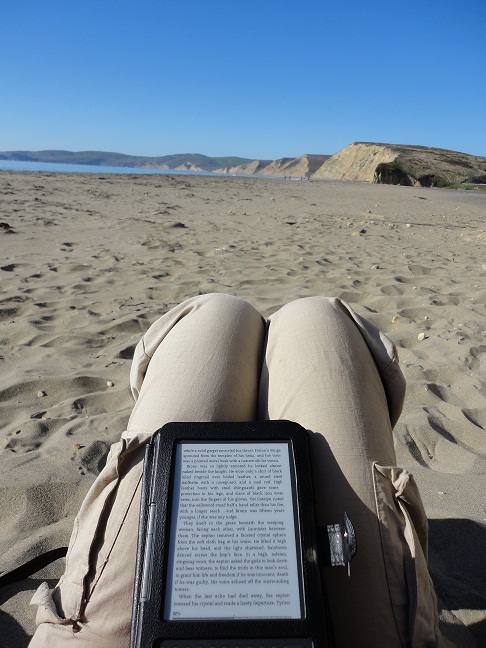
My wife decided she was done, and decided to spend the day reading A Game of Thrones on the beach and napping and taunting birds all day.

On the second day, we spent about seven hours excavating the first pinniped skeleton, which resulted in about 100 pounds of tin-foil jackets. This skeleton is probably of a large fur seal or small walrus, and the skeleton was completely disarticulated; as soon as we were close to removing one bone, another would be under it, or behind it. There were probably about two dozen or so bones in the cliff that we excavated. At about 4 in the afternoon, we wrapped up the first excavation, and walked down the beach to relocate the articulated skeleton. It took a while to relocate it, but as soon as we did, we started excavating it in a large block. Thanks to the specimen being articulated, we were able to finish this excavation in a little over an hour. Once we got back to the car, we loaded up nearly two hundred pounds of fossils we had collected in only two days in the field; furthermore, the most ridiculous aspect of the weekend was that by weight, cetacean fossils comprised less than 1% of our haul (only one specimen). For the uninitiated – pinniped fossils are relatively rare, and my master’s thesis sample of specimens indicates that there is a 4:1 ratio of cetacean fossils to pinnipeds, and that pinnipeds constitute only 8% of the marine vertebrate assemblage from the Purisima Formation at Santa Cruz. To collect a pair of associated dentaries, a tooth, a couple of associated hindlimb bones, and two skeletons (one being articulated) all in one weekend – is surprising, and tripled the number of major pinniped finds I’ve made. I’ll post some updates when some of this material gets prepared.

She nearly got this gull to come to her backpack. Sorry, no pictures of the pinniped excavation.

Tuesday, November 15, 2011

New mysticete excavation, part 2

On day two, we returned to continue the excavation process. We had mostly pedestaled the specimen on the first day, but we had not yet undercut the block. We thought we could get all of it out in one large jacket. Unfortunately, I knew this might be difficult because there were multiple fractures through the concretion - most concretions I've collected are very strong and have no cracks, but occasionally large ones are fractured, which could spell disaster during the jacketing process.

The skull on friday morning.

The tunnel I dug under the right side of the skull.

We got back to the locality on friday morning, and began to undercut the pedestal. Normally, a small jacket just requires a trench to be dug around the fossil, and then you undercut the bottom of the trench and dig under the fossil a bit - this allows a lip to be made on the bottom of the fossil with the plaster jacket, ensuring that the entire piece of rock (fossil included) leaves the excavation pit when you flip the jacket over. I've heard horror stories of jacket flipping where a stream of bone fragments pours out of the bottom of the jacket upon removal, and fortunately, this has never really happened to me. On larger specimens such as this, it is routine to dig a tunnel underneath part of it, to ensure that the jacket removes a cohesive block rather than half of it. So, I started doing this, digging from both sides, and after about an hour or so I had a cute tunnel underneath the skull where some strips of burlap could go when it came time to jacketing.

The fossil with dampened paper towel and after application of the jacket.

Late in the day on friday, we finally got to the jacketing process. In all honesty, I had not expected to get to start the jacket until saturday morning - we had scheduled a State Parks ranger to drive by on Sunday at 3pm for jacket pick up, so we knew we had until then. We finished up the plaster jacket right before dinner time.

The jacket right after flipping it.

On saturday morning, we quickly moved to undercut the rest of the jacket, "pop" it, and flip it over. This was particularly hairy, because there wasn't exactly any room to flip the jacket - usually you flip the jacket over, and have ample space to let it rotate along whatever surface you have available, which in paleontology fieldwork, is usually the ground. In our case, sure -we had opened up a large shelf we had dug out, but the fossil was already precariously positioned above a ten foot drop to the beach, more than enough distance for the fossil to break into many pieces if it were to fall. More importantly, if the jacket were to fall off the ledge, it would likely take one of us with it, which would really, really hurt. It would have really helped to have a third person, but we were barely able to lift and flip it between the two of us - we had to lift it and slowly rotate it nearly in place, move it to the side while lifting it, and while Des stayed there holding the jacket up from certain destruction, I ran up and down fetching pieces of wood to wedge it so it wouldn't fall off the ledge. During flipping, some of the fractures inside the concretion opened up, and we could feel the block 'flexing' a little bit. Fortunately, it all stayed together. Unfortunately, there were more bones going back into the cliff, which we will not be able to dig out. There was also a small part of the concretion and a possible bit of the skull left in the cliff, which we will have to return for.

The jacket after the bottom jacket was completed.

Wooden "backbone" for the sand ramp.

After flipping the jacket over, we were able to put on a plaster jacket over the bottom part of the block. Now that the jacket was completed, we had the problem of getting it down. The block appeared to weigh at least three hundred pounds, and was very heavy due to the concretion inside. There was no safe way to lift the skull down - the heaviest of a jacket that two people of my diminutive stature can manage is about 100 lbs (my friend Chris Pirrone and I once spent four hours moving a 100 lb jacket only 200 feet along a Santa Cruz cliff, while partially submerged at first, then up algae covered rocks, and along a 10 foot high, one foot wide ledge over the ocean, and up several eye-level ledges).

One thing I enjoy about paleontology fieldwork is thinking outside the box. I've had conversations with people who would have used some high-tech rope and pulley system which would have probably been a pain to put together and utilize. In my experience, when moving big (but manageable) pieces of rock, it's best to use methods developed by the masters of lugging around big rocks: the ancient Egyptians. Although it was up rather high, I thought "why not just build a big ramp?". To make it faster, we piled up a bunch of logs: sand usually moves to the angle of repose, and we needed something steeper (so we wouldn't end up with a cone of sand with a twenty foot wide imprint). The logs trapped the sand, and we were able to build a steeper ramp.

My wife with the beginning of the sand ramp, pretending it was her idea.

Des, myself, Ash Poust, and Liz Ferrer (clockwise, from upper left) start to
maneuver the block down the incline.

My wife (left, in red), Liz Ferrer (hiding in back), and Ash (white pants)
excavate a bit of the remaining concretion.

It only took us about a half hour to finish the ramp, and once we were done, we climbed up, and started to nudge the plaster jacket. Our friend Ash Poust, who was a friend of ours from MSU and now one of Kevin Padian's Ph.D. students at UC Berkeley, had brought along another one of Padian's students, Liz Ferrer, to help out. My wife sat out on this one, and took photos instead, while the rest of us muscled the jacket down. It worked like a charm, and I could not have been happier with my experiment in 'ancient methods'.

Stay tuned for the next installment!