Monday, December 10, 2012

US Research trip part 6: out and about in DC

As a US citizen it's pretty inspiring to walk around Washington DC and see all of these famous buildings and monuments in our nation's capitol. Unfortunately, while I did eat at this great diner across the street from Ford's Theater (where Lincoln was assassinated) I forgot to take some pictures. I also didn't get a chance to visit the house where The Exorcist was filmed, right in Georgetown. Either way, I saw plenty of other great stuff.


The white house! Being two weeks before the election, I was sincerely hoping that Obama would not have to move out soon.


Outside the White House. Maybe he was a Romney voter?


Looking down Pennsylvania Ave. towards the U.S. Capitol building.


The south lawn of the White House. Just to the left of this photo is Michelle's vegetable garden.


A look down Constitution Avenue from near the Washington Monument; the Department of Justice and IRS are based in these red-roofed buildings.


America! Flags next to the Washington Monument.


View west from the Washington Monument past the World War II monument and reflecting pool to the Lincoln Memorial.


Monument to Ulysses S. Grant, just west of the capitol building.


East side of the U.S. capitol building.


The national archives - they had an exhibit on the cuban missile crisis which I did not have time to visit. This is pretty close to the USNM, and I walked past this neat building every day to the metro station.


There was only one example of graffiti on the World War II memorial. This was a common graffiti cartoon that was done in Europe by GI's in random places. This example was intentionally engraved onto the WWII memorial.


The Lincoln Memorial - 8 hours before Hurricane Sandy made landfall.


The statue of Lincoln in the memorial.


The elegantly simple Vietnam memorial wall.

Saturday, December 8, 2012

Congratulations: Hutton Award, several Ph.D. student publications in OU paleontology

Several other members of the paleontology group here at the University of Otago have made some recent advances in their research and careers that I felt should be noted here.

First and foremost, last month my adviser Ewan Fordyce was awarded the Hutton Medal in Geology by the Royal Society of New Zealand. The award is given annually to researchers for outstanding work on animal, plant, and earth sciences. Ewan's long standing (~30 years) focus on the paleontology of sharks, penguins, and cetaceans of New Zealand was recognized by this award, and it was quite a surprise for him.


R. Ewan Fordyce (left) after awarding of the Hutton Medal; Alan Musgrove (right) appeared in this university photo for the 2012 Humanities Aronui Medal. From www.otago.ac.nz

I would also like to congratulate my labmates Gabriel Aguirre, Carol Loch, Felix Marx, and Cheng Hisu Tsai for getting manuscripts accepted for publication. Gabriel just got a paper from his dissertation on a new fossil dolphin accepted in the Journal of Vertebrate Paleontology; Carol has gotten several papers regarding cetacean teeth accepted over the past few months in various journals (e.g. Marine Mammal Science, Zoomorphology); Felix has gotten a paper on mysticete phylogeny accepted; and Tsai has gotten a paper on Pleistocene gray whales from Taiwan accepted in the Paleontological Journal. As for myself - I just got something accepted too, so there's some nice icing on the cake. 

Congratulations to Ewan on the award all my labmates on their accepted papers - I'll discuss some of these papers in detail once they're out.

Tuesday, December 4, 2012

US Research trip part 5: fossil pinniped bonanza at the USNM

One of my alternative goals for research at the USNM was to photograph as many fossil pinnipeds (seals, sea lions, and walruses) as I could. The USNM has an unparalleled collection of fossil pinnipeds - primarily due to the efforts of my hero Douglas Emlong. In fact, most of the fossil pinnipeds in this post were collected in the 1960's and 1970's by Emlong. Emlong's collection has been very important for understanding the early evolution of pinnipeds, and has been utilized in many publications of new species and genera, functional analyses, and phylogenetic analyses.


A partial skull referred to Pinnarctidion rayi by Annalisa Berta (1994). Pinnarctidion was a tiny pinniped - although this specimen is a bit larger than the type, which I've shown below. 


A cast of the holotype humerus of the walrus Valenictus imperialensis from the Pliocene Imperial Group of southern California. This species of Valenictus is known only from the humerus, but another species from the coeval San Diego Formation (Valenictus chulavistensis) is known from multiple partial skeletons and skulls, which show that it lacked all teeth aside from the canines.


A cast of the holotype skull of Homiphoca capensis from the Pliocene of Langebaanweg in South Africa. At the time of my visit I had not anticipated seeing casts of foreign specimens like this, as I did not know about them beforehand - but finding them was certainly a welcome surprise. I had not yet seen a cast of Homiphoca; Homiphoca is a fossil monachine seal that has something to do with the evolution of leopard, ross, crabeater, weddell, and elephant seals.


A skull from the Emlong collection from the latest Oligocene/earliest Miocene of Oregon, referred to Enaliarctos mitchelli by Annalisa Berta (1991). The species was previously reported by Larry Barnes (1979) from the earliest Miocene Jewett Sand at Pyramid Hill in Kern County, California, based on a rostrum (holotype) and a palate (paratype).


A skull of the early pinniped Pteronarctos goedertae, referred by Annalisa Berta (1994). Berta synonymized two species with P. goedertae - Pteronarctos piersoni, and Pacificotaria hadromma, all from the Astoria Formation near Newport, Oregon. Pteronarctos was a late surviving enaliarctine and would have probably looked like a small sea lion.


While not explicitly a pinniped and may seem a bit out of place in the theme of this post, the "beach bear" or "oyster bear" Kolponomos newportensis is another marine carnivore, also collected by Doug Emlong. This specimen was found near what is now the Wal-Mart in Newport, Oregon. I believe that Kolponomos has something to do with early pinniped evolution; as I've pointed out in an earlier post, if the otter-like early Miocene Puijila darwini has anything to do with pinnipeds, then so does Kolponomos, because all of the cranial features linking Puijila to pinnipeds are also present in Kolponomos.


The tiny holotype skull of Pinnarctidion rayi, described by Annalisa Berta (1994) from the early Miocene Nye Mudstone of Newport, Oregon. This specimen was collected near the Kolponomos specimen above. Pinnarctidion is another enaliarctine pinniped, which in some phylogenetic analyses has cropped up near or as the most basal member of the Phocoidea (desmatophocid seals and modern earless seals). Pinnarctidion was originally described from the early Miocene Jewett Sand of Pyramid Hill, along with Enaliarctos mitchelli and Enaliarctos mealsi.


The large and beautiful holotype skull of Proterozetes ulysses, from the early Pleistocene Port Orford Formation of Oregon - also collected by Doug Emlong. The genus Proterozetes may or may not be a junior synonym of Eumetopias, the steller's sea lion - and it was originally mentioned as a new species of Eumetopias in the 1970's.


My labmate Yoshi Tanaka with the beautiful skeleton of Enaliarctos mealsi - also from Pyramid Hill, and also collected by Emlong - described by Berta et al. (1989). This fossil appeared in two counterpart slabs of a concretion, which were glued together with a ton of epoxy, and prepared out from both right and left sides and mounted on this slab. Although Yoshi is currently studying archaic fossil dolphins from New Zealand for his Ph.D., he studied primitive walruses from Japan for his master's thesis with Naoki Kohno and also has a research interest in fossil pinnipeds.


Finally, another pinniped that was not collected by Emlong: a cast of a skeleton of Acrophoca longirostris from the latest Miocene/earliest Pliocene Pisco Formation of Peru. A mount of the whole skeleton is shown right above the in-situ display; I'll include photographs of the mounted skeleton in a subsequent post.


An adorably sized partial left maxilla of the Pliocene walrus Ontocetus emmonsi (formerly Alachtherium) from the Yorktown Formation in North Carolina (Lee Creek Mine), described by Kohno and Ray (2008). This specimen shows that even derived walruses possessed enamel caps on their teeth, just at a very young age - in contrast to previous studies that have indicated the loss of enamel in odobenine walruses such as Odobenus, Valenictus, Ontocetus, and Protodobenus.


Another view of the referred skeleton of Enaliarctos mealsi.

Further Reading:

L. G. Barnes. 1979. Fossil enaliarctine pinnpeds (Mammalia: Otariidae) from Pyramid Hill, Kern County, California). Contributions in Science of the Natural History Museum of Los Angeles County 318:1-41

L. G. Barnes, C. E. Ray, and I. Koretsky. 2006. A new Pliocene sea lion, Proterozetes ulysses (Mammalia: Otariidae) from Oregon, U.S.A. Mesozoic and Cenozoic Vertebrates and Paleoenvironments 57-77

Berta, A. 1991. New Enaliarctos* (Pinnipedimorpha) from the Oligocene and Miocene of Oregon and the role of ‘enaliarctids’ in pinniped phylogeny. Smithsonian Contributions to Paleobiology 69:1–33.

A. Berta. 1994. A new species of phocoid pinniped Pinnarctidion from the early Miocene of Oregon. Journal of Vertebrate Paleontology 14:405-413

Berta, A., and Ray, C. E. 1990. Skeletal morphology and locomotor capabilities of the archaic pinniped Enaliarctos mealsi. Journal of Vertebrate Paleontology 10:141–157.

Berta, A., C.E. Ray and A.R. Wyss. 1989. Skeleton of the oldest known pinniped, Enaliarctos mealsi. Science 244:60-62.

Kohno, N. 2006. A new Miocene odobenid (Mammalia: Carnivora) from Hokkaido, Japan, and its implications for odobenid phylogeny.  Journal of Vertebrate Paleontology 26:411–421.

N. Kohno and C. E. Ray. 2008. Pliocene walruses from the Yorktown Formation of Virginia and North Carolina, and a systematic revision of the North Atlantic Pliocene walruses. Virginia Museum of Natural History Special Publication 14:39-80

E. D. Mitchell. 1961. A new walrus from the imperial Pliocene of Southern California: with notes on odobenid and otariid humeri. Los Angeles County Museum Contributions in Science 44:1-28

R. H. Tedford, L. G. Barnes, and C. E. Ray. 1994. The early Miocene littoral ursoid carnivoran Kolponomos: Systematics and mode of life. Proceedings of the San Diego Society of Natural History 29:11-32

Monday, December 3, 2012

Rapid seafloor decomposition of pig carcass (video)

As a vertebrate paleontologist, it's necessary to have a strong understanding of the manner in which modern animals decompose, as it can inform us of formative processes in the preservation of fossils. Fossils, after all, are all parts of dead organisms - and understanding the taphonomy - or "laws of burial" of modern and fossil organisms can guide us in interpreting the paleoecology of fossil species.

Here's a video that's been making its rounds on the science blogs from the deep sea experimental station VENUS, based at the University of Victoria in British Columbia. Several forensic experiments have been conducted with the station, which is effectively a seafloor, remotely operated laboratory connected to the internet. The pigs were dropped off in the area, and an ROV docked at the seafloor station went out and brought the carcasses to the station.

Here's a fantastic video of a pig carcass being consumed by isopod and decapod crustaceans at roughly 90 meters water depth:


What exactly does this sort of data tell paleontologists? For starters, if you count the days, you'll see that a medium-sized vertebrate carcass (although small with regards to cetaceans) can be consumed and skeletonized in about a week. This could suggest that once a carcass reaches the seafloor, there may be little opportunity for the carcass to refloat, for example. In other experiments at the same site conducted during a period of lower dissolved oxygen, skeletonization took place only after 40+ days at the seafloor. So, there is quite a bit of variability, depending upon a number of factors.

For the taphonomically inclined, much of the observations from the VENUS forensic experiments have already been published by Gail Anderson:

Anderson, G.S. 2009. Decomposition and Invertebrate Colonization of Cadavers in Coastal Marine Environments. In J. Armendt et al. (eds), Current Concepts in Forensic Entomology, p. 223-272.

Sunday, December 2, 2012

US Research trip part 4: National Air and Space Museum

And now for something completely different: planes and rockets! No trip to DC is complete without a visit to the Smithsonian Air and Space Museum, especially for those interested or fascinated by aviation history. Ever since watching "The Right Stuff" and Apollo 13 as a young boy, I've been fascinated by experimental aviation and space exploration.


The single most stunning piece in the museum: the Bell X-1, aka "Glamorous Glennis", flown by Chuck Yeager in 1947, and the first flight to really break the sound barrier. There are some other possible cases of the sound barrier being broken during World War 2 by German and British pilots during dives, but none of these included sustained flight over Mach 1.


The Spirit of St. Louis, flown by Charles Lindbergh for his 1927 non-stop transatlantic flight from New York to Paris. In order to have improved center of gravity, the fuel tanks were placed in front of the cockpit - which also meant that no forward facing winshield could be used; Lindbergh navigated primarily from instruments, and a forward facing periscope was also installed.


The Apollo 11 command module capsule! They have it totally sealed off in plexiglass to keep heathens from touching it.

One of my favorite aircraft: the X-15, the grandson of the X-1. Both aircraft were carried while slung under the wing of a modified bomber like a giant bomb (B-29 mothership for the X-1, B-52 for the X-15), to be dropped off at high altitude; this was to conserve fuel which would normally be spent during takeoff. The X-15 not only set speed records at flying nearly 7 times the speed of sound, but also set altitude records, flying up to 100 km and past the Karman Line (i.e., officially into space). The shuttle program used a lot of the information generated by the X-15 later on during the 1970's.


A mockup of the Apollo-Soyuz test project in 1975, which ceremoniously 
marked the end of the space race.


A German V-1 'flying bomb' or 'buzz bomb', powered by a pulse jet engine; nearly 10,000 V-1s were fired from occuppied Europe at southeast England in 1944 and 1945.


The big brother of the V-1, the V-2 rocket, a short range liquid-propellant ballistic missile developed in Germany during the second world war. I've seen two of these: this rocket, and one at the British Military Museum in London.


Easily the sexiest aircraft in the museum: the Hughes H-1 racer, which Hughes flew himself and set world speed records in. The film "The Aviator" shows Hughes flying the H-1 during a flight in which he ran out of fuel and crash-landed; it was intended as a prototype and proof-of concept for next generation fighter planes, and Hughes later indicated he felt such military aircraft as the Japanese 'Zero' were ripped off from his plane. One of the innovations for this aircraft were flush rivets.

Tuesday, November 27, 2012

Introducing Miocaperea, a fossil pygmy right whale from Peru

I've interrupted my series of picture posts from the US trip in order to discuss a new paper that just came out this week on a new and exciting fossil mysticete from Peru. Previously organized programming will return shortly.

One of the strangest aspects of the fossil record of baleen whales is the apparent lack of fossil neobalaenids, or pygmy right whales. There is no shortage of fossil right whales (Balaenidae - e.g. Balaena ricei, Balaenula spp., Balaenella, Eubalaena shinshuensis), rorquals ("Megaptera" miocaena, Diunatans, Parabalaenoptera, Archaebalaenoptera, etc.), gray whales (Archaeschrichtius, Eschrichtioides, Gricetoides), and all manner of extinct groups (Cetotheriidae, Aetiocetidae, Mammalodontidae, Eomysticetidae, stem-balaenopteroids). Up until 2012, the only described pygmy right whale fossil is a single partial petrosal (earbone) from the latest Miocene of Beaumaris, Australia, recently published by my colleague Erich Fitzgerald. Those of us who are "in the know" are aware of a few tantalizing bits and pieces from here and there - including some Miocene material from Angola recently reported by SMU Ph.D. student John Graf (and colleagues) at the 2011 SVP meeting.


The late Miocene earbone of an indeterminate neobalaenid recently described by Fitzgerald (2012) from Australia.

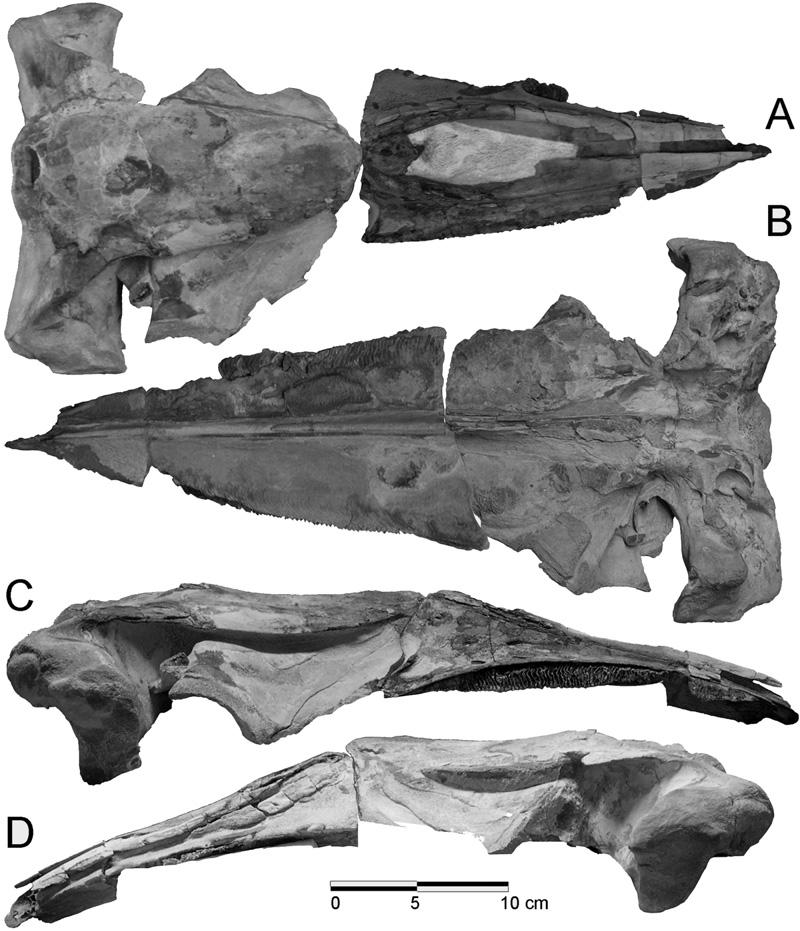
This new fossil from the late Miocene Pisco Formation of Peru is beautifully preserved, and includes a nearly complete skull with baleen preserved in situ. Baleen! The baleen racks have been left in place in "articulation" with the palate, and prepared out in three dimensions. The skull is tiny - approximately one meter in length, and 50 centimeters wide (roughly the size of a killer whale skull) - although somewhat wider, it is about the same length as tiny, dainty whales like Herpetocetus. It's age and similarity to Caperea, inspired the genus name Miocaperea, and pulchra ("beautiful" in latin) for the beautiful preservation of the specimen.


The holotype skull of Miocaperea pulchra from the late Miocene of Peru (from Bisconti 2012). 

It shares numerous hallmark features with modern Caperea, such as a short and attenuated rostrum that is somewhat arched, an extremely thrusted supraoccipital shield that is transversely arched, a bizarrely constructed squamosal which seems to lack a zygomatic process, and a huge posterior process of the petrosal that is inflated and broadly exposed on the lateral side of the skull.


 The earbone region of Miocaperea (from Bisconti 2012). 


It includes a number of differences from modern Caperea, however, such as a substantially more primitive (or should I say, less bizarre) earbone, lack of exposure of the alisphenoid bone on the braincase, and a foramen pseudovale that is located between the squamosal and pterygoid, rather than completely within the pterygoid (a unique feature of Caperea). Caperea also has a really unique postcranial skeleton, recently detailed by Buccholz (2010). Unfortunately, Miocaperea is not known from any postcranial elements.


 Side by side comparison of the skulls of Caperea (left) and Miocaperea (right), from Bisconti (2012). 

The fossil was collected in 1985 by Swiss private collector Jakob Siber from the Aguado de Lomas locality of the Pisco Formation in Peru, and later donated to the Staatliches Museum für Naturkunde in Stuttgart, Germany, along with the skeleton of Balaenoptera siberi described by Giorgio Pilleri and Siber several years later. Bisconti (2012:877) gives an interesting discussion of the legal status of the specimen:

"The new specimen is the holotype of Miocaperea pulchra gen. et sp. nov., found from the upper Miocene Pisco Formation at Aguada de Loma, Peru (Fig. 1), and is now permanently housed in the Staatliches Museum für Naturkunde, Stuttgart, Germany, as specimen no. 46978 of the palaeontological collection. The specimen was excavated by Jakob Siber in 1985, and was legally exported by the Siber+Siber Aathal/Zürich company (E.P.J. Heizmann, pers. comm.). Mr Siber confirmed the legal status of the specimen before the Society of Friends of the Natural History Museum Stuttgart bought it (E.P.J. Heizmann, pers. comm.). The legal documentation can be provided by Siber+Siber Aathal/Zürich. The specimen came to the Stuttgart collection as a present from the Society of Friends of the State Museum of Natural History (SMNS), together with further Peruvian material (e.g. the skeleton of Balaenoptera siberi Pilleri, 1989, which is exhibited in the Schloss Rosenstein building of the SMNS)."

I'll confess that I am wholly ignorant of Peruvian fossil/artifact exportation laws, but this section did pique my curiosity. I can't comment on anything specific about this specimen, but there must have been some question from someone to include this statement in the paper in the first place - If fossil exportation is illegal from Peru, then clearly private fossil dealers have not heeded it at all, given the sheer abundance of Peruvian Pisco Fm. fossils for sale on the internet. Another example of a beautiful South American fossil collected by private fossil collectors and later donated (although under what circumstances I'm unclear) to a museum is the type specimen of Pelagornis chilensis described by Mayr and Rubilar Rogers (2010) from Bahia Inglesa, Chile. The above listed website maintains that its Peruvian fossils were acquired years ago, and also indicates that Peru currently considers fossil export to be illegal. China and Mongolia have as well, but it's clear that commercial fossil dealers don't really care either.

Edit: I received a nice email from Dave Bohaska, who informed me that when he started working at the USNM in 1989 fossil export from Peru was still legal - but that sometime after he started, it was outlawed. It indeed appears that the type of Miocaperea was legally collected, as outlined by Bisconti (2012).


Three-dimensionally preserved baleen in Miocaperea (from Bisconti 2012). 

So, what exactly does this tell us about the evolution of the pygmy right whale? Given how derived the fossil is, and how similar it is to Caperea (aside from some minor earbone characters, I'm hard pressed to point at any one character of the skull that would really preclude it from being included even within Caperea itself, but I'm a bit conservative, taxonomically speaking) - it doesn't really give us too much information regarding morphological transformations that culminated in the bizarre morphology of Caperea. It's a fairly advanced cetacean, although it is from the Aguado de Lomas locality, and therefore about 7-8 million years old or so. In the eastern North Pacific, for example, we have species of baleen whales that are beginning to show features that are about as advanced as modern balaenopterids and balaenids, but have different configurations of skull features - indicating they do not belong to modern genera or species, but are essentially modern in terms of architecture (as opposed to the clearly primitive skulls of "kelloggitheres" during earlier parts of the Miocene).


 Comparison of the skulls of Balaenoptera (left), Caperea (middle), and Balaena (right), from Churchill et al. (2012).

Bisconti also spent a fair amount of the paper discussing previously published phylogenies with varying positions of Caperea among the mysticetes. Most studies have agreed upon Caperea having a sister taxon relationship with right whales - forming a clade called the Balaenoidea. Examples include Demere et al. (2005), Churchill et al. (2012), and Ekdale et al. (2011). One of my labmates - Felix Marx - published a paper in the Journal of Mammalian Evolution regarding the phylogeny of modern and fossil mysticetes, in which he included a large number of species. Instead of the typical Balaenoidea, his analysis resulted in a novel position of Caperea as the sister taxon of the rorqual-gray whale clade - separated from balaenids by all "Kelloggitheres" and the Cetotheriidae. This topic came up at the Aquatic Tetrapods (SATLW) conference last year in San Diego, and there was an interesting dialogue between Felix, Nick Pyenson, and some of the San Diego researchers. In these analyses, the way characters are defined and coded is of the utmost importance, and the different phylogenetic position of Caperea in Marx (2010) and other studies is probably due to differences in character selection, definition, and coding. I won't go into the specifics, as the minutiae of phylogenetics and cladistics are perhaps a tad too dull for the general audience. Nevertheless, the phylogenetic analyses of Churchill et al. (2012) and Ekdale et al. (2011) both responded to the novel relationship which Marx (2010) published.


Different phylogenetic hypotheses for neobalaenid and balaenid relationships 
(from Churchill et al., 2012).

What implications does this have for understanding the fossil record of cetaceans? Although the fossil baleen whale assemblage of the Pisco Formation is very poorly known, and thus far represented only by a few described species (Piscobalaena nana, Piscocetus sacaco, Balaenoptera siberi, and now Miocaperea pulchra), it is one of the largest marine mammal fossil assemblages yet amassed by researchers. The large assemblage already includes numerous pinnipeds (Acrophoca, Piscophoca, Hydrarctos), a slew of dolphins (Brachydelphis, Lomacetus, Australithax, Piscolithax, Belonodelphis, Scaphokogia, Acrophyseter, Livyatan, Messapicetus gregarius, Nazcacetus, Ninoziphius, Atocetus, Odobenocetops, Hemisyntrachelus, Pliopontos, Incacetus), and aquatic sloths (Thalassocnus). There are abundant balaenopterids known from the Pisco Formation that await description (several undescribed taxa were used in the phylogenetic analysis of another recent paper by Bisconti, and also occur in the supplementary info for the Lambert et al. 2010 paper on Livyatan). Given what we know of the current fossil record of baleen whales from Peru - published and unpublished - most are balaenopterids, and the cetotheriid Piscobalaena, and there aren't multiple skeletons of this little neobalaenid. One could certainly make the case that fossils of neobalaenids are rare (N=2 published specimens, worldwide). Both specimens are from the southern hemisphere; likewise, no neobalaenid fossils are yet known from the northern hemisphere, including well-sampled rocks from California, Italy, Japan, and the eastern USA. Assuming this point to be generally accurate, I'll make the case that even in large and "well known" fossil assemblages like the Pisco, there will always be little 'surprises' like this waiting for us. Another example of this is Livyatan - although in that case, there were previous discoveries of mysterious gigantic physeteroid teeth, and the embarrassingly large rostrum named Ontocetus oxymycterus by Kellogg (1925) - another topic for a blog post... some day. Comparable examples of weird, rare taxa in fossil assemblages from California would include the "killer" walrus Pelagiarctos from Sharktooth Hill, and the Pelagornis fossil I described with N. Adam Smith from the Purisima Formation. Discoveries like this serve to remind us that no matter how well-sampled and heavily collected a productive locality is, there is always going to be something surprising waiting for us.

References-

Bisconti, M. 2012. Comparative osteology and phylogenetic relationships of Miocaperea pulchra, the first fossil pygmy right whale genus and species (Cetacea, Mysticeti, Neobalaenidae). Zoological Journal of the Linnean Society 166: 876-911.

Buchholtz, E. 2010. Vertebral and rib anatomy in Caperea marginata: Implications for evolutionary patterning of the mammalian vertebral column. Marine Mammal Science 27: 382-397.


Churchill, M., Berta, A., Deméré, T.A. 2012. The systematics of right whales (Mysticeti: Balaenidae). Marine Mammal Science 28: 497-521.

Deméré, T. A., Berta, A., and McGowen, M. R. 2005. The taxonomic and evolutionary history of modern balaenopteroid mysticetes. Journal of Mammalian Evolution 12: 99-143.

Ekdale, E. G., Berta, A., and Deméré, T. A. 2011. The comparative osteology of the petrotympanic complex (ear region) of extant baleen whales (Cetacea: Mysticeti). PLoS ONE 6:1-42.


Fitzgerald, E.M.G. 2012. Possible neobalaenid from the Miocene of Australia implies a long evolutionary history for the pygmy right whale Caperea marginata (Cetacea, Mysticeti). Journal of Vertebrate Paleontology 32:976-980.

Graf, J., Jacobs, L., Polcyn, M., Mateus, O., Schulp, A. 2011. New fossil whales from Angola. Society of Vertebrate Paleontology 2011 meeting abstracts: 119A.

Marx, F. G. 2011. The more the merrier? A large cladistic analysis of mysticetes, and comments on the transition from teeth to baleen. Journal of Mammalian Evolution 18:77-100.

Thursday, November 22, 2012

US Research trip part 3 and 1/2 - fossil & modern mysticetes

Given my dissertation topic - fossil eomysticetids - I planned this trip so that I'd be able to see a lot of fossil mysticetes. Cenozoic marine sediments of the Atlantic coastal plain are densely fossiliferous, with several important 'classic' fossil localities: Bone Valley, Florida (late Miocene to Pliocene), Charleston, South Carolina (late Oligocene and Pliocene; Ashley, Chandler Bridge, Goose Creek Formations), Calvert Cliffs (early Miocene to late Miocene; Calvert, Choptank, St. Marys, Eastover Formations), Lee Creek/PCS Phosphate Mine, Aurora, North Carolina (middle Miocene, Pliocene; Pungo River Limestone, Yorktown Formation). With the exception of the South Carolina and Florida localities, all other strata are parts of the "Chesapeake Group" (for the uninitiated, an assemblage of formations that typically co-occur across a basin can be categorized into a group; groups can even be categorized into supergroups - such as the Proterozoic age Belt Supergroup of Montana.
In the early and mid 20th century, the preeminent paleocetologist Remington Kellogg described a large number of "cetotheres" from the Calvert and Choptank Formations of Maryland, including Aglaocetus patulus, Diorocetus hiatus, Halicetus ignotus, Parietobalaena palmeri, Pelocetus calvertensis, and Thinocetus arthritus. All of these specimens are at the USNM offsite facility at Suitland, Maryland - and I got to see most of them. Most of these are well preserved and morphologically informative - although some have been extensively reconstructed. For example, I examined the holotype of Diorocetus hiatus - and I was hard pressed to find any foramina or cranial sutures that appeared to be real. Much of the braincase was plaster or some other material that had painted the same color as the bone - there is a slight difference in color, but the telltale sign are the paintbrush striations, which contrast strongly with the natural bone texture. The holotype specimen has complete squamosals, a good vertex, and so on, but the rest of the braincase consists of non-overlapping fragments separated by wide expanses of sculpted and painted plaster. Because of issues like this, I don't feel terribly comfortable interpreting much about certain aspects of the anatomy of Diorocetus - which makes coding the taxon for phylogenetic analyses a big issue.


One of the few cetotheres named by none other than Edward Drinker Cope - Metopocetus durinasus, from either the Calvert Formation or the St. Mary's Formation (nobody really knows). Metopocetus has been considered to be a close relative of my favorite whale, Herpetocetus. Metopocetus was redescribed and reanalyzed by Kellogg in the 1960's, and more recently by Frank Whitmore and Larry Barnes.


Examination of modern mysticete skeletons is imperative for studying those of fossil mysticetes. It's even better when you can occasionally find modern crania sawn in half, to help make aspects of the internal osteology  more apparent. This is a sagittally sectioned skull of the minke whale, Balaenoptera acutorostrata.


 The heavily reconstructed skull of Diorocetus hiatus, named by Kellogg. The lighter brown areas are sculpted and painted; however, sculpted areas of the braincase are less obvious than the large patches on the rostrum.


Not exactly a mysticete - the petrosal (earbone) of the basilosaurid archaeocete Zygorhiza kochii from the Eocene of the southeastern US. Basilosaurids are important as they are typically used as outgroup comparisons for phylogenetic analyses of mysticetes; I've spent the last 7-8 months familiarizing myself with basilosaurid cranial anatomy, as I will include several in my Ph.D. analyses (Basilosaurus spp., Dorudon, Zygorhiza). This one in particular was ground away by Gerald Fleischer for his study of the evolution of the cetacean cochlea and hearing. We have a cast of this specimen here at Otago, but it was nice to see the original specimen.


The petrosal of the large Miocene balaenopterid, "Megaptera" miocaena; this same earbone morphotype (i.e. not necessarily the same species, but the same genus at least - although it needs a new genus, as it clearly doesn't belong in Megaptera) is also present in a number of other late Miocene and Pliocene rock units in California, including the Purisima Formation and Santa Margarita Sandstone (Santa Cruz County), San Mateo and San Diego Formations (San Diego County). I didn't look at the skull, but I saw the size of the storage jacket- I was not aware how enormous the skull is; it's basically nearly the size of a modern humpback whale.


The petrosal of Thinocetus arthritus, one of Kellogg's cetotheres or as some of us affectionately call them, "Kelloggitheres".


Even more earbones! A small part of the USNM's large collection of Balaenoptera physalus (Fin Whale) tympanic bullae. Samples like this help paleontologists interpret ranges of variation in modern cetaceans so that we may better interpret samples of fossil earbones.
 

 When available, fetal skulls are very useful for paleontologists. Little is known about ontogenetic skull changes in modern or fossil mysticetes - it's not that we don't have the data, it's just that few researchers have ever bothered studying it. However, ontogenetic information from modern mysticetes (and most modern taxa, for that matter) can inform us not only about the ontogeny of fossil mysticetes, but also lend critical data regarding possible growth changes related to paedomorphism/neoteny, as well as giving us an "ontogenetic polarity" for different features, a la "ontogeny recapitulates phylogeny" of Haeckel.


 One of the most important cetaceans within USNM collections - the holotype and only known specimen of Aetiocetus cotylalveus from the late Oligocene Yaquina Formation of Oregon (Yaquina, for those marine mammal paleontologists not in the know - is pronounced by local Oregonians as Ya-kwinna, not Yah-keena; I only found out after a trip to Oregon with Ray Troll and Kirk Johnson). Although originally described as an archaeocete in 1966, it was shortly thereafter correctly interpreted as an early toothed mysticete by Leigh Van Valen, who interpreted it as a morphological intermediate between basilosaurid archaeocetes and later toothless mysticetes. This was also the only fossil that my hero Douglas Emlong published upon, which he published and named at the age of 24 (and prior to that, had it collected and prepared).

Lastly, the ribs of Aetiocetus cotylalveus. One of these ribs was examined by Beatty and Dooley (2009) and found to be osteosclerotic (meaning thick cortical bone and reduced medullarity cavity) - unlike modern mysticetes which have osteoporotic ribs, but also unlike basilosaurid archaeocetes, which had osteosclerotic and pachyostotic ("inflated" bones, or outward growth/hypertrophy of cortical bone) ribs.

Next up: photos from the Smithsonian Air and Space Museum.