Sunday, November 20, 2011

New mysticete excavation, part 3

Hey Folks,

I already told the whole story of the excavation in the last two posts. However, if you'd like to see a recap of the whole dig, check out the animation I made below:


Enjoy!

Tuesday, November 15, 2011

New mysticete excavation, part 2

On day two, we returned to continue the excavation process. We had mostly pedestaled the specimen on the first day, but we had not yet undercut the block. We thought we could get all of it out in one large jacket. Unfortunately, I knew this might be difficult because there were multiple fractures through the concretion - most concretions I've collected are very strong and have no cracks, but occasionally large ones are fractured, which could spell disaster during the jacketing process.

The skull on friday morning.

The tunnel I dug under the right side of the skull.

We got back to the locality on friday morning, and began to undercut the pedestal. Normally, a small jacket just requires a trench to be dug around the fossil, and then you undercut the bottom of the trench and dig under the fossil a bit - this allows a lip to be made on the bottom of the fossil with the plaster jacket, ensuring that the entire piece of rock (fossil included) leaves the excavation pit when you flip the jacket over. I've heard horror stories of jacket flipping where a stream of bone fragments pours out of the bottom of the jacket upon removal, and fortunately, this has never really happened to me. On larger specimens such as this, it is routine to dig a tunnel underneath part of it, to ensure that the jacket removes a cohesive block rather than half of it. So, I started doing this, digging from both sides, and after about an hour or so I had a cute tunnel underneath the skull where some strips of burlap could go when it came time to jacketing.

The fossil with dampened paper towel and after application of the jacket.

Late in the day on friday, we finally got to the jacketing process. In all honesty, I had not expected to get to start the jacket until saturday morning - we had scheduled a State Parks ranger to drive by on Sunday at 3pm for jacket pick up, so we knew we had until then. We finished up the plaster jacket right before dinner time.

The jacket right after flipping it.

On saturday morning, we quickly moved to undercut the rest of the jacket, "pop" it, and flip it over. This was particularly hairy, because there wasn't exactly any room to flip the jacket - usually you flip the jacket over, and have ample space to let it rotate along whatever surface you have available, which in paleontology fieldwork, is usually the ground. In our case, sure -we had opened up a large shelf we had dug out, but the fossil was already precariously positioned above a ten foot drop to the beach, more than enough distance for the fossil to break into many pieces if it were to fall. More importantly, if the jacket were to fall off the ledge, it would likely take one of us with it, which would really, really hurt. It would have really helped to have a third person, but we were barely able to lift and flip it between the two of us - we had to lift it and slowly rotate it nearly in place, move it to the side while lifting it, and while Des stayed there holding the jacket up from certain destruction, I ran up and down fetching pieces of wood to wedge it so it wouldn't fall off the ledge. During flipping, some of the fractures inside the concretion opened up, and we could feel the block 'flexing' a little bit. Fortunately, it all stayed together. Unfortunately, there were more bones going back into the cliff, which we will not be able to dig out. There was also a small part of the concretion and a possible bit of the skull left in the cliff, which we will have to return for.

The jacket after the bottom jacket was completed.

Wooden "backbone" for the sand ramp.

After flipping the jacket over, we were able to put on a plaster jacket over the bottom part of the block. Now that the jacket was completed, we had the problem of getting it down. The block appeared to weigh at least three hundred pounds, and was very heavy due to the concretion inside. There was no safe way to lift the skull down - the heaviest of a jacket that two people of my diminutive stature can manage is about 100 lbs (my friend Chris Pirrone and I once spent four hours moving a 100 lb jacket only 200 feet along a Santa Cruz cliff, while partially submerged at first, then up algae covered rocks, and along a 10 foot high, one foot wide ledge over the ocean, and up several eye-level ledges).

One thing I enjoy about paleontology fieldwork is thinking outside the box. I've had conversations with people who would have used some high-tech rope and pulley system which would have probably been a pain to put together and utilize. In my experience, when moving big (but manageable) pieces of rock, it's best to use methods developed by the masters of lugging around big rocks: the ancient Egyptians. Although it was up rather high, I thought "why not just build a big ramp?". To make it faster, we piled up a bunch of logs: sand usually moves to the angle of repose, and we needed something steeper (so we wouldn't end up with a cone of sand with a twenty foot wide imprint). The logs trapped the sand, and we were able to build a steeper ramp.

My wife with the beginning of the sand ramp, pretending it was her idea.

Des, myself, Ash Poust, and Liz Ferrer (clockwise, from upper left) start to
maneuver the block down the incline.

My wife (left, in red), Liz Ferrer (hiding in back), and Ash (white pants)
excavate a bit of the remaining concretion.

It only took us about a half hour to finish the ramp, and once we were done, we climbed up, and started to nudge the plaster jacket. Our friend Ash Poust, who was a friend of ours from MSU and now one of Kevin Padian's Ph.D. students at UC Berkeley, had brought along another one of Padian's students, Liz Ferrer, to help out. My wife sat out on this one, and took photos instead, while the rest of us muscled the jacket down. It worked like a charm, and I could not have been happier with my experiment in 'ancient methods'.

Stay tuned for the next installment!

Wednesday, October 12, 2011

New mysticete excavation, part 1

Note: I feel like I've been doing this a lot recently, but sorry for the long lapse in posts. I just got back from SVP a week ago, and I've been sick during most of the intervening time. Before SVP, I was working like a fiend trying to get work done for a couple of presentations at SVP, and doing even more fieldwork in Marin County. I'll get some more blog work done now that things have calmed down.

Last August I had the fortune of excavating a Pliocene mysticete skull from one of my fossil localities in the Purisima Formation. I actually discovered this skull back in 2005, but had already found another that I preferred to excavate instead. I went ahead and excavated that other specimen instead, and left this one here. There were several reasons why I left this one alone. First, the other specimen was much closer to where we could park, whereas it was a mile walk to the skull featured below. Secondly, I only had the funds (and space in my small car) for one large plaster jacket, so this one had to wait.
The skull as it appeared prior to excavation, and in a basically identical
state at the time of discovery in 2005.


My permit for the locality was good for another year, so why didn't I collect it in 2006? Well, I was still preparing the 2005 whale (which I would be preparing for another four more years), and there wasn't lab space available for it. So my 2006 permit expired, and I didn't get another one until last fall. To be honest, I hadn't intended on collecting it this year either because I had no funding, no crew, and no vehicle to remove it with. One day a well known "personality" posted a question about fossil whales in concretions on the shores of some of the Channel Islands, and he was legitimately surprised by how many whales there are out there languishing, despite the number of able bodied vertebrate paleontologists in southern CA. I went on a bit of a rant and explained that it's the rule rather than the exception with regards to California fossil whales: there are uncollected bones and concretions littering Northern and Central California beaches, just asking to be put into a museum. I didn't think much of my email, until I got an email from Dr. Desmond Maxwell at University of the Pacific in Stockton, who explained that he had grown tired of taking his field crews all the way to Utah and Montana, and wanted some local prospects, and that he had plenty of funding, volunteers, and lab space for large marine mammal fossils. I gladly took him up on his offer, and this whale excavation was the "maiden voyage" of our field/lab collaboration.

The fossil, with estwing superpick for scale.

We arrived on the Thursday of the last week of August, with the intention of spending four days on the excavation. I met Des early in the morning at his hotel, and we drove out to the coast. The first day felt like two, both in terms of how much rock we went through and how long it was. The skull was in a concretion about ten feet up off the sand, and fortunately, had not been eroded at all since I found it in 2005 - at this locality, erosion is particularly slow, and the cliff erodes inch by inch, instead of being cut at the base and having blocks fall down, like at Capitola. Fossils that are over ten feet above the base of the cliff erode very slowly - a large baleen whale vertebra at another locality had the tip of its neural arch exposed in summer 2004, and as of October 2011, one half of the ventral side of the centrum is left (body of the vertebra).

Footholds cut into place for the excavation.

The first order of business was to cut footholds and ledges for us to stand on. Unlike the 2005 baleen whale excavation, the sandstone was very soft and friable; its height above the base of the cliff meant it spends more time out of the year being weathered and not waterlogged by high tides one half of the year. This made the excavation on the first day go remarkably fast.

Initial excavation of the skull, and cleaning of the exposed surfaces.

There were also several plants growing in the concretion, which we quickly plucked and removed. Fortunately, the roots did not penetrate the bone and destroy it, which has happened in some cases. After some early cleaning, it was apparent that the concretion was very thin over some parts of the skull, which would make life considerably easier than the previously excavated whale from this locality.

Des excavating the mysticete skull.

What exactly was it? It's convenient to just throw around the term 'whale' because it's huge, and you're not really quite sure. Well, initially I identified it as a right whale (balaenid), because I thought that the skull shape was consistent with that - wide braincase with a supraoccipital shield that did not extend very far forward. A few weeks later, I looked at more pictures of right whales, and I'm no longer too convinced my ID was accurate by any stretch of the imagination. Right whales have 'backswept' squamosals, and whatever this thing is, it's squamosals (it is sadly missing the lateral extremities of them) are relatively close to the vertex (top of the skull). More likely, it is a primitive balaenopterid with a short supraoccipital shield: the squamosals of balaenopterids are closer to the vertex than in balaenids, and are oriented laterally (not posterolaterally). Another possibility is that it could belong to a balaenopterid-like gray whale, which is known from the Pliocene San Diego Formation.


The skull after the first day of work. Not much appears obvious, but I'll talk more about it in the next installment.

Sunday, October 9, 2011

Update: The coastal paleontologist gets married, and goes down under?

The last couple of weeks have been pretty great, and due to being so busy in relation to recent events, I've been a little slow on posting new material on here. First and foremost, I got married to my longtime girlfriend/fiancee Sarah Michalies on September 17 up at beautiful Lake Tahoe, California. The wedding was fantastic, and a lot of fun - and there were many paleontology students from around North America in attendance. Sarah and I have been together since spring 2005, and it was about time to tie the knot. Sarah and I met as undergraduates in the paleontology program at Montana State University, and have gone on all sorts of paleo field trips together.

This is not our boat, we just borrowed it for cool pictures.

The second awesome thing that happened - I was recently (i.e. on Thursday) accepted into the Doctoral program at the University of Otago in New Zealand. I applied back in late July, and the plan is to start in January. I have the fantastic opportunity to work with Dr. R. Ewan Fordyce, who has offered me a chance to study eomysticetid fossils from the south island of New Zealand. Eomysticetids are a thus far poorly known group of early baleen whales, and constitute the earliest known and earliest diverging toothless baleen whales. So far, the only eomysticetids that have been described include Eomysticetus whitmorei and Eomysticetus carolinensis from the Oligocene of South Carolina, described by Larry Barnes and Al Sanders in 2002 in the Clayton Ray memorial volume. However, in that same volume, Barnes and Sanders name another new family of early diverging mysticetes they term the Micromysticetidae; they remove Cetotheriopsis tobieni from said genus and place it in the new genus Micromysticetus, to which they also name a new species from South Carolina, Cetotheriopsis rothauseni. This family also includes the taxon Cetotheriopsis lintianus. Anyway, Micromysticetus has almost always occurred as a sister taxon to Eomysticetus wherever included in phylogenetic analyses, and I would not be surprised if the Eomysticetidae were to include these even smaller taxa.


The holotype skull of Eomysticetus whitmorei from South Carolina (borrowed from the morphobank account for Ekdale et al., 2011).

The new material from New Zealand includes a collection of eight partial and complete crania, many with dentaries, earbones, and postcrania. In addition, two species of Mauicetus may be referable to the Eomysticetidae, and part of this project will revolve around trying to ascertain whether any of these new specimens represents referable material of Mauicetus; the skulls of the two holotypes of two Mauicetus species (not including Mauicetus parki, which is not an eomysticetid) are very incomplete or have been lost, but are still known from some earbones and postcrania (and photos of the skulls). One of my tasks will almost certainly be to determine whether or not any of this new material could be designated as a neotype specimen.


The clocktower at University of Otago.

All of that interesting paleocetaceanology aside, Sarah and I are going to New Zealand!!! We'll be living in the city of Dunedin on the south island. Above you can see a photo of the clock tower at the university; the campus there looks absolutely beautiful. Granted, Traphagen Hall at MSU Bozeman is a neat old building (but totally shitty inside), but I've seen photos of the Geology Building at OU, and it looks just like another Tudor stone castle like the main building pictured above. It looks totally awesome. Furthermore, unlike my previous 8 years of schooling in Montana, it doesn't get anywhere near as cold on the south island (although Dunedin is about as far south as you can get on the south island). And lastly, there are penguins that live there! There are penguins that have rookeries on the Otago Peninsula, within a 30 minute drive from campus! Blue/Fairy penguins, the smallest known species of penguin!

This is going to be a blast, and I have a lot of work to do to get there.

Thursday, September 29, 2011

California shark teeth

Yesterday while doing fieldwork at one of my research localities, I spotted a beautiful shark tooth poking out of the cliff. Only a very tiny part of the serrated tooth blade could be seen, and initially I was unsure of how large it was. After a few minutes of chiseling, it was clear that this was a rather large specimen of the great white shark, Carcharodon carcharias, and upon removal, ended up being about 3 cm long - the second largest specimen I had collected from this locality. This was a good day, as I generally have only found about 3-4 of these teeth per year; they are not too hard to spot - in fact, they are fairly obvious due to the easy-to see enamel and serrations (unless a root lobe is all that is exposed). Altogether, I have collected perhaps 50 Carcharodon teeth from the Purisima Formation in total - they are relatively rare in comparison to marine mammal bones. And this is not for lack of trying: I've found that it generally takes about 3-4 trips to a given locality before I spot another specimen; whether this is due to examining exposures not covered by the previous trip, or erosion between trips, I'm not sure.
The Carcharodon carcharias tooth as found in the outcrop.
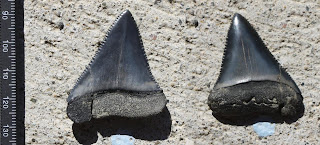
The prepared specimen.

I've found that shark teeth are nearly impossible to find during the summer months, and easy to find in the winter, when the cliffs are cleaned off by surf action. I rarely find teeth in the summer simply because I tend to pick the localities clean in the winter, and I have to wait until the erosion of the following winter to find anything. Shark teeth are so rare in west coast strata that it is not very fruitful to look for them on nearby beaches; indeed, I found one Carcharodon tooth in this manner, in 2006 - and I have not found another this way.

Certainly, the Purisima Formation is not the only shark-tooth yielding unit on the west coast. Two rock units that boast a healthy dose of shark teeth are the Sharktooth Hill Bonebed in the Round Mountain Silt near Bakersfield, one of the highest concentrations of fossil shark teeth in the world - and the Santa Margarita Sandstone near Santa Cruz. At both of these localities, one can find dozens of teeth with little work (Sharktooth Hill) or quite a bit of digging (Santa Margarita Sandstone). In high school, I played hooky one day and drove down to Santa Cruz, and spent 8 hours in a pit with a shovel and my screen, and collected 70 teeth - but only after ending up with enough screened sediment to fill a Volkswagen beetle.

Fossil mako teeth (Cosmopolitodus hastalis and Cosmopolitodus planus) from the Sharktooth Hill Bonebed, UCMP Collections (image borrowed from http://www.ucmp.berkeley.edu/).

In 2005, I was fortunate to contrast my west coast experience with that of Calvert Cliffs. I had three hours to check out the famous Brownie's Beach, where just looking through shelly debris on the beach, I found 80 shark teeth (mostly the reef shark Carcharinus), just on the surface of the beach, in an area smaller than one side of a tennis court. I've seen mason jars filled with shark teeth folks have scooped up from Florida beaches, and seen multitudes of shark teeth from the famous Lee Creek mine in North Carolina. Sure, there is plenty of lore and mysticism surrounding east coast shark teeth (and their collectors in particular!), but I have gotten the distinct impression that most shark-bearing strata on the west coast are depauperate compared to that on the east coast. Contrast nearly 100 teeth per 3 hours of work to 30 hours of work for one tooth, for example. Additionally, although I have not personally collected data on this, the obscene number of shark teeth from certain east coast units (i.e. 24,000 shark teeth from Calvert Cliffs from just 3 years of donations to the Calvert Marine Museum; Visaggi and Godfrey 2010) suggests that the ratio of sharks:marine mammals in the east coast is astronomically higher than in the Purisima Formation (which in my thesis, I determined it to be around 1:40) and other west coast units. How could this be?

A heap of shark teeth from Florida (image borrowed from www.sharkysshop.com).

A number of biological and taphonomic hypotheses can be made:
1) The fossil shark assemblages perhaps differ in their taxonomic composition, and perhaps there is some related preservation bias.
2) The western Atlantic had higher productivity and stronger upwelling in the Neogene, supporting a larger absolute population of sharks.
3) Sharks and marine mammals have a different preservation potential, which a large-scale taphonomic process could act upon.

Immediately dismissing out of hand absurd suggestions like fossil marine vertebrates were preserved differently along either coast or had different skeletal mineralogy between ocean basins, one can start to think about the above suggestions. For example, contrasting the Carcharodon carcharias-dominated shark assemblage of the Purisima Formation with that of the Calvert Formation which is dominated by carchariniforms like Carcharinus, Hemipristis, and Galeocerdo, this suggestion seems to have some merit. However, there is little difference in preservation potential between these different types of sharks, aside from differences in size. In general, marine vertebrate assemblages in bonebeds and the like are very poorly sorted, and all shark teeth are relatively small in comparison, to say, a whale jaw.


The second suggestion has some merit: the old skeletal supply v. concentration idea discussed by Susan Kidwell back in her 1985 paper (although she was talking about mollusks). She argued that skeletal concentrations are usually caused by changes in sedimentation rate - a slowdown in the rate of sedimentation eliminates the diluting effect on bioclasts, allowing them to form a shell or bonebed (or even just a zone where they are slightly more abundant). Kidwell also argued that computer modelling she used demonstrated that her concentration model still worked even when the skeletal supply rate changed. Is it reasonable to assume that the populations of organisms have not changed through time? Of course not. Can we, from a uniformitarian standpoint, work with this in mind? Using Kidwell's model, perhaps - perhaps not. This being said, I'm not sure that more teeth = more sharks. This is a relatively simplistic view of the fossil record, and in the past, interpreting the paleoecology of fossil organisms has been fraught with problems (usually of the taphonomic kind). Sharks aren't the only organisms who would enjoy higher productivity - you'd expect marine mammals to be going bat-shit crazy with all the extra fish, krill, etc. to feed on as well (and eventually dying, shedding their hard parts onto the seafloor as well along with shark teeth).
The sedimentologic fossil concentration model proposed by Kidwell (1985).

What about the third suggestion? Sharks and marine mammals clearly have different skeletal anatomy, and although some elasmobranchs have been found with preserved skeletal elements (including skates from the Purisima Formation - stay tuned!), all that typically preserve are teeth, and occasionally, dermal denticles. Marine mammals have teeth, skulls, earbones, and postcrania that get preserved frequently. Teeth are harder than bones, and probably have a higher preservation potential with respect to purely physical taphonomic processes (i.e. abrasion from winnowing, erosion, and transport). In fact, my data from my master's thesis indicate that shark teeth are less commonly abraded or fragmented relative to marine mammal bones, and therefore it is probably kosher to say they have a higher preservation potential.

Okay, so what? There is clearly some differential preservation potential. But the Atlantic and Pacific oceans are big places: any specific sedimentological process (i.e. bonebed formation) is going to vary along hundreds of miles of the continental shelf, and through geologic time, and it may be difficult to pinpoint one single phenomenon responsible. In fact, to really examine this, we have to zoom way far out, to the basin level. What is the single most obvious difference between Neogene strata of the east coast and the west coast? Again we turn back to the work of Susan Kidwell (1993). In general, because the east coast is a passive continental margin, most of the strata (i.e. Calvert Fm., Pungo Ls., Yorktown Fm., Bone Valley Fm.) are deposited in low subsidence settings ('low' sensu Kidwell, 1993). Most of the strata on the west coast, including the Purisima Fm., are deposited in smaller basins undergoing "wrench" tectonics (i.e. pull-apart basins) or even rifting (Imperial Group, southern California), which Kidwell (1993) classified as medium-high subsidence basins; most basins in California probably qualify under this category (and could be determined via deposition 'rates' and basin thickness/depth).

The concept of supply versus concentration in Kidwell's model can be extrapolated to an entire basin: basin subsidence controls the sedimentation rate, and instead of looking at the microanatomy of a single shellbed, the types of fossil concentrations and their thicknesses and lateral extent can be compared between formations and basins. Just like a longer pause in sedimentation may form thicker shell bed, a formation deposited under lower rates of sedimentation will result in more numerous, thicker, and more architecturally complex shell concentrations. The Calvert Formation in particular was Kidwell's example of a low-subsidence setting. In general, Neogene marine strata of the west coast in general have less numerous and thinner shell concentrations, a general proxy for the sedimentation rate.

A taphonomic process of this magnitude can then be imparted upon a given example of differential preservation: at the end of this, the generally lower sedimentation rate of the western Atlantic resulted in higher amounts of taphonomic damage, more widespread and longer-duration hiatuses/bonebeds, and could have effectively acted as a taphonomic "wedge". By wedge, I am referring to the eventual difference in the preserved abundances of shark teeth and marine mammal bones. Marine mammal bones, with their relatively lower preservation potential, perhaps lost out due to their greater susceptibility to damage by abrasion and fragmentation.

References Cited

Kidwell, S. M. 1985. Paleobiological and sedimentological implications of fossil
concentrations. Nature 318:457-460.

Kidwell, S. M. 1993. Influence of subsidence on the anatomy of marine siliciclastic
sequences and on the distribution of shell and bone beds. Journal of the Geological
Society, London 150:165-167.

Visaggi, C.C. and S.J. Godfrey. 2010. Variation in Composition and Abundance of Miocene Shark Teeth from Calvert Cliffs, Maryland. Journal of Vertebrate Paleontology 30:1:26-35.

Tuesday, September 27, 2011

Getting material curated at UCMP

On my last visit to UCMP, I spent an hour with a student volunteer and my good friend Ash Poust placing some material I had donated last year into specimen trays. These are all specimens collected from a locality in the Purisima Formation I studied as an undergraduate student. Most of this material was collected in 2005 and 2006, and I slowly curated and prepared it during my undergraduate career (and during grad school). I've now gotten about 1/2 of this collection to UCMP, and already it fills a drawer and a half.
Which is bad (and good). It's bad because the entire collection from this locality will take up half a cabinet by itself, not including the large oversize material. What's worse is that this material is roughly 1/3 of my entire collection - I have material I've collected from other Purisima localities, as well as the Santa Margarita Sandstone. All in all, my collection will probably require two-three cabinets at UCMP. Keep in mind I've already donated about 1/10 of my collection to the Santa Cruz Museum of Natural History.

Shark teeth and bird bones from the Purisima Formation.

That being said, it was a very satisfying experience to see all this material finally looking like it was part of a museum collection. I'm more motivated than ever to get the rest of it curated (and out of my house!). Now that I'm writing up the marine mammal assemblage from this locality, I can finally get rid of it all and get it into a proper museum setting.

Tuesday, September 13, 2011

Help preserve the Sharktooth Hill Bonebed

Hey Folks,

This web page was posted several months ago, but to anyone who is interested, the Natural History Museum of Los Angeles County is trying to raise money to purchase the Sharktooth Hill locality for posterity.

To those unaware, the venerated Bob Ernst (who formerly owned the property) passed away several years ago. Unbeknownst to many, the vast collections at the Buena Vista Museum of Natural History made from Sharktooth Hill were not an actual museum collection, but Ernst's private collection on display, and passed on to his widow. When she began having financial problems, she began to sell and auction off the collection, including many specimens which have now been published in peer-reviewed articles (a big, big, BIG screw up on the part of certain researchers). This is really bad, because unless these specimens are donated to collections of real museums - that work is effectively rendered untestable.

That being said, here is the page, posted by Don Prothero and Teresa LaVelle:

http://www.skeptic.com/eskeptic/11-05-11/

A personal tour of the Sharktooth Hill locality will be given by the museum director, John Long, for donations of over 2000$.

Unfortunately, I'm still relatively poor, as a student, and anything I could scrounge together would barely amount to a drop in the bucket - however, I can help out by posting it here, and hoping that this message can get spread a little further. This is probably the most spectacular marine vertebrate fossil site in western North America, and so many problems could be solved for Mrs. Ernst and marine mammal paleontologists if this money were raised.