Tuesday, August 9, 2011

Recent fieldwork in the Purisima Formation, Part 2: a possible new species of Herpetocetus?

Back in late May, Dick Hilton (Sierra College) and I did a three day field trip collecting fossil vertebrates from a locality in the Purisima Formation I recently got a permit for. On the second day, excavated a large block of sediment with what I assumed at the time were sirenian bones. I had not seen the bones except in cross section, and because they were somewhat dense, I thought they might be from a sea cow. We quickly carved out a large block, and due to the cohesive nature of the sediment, we were able to wrap it in tinfoil and duct tape. It was one of the first finds of the day, and I thought there could definitely be something neat inside. Because we were only a half mile from the cars, I left my pack with Dick and hoofed it back to the car with the thirty pound block, and also to grab some gatorade I had left in my car. When I returned, Dick was taking a siesta, and after some lunch, we headed further down the beach. Only a few hundred feet down I spotted a distinctly potato-shaped thing sticking out next to a piece of bone: it rather looked to me like a tympanic bulla, and I climbed up a bit to check it out. It was in fact a tympanic, and when the rest of the piece came out, I was able to see that it was in fact a nearly complete squamosal, complete with the bulla and posterior process of the petrosal. Dick and I thought the trip had been a success just because of this specimen, especially because it was from a section of cliffs where neither of us expected to find anything.

Dick Hilton digging up a huge baleen whale tympanic.

I couldn't have been more wrong. Unfortunately, I didn't know that I was until after the SATLW (Aquatic Tetrapods) conference. I did have a day or two before the conference to prepare the squamosal, and it did indeed have a plug-shaped posterior process of the petrosal, indicating it belonged to the Herpetocetinae, which includes Herpetocetus, Nannocetus, (probably) Piscobalaena, and Cephalotropis (according to Steeman, 2007). After the conference, I opened up the duct taped jacket and began preparation. After a couple hours the exposed pieces were still not making sense, and then I found a couple of bones that looked like they were adjacent to one another. When I removed them, there was a tiny neck of bone connecting them – and after a little more preparation, I realized it was a Herpetocetus petrosal and posterior process. Damnit, another goddamn Herpetocetus.

The petrosal and posterior process of the new specimen, with the facial nerve canal labeled. Upper left is ventral, lower left is dorsal, and right is medial view.

The skull with (partially incorrectly) articulated petrosal of the new skull in dorsal (top) and ventral (bottom) views.

Once I had enough of the block prepared, I realized I had quite a bit of the ventral portion of a small braincase preserved. It includes both exoccipitals, one occipital condyle, the basioccipital, the right squamosal, and the complete petrosal. After preparation, the petrosal is most similar to petrosals of Herpetocetus. This may be a bit technical, but herpetocetine baleen whales have several peculiar features that define them as a group. The posterior process of the petrosal – which is typically an elongate strap of bone that connects with the skull posteriorly – is very short and plug-shaped in these animals. Additionally, the posterior process (which is rarely found attached in isolated fossil mysticete petrosals) is flat and contributes to the lateral side of the skull, instead of being 'hidden' in a trench between the squamosal and exoccipital bones. Secondly, some herpetocetines have a flattened anterior process that is blade shaped; this structure is typically conical and robust or knoblike in most other mysticetes. Clearly, this specimen exhibits both of these features. Additionally, Herpetocetus spp. exhibit a large triangular flange on the side of the bone, which overhangs the squamosal – also present in this specimen. Additionally, herpetocetines all have extremely small earbones relative to most mysticetes. Unfortunately, the neck of the posterior process appears to have been deformed slightly, and when the main portion is articulated correctly, the posterior process sits in its trough a little wonky, and when the posterior process is articulated correctly, the main portion doesn't articulate well.

The posterior process, squamosal, and tympanic of Herpetocetus bramblei.

The two alternate articulations of the petrosal showing correct articulation of the posterior process (left) and correct articulation of the body of the petrosal (right).

The temporal region of the skull of Herpetocetus bramblei with the petrosal outlined in red.

However – it shows several features that differentiate it from all species of Herpetocetus as well as other herpetocetines like Nannocetus and Piscobalaena. Firstly, the anterior process is medially oriented – it is usually anteriorly facing instead. Second, the posterior process is very transversely narrow and elongate – it is typically more nearly circular in other species. Lastly, the most bizarre feature is that it has a very long anterior fissure of the facial nerve canal which is contorted into an S-shape – something I have not seen in any mysticete, fossil or modern.

Various mysticete petrosals in ventral view, showing two fossil rorquals (Plesiobalaenoptera and Balaenoptera sursiplana), a modern balaenid (Eubalaena japonica), the new specimen, and two other Herpetocetus specimens.

This is pretty exciting, and I am looking forward to preparing the other specimen, which includes part of a squamosal and a tympanic, and most likely a petrosal. It should not be too difficult to get these specimens written up and described.

Further Reading

Geisler, J. H. & Luo, Z.-X. 1996. The petrosal and inner ear of Herpetocetus sp. (Mammalia: Cetacea) and their implications for the phylogeny and hearing of archaic mysticetes. Journal of Vertebrate Paleontology, 70, 1045–1066.

Steeman, M.E. 2007. Cladistic analysis and a revised classification of fossil and recent mysticetes. Zoological Journal of the Linnean Society 150:875–894.

Steeman, M.E. 2010. The extinct baleen whale fauna from the Miocene-Pliocene of Belgium and the diagnostic cetacean ear bones. Journal of Systematic Palaeontology 8:63-80.

Whitmore, F.C., and L.G. Barnes. 2008. The Herpetocetinae, a new subfamily of extinct baleen whales (Mammalia, Cetacea, Cetotheriidae). In C.E. Ray, D.J. Bohaska, I.A. Koretsky, L.W. Ward, and L.G. Barnes (eds.). Geology and Paleontology of the Lee Creek Mine, North Carolina, IV. Virginia Museum of Natural History Special Publication 14:141–180.

Sunday, August 7, 2011

Recent fieldwork in the Purisima Formation, Part 1: Gigantor whale jaw

If you pay attention to paleo-related news on the intertubes, you may have seen a recent article about a 700 lb dinosaur bone excavated from the Morrison Formation near Fruita, Colorado. Fellow MSU student Krista Brundridge was even interviewed and involved in the excavation. They only state that the bone is from the animal's back, so I can only assume that it's a huge sauropod vertebra. Which means that maybe the kind folks over at SV-POW! will be drooling over the news. If people really wanted to dig up humongously sized plaster jackets, they'd come to California and dig up whales. Why, back in may, Dick Hilton and I prospected a locality in the Purisima that hasn't been collected by paleontologists in over twenty years, and over the course of two days, found dozens of multi-ton blocks just sitting there on the beach. Many of them had vertebrae (which unlike those of sauropods, are much more conservative in their anatomy), ribs, and other odds and ends. However, I counted many that had skulls. One block that was the size of a pickup truck had a complete skull, at least one lower jaw, and apparently part of an articulated vertebral column and ribcage.

Me posing with half of a gigantic whale jaw.

Wait a second, you say. Dinosaur paleontologists scrounge up every scrap of bone, and re-re-describe old fossils (i.e. Dryptosaurus was first described, then re-described, and then re-re-described), and bitch and moan about there not being enough material for new researchers. How would complete skulls of baleen whales just sit on the beach without some intrepid explorer to come along and excavate or collect them? Below, I've got a photo of what used to be a complete baleen whale jaw sitting in a large boulder, ~20 feet above the beach. I climbed up to it, which was pretty hairy – usually the Purisima Formation is sandstone, and easy to carve handholds in, but this was nasty hard fractured mudrock. This jaw must be in a concretion that weighs the same as my small Honda. For baleen whales, jaws are "relatively" diagnostic (see here, here, and Boessenecker 2011), so specimens like this are of interest. Baleen whale skulls are of course diagnostic, and it is unfortunate that they are languishing like this.

It was kind of a pain to get down from there.

One problem, you might say, is that they're big, and in very tough rock. Yes, I spent five years of my life (intermittently) preparing a mysticete skull in a concretion that I collected from the Purisima Formation. Sure, it's a big heavy skull, but surely smaller and less heavy than any ceratopsid skull you can point at. Obviously, blue whales have bigger crania than dinosaurs like Triceratops. Most fossil mysticetes have skulls that are smaller than or roughly the same length as the largest "Torosaurus" skulls, but many museums out there don't hesitate to go dig up more Triceratops skulls. Is it the often concretionary matrix and the time-intensive nature of the preparation that makes whale fossils "unpopular"? I don't think so, because I can't count the number of dinosaur bones (even undiagnostic material like ribs) encased in hard rock being prepared.

Permanently borrowed from SV-POW! Thanks guys, this image is awesome.

Are whales and whale fossils just unpopular within vertebrate paleontology? Maybe. Given how whales captivate the imagination – mind you, not in the gory, Velociraptor-chasing-kids-through-a-kitchen and lawyer-eating sort of way but the holy-shit-its-a-brachiosaurus-on-a-grassy-hill sort of way – I highly doubt that cetaceans lack the cool-factor. They may not have big sharp pointy teeth... oh shit, I forgot that fossil sperm whales are far more impressive than any puny theropod. Sorry, Livyatan beats T. rex. I think the real problem is that we have the Jurassic Park generation in vertebrate paloentology now – and not to sound like a bitchy hipster, although I am of the correct age group – I was into paleontology before Jurassic Park came out.

Nevermind that in the background.

Perhaps this is a problem that is, within the United States, unique to Northern and Central California. Southern California fossil cetaceans are really well taken care of, and get excavated and pampered at places like LACM, the Cooper Center, and the San Diego Natural History Museum. The extremely rich Calvert Cliffs and other Mio-Pliocene units of the Chesapeake Group of the mid Atlantic coastal plain are covered by the Calvert Marine Museum, the Smithsonian, and my dear friend Butch Dooley at the Virginia Museum of Natural History. Florida fossils are generally covered by the FLMNH and the University of Florida. The comparatively rich fossil record in the Oligocene and Miocene of Washington State (and parts of Oregon as well) are covered by the Burke Museum in Seattle. However, all of the UCMP students who collected a ton of material from Northern California in the 1970's and early 1980's moved on elsewhere.

I don't mean to complain – having a surplus of fossils available for my research is nothing to complain about. However, it is depressing if not distressing to see so many fossils I could not collect, prepare, and study alone in five or six lifetimes, just sitting out there on the beach. So: to all of you dinosaur folks who feel perhaps the field is a little too crowded, too much of a circlejerk, or whatever, come join marine mammal paleontology! Trust me, there are is a large hoard of new genera and species out there just waiting for the taxonomically hungry. In five years of serious collecting, I've got enough material to research for another ten years, and this is barely scraping the surface. So, this is a call for action! If you're interested in marine mammal paleontology, go dig up a whale (instead of Apatosaurus #32, or NewGenusOfUninterestingChineseDinoBird #54, or re-re-redescribing something everyone is already familiar with) or find someone who can help you (...or me, for that matter).

Unfortunately, the sad reality is that that jaw I posted above will probably not be collected. I don't have the funding, resources, or the connections (read: friends with heavy machinery) to collect stuff like that now. To be honest, it isn't complete enough for it to be worth it anyway. But that's besides the point: it was at one point, and another one will come along that will be worth collecting. Will we be up to the challenge?

Sorry for the rambling here, the rest of these posts will be about fieldwork I did with Dick Hilton in May, I promise!

Tuesday, August 2, 2011

More problems with Herpetocetus

Back in June at the Aquatic Tetrapods conference I coauthored a poster with Joe El Adli (San Diego Natural History Museum) and Jonathan Geisler (New York College of Osteopathic Medicine) on some of the taxonomic problems of Herpetocetus. Herpetocetus, as I've mentioned before, is an enigmatic small bodied mysticete whale which many bizarre and derived features, while retaining some primitive features as well. Fossils of Herpetocetus are fairly common in Northern California, particularly in the Purisima Formation - or maybe I just have a knack for finding them. Thus far, there is only one described species of Herpetocetus from California: Herpetocetus bramblei, named by Whitmore and Barnes (2008) from a very partial skull (basically just a squamosal with part of the exoccipital, parietal, and pterygoid) with a petrosal from the Purisima Formation. In summer 2007, I excavated a nearly complete skull of this same species from near the type locality, and last summer, I excavated a second specimen which lacked the braincase but included a complete rostrum. Since this topotypic material was collected, additional specimens from other localities in the Purisima Formation indicate that two additional undescribed species are present - one of the new species was discovered very recently, and I'll have more on that soon.

*Holotype, for the non-specialist, is the specimen which a new species is based off of. It should be representative of the new species in terms of its anatomy, and should be relatively complete enough to be comparable to other taxa. A type locality is where the holotype specimen originated.

There are several other described species of Herpetocetus from other corners of the globe - all from the Northern Hemisphere. The genus was first described from the Pliocene of Belgium (Herpetocetus scaldiensis) based on a partial dentary. A partial skull from the Pliocene Yorktown Formation was described as Herpetocetus transatlanticus, also by Whitmore and Barnes (2008). In the 1960's, an isolated tympanic bulla from Japan was named as the type specimen of Mitzuhoptera sendaicus, and a fossil mysticete skeleton with a skull, earbones, and dentary shared both the dentary morphology of Herpetocetus scaldiensis as well as the tympanic morphology of Mitzuhoptera sendaicus, and Oishi and Hasegawa (1995) transferred M. sendaicus to Herpetocetus, resulting in the new combination, Herpetocetus sendaicus. Each of these records is from either side of the Pacific (east and west) and the Atlantic (east and west).

How diagnostic are bullae and dentaries? I've already addressed problems with the jaw morphology of herpetocetines (here and here), and mysticetes in general. If you recall, there are two problems concerning the dentary of Herpetocetus spp. in particular: 1) The dentary of the possible sister taxon Nannocetus is not yet known, and dentaries substantially older than Herpetocetus (and possibly belonging to Nannocetus) are nearly identical to Herpetocetus (see below image), indicating that this general morphology is possibly characteristic of a larger group of whales. 2) Some species of Herpetocetus have dentaries that are very difficult to tell apart and lack autapomorphic characters (unique derived features), and thus are not suitable as holotypes. This logically results in the implication that Herpetocetus scaldiensis, which is based on a jaw, is the type species of Herpetocetus, and thus the species and genus may be taxonomically invalid or nomina dubia (means dubious name in latin).

The first figure of our poster, showing comparative drawings of various fossil herpetocetines.

Earbones have long been used for taxonomic purposes, and in many cases have been designated as holotypes. Sir Richard Owen designated many isolated bullae from the Plio-Pleistocene Red Crag of eastern England as holotypes (all of which have been sunk; e.g. Balaena definata). It is unclear how diagnostic earbones are for baleen whales: petrosals (otherwise known as periotics - the inner ear bone) have all sorts holes and knobs and crests and are rather easy to tell apart from genus to genus. A recent paper published by Eric Ekdale, Annalisa Berta, and Tom Demere (2011) indicate that earbones of extant mysticetes are diagnostic to the species and are easily told apart. Additionally, Steeman (2010) reexamined a large suite of earbones previously described by taxonomic mad man P.J. Van Beneden, who is largely responsible for constipating the entire field of mysticete systematics for over 100 years. Steeman (2010) found that many of these earbones - specifically petrosals - may be diagnostic tools, and generally reached a similar conclusion like Ekdale et al. (2011). But what about bullae?


The second figure from our poster, showing variation in tympanic bulla morphology from various herpetocetines. Note the overall similarity between Herpetocetus spp.

Bullae of three species of Herpetocetus have been described: H. scaldiensis, H. transatlanticus, and H. sendaicus. In our poster, we figured all known bullae (described or undescribed), including both the holotype of Mizuhoptera sendaicus and the referred specimen of Herpetocetus sendaicus, and a new bulla of Herpetocetus bramblei. Additionally figured are bullae of Nannocetus and Piscobalaena, also herpetocetines. We concluded, as we hope that you will when looking at this figure, that the bullae of different Herpetocetus species do not vary significantly from species to species. They are, on the other hand, diagnostic at the family level: they are clearly distinct from all other bullae of (described) cetotheriids. However, a bulla that is only distinct at the genus level is inadequate to be used as a holotype. This suggests that Mizuhoptera sendaicus, unsurprisingly, is probably a nomen dubium. It also indicates something interesting is going on with the skulls of mysticetes, or at least cetotheriids: tympanics are slightly less informative than the petrosals. It might be possible someday to quantify how phylogenetically useful different anatomical regions are, aside from just counting up the number of characters used per anatomic region in a cladistic analysis. Who knows, maybe someone has already thought of that and developed a method.

Further Reading:

New published article (Part 1): herpetocetine jaws, and an example of finding a "simple" research project


New published article (Part 2): taxonomic problems with Herpetocetus and "cetotheres"

References:


El Adli, J., Boessenecker, R.W., and J. H. Geisler. 2011. Taxonomic problems of and relationships among species of the fossil baleen whale genus Herpetocetus. Sixth Triennial Conference on Secondary Adaptation of Tetrapods to Life in Water Program with Abstracts: 23.

Ekdale, E.G., A. Berta, and T.A. Demere. 2011. The comparative osteology of the petrotympanic complex (ear region) of extant baleen whales (Cetacea: Mysticeti). PLOS One 6:1-42.

Oishi, M., and Y. Hasegawa 1995. Diversity of Pliocene mysticetes from eastern Japan. The Island Arc 3:436–552.

Steeman, M.E. 2010. The extinct baleen whale fauna from the Miocene-Pliocene of Belgium and the diagnostic cetacean ear bones. Journal of Systematic Palaeontology 8:1:63-80.

Whitmore, F.C., and L.G. Barnes. 2008. The Herpetocetinae, a new subfamily of extinct baleen whales (Mammalia, Cetacea, Cetotheriidae). In C.E. Ray, D.J. Bohaska, I.A. Koretsky, L.W. Ward, and L.G. Barnes (eds.). Geology and Paleontology of the Lee Creek Mine, North Carolina, IV. Virginia Museum of Natural History Special Publication 14:141–180.

Sunday, July 31, 2011

Preparing an auk bone from the Purisima Formation, part 2

In order to properly prepare this bird bone (see previous post) , I decided to pour two part epoxy onto the eroded surface of the bone. In the field, I carved a block out of the rock with the bird bone in it, and wrapped it in tin foil. Weeks later, I unwrapped it and began the preparation process.

Beginning steps of preparation. A - the collected block prior to preparation. B - supplies needed. C - application of vinac using a paintbrush. D - application of thin superglue to stabilize parts of the bone.

First off, the bone had to be stabilized. Vinac and Butvar are two acetone-based consolidant glues which are very thin (i.e. have a low viscosity) and soak into porous bone well. In this case, I was not satisfied with vinac alone, so I began by dripping superglue into the most poorly preserved parts of the bone; superglue is also thin enough for this task, although it is substantially more difficult to reverse if you screw something up. I followed this by a liberal application of vinac onto the bone. I also painted vinac onto the sandstone where I would later pour epoxy. I did not want the outermost layer of the sandstone to flake off of the cured epoxy and take the bone with it, or alternatively, have only part of the bone stick onto the epoxy plate and the rest fragment off.


Epoxy application onto the fossil. A - a rolled up cylinder of paper serves as a convenient and cheap tool to drip epoxy with (as opposed to popsicle sticks or tongue depressors). B and C - the rolled up paper tube is used to drip epoxy. D - the epoxy sheet is allowed to cure overnight.


Part two of the preparation process was to apply a generous layer of epoxy, once the vinac had cured. Two part epoxy comes in paired tubes, and has to be mixed - I usually just mix it onto a piece of scratch paper. I tear off one side, and roll it up to use as a "honey dripper" (you know, like the thing you see in honey nut cheerios commercials and cereal boxes) to collect and drip epoxy from. It is imperative to try and mix it 1-1 - it can be difficult, because sometimes pushing on the plunger results in one tube being pushed more than the other, and you get something more like 1.3-1, which will take longer to cure and may not cure ever, which is a really bad problem if you're working on an important specimen. Don't screw that up. Sometimes, there is also more of a bubble in one tube, making one of the component parts come out more than the other; you can mitigate this by pushing back on the sides of the plunger, making the other tube extrude more epoxy (maybe I should do a post on beginner epoxy tips).

A second coat of epoxy was applied along the bone in order to strengthen it, and
was allowed several days to cure.
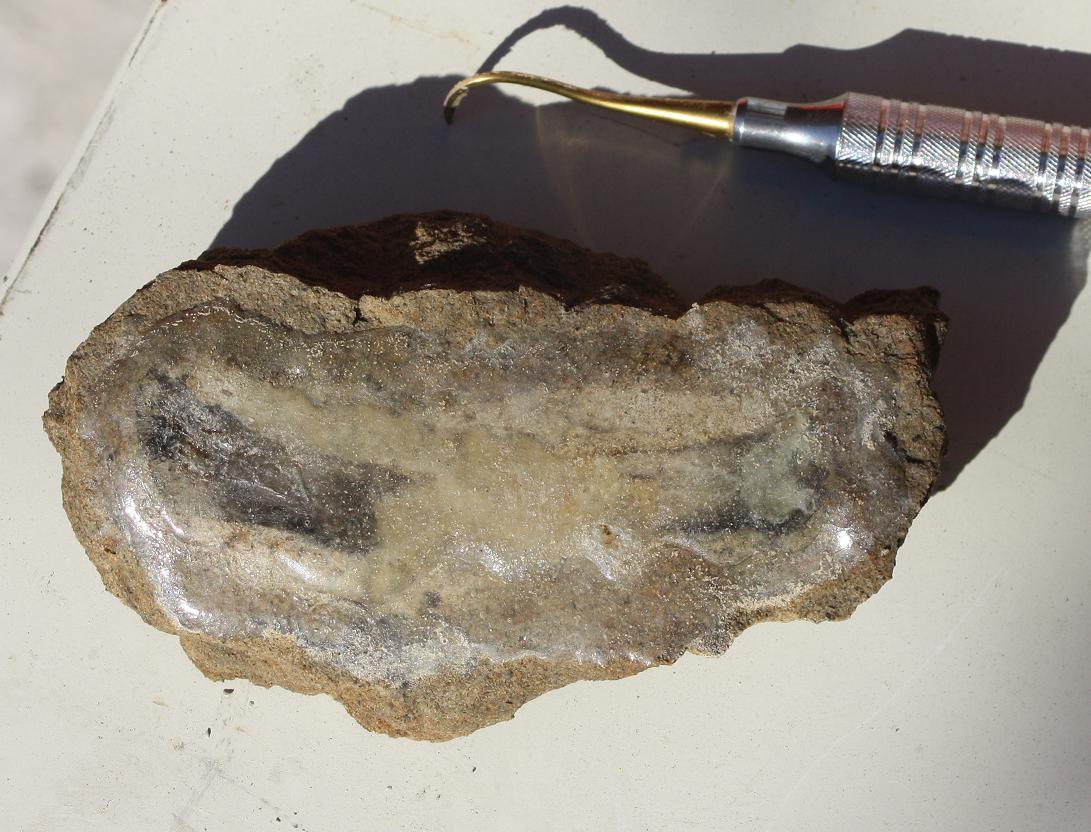
Once it was cured, the soft sandstone matrix was wetted for easy removal, and the block was picked away and carved down to size.

The initial coat came out sort of thin in places, which I thought would be too flimsy. I decided to mix some more epoxy and add a second, thicker coat right up along the bone. The first coat was still sticky to touch even after 24 hours, so after I added this second coat, I allowed it to cure for about four or five days while my fiance and I went on vacation. When we returned, I soaked the sandstone block in warm water and allowed the sandstone to become saturated; Purisima Formation sediment is much easier to prepare and separates from bone much more easily when wet - I estimate it makes preparation take 2/3 to 1/2 less time than it would if the sandstone were dry. The block was carved down to a size roughly equal with the epoxy plate.

Preparation of the sandstone off of the bone and epoxy plate. A - one centimeter of sandstone left. B - a small bit of the ventral tubercle (a small dark spot of bone down and to the left of the 'B') is exposed. C - it doesn't take more than another ten minutes to expose nearly the entire proximal end of the bone. D - after some more work with a dental pick and a wet toothbrush, the preparation is finished. E - the finished product, after vinac application.

The above picture shows the progress of preparation. The final product shows the important bits of the cranial/anterior surface of the bone. Additionally, where the middle of the shaft had broken away it left a slight mold that more or less shows the shape and curvature of the shaft - the epoxy filled in this as a small cast, and the original shape of the bone can be seen. The only unfortunate thing about this is that the mancalline "scar" that allows identification of various species is not really accessible - it is probably preserved, and the pneumatic foramen is filled in with sediment; preparation of this would require removal of some of the epoxy around the ventral tubercle. It does, however, preserve a slight muscle attachment crest on the bicipital crest, which suggests this specimen may belong to Mancalla lucasi as well. Either way, this specimen indicates that this part of the Purisima is Pliocene in age.

Saturday, July 30, 2011

Preparing an auk bone from the Purisima Formation, part 1

I know I had promised another post on pelagornithids (and sooner than this), but I just finished a preparation project on a small bird bone, and I think it is too cool not to share the method I used for this. Dick Hilton and I were recently doing some fieldwork together in the Purisima Formation, and I jumped up on a ledge and found a bird humerus exposed in a horizontal exposure.Dick Hilton near a new baleen whale find in the Purisima Formation.
The new bird bone, not entirely unsalvageable.

As soon as I saw it, I thought it was unfortunate that so much was missing; nearly the entire caudal/posterior face was missing, and eroded parallel to the long axis of the bone. Additionally, the middle of the bone was completely gone; enough of each end were missing that it would be very difficult to collect each end separately and not have them fragment into a million pieces during preparation. Bird bones are not exactly rare in the Purisima Formation, but since the length of bird bones has historically been used as a taxonomic tool along with other morphologic features, I thought it better to excavate it as a block - and to be honest, nearly the moment I saw it, the gears were already turning and quickly formulated a preparation solution.

The new fossil specimen compared with a more complete humerus of Mancalla lucasi (formerly Mancalla diegensis). The cross-hatched area indicates what was missing of the new specimen.

Additionally, the curvature of the shaft and the distinctive proximal end (even in cross section) made the bone very easy to identify - it is transversely flattened and curved, which identifies it as the flightless auk Mancalla; this bird happens to be the most common bird taxon in the Purisima Formation - auks and puffins (Alcidae) happen to be relatively common in general. In a forthcoming paper, I describe a fossil humerus identifiable as the species Mancalla diegensis; in a recent paper on mancalline auks, my colleague (and coauthor on the Pelagornis article) Adam Smith sunk Mancalla diegensis and erected a new taxon, Mancalla lucasi (I have another post lined up summarizing mancallines and Smith's new monograph). This specimen is very similar to Mancalla diegensis in terms of size, but could just as easily belong to Mancalla cedrosensis, Mancalla calforniensis, or Mancalla vegrandis.

I thought an easy way to deal with this specimen would be to liberally apply a large sheet of two-part epoxy onto the exposed broken surface of the bone and sediment, and prepare it down from the other side. This I hoped would result in a sheet of plastic with the caudal surface of the bone exposed on the other side. The next post will describe the preparation process, and hopefully give you ideas on how to tackle similar problems when dealing with fragmentary fossils.

Saturday, July 16, 2011

A bony toothed bird from the Purisima Formation, part 2

After I got the bone identified as a bird, I emailed pictures to my colleague N. Adam Smith, who at the time was a Ph.D. student at University of Texas at Austin, studying with Julia Clarke. We both agreed on the identification of the specimen as a pelagornithid, and also agreed that it could be written up quickly, and we immediately began working on the manuscript. This was the fastest paper I ever wrote - partially because each of us did about 50% of the work, and we went through a bazillion drafts (a new draft every 24-36 hours for four weeks in September and October), and we finally submitted it on Halloween.


We were pretty anal about properly figuring and labeling all the anatomic structures of this specimen in our paper; we were wholly dissatisfied with previous papers which had not labeled the relatively divergent anatomical structures of pelagornithid humeri sufficiently. Many anatomical features are fairly modified relative to non-pelagornithids, and without adequately labeled (or unlabeled) figures, it is difficult for the non-specialist to interpret their morphology; we thought we'd do everyone a favor and do it properly. One exception is Bourdon et al. (2010), who studied Eocene pelagornithids from Morocco (whose paper was also not out yet when we submitted our article).

Figure 2 from our paper, highlighting the anatomical structures of UCMP 219007.

A comparison of humeri of pelagornithids and modern pelecaniform and procellariiform birds. A- Pelagornis sp. (UCMP 219007); B- Pelagornis chilensis, late Miocene, Bahia Inglesa, Chile (holotype, from Mayr and Rubilar-Rogers 2010); C- Pelagornis miocaena, Miocene, France; D- Pelagornis sp., Pisco Formation, Peru (Pliocene); E- Morus bassanus, Gannet, extant (CAS specimen); F- Phoebastria irrorata, Waved Albatross, extant (CAS specimen); G - cf. Macrodontopteryx (synonymized with Dasornis iby Bourdon, 2010), Eocene, Belgium; H- Pelagornis mauretanicus, Pliocene, Morocco.

Many features of pelagornithids (and specifically, Pelagornis spp.) are highly divergent relative to other pelecaniformes (as you can see above, compared with Morus). Additionally, as you can see, our specimen is one of the most well preserved pelagornithid humeri now known, even more so than the beautiful holotype of Pelagornis chilensis, the humerus of which still has quite a bit of matrix encrusted and glued onto the bone, obscuring some of the fossae. One of the pneumatic fossae is actually pneumatized, and bears a pneumatic foramen that appears to connect to the internal cavity of the bone, a condition we had not read about or observed in any fossil or modern relative.

Shaded drawing I made and used for figure 3 of our paper, showing the pneumatic foramen.

Lastly, for our paper I thought I would try a skeletal reconstruction of Pelagornis. It was on my to-do list for the paper, and we already had a couple of drafts sent back and forth when Pelagornis chilensis graced the cover of JVP: it couldn't have been more timely. Although not in the original paper, associated with the press release were several skeletal reconstructions. I emailed the artist Carlos Anzures in Chile to ask for permission to modify it for our study. Well, I didn't just modify it; I redrew it by hand, reposed it, inked the drawing on vellum, and then edited the image in adobe illustrator, to eventually get something like what you see below:

Part of Figure 1 of our paper, showing the skeletal reconstruction of Pelagornis.

Next time: more on pelagornithid evolution and ecology, as well as biogeography and the implications of our find.

Bourdon, E., Amaghzaz, M., and Bouya, Baadi. 2010. Pseudotoothed birds (Aves, Odontopterygiformes) from the Early Tertiary of Morocco. American Museum Novitates 3704:1-71.

Mayr, G., and D. Rubilar-Rogers. 2010. Osteology of a new giant bonytoothed bird from the Miocene of Chile, with a revision of the taxonomy of Neogene Pelagornithidae. Journal of Vertebrate Paleontology 30:1313–1330.

Tuesday, July 12, 2011

A bony toothed bird from the Purisima Formation, part 1

One foggy morning while doing fieldwork in the Purisima Formation, I spotted a cylindrical bone in the base of a cliff. It initially appeared hollow, but at the time of discovery, I wasn't so sure - sometimes mud and weathering products can obscure certain details of an exposed fossil. Eventually, I decided that it was most likely hollow - I scratched the inside of the bone, and had grains of ancient sand in my palm rather than bone fragments. The first step of excavating a fossil is trying to identify it: if you are positive about A) what bone you have discovered, B) what taxon it belongs to, and C) how it is oriented, you may excavate the fossil in a large block and not damage it. Sometimes you cannot limit your identification to one taxon, and this case was an example.

The end of the bone as it was exposed in the field.
Given the size of the bone, and how common marine mammals are, I assumed the most likely possibility was some sort of a fossil odontocete (toothed whale) jaw: the posterior lower jaws of odontocetes are hollow, and walled with thin bone. The only problem with this identification was that in cross section, odontocete jaws are flattened and sometimes nearly kidney-shaped - while this specimen had a more oval cross section. Nevertheless, it was my best guess at the time. When confronted by a situation like this- where you are uncertain of points A and B above, the best option is to carefully expose as much as possible until you can positively identify it. This is sometimes called "field prepping" (i.e. preparation), and sometimes may result in fragile bits of bones being broken off if you screw up or make a mistake while excavating (because field tools are less precise than lab tools, among other reasons). Aside from potentially resulting in breakage, field prepping takes time - time you may not have, if for example, you are working at low tide within the intertidal zone and have two hours left to finish.
The two sides of the unidentified bone.

Towards the end of the excavation, it was becoming clear that whatever I had found was something strange. I still thought I had an odontocete jaw, and at the time it was my best guess (I'll explain why later). I joked to myself in the field "Perhaps you've found the world's first Pliocene pterosaur!" Little did I know, I was more right about that joke than I realized at the time.

It had a slight curve to it, but it did not fan out at the posterior end like it should have if it were a jaw. I collected it in three big pieces, and upon these coming out, I saw that the sediment inside the bone was cemented - explaining why it was so well preserved, and not crushed. When I began preparing it at home, I was surprised to see that there was no enlarged mandibular foramen - again, a large hole should have been there - but instead, there was no opening in the bone.
A dentary of the bottlenose dolphin Tursiops; the enlarged posterior end and mandibular foramen can be seen on the right side of the picture (from Mead and Fordyce, 2009).

So what the hell was it? Upon leaving the field, I thought all I had was some weird odontocete with a strangely shaped jaw - perhaps a small sperm whale; they often have skinny lower jaws. However, I was once again surprised (and frustrated) by my lack of an identification, now that I had prepared the end of it (whichever end it was!). So I took a guess: some sort of a large bird bone. I did not take my thought too seriously, but the bone was in fact hollow, so I humored myself and opened up my copy of Lee Creek Volume III, and flipped to the article on the Yorktown Fm. bird assemblage.

One side of the complete end of the mystery bone.
The other end of the mystery bone.

Lo and behold, I had a match! The proximal end was a nearly exact match with the proximal fragment of a Pelagornis humerus figured by Olson and Rasmussen (2001); Pelagornis is a gigantic extinct species of bony toothed bird. I couldn't believe it: there was a very specific reason that I had not considered a bird as the owner of the unidentified bone: it was too large to represent any bird already known from the Purisima Formation, even a pelican or an albatross (in fact, it was over twice the size). I did not consider a pelagornithid simply because there are no documented occurrences of pelagornithids in younger than early Late Miocene rocks from the eastern North Pacific: there are plenty of Middle Miocene records of the bird Osteodontornis,
and a couple of records of it from the Monterey Formation. I had always assumed that they had gone extinct in the NE Pacific before the Pliocene; not only that, but this was a late Pliocene fossil. There are some Tortonian stage-like critters from the lowermost Purisima - a possible record of Imagotaria, as well as Megaptera miocaena, a Nannocetus-like cetotheriid, a possible record of Dusisiren, and some odds and ends - but this bird was far, far younger than this assemblage.Comparison of the fossil pelagornithid humerus (A, C) with the fragment from the Pliocene Yorktown Formation of North Carolina figured by Olson and Rasmussen (2001).

Check back for part 2, soon.

References:

Boessenecker, R.W. and N.A. Smith. 2011. Latest Pacific basin record of a bony-toothed bird (Aves, Pelagornithidae) from the Pliocene Purisima Formation of California, U.S.A. Journal of Vertebrate Paleontology 31(3):652-657.

Mead, J. G., and R. E. Fordyce. 2009. The therian skull: a lexicon with emphasis on the odontocetes. Smithsonian Contributions to Zoology 627:1-248.

Olson, S. L., and P. C. Rasmussen. 2001. Miocene and Pliocene birds from
the Lee Creek Mine, North Carolina. Smithsonian Contributions to
Paleobiology 90:233–365.