New articles will be coming soon. I've spent the week and a half since I've been back in Montana recuperating from a moderate case of poison oak, writing major revisions for an article about Pliocene pelagornithids from California (for JVP, with N. Adam Smith), and completing revisions for an article on nonmammal vertebrates from the Purisima Formation (for PalArch's Journal of Vertebrate Paleontology).
Anyway, sometime in the next week or two, the February issue of Palaios will be published, which includes one of my first published articles: Mammalian bite marks on juvenile fur seal bones from the late Neogene Purisima Formation of Central California, by myself and Frank Perry of the Santa Cruz Museum of Natural History.
To view the abstract of the forthcoming article, go here. Once the article comes out, I'll have a less technical summary of it posted here at coastal paleo.

perspectives on marine vertebrate paleontology
Sunday, January 23, 2011

Tuesday, January 4, 2011
Odontocete skull excavation 2
Around 4 o'clock in the afternoon along the central California coast, the winter sun gets low on the horizon, giving a few minutes of lengthened shadows and rich, golden light, before it disappears behind a fog bank shortly afterward. The resulting decrease in light marks a premature sunset that can be barely workable sometimes. Winter field work is difficult even in California due to the shortened days, extreme tide fluctuations (even worse in Northern California), stormy weather, muddy trails, and low amount of sand on the beach (which results in a decrease in the number of access points and thus, fewer choices in access route). Oh, and not to mention poison oak, which during the winter, lacks its distinctive leaves). In this case, one of our access points was a small canyon which opens up towards the beach; during the winter, the stream fills the landward side of the canyon up with fetid, organic rich water while waves buildup a barrier bar, which dams the creek and forms a nice, disgusting little lagoon. When we arrived at this locality, the creek had pooled up, and was extremely cold as it had still been in the shade when we got there. The creek water hovered just over freezing, and was a good ten degrees colder than the ocean. It was still just as cold when we left; by the time we were done with the jacket, it was twilight. Oddly enough, on our way out, we came across a couple teenagers going down to the beach (the hard way, staying dry, but going up above the water-filled canyon on the side of a cliff) with only their cellphones for light. They must have made it out safely, although I'm not sure how (I never read in the paper about anyone dying out there).
 Here's the excavated pit after the pedestal popped out.
 Because the fossil-bearing pedestal had already popped off, we had to place the pedestal on a mound of sand to jacket it.
 Chris takes burlap strips back to the excavation. I quite like this photo.
 Just before we started the jacketing process. You can see in the background where the hole is, and that just a small sliver of the former 'fairweather' beach was left to stand on in order to reach the fossil. Within a few days, this was all gone. The sand surface you see there (where the red jacket is laying) is the higher surface of the beach from over the summer - just a small remnant of it remains. After this sliver is gone, the fossil would have been many feet out of reach above the beach.
 A beautiful sunset (and advancing rainclouds) heralded our completion of the excavation.
 The odontocete skull is halfway jacketed, and as the temperature begins to drop, our hands were beginning to go numb.
 Chris cuts more burlap strips for the second half of the jacket.
 Finally! Just before dark, the plaster jacket is completed, and we're ready to lug all the gear and fossils back up the trail.
 Here's the excavated pit after the pedestal popped out.
 Because the fossil-bearing pedestal had already popped off, we had to place the pedestal on a mound of sand to jacket it. Chris takes burlap strips back to the excavation. I quite like this photo. Just before we started the jacketing process. You can see in the background where the hole is, and that just a small sliver of the former 'fairweather' beach was left to stand on in order to reach the fossil. Within a few days, this was all gone. The sand surface you see there (where the red jacket is laying) is the higher surface of the beach from over the summer - just a small remnant of it remains. After this sliver is gone, the fossil would have been many feet out of reach above the beach. A beautiful sunset (and advancing rainclouds) heralded our completion of the excavation. The odontocete skull is halfway jacketed, and as the temperature begins to drop, our hands were beginning to go numb. Chris cuts more burlap strips for the second half of the jacket.
 Finally! Just before dark, the plaster jacket is completed, and we're ready to lug all the gear and fossils back up the trail.
 Monday, January 3, 2011
Odontocete skull excavation 1
Over Thanksgiving break in 2009, while scouting out a locality for a future permit application, I spotted a nice braincase of a small odontocete skull exposed in a cliff face. The following november, I received a permit, and returned to the locality one year later with my friend Chris Pirrone to excavate the fossil. I knew this excavation would be slightly challenging, because we would be pedestaling the fossil sideways instead of from the top (I have done worse before - I have successfully trenched and pedestaled fossils in overhangs, including an odontocete skull).
 Chris excavating the cranium.

 The skull by midafternoon.

Here's the posterior braincase exposed: the right side of the skull is exposed, and the skull is upside down. The right squamosal, and occipital condyle are clearly visible in this photo.
 Chris excavating the cranium.
Chris excavating later in the morning.
The skull by midafternoon.By the middle of the afternoon, we had excavated a ring shaped hole around a cylinder of rock which contains the skull. A few pieces broken off (and glued back on) indicated that the skull was very well preserved. However, given the remaining amount of rock, I was concerned that we would not be able to finish before 5pm. Additionally, while excavating on the left side of the hole, I split off a piece of rock which contained a fragment of the rostrum. This indicated the rostrum was relatively long - a scary prospect, perhaps meaning I would have to return and finish the excavation the following day.

Here's the posterior braincase exposed: the right side of the skull is exposed, and the skull is upside down. The right squamosal, and occipital condyle are clearly visible in this photo.
After continued trenching around the cylinder of rock, at about 4pm, the base of the pedestal snapped unexpectedly, and the whole thing came out in one fifty pound piece. The anterior end of the pedestal terminated against an oblique fracture surface; I was nervous that the rostrum may have continued through this fracture. I carved off a half-inch from this surface, and found no bone; additionally, I found no bone in the end of the pedestal. Fortunately, this means the entire skull is preserved within the block.
Saturday, January 1, 2011
Associated dolphin vertebrae
Sorry for the delay in posting; I've been enjoying a lazy winter break so far. Over thanksgiving break, I spent some time at a Purisima Formation locality which I had just received a new collections permit for. I went out with my friend Chris Pirrone to this new locality. Unfortunately, there hadn't been much storm activity since the summer. Storm activity achieves two things: it washes off a ridnd of weathered clay minerals off (in addition to algae), and it transports sand from the beach to offshore bars, which during fairweather, are slowly eroded and the sand is transported back onshore.
 After a while of not finding anything, I spotted these three associated vertebrae - from some kind of a small odontocete. Two of the vertebrae lie in near articulation, and the other is slightly displaced.
Here's a closeup view of the specimens.

Chris Pirrone applies vinac to the fossil vertebrae.
We collected these three vertebrae, but it was too cold to stay and dig through the sediment for more bones. I'm sure there are more; some forelimb or cranial elements would be great. I'll return to the locality once some more storm activity cleans off the cliff exposures.
During the course of my taphonomic research of fossil vertebrates in the Purisima Formation, I've found that associated vertebrate remains (two or more elements which in life are only joined by soft tissue) are extremely rare in the shallow marine fossil record (if the Purisima Formation is taken to be a representative shallow marine deposit). Indeed, this is one of a couple dozen specimens showing any degree of association or articulation.
Tuesday, December 14, 2010
New updates, soon!
Hey Folks, Sorry for the delay - just to show you that I have actually been busy and not just lazy, is a picture taken during fieldwork over the Thanksgiving holiday. This was actually taken on Black Friday. More on this story in a few days, after I finish (and hand in) a draft of my thesis (which I have been working diligently on).
 Sorry for the delay - just to show you that I have actually been busy and not just lazy, is a picture taken during fieldwork over the Thanksgiving holiday. This was actually taken on Black Friday. More on this story in a few days, after I finish (and hand in) a draft of my thesis (which I have been working diligently on).
Wednesday, November 17, 2010
At long last: a new skull of Herpetocetus bramblei
A while ago I posted about some fieldwork I did over the summer regarding a brand new skull of Herpetocetus bramblei. For those of you cetaceophiles, I'm posting pictures of the partially prepared new specimen. As previously mentioned, I suspected the rostrum was offset by quite a bit. Turns out I was right, and it is really offset.
 This is after approximately forty hours of preparation, over about two months. I've been really busy working on all sorts of things, including my thesis, and preparation has been going slow. Also, preparation is slightly more difficult due to the much finer sediment - its sandy siltstone - which is hard when dry and easily scraped when damp, although it dries out really, really quickly.
 You'll notice a bunch of other offset portions - alas, the skull is a bit more chopped up than I would prefer. That being said, it does look pretty damn cool. All the small fractures and microfaults are left-lateral (sinistral).
 The fractures and their relative movement.
 I decided to palinspastically restore the rostrum of this skull using photoshop; in addition to left-lateral movement, there's some vertical axis rotation in some of the blocks, so I had to play around with that a bit. Anyway, here's what the complete thing should look like.
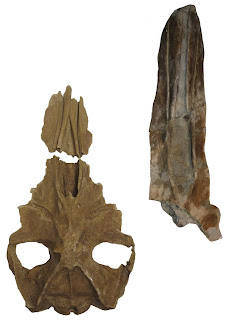
And here it is for comparison with my other skull, which is quite a bit larger; I think this new one is from a juvenile. They are reduced to roughly the same size here. In fact, it looks like I could have made the new specimen a bit larger. Herpetocetus has a pretty long schnoz, that's for sure. That's not terribly surprising, given what we know about Piscobalaena.
 This is after approximately forty hours of preparation, over about two months. I've been really busy working on all sorts of things, including my thesis, and preparation has been going slow. Also, preparation is slightly more difficult due to the much finer sediment - its sandy siltstone - which is hard when dry and easily scraped when damp, although it dries out really, really quickly.
 You'll notice a bunch of other offset portions - alas, the skull is a bit more chopped up than I would prefer. That being said, it does look pretty damn cool. All the small fractures and microfaults are left-lateral (sinistral).
  The fractures and their relative movement.
 I decided to palinspastically restore the rostrum of this skull using photoshop; in addition to left-lateral movement, there's some vertical axis rotation in some of the blocks, so I had to play around with that a bit. Anyway, here's what the complete thing should look like.
And here it is for comparison with my other skull, which is quite a bit larger; I think this new one is from a juvenile. They are reduced to roughly the same size here. In fact, it looks like I could have made the new specimen a bit larger. Herpetocetus has a pretty long schnoz, that's for sure. That's not terribly surprising, given what we know about Piscobalaena.
Friday, November 12, 2010
Shark-bitten dolphin skull
In 2008 I spent the day before Christmas Eve shivered on a cold, wind-blasted California beach prospecting for vertebrate fossils in the Purisima Formation. I was home on winter break, and although it is far more cold where I go to graduate school in Montana (as I write this I'm looking out at the results of our first winter snow), nothing is worse than being wet and miserably cold out on the foggy, windy coast of the golden state (except perhaps being wet and miserable on the Oregon coast, which I've done).
The thrill (or promise) of discovery is more than enough to keep me fueled in the field during the winter. Indeed, when the birds start singing and the snow melts in the spring, most paleontologists start to get field fever - the field season for most vertebrate paleontologists is during the summer months. Anyone who's ever tried to do coastal fieldwork during the summer, on the other hand, is in for a rude awakening. No erosion takes place during the summer, and many of the outcrops are totally buried. The exposures that are above the beach sand level (which is higher during the summer) are typically covered with dust, sand, and grime, which obscures fossils. The storms in the winter months clean this nasty coating off, and transport beach sand into offshore bars, often exposing strata below the beach (I see new fossil localities every winter this way). Winter is my field season.
Historically, I've had really good luck the day before Christmas Eve. It's my last day before Christmas to make it out in the field. The prior year, I found a humongous Carcharocles megalodon tooth (the only specimen known from the Purisima Formation), and discovered a partially articulated fur seal skeleton.
 The Christmas Eve dolphin.
At 4pm, the tide was beginning to come back in, and with little over an hour of daylight, it was looking like I was going to come home empty-handed. I went to one last cove before I turned around to head back to the beach. I walked for a few minutes and spotted something in a boulder I had not seen on my way out: a pair of flat bones joined along an articulation that looked suspiciously (even from 20 feet away) like the palate of a dolphin skull. Upon closer examination, yes indeed! It was a dolphin skull in a mollusk shell bed; the width and flatness of the palate suggested it was not Parapontoporia, the most common odontocete in the Purisima Formation. I set about chopping into the boulder; fortunately, most of it was relatively soft. However, an extremely hard calcium-carbonate cemented concretion the size of a basketball had formed over the dorsal surface of the braincase and rostrum, and this slowed digging down. By dusk, the concretion didn't budge. After another half hour, it finally popped out of the boulder, and I lugged the 45 pound block back to my car. Exhausted, I drove home, drank a couple of hard-earned beers with dinner, and passed out.
 View of the facial region of the skull.
of luggage through the Denver airport), I almost immediately began preparation (starting, of course, with acetic acid baths for several weeks to soften the concretionary matrix). It took about two months to prepare, and as you can see from the above photos, it is damn beautiful. I initally identified it as something like Haborophocoena - it bears numerous similarities. However, after showing them photos of the specimen at SVP 2009 in Bristol, UK, Olivier Lambert and Giovanni Bianucci both think this represents a basal delphinid rather than a basal phocoenid. I'm inclined to agree with them, although part of my original ID was based on the presence of premaxillary eminences, which this specimen has (a phocoenid character). However, the ascending process of the right premaxilla is in contact with the nasals while the left is not (a delphinid character). Whatever it is, it will require preparation of the ventral aspect, and more careful analysis of the morphology than what I've been able to do thus far. Whatever it is, it appears to represent a new genus and species, and will make a beautiful holotype specimen in the future. During preparation, one curious thing I noticed was a notch in one of the premaxillary eminences (the large pads/bumps in front of the bony nares). I initially dismissed it as a pathology.
 The left premaxillary eminence showing linear gouges (red lines) and missing bone.
Upon closer examination (which admittedly did not occur until yesterday, almost two years after collection) it became apparent that the abnormal area had two distinct, paralell linear gouges, and a short, less distinct third one in the middle (this one is still partly filled with matrix). Around these gouges is an area of exposed cancellous bone, where the bone has been removed.
 Additional gouges present near the base of the rostrum.
I also found four more gouges present: two long ones, and two short ones; all but one are parallel. In fact, aside from the one gouge seen above trending towards the upper left corner of the photo, all the gouges are parallel. This is a textbook set of shark-inflicted bite marks. There are a lot of papers on this in the literature, documenting shark bites on dolphins, baleen whales, pinnipeds, sea turtles, other shark teeth, mosasaurs, plesiosaurs, dinosaur bones, sea stars, and probably other marine critters as well.
In fact, the first record of these types of trace fossils were actually first documented in the modern environment: on predated and scavenged sea-otter carcasses from Monterey Bay, and reported by Ames and Morejohn (1980). The reported linear gouges, subparallel wavy small gouges, and a specimen including a shark tooth embedded in a sea otter skull. The morphology of the traces along with the tooth identified the culprit as the Great White Shark, Carcharodon carcharias. Two years later, these exact types of traces were identified by Tom Demere and Richard Cerutti (1982) on a baleen whale dentary (of my favorite whale, Herpetocetus!), and identified as "Carcharodon sulcidens" (a taxon now just considered to be fossil Carcharodon carcharias).
It's not clear what type of shark fed on my poor little dolphin, or if it was a case of predation or scavening; from what I've read, the majority of carcasses that exhibit bites have bite marks on the posterior portion of the body, which is just about as far as you can get from the face. This makes total sense, given how a shark would have to bite into a fleeing dolphin during pursuit. Furthermore, it's interesting to note that this bite would have had to go clean through the dolphin's melon (if it had not already decomposed). Anyway, I interpret these traces as drag marks from the apices of the shark's teeth; I suppose later on I can figure out the relative motion of the shark's mouth during the bite (most likely lateral shake feeding). It'll make for a nice short paper some day...
The thrill (or promise) of discovery is more than enough to keep me fueled in the field during the winter. Indeed, when the birds start singing and the snow melts in the spring, most paleontologists start to get field fever - the field season for most vertebrate paleontologists is during the summer months. Anyone who's ever tried to do coastal fieldwork during the summer, on the other hand, is in for a rude awakening. No erosion takes place during the summer, and many of the outcrops are totally buried. The exposures that are above the beach sand level (which is higher during the summer) are typically covered with dust, sand, and grime, which obscures fossils. The storms in the winter months clean this nasty coating off, and transport beach sand into offshore bars, often exposing strata below the beach (I see new fossil localities every winter this way). Winter is my field season.
Historically, I've had really good luck the day before Christmas Eve. It's my last day before Christmas to make it out in the field. The prior year, I found a humongous Carcharocles megalodon tooth (the only specimen known from the Purisima Formation), and discovered a partially articulated fur seal skeleton.
 The Christmas Eve dolphin.
At 4pm, the tide was beginning to come back in, and with little over an hour of daylight, it was looking like I was going to come home empty-handed. I went to one last cove before I turned around to head back to the beach. I walked for a few minutes and spotted something in a boulder I had not seen on my way out: a pair of flat bones joined along an articulation that looked suspiciously (even from 20 feet away) like the palate of a dolphin skull. Upon closer examination, yes indeed! It was a dolphin skull in a mollusk shell bed; the width and flatness of the palate suggested it was not Parapontoporia, the most common odontocete in the Purisima Formation. I set about chopping into the boulder; fortunately, most of it was relatively soft. However, an extremely hard calcium-carbonate cemented concretion the size of a basketball had formed over the dorsal surface of the braincase and rostrum, and this slowed digging down. By dusk, the concretion didn't budge. After another half hour, it finally popped out of the boulder, and I lugged the 45 pound block back to my car. Exhausted, I drove home, drank a couple of hard-earned beers with dinner, and passed out.
 View of the facial region of the skull.
 When it came time to go back to Montana, I decided I would rather take the fossil as a carry-on than risk checking it and picking up a broken fossil that I had paid 25 bucks for thanks to baggage fees. After arriving in Bozeman (with a very sore back and neck from lugging 65 pounds
 The left premaxillary eminence showing linear gouges (red lines) and missing bone.
 Upon closer examination (which admittedly did not occur until yesterday, almost two years after collection) it became apparent that the abnormal area had two distinct, paralell linear gouges, and a short, less distinct third one in the middle (this one is still partly filled with matrix). Around these gouges is an area of exposed cancellous bone, where the bone has been removed.
 Additional gouges present near the base of the rostrum.
I also found four more gouges present: two long ones, and two short ones; all but one are parallel. In fact, aside from the one gouge seen above trending towards the upper left corner of the photo, all the gouges are parallel. This is a textbook set of shark-inflicted bite marks. There are a lot of papers on this in the literature, documenting shark bites on dolphins, baleen whales, pinnipeds, sea turtles, other shark teeth, mosasaurs, plesiosaurs, dinosaur bones, sea stars, and probably other marine critters as well.
In fact, the first record of these types of trace fossils were actually first documented in the modern environment: on predated and scavenged sea-otter carcasses from Monterey Bay, and reported by Ames and Morejohn (1980). The reported linear gouges, subparallel wavy small gouges, and a specimen including a shark tooth embedded in a sea otter skull. The morphology of the traces along with the tooth identified the culprit as the Great White Shark, Carcharodon carcharias. Two years later, these exact types of traces were identified by Tom Demere and Richard Cerutti (1982) on a baleen whale dentary (of my favorite whale, Herpetocetus!), and identified as "Carcharodon sulcidens" (a taxon now just considered to be fossil Carcharodon carcharias).
It's not clear what type of shark fed on my poor little dolphin, or if it was a case of predation or scavening; from what I've read, the majority of carcasses that exhibit bites have bite marks on the posterior portion of the body, which is just about as far as you can get from the face. This makes total sense, given how a shark would have to bite into a fleeing dolphin during pursuit. Furthermore, it's interesting to note that this bite would have had to go clean through the dolphin's melon (if it had not already decomposed). Anyway, I interpret these traces as drag marks from the apices of the shark's teeth; I suppose later on I can figure out the relative motion of the shark's mouth during the bite (most likely lateral shake feeding). It'll make for a nice short paper some day...
Ames, J. A., and Morejohn, G.V., 1980, Evidence of white shark, Carcharodon carcharius, attacks on sea otters, Enhydra lutris: California Fish and Game, v. 66, p. 196-209.
Deméré, T.A., and Cerutti, R.A., 1982, A Pliocene shark attack on a cetotheriid whale: Journal of Paleontology, v. 56, p. 1480-1482
Subscribe to:
Posts (Atom)